
 Worksheets
Periodic Table Review
Total questions: 75
Worksheet time: 1hrs 26mins
The vertical (up and down) columns in the Periodic Table are called
groups
towers
periods
atomic numbers
Elements in a .................. have similar chemical properties.
period
group
row
Which group of the periodic table is composed of inert (not reactive) gases?
answer choices
alkali metals
alkaline earth metals
halogens
noble gases


Elements on the Periodic Table of the Elements are classified into categories such as
rocks and minerals
molecules and atoms
metals and nonmetals

The majority (most) of the elements are:
metals
nonmetals
metalloids

The elements on the left side of the periodic table of elements are mainly:
metals
nonmetals
metalloids

The elements on the right side of the periodic table of elements are mainly:
metals
nonmetals
metalloids

The elements along zig zag line on the periodic table of elements are:
metals
nonmetals
metalloids

Based on its position in the Periodic Table, at room temperature, cadmium is most likely a
metal
nonmetal
metalloid
On the periodic table, elements with similar chemical characteristics are found in the same:
period (row)
group (column)

Helium (He) belongs to the ______ family.
alkali metal
halogen
noble gas

Sodium, Na, belongs to the ______ family.
Halogen
alkali metal
Noble gas
alkaline earth metal

Which element is a noble gas?
Fluorine (F)
Krypton (Kr)
Phosphorus (P)
Aluminum (Al)

Chlorine, Cl, belongs to the ______ family.
Noble gas
alkaline earth metal
Halogen
Transition metal

Which elements would react similarly to Chlorine? (Cl)
Oxygen (G)
Fluorine (F)
Neon (Ne)
Bromine (Br)

Which element would react similarly to Gold (Au)?
Silver (Ag)
Mercury (Hg)
Iron (Fe)
What is the family name of group 1?
halogens
noble gases
alkali metals
alkaline earth metals
What is the family name of group 2?
transition metals
halogens
metaloids
alkaline earth metals
Where are the metalloids found?
in the far left vertical column
along the stair step/diagonal
in the far right horizontal row
in the bottom 2 rows
What is the group number of the halogens?
18
1
2
17
Periodic law states that the elements are arranged according to their atomic ________ and that elements with similar chemical properties are in the same ________ so that properties repeat periodically.
numbers, rows
masses, rows
masses, column
numbers, column
A grouping of elements based on similar chemical properties, arranged by columns in the periodic table; also known as a group
family
period
row
isotope
A row on the Periodic Table of Elements is called a(n)_____
family.
period.
row.
isotope.
Metals (select all that apply)
are found on the right side of the periodic table.
are found on the left side of the periodic table.
are good conductors of heat and electricity.
are brittle.
are malleable and ductile.
Nonmetals (select all that apply)
are found on the right side of the periodic table.
are found on the left side of the periodic table.
are good conductors of heat and electricity.
are brittle.
can be solid, liquids, or gases at room temperature.

Which element is found in group 2, period 6?
Oxygen (O)
Barium (Ba)
Selenium (Se)
Carbon (C)
Which halogen is found in period 4?
Krypton (Kr)
Xenon (Xe)
Bromine (Br)
Iodine (I)
Which element has similar chemical properties as sodium but has 7 energy levels?
Francium (Fr)
Cesium (Cs)
Rubidium (Rb)
Potassium (K)
Elements that have the same number of energy levels are said to be in the same ______.
group
period
family
classification
Which scientist edited the Periodic Table and arranged elements in increased atomic number?
Rutherford
Dalton
Mendeleev
Moseley
Which scientist created the Periodic Table and arranged elements in increasing atomic mass?
Rutherford
Thomson
Mendeleev
Moseley
Elements in the same group or family have _____________.
the same number of valence electrons and different properties.
the same number of valence electrons and similar properties
different number of valence electrons and similar properties.
different number of valence electrons and different properties.
Which class of elements are malleable, ductile, shiny when clean and polished, good conductors of heat and electricity, and reacts with acids to form hydrogen gas?
metals
nonmetals
metalloids
ions
What is the name of Group 1 elements?
Alkali Metals
Alkaline Earth Metals
Transition Metals
Halogens
What is the name of the elements that are unreactive and have a full octet?
Halogens
Noble Gases
Alkali Metals
Transition Metals
What is an atom or bonded group of atoms that has a positive or negative charge?
ion
atom
metal
nonmetal
False; sulfur has a greater ionization energy than chlorine.
sulfur elevates one of its "p" electrons to a "d" orbital, thus making it easier to remove the electron.
For an atom of Aluminum, what is the effective nuclear charge and what charge will it have when it becomes an ion, respectively?
+13; +3

F−1 is bigger than F because
F−1 has one more electron which causes greater electron repulsions in the outer orbitals, thus expanding the electron cloud.
F−1 has one more electron so there is less effective shielding of the nuclear charge.
F−1 has one less electron so there is less effective shielding of the nuclear charge.
F−1 has one more electron which causes less electron repulsions in the outer orbitals, thus expanding the electron cloud.
Group with the lowest ionization energy
Alkali metals
Alkaline earth metals
Halogens
Noble gases
Which of the following elements has the largest atomic radius?
Mn
Ga
Ca
Br
Which of the following elements has the lowest ionization energy? HINT: larger the atom, lower the energy
Be
Mg
Ca
Ba
Is Silicon (atomic # 14) bigger or smaller than Argon (atomic #18)?
bigger
smaller
same size
neither
Which element would have the highest ionization energy?
HINT: ionization wants to remove electrons. Who will never want to give up their electrons?
Argon
Lithium
Chlorine
Sodium
Why does atomic radius increase top to bottom in a group?
Zeff (nuclear pull) is greater. More protons pull the atom closer together
Zeff (nuclear pull) is less. More energy levels are added and the nucleus can't hold on.
Electrons are being lost
Protons are being lost
When Barium (Ba) is compared to Calcium (Ca):
Barium isn't in the same group as Calcium
Barium is bigger than Calcium in size
Barium is more electronegative than Calcium
Calcium is bigger than Barium
First Ionization Energy increases as you go ....
up and to the right across the Periodic Table
down and to the right across the Periodic Table
up and to the left across the Periodic Table
down and the left across the Periodic Table
Which of the following is the term that describes the size of the atom.
atomic radius
first ionization energy
electronegativity
effective nuclear charge
Which of the following is the term that describes how powerful an atom's nucleus is.
atomic radius
first ionization energy
electronegativity
effective nuclear charge
Which of the following is the term for the amount of energy required to remove the most loosely held electron from a neutral atom?
atomic radius
first ionization energy
electronegativity
effective nuclear charge
An atom with a large radius will also have...
a large first ionization energy
a small first ionization energy
a large Zeff
a large electronegativity
For an atom of Sulfur, what is it's effective nuclear charge, and what charge will it have when it becomes an ion, respectively?
+6, -6
+6, -2
+6, +2
-6, -2
Periodic Law states that:
The periodic table arranges elements into periods and groups.
The properties of elements recur periodically based on their metallic qualities.
The properties of elements recur periodically when arranged by increasing atomic mass.
The properties of elements recur periodically when arranged by increasing atomic number.
When atoms react, they often lose, gain, or share electrons to form a more stable version of themselves. For example, alkali metals such as Na lose their outer shell electron in their reactions to form compounds. The electron configuration of alkali metals would then resemble those of which group of the periodic table in the compounds they form?
1
2
17
18
In the periodic table hydrogen is placed and Group 1 and helium is placed in Group 18. The most likely reason for this is:
Hydrogen has one outer shell electron and helium has a full outer shell of electrons.
Hydrogen has one outer shell electron and helium has 8 electrons in its outer shell.
Hydrogen and helium are both metals.
Hydrogen and helium are both gases.
The metallic character of elements _____ across a period. Metals are good conductors of ______.
increases; electricity
decreases; heat
decreases; metalloids
remains the same; luster
Match the scientist to their arrangement of the periodic table.
Atomic Mass
Mendeleev
Atomic Number
Mosley
Octaves
Newlands
Triads
Dobereiner
Which statements are true concerning elements in the same group of the periodic table?
They have the same number of shells of electrons.
They have the same number of inner core electrons.
They have the same outer shell electron configuration.
They have similar periodic properties.
They are all solids, or all liquids or all gases.
The valence electrons of an atom do not experience the full attractive force of protons in the atom’s nucleus due to the presence of inner core electrons. The reduction in attractive force experienced by valence electrons due to inner core electrons is called the
periodic law effect.
shielding effect.
ionization energy effect.
nuclear charge effect.
The effective nuclear charge, Zeff, experienced by valence electrons in an atom can be estimated from the equation:
Zeff = the number of protons – the number of core electrons
Using this estimation, effective nuclear charge for Main Group elements (groups 1, 2, 13 – 18) would ___ left to right across a period and ___ down a group.
Which option correctly completes the blanks in the statement?
decrease; remain the same
remain the same; remain the same
increase; decrease
increase; remain the same
A Main Group element has 81 protons and an estimated effective nuclear charge of +3. Therefore, the element has ___ core electrons and can be found in Group ___ of the Periodic Table.
Which set correctly completes the blanks?
78, 13
78, 15
84, 13
81, 15
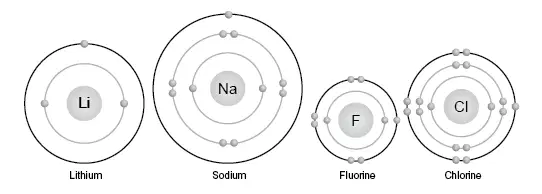
The diagram shows the electron structures of two alkali metals and two halogens. When these elements react and form compounds, alkali metals lose their one valence electron while halogens gain one additional electron to their valence shell. The vigor of the reaction is directly related to the distance of the valence electrons from the attractive pull of the atom’s nucleus. For alkali metals, it becomes easier to lose the valence electron with increasing distance of that electron from the attractive pull of the nucleus. For halogens, it becomes easier to gain an additional electron to the valence shell with decreasing distance of that shell to the attractive pull of the atom’s nucleus.
Na and F
Na and Cl
Li and F
Li and Cl
Which of the following correctly completes the statement:
Cations are always _____ than the parent atom and anions are always _____ than the parent atom.
smaller; smaller
larger; smaller
smaller; larger
larger; larger
Lithium is in Group 1, Period 2 of the periodic table. Which statement describes the charge of the ion it typically forms?
It forms a cation with a +2 charge.
It forms a cation with a +1 charge.
It forms an anion with a +1 charge.
It forms an anion with a -1 charge.
The elements Ca, Ga, K, Kr and Se, all appear in Period 4 of the Periodic Table. Which arrangement, from left to right, orders them with respect to their atomic size, from largest to smallest?
K, Ca, Se, Kr, Ga
Ca, Ga, K, Kr, Se
K, Kr, Se, Ca, Ga
K, Ca, Ga, Se, Kr
Based on their definitions, electron affinity could be considered the opposite of
shielding effect.
ionization energy.
nonmetallic character.
effective nuclear charge.
The labels on two bottles of powdered metals have fallen off. From the labels, the metals are known to be Mg and Ca. Your friend Jace says it is possible to determine which label should go on which bottle by observing the reaction between small amounts of each metal in separate beakers containing equal quantities of water.
Considering particles at the subatomic level, carrying out this experiment would help to identify the metals given that:
Ca has the (smaller/larger) atomic radius. In chemical reactions, it would be (easier/harder) for it to lose its valence electrons to form ions. This means it has comparatively (lower/higher) ionization energies and would react more (slowly/quickly) with the water.
Which list of words correctly completes (from left to right) the passage?
smaller; easier; higher; quickly
larger; easier; lower; quickly
smaller; harder; higher; slowly
larger; harder; lower; slowly

