
 Worksheets
Scientific Method, Graphing , Intro to Bio
Total questions: 41
Worksheet time: 28mins
Name
Class
Date
1.
Why do scientist use the scientific method?
a)
To make sure they get credit for their discoveries.
b)
To make sure their results are valid and can be performed by other scientists.
c)
So that other scientist don't get mad at them
2.
This part of the experiment serves as a basis of comparison; the one variable being tested has been omitted.
a)
experimental group
b)
control group
c)
data
d)
variables
3.
There are two types of data. Which type of data involves descriptions that cannot be counted or measured?
a)
qualitative
b)
quantitative
4.
There are two types of data. Which type of data involves numbers that are obtained by counting or measuring?
a)
quantitative
b)
qualitative
5.
An experiment is performed on plants to see how different liquids affect plant growth. Each plant in the experiment is given a different liquid; water, apple juice, or milk. Each plant has the same amount of soil, sunlight, and listens to the same music. In this investigation, the independent variable is ...
a)
The type of plant
b)
The amount of sunlight
c)
The type of music
d)
The type of liquid
6.
A testable prediction about a scientific investigation
a)
Question
b)
Observation
c)
Hypothesis
d)
Experiment
7.
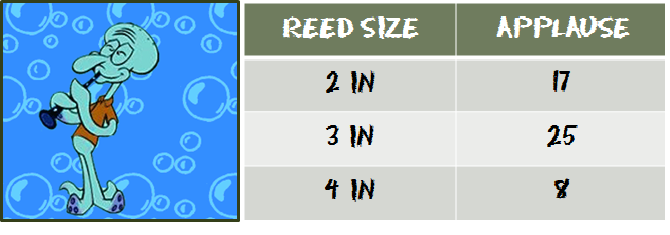
Squidward found new reeds to tryout for his clarinet. He used an APPLAUSOMETER to measure applause after playing Under the Sea with each reed. The results were put in the table.
What was the independent variable?
What was the independent variable?
a)
The Song
b)
The Reed
c)
The Applause
8.
Squidward found new reeds to tryout for his clarinet. He used an APPLAUSOMETER to measure applause after playing Under the Sea with each reed. The results were put in the table.
What was the dependent variable?
What was the dependent variable?
a)
The Song
b)
The Reed
c)
The Applause
9.
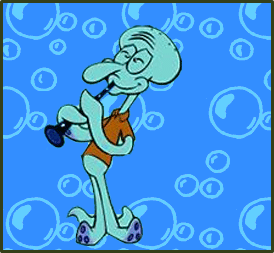
The data collected supports which of the following questions that Squidward could have tested?
a)
Which song does the audience prefer?
b)
Which instrument does the audience like best?
c)
Which reed length creates the best sound?
d)
How do applause affect performance?
10.
What is the group in an experiment that receives treatment with the independent variable?
a)
control group
b)
experimental group
c)
constant group
d)
variation group
11.
This part of the experiment serves as a basis of comparison; the one variable being tested has been omitted.
a)
experimental group
b)
control group
c)
data
d)
variables
12.
The part of the experiment that is used for comparison
a)
control
b)
quantitative
c)
data
d)
observation
13.
To test if color affects what children choose for lunch mashed potatoes were dyed with food color in the following colors: red, green and blue and placed in identical bowls. A fourth bowl contained natural mashed potatoes. The potatoes were served at an elementary school. Identify the dependent variable.
a)
Which color was chosen the most.
b)
The red, green and blue potatoes.
c)
The natural potatoes.
d)
The bowls.
14.
To test if color affects what children choose for lunch mashed potatoes were dyed with food color in the following colors: red, green and blue and placed in identical bowls. A fourth bowl contained natural mashed potatoes. The potatoes were served at an elementary school. Identify the control variable.
a)
natural potatoes
b)
red, green, blue potatoes
c)
The same bowls.
d)
Which potatoes were chosen most often.
15.
On a graph, where is the independent variable placed?
a)
The X axis
b)
The Y axis
c)
Neither
16.
On a graph, where is the dependent variable placed?
a)
X axis
b)
Y axis
c)
Both
d)
Neither
17.
Which line of the graph is the X axis on?
a)
Vertical line
b)
Horizontal line
18.
On the graph, what line is the Y axis on?
a)
Vertical line
b)
Horizontal line
19.
Which part of a graph should describe the relationship between the independent and dependent variables?
a)
The Y axis
b)
The X axis
c)
The legend
d)
The title
20.
What type of graph is used the show how change occurs over a continuous variable?
a)
Bar
b)
Line
c)
Pie
21.
Scientists select similar plots of grass in an experiment. They have the same soil, water, and so on. These traits are:
a)
constants or controlled variables
b)
experimental groups
c)
hypotheses
d)
none of the above
22.
Evidence from many studies that tie hypotheses together is called a:
a)
proposal
b)
educated guess
c)
hypothesis
d)
theory
23.
Fred experiments with color-changing frogs. They change in response to their environment. He puts a green frog on a brown background and a brown frog on a green background. Although he thinks both should change color, neither does. Why?
a)
The background may not work for the frogs
b)
They may need to put themselves onto the surface
c)
The test may need more time
d)
Something other than color (in the environment) may cause the change
24.
An experiment was designed to determine the effects of temperature on germination of pine seeds. Which variable is LEAST important to control in this experiment?
a)
brand of refrigerator
b)
number of seeds used
c)
time seeds exposed to cool temperatures
d)
species of seeds used
25.
Organs and tissues that perform related functions form a(n) _____________?
a)
cells
b)
tissues
c)
organ system
d)
organs
26.
A group of tissues that perform a similar function is called_____. (Examples include the heart, lungs or stomach)
a)
cells
b)
tissues
c)
organs
d)
organ system
27.
What is the correct order of organization
a)
tissues-cells-organs-organ systems-organism
b)
cell-tissue-organs-organ systems-organism
c)
organism-cells-tissues-organ systems-organism
d)
tissues-cells-organs-organ sytems-organism
28.
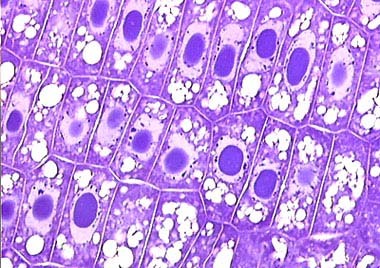
This is a example of ........
a)
cell
b)
tissue
c)
organ
d)
organ system
29.
What is the basic structural and functional unit of all living things?
a)
atom
b)
cell
c)
molecule
d)
human
30.
Maintaining a stable internal environment.
a)
Homeostasis
b)
Metabolism
c)
Stimulus
d)
DNA
31.
Chemical reactions that build up or break down materials.
a)
homeostasis
b)
metabolism
c)
asexual reproduction
d)
DNA
32.
Which one of the following is a characteristic of life?
a)
Photosynthesis
b)
Adapting to your environment/ surroundings
c)
Expelling toxins
d)
Breathing
33.
A worm turns away from light is an example of a worm
a)
reproducing
b)
doing cellular respiration
c)
having cells
d)
responding to its environment
34.
Change that improves survival in the environment
a)
Organization
b)
Adaption
c)
Growth and Development
35.
The maturation of an organism.
a)
Growth
b)
Development
c)
Adaptation
d)
Evolution
36.
Energy is required for all life processes. How do DECOMPOSERS obtain energy?
a)
They break down dead and decaying materials and then absorb the nutrients.
b)
They consume other organisms for energy.
c)
They make their own food through the process of photosynthesis.
d)
They absorb energy from the sun.
37.
A plant growing towards sunlight would be an example of which characteristic of life? Select the best answer.
a)
Response to a stimuli
b)
Capable of reproduction
c)
Made up of cells
d)
Growth and development
38.
True or False: A strong species is one that is genetically varied.
a)
True
b)
False
39.
Which of the following correctly describes ASEXUAL reproduction?
a)
One parent, genetically identical offspring
b)
One parent, genetically different offspring
c)
Two parents, genetically identical offspring
d)
Two parents, genetically different offspring
40.
All living things grow and develop. _________ is an increase in mass, while _________ results in different abilities.
a)
Growth ; Development
b)
Development ; Growth
41.
Which of the following molecules is responsible for carrying and transmitting genetic information
a)
DNA
b)
Lipids
c)
Proteins
d)
Carbohydrates
100 %

