
 Worksheets
Core Concepts 1 Archaeology Pages 1-16
Total questions: 71
Worksheet time: 37mins
Name
Class
Date
1.

A line marked off with a series of events and dates.
a)
number line
b)
sentence
c)
timeline
d)
calendar
2.

A list of events in the order in which they occurred.
a)
time order
b)
"If you ain't first ur last"
c)
chronology
d)
oldest to newest
3.
A length of time singled out because of a specific event or development
a)
period
b)
time zone
c)
time frame
d)
score
4.
A period is also known as an _______.
a)
leap year
b)
decade
c)
epoch
d)
long time
5.
Historians use periods and ______ to organize and describe human activities.
a)
eras
b)
time frames
c)
lead years
d)
commas
6.
History is divided between history and ____________.
a)
the future
b)
prehistory
c)
jurassic park
d)
now
7.

Prehistory is the time before humans invented __________.
a)
language
b)
stone tools
c)
writing
d)
arithemetic
8.
How long ago did written history begin?
a)
152,000 years ago
b)
5,200 years ago
c)
July 4, 1776
d)
1945
9.

Years after Jesus's birth are labeled A.D. meaning anno Domini which means:
a)
"in the year of our Lord"
b)
After Death
c)
Common Era
d)
Before the Common Era
10.

Astrolabe was used by Muslim astronomers to calculate the positions of all of the following except _________.
a)
The Sun
b)
The Moon
c)
The Stars
d)
Astroids
11.
A decade is
a)
10 years
b)
50 years
c)
100 years
d)
1000 years
12.
A century is
a)
10 years
b)
50 years
c)
100 years
d)
1000 years
13.
A millennium is
a)
1 year
b)
100 years
c)
1000 years
d)
10,000 years
14.

Which group had two calendars? A 365 day agricultural calendar, and a 260 day religious calendar.
a)
Aztec
b)
Maya
c)
Romans
d)
Klingons
15.
Why must students of history learn to evaluate historical sources?
a)
Only primary sources are reliable and accurate.
b)
Only secondary sources are reliable and accurate.
c)
All types of sources can be biased and unreliable.
d)
Opinions are much more useful than facts.
16.
A historical source in which the author clearly disliked a key figure should be carefully evaluated for
a)
unnecessary facts
b)
primary sources
c)
secondary opinions
d)
bias
17.
Why does obtaining a secondary source from the internet require great caution?
a)
Internet sources tend to be biased.
b)
Few qualified scholars post their work on the internet.
c)
The internet has many fine sources, but also many inaccurate ones.
d)
It is difficult to check the reliability of sources on the internet.
18.
Who is most likely to study the oral traditions of a society?
a)
An anthropologist
b)
An archaeologist
c)
An architect
d)
A paleontologist
19.
Archaeologists focus their studies on
a)
oral traditions.
b)
the buried and hidden evidence of ancient times.
c)
the written records left by ancient peoples.
d)
human remains.
20.
An anthropologist might study these to learn how human beings developed physically
a)
Oral traditions
b)
buried ruins
c)
fossils
d)
layers of soil
21.
Archaeologists can be described as treasure hunters because
a)
ancient peoples often had lots of gold and jewels.
b)
they are mostly interested in finding artifacts of great value.
c)
good archaeologists are wealthy.
d)
they search for hidden objects.
22.
Historians can learn about the past through the study of
a)
historical sources.
b)
geography.
c)
bias.
d)
language.
23.
Primary sources and artifacts are valuable because they
a)
are free of bias.
b)
never have to be evaluated for reliability or validity.
c)
are valid but not reliable.
d)
come directly from people who witnessed the event.
24.
A person who studies ruined buildings and artifacts of an ancient culture is
a)
an archaeologist.
b)
an anthropologist.
c)
an oral historian.
d)
a geographer.
25.

a)
PRIMARY
b)
SECONDARY
26.
Which of these is NOT an example of a primary source?
a)
Original uniforms worn at a time in history
b)
Diaries written at the time of an event
c)
Film footage of a historical event
d)
A poem about World War II from your classmate
27.
A magazine article about the War of 1812.
a)
Primary
b)
Secondary
28.
An interview you had with a Vietnam War veteran.
a)
Primary
b)
Secondary
29.
Benjamin Franklin's Autobiography.
a)
Primary
b)
Secondary
30.
What is Archaeology?
a)
The study of dinosaur bones
b)
The study of artifacts
c)
Playing adventure video games
d)
The study of old rocks
31.
Archaeology is important because it helps us understand our ______.
a)
past
b)
present
c)
future
d)
dreams
32.
What is the job of an Archaeologist?
a)
to study past cultures, human remains, settlements, fossils, and artifacts
b)
To study scientific and historical fossils from dinosaurs
c)
To find cool stuff underground
d)
To study the relationship between geography and fossils
33.
A scientist who studies the origin, culture, and values of different people is a/an
a)
anthropologist
b)
botanist
c)
culturist
d)
ornithologist
34.
An autobiography is a
a)
Primary Source
b)
Secondary Source
35.

The part of the map that would help you measure distance between two cities
a)
key.
b)
title.
c)
scale bar.
d)
compass rose.
36.

The part of the map that would help you identify what a particular color or symbol means is the
a)
key.
b)
title.
c)
scale bar.
d)
compass rose.
37.

Which part of the map that tells you where North, South, East, and West are?
a)
The key.
b)
The title.
c)
The compass rose.
d)
The label
38.

If a political map and a road map showed the same state at the same size, they should both have the same
a)
title.
b)
scale bar.
c)
key symbols.
d)
shading.
39.

A locator map can be useful
a)
with any map.
b)
only with road maps.
c)
only with physical maps.
d)
only with maps that have keys.
40.

The purpose of this map is to show
a)
the nations of Europe, Asia, and Africa.
b)
the Eastern Hemisphere.
c)
the climate of regions in the Roman empire.
d)
the extent and location of the Roman empire at a point in history.
41.

The map of the Roman empire shows the empire as it was
a)
over the course of its history.
b)
at the time of its fall.
c)
in the year A.D. 117
d)
most recently.
42.

What is the purpose of a historical map?
a)
To give information about a place at a particular time
b)
To compare the past to the present
c)
To illustrate the five themes of geography
d)
To contrast two different places
43.

A historical map would be a good way to learn about which of the following?
a)
The highway system in a particular state today
b)
The outcome of a battle in an ancient war
c)
The location of your state's capital
d)
The physical geography of your state
44.

In terms of their features, historical maps are
a)
unlike any other map.
b)
difficult to read.
c)
similar to other maps.
d)
most like physical maps.
45.
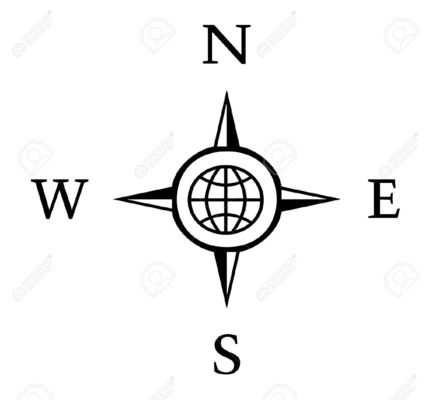
What is this called?
a)
North, South, East, West
b)
Compass Rose
c)
A map
d)
A map key
46.

A _______________ shows what distances on the map represent.
a)
Scale
b)
Legend
c)
Compass
d)
Title
47.

A _________________ identifies what any symbols on the map represent.
a)
Scale
b)
Legend or Key
c)
Compass
d)
Title
48.

What's the purpose of a map?
a)
Decor a room
b)
Help you find things
c)
Help you see things
d)
Help you find places
49.

Which part of a map lets you know the symbology in it?
a)
compass rose
b)
capital
c)
scale bar
d)
key
50.

This map, which shows the area around Washington, D.C., illustrates which of the following geographic themes?
a)
Region
b)
Movement
c)
Human-environment Interaction
d)
Absolute location
51.

The relative location of Washington D.C. is
a)
impossible to tell from this map
b)
at 380 north latitude and 770 west longitude
c)
about eight miles south of Silver Spring
d)
about five miles south of Oxon Hill
52.
If you were describing your home town and you spoke about the typical summer and winter weather, you would be using the geographic theme of
a)
movement.
b)
place.
c)
location.
d)
region.
53.
The five themes of geography are
a)
location, place, region, movement, and human-environment interaction
b)
absolute location, relative location, movement, region, and place
c)
place, human features, nonhuman features, region,and movement
d)
absolute location, relative location, human features, culture, and place
54.
Which of the five themes describes where a place is found?
a)
Movement
b)
Human-environment interaction
c)
Region
d)
Location
55.
Human-environment interaction is a theme that might help a geographer understand how
a)
to find a place on a map
b)
a new housing development might affect local wildlife
c)
immigration might affect a country's government
d)
a region is defined
56.
If you were studying the human and nonhuman features of a particular location, you would be exploring which of the following themes?
a)
Location
b)
Region
c)
Place
d)
Movement
57.
380 North, 890 West
a)
absolute location
b)
relative location
c)
place
d)
region
58.
"I live near Walmart in Alcoa." What is this statement an example of?
a)
absolute location
b)
relative location
c)
human-environment interaction
d)
place
59.
The mix of human and nonhuman features at a given location.
a)
Location
b)
Place
c)
Movement
d)
Region
60.
Which is NOT one of the Five Themes of Geography
a)
Location
b)
Movement
c)
Language
d)
Human-Environment Interaction
61.
Absolute and relative are words that describe...
a)
Place
b)
Location
c)
Movement
d)
Region
62.
Place can be described by both physical and _____ characteristics.
a)
regional
b)
logistical
c)
human
d)
weather
63.
Human-environment interaction is the relationship between _____ and _____.
a)
people, the world
b)
people, the government
c)
people, other people
d)
God, man
64.
People, ideas, goods, etc that are transported from one location to another describe the theme of _____.
a)
place
b)
region
c)
interaction
d)
movement
65.
All of the following are examples of Human characteristics EXCEPT
a)
The Golden Gate Bridge
b)
The Pacific Ocean
c)
The Twin Towers
d)
The Eiffel Tower
66.

Name the theme that this statement falls under: "Physical characteristics including landforms, climate, vegetation, and bodies of water."
a)
Movement
b)
Region
c)
Place
d)
Location
67.
The areas that share common characteristics are called
a)
Movements.
b)
Absolute locations.
c)
Regions.
d)
Relative locations.
68.
There are two types of location; they are
a)
movement and place.
b)
absolute and relative.
c)
human interaction and movement.
d)
absolute movement and relative places.
69.
This theme is the physical and human characteristics that make a location unique. The theme is called
a)
Regions.
b)
Place.
c)
Movement.
d)
Human-Environment Interaction.
70.

People who study events of the past.
a)
professors
b)
historians
c)
surgeons
d)
old people
71.
A line marked off with a series of events and dates.
a)
number line
b)
sentence
c)
timeline
d)
calendar
100 %

