
 Worksheets
Quarter 1 Review: Scientific Method, Macromolecules, & Cells
Total questions: 60
Worksheet time: 45mins
Name
Class
Date
1.
A possible explanation to a problem that has not yet been tested.
a)
data
b)
theory
c)
hypothesis
d)
fact
2.
This variable in an experiment is the one being deliberately changed by the scientist.
a)
dependent variable
b)
independent variable
c)
data
d)
control group
3.
There are two types of data. Which type of data involves numbers that are obtained by counting or measuring?
a)
quantitative
b)
qualitative
4.
A series of steps used by scientists to solve a problem or answer a question.
a)
scientific method
b)
recipe
c)
data collection
d)
metric system
5.
In a controlled experiment, how many independent variables can be worked with at a time?
a)
one
b)
none
c)
two or more
d)
how ever many makes sense.
6.

Which statement is an inference about this picture?
a)
The van is tan.
b)
The van ran into KFC.
c)
The driver was hungry.
d)
Red and white are part of the KFC building.
7.
An experiment is performed on plants to see how different liquids affect plant growth. Each plant in the experiment is given a different liquid; water, apple juice, or milk. Each plant has the same amount of soil, sunlight, and listens to the same music. In this investigation, what is the dependent variable?
a)
Type of plant
b)
Water, apple juice, milk
c)
Plant growth
d)
Color of the plant's leaves
8.
Which is NOT a step in the scientific method?
a)
Make observation
b)
Form a theory
c)
Collect data
d)
Form a hypothesis
9.
What step does every scientific experiment begin with?
a)
hypothesis
b)
question/problem
c)
procedures
d)
conclusion
10.
This part of the experiment serves as a basis of comparison; the one variable being tested has been omitted.
a)
experimental group
b)
control group
c)
data
d)
variables
11.
Which of these contains steps in the right order?
a)
Ask a question, state your hypothesis, research, experiment, analyze, make a conclusion
b)
State your hypothesis, ask a question, research, experiment, analyze, make a conclusion
c)
Ask a question, research, state your hypothesis, experiment, analyze, make a conclusion
d)
State your hypothesis, ask a question, research, make a conclusion, experiment, analyze
12.
Why do we want to test only one independent variable at a time?
a)
Because it is hard to setup a data table with more than one variable
b)
To better identify what is causing the changes
c)
It is what has always been done
d)
It's easier to perform the experiment
13.
True or False: Your hypothesis can never be wrong.
a)
True
b)
False
14.
Should experiments be repeated over and over to see if the results are the same each time?
a)
yes
b)
no
15.
The summary at the end of an experiment that explains the results.
a)
conclusion
b)
procedures
c)
materials
d)
responding variable
16.
Proteins are made of monomers called ___________
a)
Nucleotides
b)
Monosaccharides
c)
Amino Acids
d)
Glycerol and fatty acids
17.
The element _______is found in all of the organic compounds.
a)
Iron
b)
Nitrogen
c)
Carbon
d)
Oxygen
18.
_________ are composed out of carbon (C), hydrogen (H), oxygen (O), nitrogen (N), and phosphorus (P)
a)
Carbohydrates
b)
Lipids
c)
Proteins
d)
Nucleic Acids
19.
DNA and RNA are examples of
a)
Carbohydrates
b)
Lipids
c)
Proteins
d)
Nucleic Acids
20.
Monosaccharides are monomers of
a)
Carbohydrates
b)
Lipids
c)
Proteins
d)
Nucleic Acids
21.
Glycerol and fatty acids are the monomers of
a)
Carbohydrates
b)
Lipids
c)
Proteins
d)
Nucleic Acids
22.

Which macromolecule is shown?
View Figure 1 (if not visible)
View Figure 1 (if not visible)
a)
lipid
b)
protein
c)
nucleic acid
d)
carbohydrate
23.
The organic compounds that have many structural purposes and are used in many processes within the
cell are called ____________________.
cell are called ____________________.
a)
Carbohydrates
b)
Lipids
c)
Proteins
d)
Nucleic Acids
24.

Which macromolecule is shown?
View Figure 2 (if not visible)
View Figure 2 (if not visible)
a)
lipid
b)
protein
c)
nucleic acid
d)
carbohydrate
25.

Which macromolecule is shown?
View Figure 3 (if not visible)
View Figure 3 (if not visible)
a)
lipid
b)
protein
c)
nucleic acid
d)
carbohydrate
26.
What is the function of nucleic acids?
a)
store genetic information
b)
store energy (long-term)
c)
store energy (short-term)
d)
build skin, hair, nails, muscles
27.

Which macromolecule is shown?
View Figure 4 (if not visible)
View Figure 4 (if not visible)
a)
lipid
b)
protein
c)
nucleic acid
d)
carbohydrate
28.
What type of macromolecule are enzymes?
a)
Protein
b)
Carbohydrate
c)
Lipid
d)
Nucleic Acid
29.
Which of the following organic compounds is the main source of energy for living things?
a)
carbohydrates
b)
lipids
c)
nucleic acids
d)
proteins
30.
Lipids are made of...
a)
C H O
b)
C H O N
c)
C H O N P
d)
C H O N S
31.
Proteins are made of...
a)
C H O
b)
C H O N
c)
C H O N P
d)
C H O N S
32.
Which macromolecule stores energy, insulates us, and makes up the cell membrane?
a)
lipids
b)
proteins
c)
carbohydrates
d)
nucleic acids
33.

Building blocks of the body, hair , muscles etc.
a)
protein
b)
nucleic acid
c)
lipids
d)
carbohydrates
34.

Used for short term (quick) energy.
a)
carbohydrates
b)
lipids
c)
proteins
d)
nucleic acids
35.
This organelle is a rigid outer layer that protects plant cells.
a)
Cell Membrane
b)
Cell Wall
c)
Nucleus
d)
Chloroplast
36.
This organelle controls what goes in and out of plant and animal cells.
a)
Cell Wall
b)
Cell Membrane
c)
Cytoplasm
d)
Cytoplasm
37.
The _____________ stores food, water, wastes, and other materials in both plant and animal cells.
a)
Vacuole
b)
Mitochondria
c)
Ribosomes
d)
Chromatin
38.
An organelle that captures energy from the sunlight in order to use it to produce food in plant cells is ______________.
a)
Chromatin
b)
Chloroplast
c)
Cytoplasm
d)
Cell Membrane
39.
________________ create proteins for plant and animal cells.
a)
Ribosomes
b)
Endoplasmic Reticulum
c)
Golgi Bodies
d)
Lysosomes
40.
The organelles that clean plant and animal cells by using chemicals to break down food and worn out cell parts are ______________.
a)
Lysosomes
b)
Mitochondria
c)
Nucleolus
d)
Cell Wall
41.
The _____________ holds the DNA, and controls the functions of plant and animal cells.
a)
Nucleus
b)
Nuclear Membrane
c)
Nucleolus
d)
New Moon
42.
This can be found in the nucleus, and are tiny strands that contain the instructions for directing the cell's functions.
a)
DNA/Chromatin
b)
Chloroplasts
c)
Golgi Bodies
d)
ER
43.
This organelle can be found inside the nucleus, and produces ribosomes.
a)
Nucleus
b)
Nucleolus
c)
New Moon
d)
New Balance Shoe
44.
The _________ ____________ can be found in plant and animal cells, and receive proteins and materials from the ER, packages them, and distributes them.
a)
ER
b)
Golgi Bodies
c)
Cell Membrane
45.
The _____________ is like JELL-O, and is a gel-like fluid that fills plant and animal cells, and is where the organelles are found.
a)
Cytoplasm
b)
Cell Membrane
c)
Cell Wall
d)
JELL-O
46.

What type of cell is shown below?
a)
Prokaryotic
b)
Eukaryotic
c)
Awesomekaryotic
d)
Lamekaryotic
47.
What three things do ALL cells have?
a)
Cytoskeleton, Cell membrane, vacuole
b)
DNA, ribosome, nucleus
c)
Cell wall, cytoskeleton, golgi apparatus
d)
Cell membrane, cytoplasm, DNA
48.
Provides structure and support to the cell
a)
Chloroplast
b)
Cytoskeleton
c)
Cell membrane
d)
Golgi apparatus
49.
“Powerhouse” of the cell, breaks food down into energy for the cell
a)
Vacuole
b)
Chloroplast
c)
Nucleus
d)
Mitochondria
50.
This organelle provides support for the plant cell and is made of cellulose.
a)
Cell Membrane
b)
Cell Wall
c)
Nucleus
d)
Chloroplasts
51.
What is an example of a single celled organism?
a)
Dog
b)
Cat
c)
Bacteria
d)
Human
52.
The system of channels that transport materials throughout the cell
a)
nucleous
b)
golgi body
c)
vacuoles
d)
endoplasmic reticulum
53.
Has Mitochondria
a)
Prokaryote
b)
Eukaryote
c)
both
54.
Which has ribosomes?
a)
Prokaryote
b)
Eukaryote
c)
both
55.
Has nucleus
a)
Prokaryote
b)
Eukaryote
c)
both
56.
Bacteria
a)
Prokaryote
b)
Eukaryote
c)
both
57.
Has chloroplast
a)
Prokaryote
b)
Eukaryote
c)
both
58.
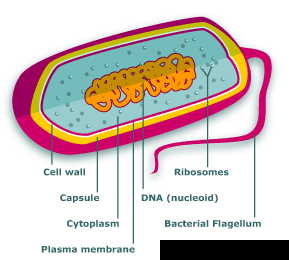
Which type of cell?
a)
Prokaryote
b)
Eukaryote
59.

Which type of cell?
a)
Prokaryote
b)
Eukaryote
60.
Where is the DNA found in a prokaryotic cell?
a)
floating around in the cytoplasm
b)
in the nucleus
100 %

