
 Worksheets
Exploring Earth PT
Total questions: 100
Worksheet time: 1hrs 6mins
Name
Class
Date
1.
A key that lists all the symbols used on the map
a)
map legend
b)
compass rose
c)
map scale
2.
The relationship between a distance on the map and the actual distance on the ground
a)
map legend
b)
longitude
c)
map view
d)
map scale
3.
Drawn as if you were looking down on an area from above Earth's surface
a)
profile view
b)
map view
c)
map scale
d)
map view
4.
Drawing that shows an object as though you were looking at it from the side
a)
map view
b)
map legend
c)
time
d)
profile view
5.
The distance in degrees east or west of the prime meridian
a)
latitude
b)
longitude
c)
prime meridian
d)
equator
6.
The distance in degrees north or south of the equator
a)
longitude
b)
prime meridian
c)
latitude
7.
The area on Earth's surface between two meridians where people use the same time
a)
prime meridian
b)
International Date Line
c)
time zone
8.
The line of latitude 180 degrees east or west of the prime meridian
a)
cylindrical projection
b)
time zone
c)
International Date Line
9.
Map that shows detailed shapes of Earth's surface, along with its natural and human made features
a)
topographical map
b)
elevation
c)
contour line
10.
The height above sea level of any point on Earth's surface
a)
contour interval
b)
elevation
c)
slope
11.
The measure of the steepness of the land
a)
prime meridian
b)
topographical map
c)
slope
12.
A diagram that shows a vertical slice through the rocks below the surface of Earth
a)
database
b)
geological map
c)
cross section
13.
The number of satellites needed to triangulate your position on Earth
a)
one
b)
three
c)
27
14.
A parallel 66 ½ degrees north of the equator.
a)
Tropic of Cancer
b)
Tropic of Capricorn
c)
Arctic Circle
d)
Antarctic Circle
15.
Smaller objects that orbit a planet.
a)
Moons
b)
Planets
c)
satellites
d)
Astroid
16.
The time when both of Earth’s poles are at a 90 degree angle from the sun and the sun’s direct rays strike the equator.
a)
Solstice
b)
Equinox
c)
Rotation
d)
Revolution
17.
Major bodies that orbit a star.
a)
Moons
b)
Planets
c)
Satellites
d)
Solar Systems
18.
The time when both of Earth’s poles are at a 90 degree angle from the sun and the sun’s direct rays strike the equator.
a)
Solstice
b)
Equinox
c)
Rotation
d)
Revolution
19.
Earth’s water in all of its forms.
a)
Lithosphere
b)
Hydrosphere
c)
Atmosphere
d)
Biosphere
20.
Warm, low-latitude areas near the equator.
a)
Temperate
b)
Doldrums
c)
Poles
d)
Tropics
21.
The part of the Earth that includes all life forms.
a)
Biosphere
b)
Lithosphere
c)
Ecosystems
d)
Hydrosphere
22.
One complete spin of Earth on its axis
a)
Rotation
b)
Revolution
c)
Axis
d)
Leap year
23.
The time that Earth’s poles point at their greatest angle toward or away from the sun
a)
Equinox
b)
Revolution
c)
Solstice
d)
Rotation
24.
The parallel 23 ½ degrees south of the equator
a)
Antarctic Circle
b)
Arctic Circle
c)
Tropic of Cancer
d)
Tropic of Capricorn
25.
The sun and the group of bodies that revolve around it.
a)
Solar System
b)
planets
c)
Solar energy
d)
satellites
26.
A parallel 66 ½ degrees south of the equator
a)
Tropic of Capricorn
b)
Tropic of Cancer
c)
Arctic Circle
d)
Antarctic Circle
27.
Solid crust of Earth.
a)
Lithosphere
b)
Biosphere
c)
Atmosphere
d)
Hydrosphere
28.
A body that orbits a larger body
a)
Moon
b)
Satellite
c)
Planet
d)
meteor
29.
High-latitude, cold regions around the North and South Poles
a)
Temperate Regions
b)
Tropic Regions
c)
Polar Regions
d)
Permafrost Regions
30.
Hydropower uses _________ to turn turbines that run generators.
a)
steam
b)
moving water
c)
uranium
d)
tides
31.
Which is a disadvantage of hydropower?
a)
it disrupts habitats and floods land
b)
you can only use in areas with very high tides
c)
it can injure birds and bats
d)
dams are very noisy and disrupt the view
32.
Which energy source is non-renewable?
a)
biomass
b)
nuclear
c)
hydropower
d)
tidal power
33.
Bio =
a)
Science
b)
Math
c)
Earth
d)
Life
34.
Geo =
a)
Earth
b)
Sphere
c)
Life
d)
Water
35.
Hydro =
a)
Sphere
b)
Earth
c)
Life
d)
Water
36.
Earth's metal core, solid middle layer, and outer rocky layer.
a)
Biosphere
b)
Geosphere
c)
Hydrosphere
d)
Atmosphere
37.
These kind of observation use your senses to observe results.
a)
Qualitative
b)
Quantitative
c)
Scientific
38.
These kind of observations are made using instruments such as rulers, balances and thermometers.
a)
Qualitative
b)
Quantitative
c)
Scientific
39.

Your teacher has asked you to explain the difference between quantitative and qualitative observations. Which statement is correct?
a)
Quantitative observations use numbers, qualitative uses the senses.
b)
Quantitative observations use the senses, qualitative uses numbers.
c)
Quantitative observations use measurement, qualitative uses numbers.
d)
Quantitative observations use colors, qualitative uses the senses.
40.
The rocks that make up the Earth are part of what sphere?
a)
atmosphere
b)
biosphere
c)
geosphere
d)
hydrosphere
41.
A alligator in a ocean is an example of the biosphere interacting with?
a)
Hemisphere
b)
geosphere
c)
atmosphere
d)
hydrosphere
42.
Which is the main source of energy that drives the Earth system?
a)
energy of moving water
b)
oil from inside earth
c)
gases in the atmosphere
d)
heat from the sun
43.
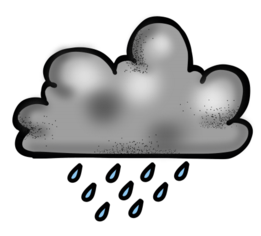
What part of the water cycle does this picture show?
a)
condensation
b)
precipitation
c)
evaporation
44.
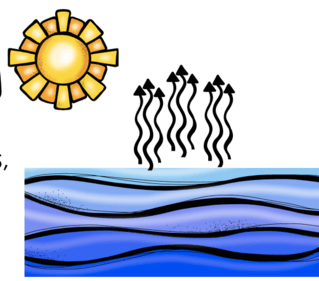
What part of the water cycle does this picture show?
a)
condensation
b)
precipitation
c)
evaporation
45.
What is condensation?
a)
The part of the water cycle when the sun heats up water, turning it from a liquid into water vapor or steam. It rises from the ground into the air.
b)
The part of the water cycle when the water vapor in the air gets cold. The water turns back into a liquid and forms clouds.
c)
The part of the water cycle when clouds get heavy and can no longer hold the liquid water. This causes the water to fall from the sky to the earth as rain, snow, sleet, or hail.
46.
When water condenses, the liquid water forms ______________.
a)
water vapor
b)
steam
c)
air
d)
clouds
47.

Precipitation happens when clouds of water droplets are too ______________.
a)
cold
b)
light
c)
heavy
d)
hot
48.

Does evaporation happen before or after condensation?
a)
before
b)
after
c)
during
49.

What is the water cycle?
a)
the 3 forms of water
b)
the movement of water on, above, or below the surface of the Earth
c)
when water melts
d)
when clouds form
50.
Compacting and cementing of sediments can also be called
a)
stratification
b)
sedimentariation
c)
lithification
d)
metamorphism
51.
What type of rock forms from stratification?
a)
Intrusive
b)
Igneous
c)
Sedimentary
d)
Metamorphic
52.
Which type of rock results from melting and cooling of magma?
a)
Igneous
b)
Metamorphic
c)
Sedimentary
d)
Extrusive
53.
Which type of rock forms from extreme heat and pressure?
a)
Igneous
b)
Sedimentary
c)
Organic
d)
Metamorphic
54.
Which type of igneous rock forms above ground?
a)
Intrusive
b)
Organic
c)
Extrusive
d)
Foliated
55.
Coal is an example of a _______ sedimentary rock.
a)
Chemical
b)
Organic
c)
Clastic
d)
Intrusive
56.
A metamorphic rock changes into an igneous rock by what two processes?
a)
Melting and cooling
b)
Extreme heat and pressure
c)
Compaction and cementation
d)
Weathering and erosion
57.
Wind, water, and ice breaking down rock is called
a)
Erosion
b)
Deposition
c)
Compaction
d)
Weathering
58.
Scientists classify rocks by their composition and
a)
chemicals
b)
size
c)
color
d)
texture
59.
What is the MAIN way rocks are classified?
a)
Their color and shapes
b)
How they form
c)
Mineral bands
d)
Where they form
60.
The process which forms layers of sedimentary rock is called
a)
weathering
b)
deposition
c)
erosion
d)
stratification
61.
Texture is determined by
a)
the chemicals in a rock
b)
the color of a rock
c)
the bumpiness of a rock
d)
the size and shape of the rock's mineral grains
62.
Which of the following are nonrenewable resources?
a)
Plants and animals
b)
Wind and water
c)
Sunlight and water
d)
Coal and petroleum
63.
What do we call the powder left behind when a mineral is scratched on a plate?
a)
Hardness
b)
Luster
c)
Cleavage
d)
Streak
64.
Which is not a characteristic of a mineral?
a)
Organic
b)
Naturally Formed
c)
Inorganic
d)
Definite crystalline structure
65.
A mineral is broken into pieces using a hammer. The rocks edges are straight and even. What property does this mineral have?
a)
Fracture
b)
Hardness
c)
Cleavage
d)
Luster
66.
Mid-ocean ridges are formed along lines where two plates _______ under the water.
a)
converge
b)
come together
c)
slide
d)
diverge
67.
Plates of the lithosphere float on the
a)
crust
b)
core
c)
asthenosphere
d)
atmosphere
68.
Seafloor spreading occurs because...
a)
new material is being added to the asthenosphere
b)
earthquakes break apart the ocean floor
c)
sediments accumulate at the area of spreading
d)
molten material beneath Earth's crust rises to the surface
69.
Active volcanoes are most likely to form at ____
a)
transform boundaries
b)
divergent boundaries
c)
the center of continents
d)
convergent oceanic-continental boundaries
70.
Which of the following forms when Earth's crust folds and crumples
a)
mountains
b)
ocean trench
c)
mid-ocean ridge
d)
subduction zone
71.
Plates slide past one another at
a)
subduction zones
b)
transform boundaries
c)
convection currents
d)
divergent boundaries
72.
Where do erosion and deposition occur in a river?
a)
Erosion occurs where fast-moving river water picks up soil and moves it downstream. Deposition occurs where a river current slows as it enters a larger body of water and drops the soil.
b)
Deposition occurs where fast-moving river water picks up soil and moves it downstream. Erosion occurs where a river current slows as it enters a larger body of water and drops the soil.
c)
A river erodes land and there is no deposition.
d)
A delta forms at the mouth of a river from deposition and there is no erosion
73.
In order to complete a convection current, the rising material must eventually _____ Earth.
a)
stop inside
b)
cool
c)
sink back into
d)
warm
74.
Melted rock at Earth's surface is called
a)
lava
b)
the mantle
c)
the lithosphere
d)
magma
75.
The size of an earthquake is determined by how much ____ is released.
a)
oxygen
b)
sulfur
c)
energy
d)
vibration
76.
A fracture in the crust of a planet is a
a)
mountain
b)
valley
c)
fault
d)
river
77.
What form along plate boundaries directly above the plates that subducted?
a)
lava plateau
b)
desert
c)
earthquake
d)
volcano
78.
Other scientists rejected Wegener's Continental Drift Theory because...
a)
He did not have evidence
b)
He couldn't explain how the continents moved
c)
He wasn't a scientist
d)
He was a bad communicator
79.
Energy source used to replace fossil fuels.
a)
alternative
b)
renewable
c)
nonrenewable
d)
recyclable
80.
Energy from the sun.
a)
wind
b)
hydroelectric
c)
solar
d)
biofuel
81.
Takes millions of years to form.
a)
hydroelectric
b)
renewable
c)
solar
d)
fossil fuels
82.
A resource that can be easily replaced.
a)
renewable
b)
alternative
c)
nonrenewable
83.
Plastic water bottles.
a)
nonrenewable
b)
alternative
c)
renewable
84.
Heat produced from magma within the earth.
a)
solar
b)
biofuel
c)
hydroelectric
d)
geothermal
85.
Energy from living organisms.
a)
fossil fuels
b)
biofuels
c)
geothermal
d)
oil
86.
Electricity produced by moving water.
a)
geothermal
b)
hydroelectric
c)
wind
d)
solar
87.
Any useful material found in nature.
a)
natural
b)
alternative
c)
renewable
d)
nonrenewable
88.
Main disadvantage to solar energy.
a)
Produce too much energy.
b)
Causes wind.
c)
Expensive.
d)
Causes heat.
89.
Diamonds and other minerals.
a)
alternative
b)
renewable
c)
nonrenewable
90.
Most plastic is made from oil.
a)
True
b)
False
91.
Another name for oil.
a)
coal
b)
natural gas
c)
petroleum
d)
alternative
92.
Cars are powered by natural gas.
a)
True
b)
False
93.
When sediment is pressed or squeezed together.
a)
cementation
b)
compost
c)
celebration
d)
compaction
94.

The process of reclaiming products such as metal, glass, paper, and plastic and reusing them to create new products is called
a)
mining.
b)
incineration.
c)
composting.
d)
recycling.
95.

To create less waste in the first place is to
a)
reduce.
b)
incinerate.
c)
reuse.
d)
recycle.
96.

One group of gases that is responsible for destroying ozone in the ozone layer is
a)
CFCs.
b)
car exhaust fumes.
c)
carbon monoxide and carbon dioxide.
d)
nitrogen oxides and sulfur oxides.
97.

Most of the Earth's water (about 97 percent) is
a)
salt water in the oceans.
b)
freshwater in lakes and rivers.
c)
in the form of snow or ice.
d)
in the clouds.
98.

A full landfill is covered to keep out rainwater. This step is taken to
a)
prevent desertification.
b)
protect biodegradeable materials.
c)
help with recycling.
d)
prevent the formation of leachate.
99.

Most water pollution is the result of
a)
human activities.
b)
drought.
c)
volcanic eruptions.
d)
storms.
100.

What is the thick, brownish haze formed when certain gases react in sunlight?
a)
carbon monoxide
b)
Photochemical smog
c)
acid rain
d)
radon
100 %

