
 Worksheets
Pathophysiology: DNA, RNA, Protein
Total questions: 40
Worksheet time: 53mins
Name
Class
Date
1.
If there was 300 amino acids present in the polypeptide chain, how many bases had to have been present in the mRNA sequence that was translated?
a)
600
b)
900
c)
1200
d)
1500
2.
A nucleotide includes...?
a)
pentose sugar
b)
nitrogenous base
c)
phosphate group
d)
all of the above
3.
In DNA, Adenine bonds with ______________.
a)
Guanine
b)
Thymine
c)
Cytosine
d)
Adenine
4.
Guanine bonds with ______________.
a)
Adenine
b)
Guanine
c)
Cytosine
d)
Thymine
5.
Which 2 molecules forms the sides (backbone) of the DNA ladder?
a)
deoxyribose and adenine
b)
deoxyribose and a hydrogen bond
c)
sugar and the nucleus
d)
deoxyribose (sugar) and phosphate
6.
Which shows the correct complementary base pairing for DNA?
a)
C-A, T-G
b)
A-G, C-T
c)
C-G, U-A
d)
T-A, G-C
7.
What does DNA stand for?
a)
Deoxyribonucleic acid
b)
Denitrogenous acid
c)
Deribonucleic acid
d)
Diribonucleic acid
8.
What is responsible for holding the two strands of the DNA double helix together?
a)
hydrogen bonds
b)
alleles
c)
London dispersion forces
d)
deoxyribose sugars
9.
Which sequence of DNA bases would pair with this partial strand
ATG TGA CAG
ATG TGA CAG
a)
ATG TGA CAG
b)
TAC ACT GTC
c)
GTA AGT GAC
d)
CAT TCA CTG
10.
RNA is read in sections called:
a)
Triplets
b)
Genes
c)
Codons
d)
Genes
11.

Transcription is a process that in eukaryotic cells takes place in the:
a)
Nucleus
b)
Cytoplasm
c)
Golgi Apparatus
d)
Rough E.R.
12.

What is the RNA synthesized from a section of DNA with the code: GATTACA ?
a)
CUAAUGU
b)
GATTACA
c)
GAUUCA
d)
CTAATGA
13.

The enzyme that produces RNA in Transcription is called
a)
RNA Polymerase
b)
DNA Polymerase
c)
Transcriptase
d)
RNA Intrase
14.

Splicing is accomplished by:
a)
Spliceosomes
b)
DNA Ligase
c)
RNA Polymerase I
d)
SSBPs
15.

Translation is a process in eurkaryotic cells takes place in the:
a)
Cytoplasm
b)
Nucleus
c)
Nucleolus
d)
Golgi Bodies
16.

tRNA molecules move through the ribosome in the order:
a)
A-P-E
b)
E-P-A
c)
E-A-P
d)
P-E-A
17.

tRNA molecules match the mRNA codons with a(n):
a)
Codon
b)
Anti-Codon
c)
Intron
d)
Methylated Cap
18.

Translation begins with a(n):
a)
Start Codon
b)
Intron
c)
Promoter
d)
Origin
19.

The codon 5'-UAC-3' would have an anti-codon match:
a)
3'-AUG-5'
b)
3'-TAC-5'
c)
5'-AUG-3'
d)
5'-CAU-3'
20.

When the Ribosome reaches ________________ the process of translation stops
a)
Stop Codon
b)
Okazaki Fragment
c)
Terminator
d)
taq Polymerase
21.

Translation is a process that produces
a)
mRNA
b)
Protein
c)
Polypeptide Chains
d)
tRNA
22.
The process of copying a gene's DNA sequence into a sequence of RNA is called:
a)
Transcription
b)
Translation
c)
Splicing
d)
Protein Synthesis
23.

RNA contains which bases?
a)
adenine, guanine, uracil, cytosine
b)
thymine, guanine, cytosine, uracil
c)
thymine, uracil, cytosine, guanines
d)
adenine, uracil, guanine, thymine
24.

Which of the following is an example of the degeneracy of the genetic code?
a)
The genetic code is not degenerate
b)
A given amino acid has more than one codon
c)
Codons can specifies more than one amino acid
d)
The first base specifies the amino acid
25.
RNA has __ strand of nucleotides, __ and __.
a)
single, ribose, uracil
b)
single, deoxyribose, thymine
c)
double, ribose, thymine
d)
double, deoxyribose, uracil
26.
The genetic material in cells is called......
a)
RNA
b)
Gene
c)
DNA
d)
Neuclotide
27.
What are the chemical components of DNA?
a)
A phosphate, nitrogenous base, and an amino acid
b)
A nitrogenous base, a sugar, and an amino acid
c)
A phosphate, a sugar, and a nitrogenous base
d)
A nitrogenous base, sugar, and a helix
28.
A sample of DNA is analyzed, the percentage of Adenine is found to be 27% What is the percentage of Guanine?
a)
27%
b)
54%
c)
23%
d)
46%
29.
If there was 1200 bases present in the mRNA strand, how many amino acids could potentially be synthesized through translation?
a)
100
b)
200
c)
300
d)
400
30.
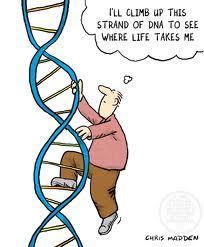
Transcribe the following strand of DNA:
AATCATGGA
AATCATGGA
a)
AATCATGGA
b)
TTAGTACCT
c)
UUAGUACCU
d)
GGATAUCUA
31.

After analyzing a sample of DNA, a scientist recorded the data shown in the table. What percentage of the DNA sample is cytosine?
a)
22%
b)
25%
c)
28%
d)
56%
32.
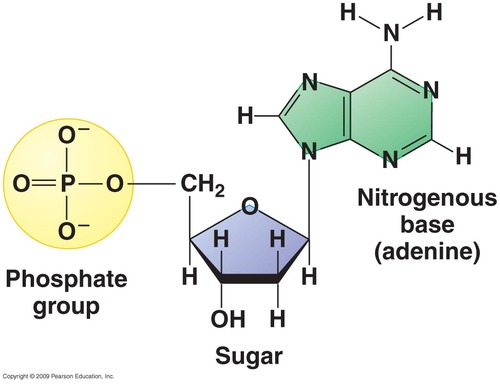
Which DNA component holds the genetic information?
a)
The phosphate backbone
b)
The deoxyribose sugar
c)
The sequence of nucleotides
d)
The ratio of adenine and guanine
33.
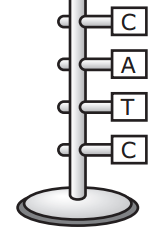
Which sequence of bases match the DNA model?
a)
CATC
b)
GTAG
c)
CAAG
d)
GTAC
34.
If a DNA sample has 40% ADENINE, how much THYMINE will it have?
a)
10%
b)
20%
c)
40%
d)
60%
35.
What it the significance of the nitrogenous bases?
a)
# of adenines and cytosines determine RNA
b)
order of nitrogenous bases determines order of amino acids
c)
amount of thymine and guanine determines length of genes
d)
type of hydrogen bonds determines amino acids
36.
How does DNA in cells determine an organism's complex traits?
a)
DNA contains codes for proteins
b)
DNA separates into long single strands
c)
DNA produces energy
d)
DNA folds into the nucleus
37.
Post transcriptional modification happens in:
a)
cytoplasm
b)
ribosome
c)
nucleus
d)
none of the above
38.
the non-coding portions our genes are known as:
a)
introns
b)
exons
c)
codons
d)
none of the above
39.
this part of the ribosome holds the tRNA carrying the polypeptide chain
a)
A
b)
P
c)
E
d)
none of the above
40.
the only start codon that is responsible for initiation of translation is
a)
TAC
b)
ACG
c)
AUG
d)
GAU
100 %

