
 Worksheets
Transport Practice
Total questions: 26
Worksheet time: 21mins
Name
Class
Date
1.
Which of the following require energy?
a)
diffusion
b)
osmosis
c)
facilitated diffusion
d)
none of these
2.
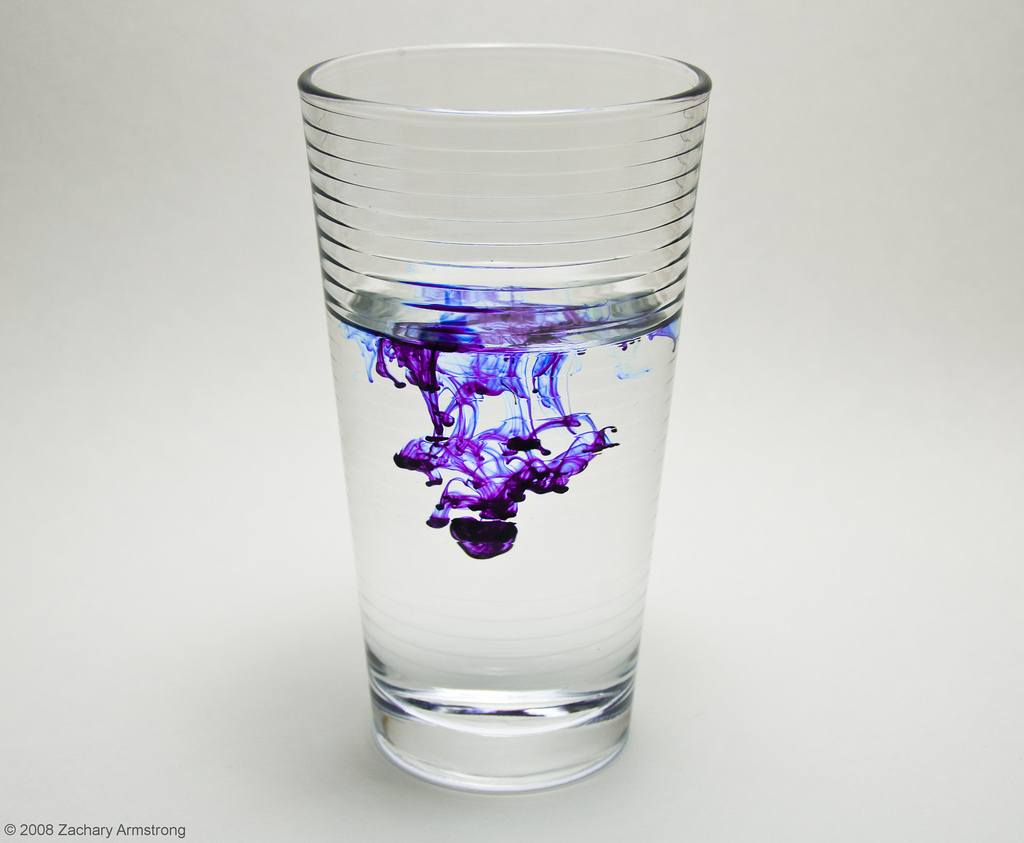
Where is there a low concentration of dye?
a)
at the bottom of cup
b)
in the color
c)
at the top of cup
d)
no concenteraion gradient
3.
During osmosis
a)
water moves from high to low concentration
b)
large or oddly shaped molecules move across a cell membrane
c)
water moves when energy is used
d)
proteins are built
4.
A person would never have pure water put into their veins in a hospital because their cells would...
a)
Shrink and Shrivel
b)
Expand and Pop
c)
Stay the same rather than heal
5.
A person should never drink salty water because their cells would
a)
shrink and shrivel
b)
expand and pop
c)
get attacked by bacteria
d)
have no concentration gradient
6.

The cell is in a _____________ solution.
a)
Hypertonic
b)
Hypotonic
c)
Isotonic
d)
None of these
7.

The cell is in a _________ solution.
a)
Hypotonic
b)
Hypertonic
c)
Isotonic
d)
None of these
8.
The movement of molecules against a concentration gradient
a)
simple diffusion
b)
facilitated diffusion
c)
active transport
d)
osmosis
9.

Which way will the water molecules move during osmosis?
a)
Out of the cell, so the cell shrinks.
b)
Out of the cell, so the cell swells.
c)
Into the cell, so the cell shrinks.
d)
Into the cell, so the cell swells.
10.
If a cell containing 5% salt is placed into a glass of water with 20% salt, the water is _______ compared to the cell.
a)
hypertonic
b)
hypotonic
c)
isotonic
d)
none of these
11.
In a solution, salt is considered the _______.
a)
solvent
b)
solute
c)
solution
d)
ion
12.
When both inside and outside of a cell have the same amount of water it is said that the cell has reached a state of ___________.
a)
osmosis
b)
equilibrium
c)
diffusion
d)
hypertonic
13.
An animal cell placed in a hypertonic solution will
a)
Stay the same
b)
Shrink- get smaller
c)
Swell- get bigger
d)
None of these
14.
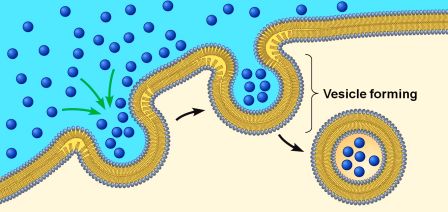
Which form of active transport is being shown?
a)
Facilitated Diffusion
b)
Exocytosis
c)
Endocytosis
d)
Protein Pumps
15.
When cells take in a liquid through active transport, what is it called?
a)
Exocytosis
b)
Phagocytosis
c)
Pinocytosis
d)
Osmosis
16.
When cells take in food particles through active transport, what is it called?
a)
Pinocytosis
b)
Phagocytosis
c)
Exocytosis
d)
Osmosis
17.
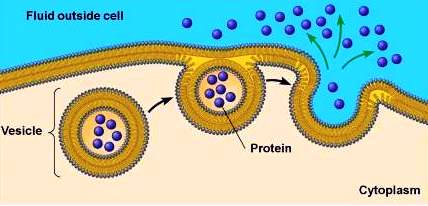
Which form of active transport is being shown?
a)
Pinocytosis
b)
Endocytosis
c)
Exocytosis
d)
Osmosis
18.
Molecules diffuse from a high concentration, to a low concentration
a)
True
b)
False
19.
A hypertonic solution has
a)
More solutes
b)
Less solutes
c)
The same amount of solutes
d)
More solvent
20.
The difference in the concentration of a substance from one location to another is called
a)
diffusion
b)
semi-permeable
c)
concentration gradient
d)
passive transport
21.

Movement of solute through the cell membrane from high to low concentration.
a)
diffusion
b)
active transport
c)
facilitated diffusion
d)
osmosis
22.
Movement of solute through the cell membrane from high to low concentration using a channel protein.
a)
diffusion
b)
active transport
c)
facilitated diffusion
d)
osmosis
23.
Which is NOT a form of active transport?
a)
Endocytosis
b)
Osmosis
c)
Exocytosis
d)
Pinocytosis
24.
Diffusion with the help of transport proteins.
a)
facilitated diffusion
b)
active transport
c)
passive transport
d)
exocytosis
25.
Type of solution in which water enters and leaves the cell at the same rate.
a)
hypotonic solution
b)
hypertonic solution
c)
isotonic solution
26.
What does “high concentration area” mean?
a)
Spread out
b)
Tightly packed together
c)
Uncrowded
d)
Spacious
100 %

