
 Worksheets
CA #1 Review
Total questions: 39
Worksheet time: 31mins
Name
Class
Date
1.
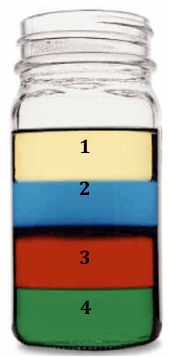
Put the liquids in order from most dense to least dense?
a)
4, 3, 2, 1
b)
1, 2, 3, 4
c)
3, 4, 2, 1,
d)
4, 3, 1, 2
2.

Which box has a higher density?
a)
Box A
b)
Box B
c)
cannot be determined
d)
they are the same
3.
What is the formula for density?
a)
density = mass x volume
b)
density = mass / volume
c)
density = mass + volume
d)
density = mass - volume
4.
Carbon is considered an element while carbon dioxide is considered a compound. This is because carbon dioxide is –
a)
a gas at room temperature.
b)
made of two different elements.
c)
given off by green plants.
5.
The smallest particle of any particular type of matter is known by which of the following terms?
a)
Element
b)
Chemical
c)
Atom
d)
Substance
6.
Something new is created, a reaction takes place.
a)
Physical Change
b)
Homogeneous Mixture
c)
Heterogeneous Mixture
d)
Chemical Change
7.

Whose atomic model said electrons orbit the atom like planets orbit the sun
a)
Einstein
b)
Thomson
c)
Bohr
d)
Dalton
8.

The mass of one proton is equal to the mass of one...
a)
neutron
b)
electron
9.

The mass of one proton is greater than the mass of one...
a)
neutron
b)
electron
10.
The two subatomic particles that make up the mass of the atom are the _____ and the _____.
a)
proton, neutron
b)
proton, electron
c)
neutron, electron
d)
electron, energy levels
11.

What is the atomic mass of the atom pictured?
a)
9
b)
10
c)
18
d)
19
12.
What is the atomic number of the atom pictured?
a)
9
b)
10
c)
18
d)
19
13.
What is the element name of the atom pictured?
a)
Fluorine
b)
Neon
c)
Argon
d)
Potassium
14.

How many electrons are in the atom pictured?
a)
1
b)
2
c)
3
d)
0
15.
If the atom pictured is neutral, what element would it be?
a)
Lithium
b)
Helium
c)
Beryllium
d)
Hydrogen
16.
Which of the following is a sign that a chemical reaction has occurred?
a)
change in shape
b)
melting
c)
formation of a gas
d)
dissolving
17.
Is hammering wood together to build a house a chemical or physical change?
a)
chemical
b)
physical
18.

Is burning wood a chemical or physical change?
a)
chemical
b)
physical
19.
Adding baking soda and vinegar together and it fizzes and creates carbon dioxide.
a)
Chemical
b)
Physical
20.
Group 18 elements are known as the __________ and have full valence shells.
a)
royal gases.
b)
supreme solids.
c)
noble gases.
d)
legit liquids.
21.
Find the element that has 3 VE and 2 shells.
a)
Magnesium - Mg
b)
Lithium - Li
c)
Aluminum - Al
d)
Boron - B
22.
Find the element that has 5 VE and 4 shells.
a)
Arsenic - As
b)
Selenium - Se
c)
Calcium - Ca
d)
Vanadium - V
23.
Protons determine an element's __________.
a)
Reactivity
b)
Nucleus
c)
Identity
d)
Color
24.
Valence Electrons determine an element's _____________.
a)
Reactivity
b)
Location
c)
Identity
d)
Color
25.

In what section would Noble Gases be found?
a)
white
b)
yellow
c)
blue
d)
red
26.

True or False: The nonmetals are in the dark blue section
a)
true
b)
false
27.

Which section are the metals in?
a)
dark blue
b)
light blue
c)
purple
d)
pink
28.
What happens to the atomic number of elements as you move left to right, top to bottom on the Periodic Table?
a)
Increases
b)
Decreases
29.
Which group of the periodic table is composed of inert (not reactive) gases?
a)
alkali metals
b)
alkaline earth metals
c)
halogens
d)
noble gases
30.
Elements which are shiny, conduct electricity and heat are called
a)
metal
b)
nonmetal
c)
metalloid
d)
nonexistent
31.

The atoms along the staircase are called
a)
metals
b)
nonmetals
c)
metalloids
d)
noble gases
32.
Which is a halogen?
a)
Helium
b)
Chlorine
c)
Oxygen
d)
Neptune
33.

Which group does this atom belong?
a)
Group 1
b)
Group 2
c)
Group 4
d)
Group 18
34.
What element has 7 valence electrons and 2 shells?
a)
Beryllium
b)
Chlorine
c)
Magnesium
d)
Fluorine
35.
The subatomic particle with a neutral charge is:
a)
protons
b)
electrons
c)
neutrons
d)
cloud
36.

How many neutrons does NA have?
a)
11
b)
23
c)
22
d)
12
37.
How are elements distinguished from one another?
a)
The number of valence electrons
b)
The number of neutrons
c)
The number of protons
d)
How they react with other elements
38.
What gives an atom mass?
a)
Protons & electrons in the nucleus
b)
electrons in the cloud
c)
protons & neutrons in the nucleus
d)
Protons & electrons in the cloud
39.
Which type of subatomic particles have the LEAST amount of mass?
a)
protons
b)
electrons
c)
neutrons
d)
nucleus
100 %

