
 Worksheets
Space Test Review
Total questions: 87
Worksheet time: 1hrs 7mins
Name
Class
Date
1.
Why does the Moon have different phases?
a)
It follows the Sun around the Earth.
b)
It moves around the Earth.
c)
It moves around the Sun.
2.
What is the correct order of the Moon Phases?
a)
1st Quarter, 3rd Quarter, New, Full
b)
New, 1st Quarter, Full, 3rd Quarter
c)
New, Full 1st Quarter, 3rd Quarter
3.
We can see the light shining on the Moon during the New Moon Phase.
a)
True
b)
False
4.
When the Moon is between the Earth and the Sun, it is most likely in what phase?
a)
New
b)
3rd Quarter
c)
Full
5.
How many phases of the moon are there?
a)
eight
b)
four
c)
ten
6.
The Moon gets its light from the
a)
Earth
b)
Stars
c)
Sun
7.

What moon phase would be visible from Earth when the moon is at position 5?
a)
first quarter
b)
third quarter
c)
new moon
d)
full moon
8.

What phase of the moon would be visible when the moon is at position 3?
a)
new moon
b)
first quarter
c)
full moon
d)
third quarter
9.

What phase of the moon would be visible from Earth when the moon is at position 1?
a)
new moon
b)
first quarter
c)
full moon
d)
third quarter
10.

What moon phase is this?
a)
waxing crescent
b)
waxing gibbous
c)
waning crescent
d)
waning gibbous
11.

What moon phase is this?
a)
waxing crescent
b)
waxing gibbous
c)
waning crescent
d)
waning gibbous
12.

What moon phase would be seen from Earth when the moon is at position 1?
a)
new moon
b)
first quarter
c)
third quarter
d)
full moon
13.

What moon phase is this?
a)
new moon
b)
full moon
c)
waxing crescent
d)
waning crescent
14.

What moon phase is this?
a)
first quarter
b)
third quarter
c)
waxing crescent
d)
waning crescent
15.
What does "waxing" mean?
a)
growing
b)
shrinking
c)
lighted
d)
dark
16.
What does "waning" mean?
a)
growing
b)
shrinking
c)
lighted
d)
dark
17.
What side of the moon is the light on when the moon is waxing?
a)
left
b)
right
c)
front
d)
back
18.

What is the name of this phase?
a)
3rd quarter
b)
New Moon
c)
waxing crescent
19.

Does this picture represent a waxing or waning moon?
a)
waxing
b)
waning
20.
How many full moons are there per year?
a)
8
b)
4
c)
6
d)
12
21.
What causes day and night?
a)
Sun's rotation
b)
Earth's rotation
c)
Moon's rotation
d)
None of these
22.
What causes the seasons?
a)
The Sun going around the Earth
b)
Only temperatures changing
c)
Earth's revolution and tilted axis.
d)
None of these answers
23.
What is "rotation"?
a)
Jumping to a new place
b)
Running in place
c)
Going completely around something
d)
Spinning
24.
What is "revolve" or "revolution"?
a)
Go complete around something
b)
Staying in place
c)
Spinning for hours
d)
Tossing something into the air
25.
True or False: The Sun revolves around the Earth
a)
True
b)
False
26.
True or False: Earth's axis has a tilt that helps to cause the seasons.
a)
True
b)
False
27.
True or False: It takes 24 hours (1 day) for the Earth to rotate completely.
a)
True
b)
False
28.
True or False: It takes Earth 365 days (1 year) to revolve around the Sun.
a)
True
b)
False
29.
This is the imaginary line that intersects the Earth through both the North and South Poles
a)
Equator
b)
Axis
c)
Fault line
d)
Latitude
30.

This picture shows Earth's
a)
Rotation
b)
Revolution
31.

This picture shows Earth's
a)
Rotation
b)
Revolution
32.

Earth is tilted as it revolves around the sun which gives us seasons. Which season would it be in North America at letter D?
a)
Summer
b)
Spring
c)
Winter
d)
Fall
33.

When the Northern Hemisphere of Earth is Leaning away from the Sun, What season is the Southern Hemisphere experiencing?
a)
Summer
b)
Winter
c)
Spring
d)
Fall
34.
What is a constellation?
a)
A group of stars that forms a pattern in the sky
b)
A way to find the North Star
c)
When a planet "spins" around its axis
d)
The process that creates energy inside of a star
35.
What star are we revolving around now?
a)
Planets
b)
Science
c)
The sun
36.

Name this
a)
Ursa Minor
b)
Orion the Hunter
c)
Leo the Lion
37.
Constellations are pictures formed in the night sky by
a)
clouds
b)
planets
c)
stars
38.
Ursa Major (Part of the Great Bear) is formed from
a)
the Little Dipper
b)
the Big Dipper
c)
Orion
d)
The Crux
39.
The North star can be found at the end of the ____ constellation
a)
Little Dipper (Ursa Minor)
b)
Big Dipper (Ursa Major)
c)
Scorpius
d)
Orion
40.
The stars "spin" through the night sky because _____
a)
The Earth rotates or spins
b)
The stars spin in circles through space
c)
Stars follow parts of Earth around in space
41.

People in the Northern Hemisphere do see the same constellations as the people in the Southern Hemisphere.
a)
True
b)
False
42.

Ursa Major is also called “Great Bear” and is one of the largest constellations.
a)
True
b)
False
43.

Ursa Minor means “Little Bear” in Latin and is commonly known as the Big Dipper.
a)
True
b)
False
44.
At ____ the length of a shadow is the shortest.
a)
8am
b)
5pm
c)
midday
45.
The _______ of the Earth on its axis causes the position and length of the shadow to change.
a)
rotation
b)
revolution
c)
spin
d)
tilt
46.

At which location of the sun would the shadow of the lamp post be pointing to the west?
a)
A
b)
B
c)
C
d)
D
47.
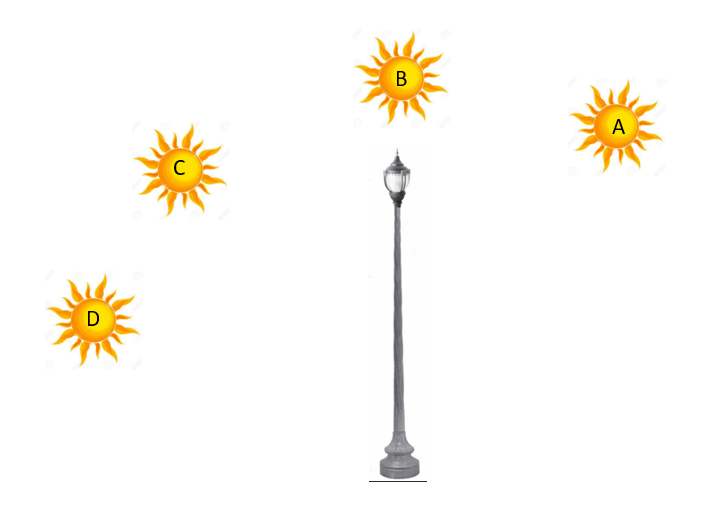
At which location of the sun would the shadow of the lamp post be the shortest?
a)
A
b)
B
c)
C
d)
D
48.
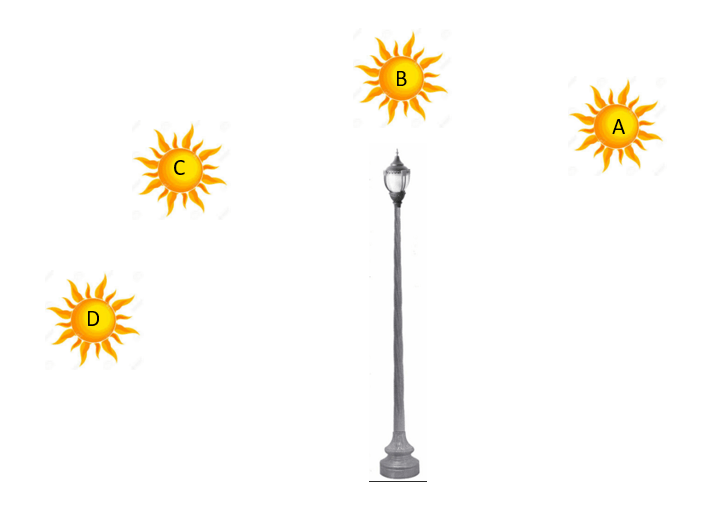
At which location of the sun would the shadow of the light pole be the longest?
a)
A at 11 a.m
b)
B at noon
c)
C at 2 p.m.
d)
D at 6 p.m.
49.

What part of the moon do we see from Earth?
a)
all of it
b)
only one quarter
c)
none of it
d)
the same side
50.
How does the Sun's position in the sky effect the length of a shadow?
a)
It determines the length of the shadow.
b)
It makes shadows appear super large.
c)
It helps you to see your shadow.
d)
It blocks all shadows, so you cannot see them.
51.
The Sun seems to travel across the sky from ___________ to __________.
a)
south to north
b)
west to east
c)
north to south
d)
east to west
52.

What is causes a shadow?
a)
turning the lights off in a room
b)
standing still with your back to the sun
c)
the sun being blocked out by an object
d)
standing in a dark room
53.

Look at the picture. Would the sun be low or high in the sky in the afternoon picture?
a)
The sun would be directly above.
b)
You would not be able to see the sun at all.
c)
The sun would be low in the sky.
d)
The sun has nothing to do with shadows.
54.
What is the first planet from the sun?
a)
Mercury
b)
Saturn
c)
Venus
d)
Neptune
55.
Which below is a terrestrial planet?
a)
Neptune
b)
Mars
c)
Saturn
d)
Uranus
56.
Jupiter, Saturn, Uranus, and Neptune are considered what?
a)
Terrestrial planets
b)
extra terrestrial planets
c)
Rocky planets
d)
Gaseous planets
57.
The largest planet in our solar system belongs to what group?
a)
Gaseous planets
b)
Terrerestrial planets
58.
Do the four gaseous planets, Jupiter, Saturn, Neptune, and Uranus all have rings?
a)
Yes
b)
No
59.
The hottest planet belongs to what group
a)
Gaseous planets
b)
Lunar planets
c)
Terrestrial planets
d)
Inner circle
60.
Mars is considered a
a)
Gaseous planet
b)
Terrestrial Planet
c)
Lunar Planet
61.
Venus belongs to this group
a)
gaseous planets
b)
terrestrial planets
62.
The planet that is 4th from the sun, is it a rocky or gaseous planet?
a)
Gaseous
b)
Rocky
c)
Neither
63.
What planet is 6th from the sun?
a)
Earth
b)
Neptune
c)
Venus
d)
Saturn
64.
Pick the correct order
a)
Mercury, earth, venus, mars
b)
Earth, mars, Mercury, Venus
c)
Mars, Earth, Venus, Mercury
d)
Mercury, Venus, Earth, Mars
65.
Pick the Correct order
a)
Mars, Jupiter, Saturn, Uranus
b)
Jupiter, Saturn, Mars, Uranus
c)
Mars, Saturn, Jupiter, Uranus
d)
Uranus, Saturn, Mars, Jupiter
66.

Which planet is Earth's sister planet?
a)
Mercury
b)
Venus
c)
Earth
d)
Mars
67.

Which planet rotates to give day/night every 24 hours?
a)
Mercury
b)
Venus
c)
Earth
d)
Mars
68.

Which planet has the biggest rings?
a)
Jupiter
b)
Saturn
c)
Uranus
d)
Neptune
69.

Which planet is the largest?
a)
Jupiter
b)
Saturn
c)
Uranus
d)
Neptune
70.

What force keeps the planets orbiting the sun?
a)
Gravity
b)
Magnetism
c)
Electricity
d)
Friction
71.

Which body has the greater effect on Earth's tides?
a)
Sun
b)
Saturn
c)
Moon
d)
Venus
72.
Tides are caused by
a)
strong winds that blow over ocean waters.
b)
the interaction of Earth, the moon and the sun.
c)
the shifting of the plates on the ocean floor.
d)
variations in the salinity of ocean water
73.
How many low tides and high tides happen in a day?
a)
1 low tide, 1 high tide
b)
4 low tides, 4 high tides
c)
3 low tides, 3 high tides
d)
2 low tides, 2 high tides
74.
You visited the beach at 12 pm (noon) and it is high tide. If you return 6 hours later what tide will you see?
a)
high
b)
low
c)
none
d)
spring
75.
If tides alternate from high to low and there are two of each type of tide a day, about how many hours will generally be between each different tide?
a)
2 hours
b)
6 hours
c)
12 hours
d)
24 hours
76.
Differences in the moon's and sun's pull on different sides of the Earth cause _________.
a)
gravity
b)
lunar phases
c)
tides
d)
dabbing
77.

What happens when the area in which you live tilts away from the sun?
a)
It is summer.
b)
It is spring.
c)
It is winter.
d)
It is fall.
78.

What causes the seasons to change?
a)
The warming and cooling of Earth's core.
b)
The distance from the sun.
c)
Earth's tilt in relation to the sun.
d)
Earth's rotation on its axis.
79.

What season is it in the Southern Hemisphere when it is fall in the Northern Hemisphere?
a)
winter
b)
spring
c)
summer
d)
fall
80.
One rotation of Earth is equal to
a)
a day.
b)
a year.
81.

Which season is taking place in the Southern Hemisphere in Position 1?
a)
Winter
b)
Spring
c)
Summer
d)
Fall
82.

Which season is taking place in the Northern Hemisphere in Position 2?
a)
Winter
b)
Spring
c)
Summer
d)
Fall
83.

Which season is taking place in the Northern Hemisphere in Position 3?
a)
Winter
b)
Spring
c)
Summer
d)
Fall
84.

Which pieces of technology helped explorers navigate or find their way?
a)
Astrolabe, Compass
b)
Caravel Ship
85.

Which piece of technology used magnets to help guide the sailors?
a)
Sextant
b)
Astrolabe
c)
Compass
86.

At the equator, the stars move in a ______ across the sky.
a)
circle
b)
straight line
c)
rotating motion
d)
slow motion
87.

Constellations may be only visible during certain seasons due to the Earth’s orbit around the____.
a)
Earth
b)
Mars
c)
Planets
d)
sun
100 %

