
NEW
Font size
S
M
L
XL
 Worksheets
Acids
Total questions: 70
Worksheet time: 2hrs 33mins
Name
Class
Date
1.
chlorous acid
a)
HClO3
b)
HClO2
c)
HClO
d)
HCl
2.
What is the formula for phosphorous acid?
a)
H3PO4
b)
H2PO4
c)
H3P
d)
H3PO3
3.
Name H2Te
a)
hydrotelluric acid
b)
Hypotelluric acid
c)
telluric acid
d)
tellurous acid
4.
HNO2
a)
hydronitrogen
b)
hydrogen nitrogen oxygen
c)
nitrous acid
d)
nitric acid
5.
Name the acid: H2SO3
a)
Sulfurous Acid
b)
Sulfuric Acid
c)
Hydrosulfuric Acid
d)
Hydrosulfurous Acid
6.
Select the name for the following acid: H2SO4
a)
Sulfuric acid
b)
Sulfurous acid
c)
Hydrosulfuric acid
7.
Select the formula for the following acid: perchloric acid
a)
HClO4
b)
HClO3
c)
HClO2
d)
HCl
8.
What determines the number of hydrogens in your acid?
a)
there are always just one
b)
its the same as the charge of hydrogen
c)
its the same as the charge of the anion
d)
magic
9.
What is the formula for nitric acid?
a)
HNO2
b)
HNO3
c)
HNO4
d)
H2NO3
10.
What is the formula for Carbonic Acid?
a)
H2CO3
b)
H2CrO4
c)
H2C2O4
d)
HCO3
11.
What is the formula for Acetic Acid?
a)
CH3COO
b)
HC2H3O2
c)
HCO
d)
HCH3O2
12.
Select the name for the following acid: H2S
a)
Hydrosulfuric acid
b)
Sulfuric acid
c)
Sulfurous
d)
Hydrosulfic acid
13.
What is the name of the following acid: HI
a)
iodic acid
b)
hydroiodic acid
14.
What is the name of the following acid: HF
a)
fluoric acid
b)
hydrofluoric acid
c)
hydrofluorine acid
d)
hydroflouric acid
15.
What is the name of the following acid: HMnO4
a)
permanganic acid
b)
permanganous acid
c)
hydropermanganic acid
16.
What is the name of the following acid: HBr
a)
Bromic acid
b)
hydrobromic acid
c)
hydrobromine acid
17.
H3P
a)
phosphoric acid
b)
hydrophosphoric acid
c)
phosphorus acid
18.
H2SO3
a)
sulfuric acid
b)
sulfurous acid
c)
hydrosulfuric acid
19.
HClO3
a)
hypochlorous acid
b)
chloric acid
c)
perchloric acid
d)
chlorous acid
20.
H2CrO4
a)
hydrochromic acid
b)
chromic acid
c)
chromous acid
21.
H2CO3
a)
hydrocarbonic acid
b)
carbonous acid
c)
carbonic acid
d)
hydrocarbonous acid
22.
H2Se
a)
hydroselenic acid
b)
selenic acid
c)
selenous acid
23.
HAt
a)
hydroastatic acid
b)
astatic acid
c)
astatous acid
d)
hydroastatous acid
24.
H3As
a)
hydroarsenic acid
b)
arsenic acid
c)
arsenous acid
d)
hydroarsenous acid
25.
H3BrO4
a)
hydrobromic acid
b)
bromic acid
c)
bromous acid
d)
hydrobromous acid
26.
HClO2
a)
perchloric acid
b)
chloric acid
c)
chlorous acid
d)
hypochlorous acid
27.

What atom matches this electron configuration?
1s22s22p63s23p64s23d10
1s22s22p63s23p64s23d10
a)
Zinc
b)
Copper
c)
Nickel
d)
Germanium
28.

What electron configuration matches an oxygen atom?
a)
1s22s22p63s2, 3p64s23d104p5
b)
1s22s22p4
c)
1s22s22p6
d)
1s22s22p63s23p64s23d1
29.

How many electrons can the first energy level hold?
a)
1
b)
2
c)
8
d)
0
30.
The electron configuration of an atom is 1s22s22p6. The number of electrons in the atom is
a)
3
b)
6
c)
8
d)
10
31.

Which electron configuration belongs to Chlorine (Cl)?
a)
1s2 2s2 2p6 3s2 3p5
b)
1s2 2s2 2p6 3s2 3p6
c)
1s2 2s2 2p6 3s2 3p7
32.
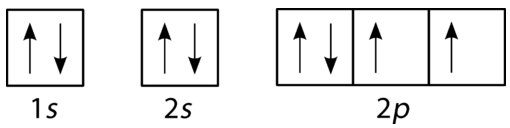
This orbital diagram represents:
a)
C
b)
B
c)
N
d)
O
33.

This orbital diagram represents:
a)
C
b)
B
c)
N
d)
O
34.

What is incorrect about this orbital diagram?
a)
Both arrows in the 2p box should be pointing up
b)
There is nothing incorrect with this diagram
c)
In the there should only be 1 orbital in the first 2p box and one in the 2nd 2p box
d)
All the arrows should be pointing up.
35.

Which element is pictured?
a)
neon
b)
fluorine
c)
magnesium
d)
argon
36.

Which element is pictured?
a)
neon
b)
fluorine
c)
magnesium
d)
argon
37.
What atom matches this electron configuration?
1s22s22p63s23p64s23d10
1s22s22p63s23p64s23d10
a)
Zinc
b)
Copper
c)
Nickel
d)
Germanium
38.
What is the noble gas shorthand electron for Sulfur atom?
a)
[Ar] 3p4
b)
[He] 3s23p4
c)
[Ne] 3s23p4
d)
[Na] 3s23p4
39.
What atom matches this electron configuration?
[Xe] 6s24f145d9
[Xe] 6s24f145d9
a)
Mercury
b)
Gold
c)
Platinum
d)
Thallium
40.

How many valence electrons does Si contain? (click to see image)
a)
14
b)
28
c)
2
d)
4
41.
The electron configuration of an atom is 1s22s22p6. The number of valence electrons in the atom is
a)
3
b)
6
c)
8
d)
10
42.

What is the electron configuration for this atom?
a)
1s22s22p6
b)
1s22s22p5
c)
1s22s22p3
d)
2s22p3
43.
Valence electrons are:
a)
Electrons farthest away from the nucleus
b)
Electrons closest to the nucleus
c)
Electrons that just come and go - they don't stay with the atom
44.

Which element is depicted from this orbital diagram
a)
Fluorine
b)
Neon
c)
Chlorine
d)
Argon
45.
When an atom loses a valence electron, it becomes a(n) _____________ ion.
a)
positive
b)
negative
c)
neutral
d)
polyatomic
46.
When an atom gains a valence electron, it becomes a(n) _____________ ion.
a)
positive
b)
negative
c)
neutral
d)
polyatomic
47.
Atoms that gain & lose electrons are called _________
a)
ions
b)
isotopes
c)
radioactive
d)
corrosive
48.
Cations are _______ that form ____________ ions and __________ electrons.
a)
nonmetals, positive, lose
b)
nonmetals, negative, gain
c)
metals, positive, gain
d)
metals, positive, lose
49.
Anions are _______ that form ____________ ions and __________ electrons.
a)
nonmetals, positive, lose
b)
nonmetals, negative, gain
c)
metals, positive, gain
d)
metals, positive, lose
50.
How many unpaired electrons would lithium have?
a)
1
b)
2
c)
3
d)
0
51.
What atom matches this electron configuration?
1s22s22p63s2
1s22s22p63s2
a)
Neon
b)
Magnesium
c)
Aluminum
d)
Potassium
52.
What is the Pauli Exclusion Principle?
a)
An atomic orbital can only hold a maximum of 2 electrons, each with opposite spins
b)
An atomic orbital can hold a minimum of 6 electrons, each with opposite spins
c)
An atomic orbital can hold a maximum of 6 electrons, each with the same spin
d)
An atomic orbital can hold a minimum of 2 electrons, each with opposite spins
53.
What is the electron configuration for Bromine (Br)
a)
1s2, 2s2, 2p6, 3s2, 3p6, 4s2, 3d1
b)
1s2, 2s2, 2p4
c)
1s2, 2s2, 2p6, 3s2, 3p6, 4s2, 3d10, 4p5
d)
1s2, 2s2, 2p6
54.
Electrons occupy orbitals of lowest energy first is part of what electron configuration rule?
a)
Hund’s Rule
b)
Aufbau Principle
c)
Pauli Exclusion Principle
55.

This is the correct dot diagram for sodium (Na)
a)
true
b)
false
56.

This is a correct dot diagram for oxygen (O)
a)
true
b)
false
57.

This is a correct dot diagram for magnesium (Mg)
a)
true
b)
false
58.
This "rule" of Quantum Chemistry states that it is impossible to know both the position and velocity of an electron at the same time.
a)
Hund's Rule
b)
Heisenberg Uncertainty Principle
c)
Aufbau Principle
d)
Pauli Exclusion Principle
59.
According to the Aufbau Principle, which sublevel should starting filling with electrons after 5s?
a)
6s
b)
5p
c)
4d
d)
3f
60.
This "rule" of Quantum Chemistry states that no 2 electrons in an atom can be in the exact same state...each electron in an atom can be described by a unique set of quantum numbers.
a)
Hund's Rule
b)
Heisenberg Uncertainty Principle
c)
Aufbau Principle
d)
Pauli Exclusion Principle
61.
As atoms of elements in group 16 are considered in order from top to bottom, the electronegativity of each successive element....
a)
decreases
b)
increases
c)
remains the same
d)
none of the above
62.
Which atom has the largest atomic radius?
a)
potassium
b)
rubidium
c)
francium
d)
cesium
63.
As you move down the periodic table atoms get bigger. This is because ____________.
a)
The atoms have more mass.
b)
The atoms have more protons.
c)
The atoms have more energy levels
d)
The atoms have more nuetrons
64.
Atoms that have a high electronegativity, _______________.
a)
give up their electrons more easily.
b)
hold on to their electrons more tightly.
c)
have more electron shells.
65.
Electronegativity is...
a)
how good an atom is at attracting electrons
b)
the ability of an atom to lose electrons
c)
the energy required to remove an electron from a specific atom
d)
how easy it is to make friends.
66.
Ionization energy is...
a)
the energy required to add an electron to a specific atom
b)
how much energy it takes to remove an electron from an atom
c)
the energy required to shield the outer electrons from the nucleus
d)
a measure of the ability of an atom to attract electrons
67.
The atom with the largest atomic radius in Group 18 is -
a)
Ar
b)
He
c)
Kr
d)
Rn
68.
The element with the largest electronegativity in the halogens is -
a)
At
b)
F
c)
Cl
d)
Br
69.
The element with the lowest electronegativity in Period 3 is -
a)
Na
b)
Cl
c)
Ar
d)
Mg
70.
Electronegativity __________ from left to right within a period and __________ from top to bottom within a group.
a)
decreases, increases
b)
increases, increases
c)
increases, decreases
d)
stays the same, increases
Reset

