
 Worksheets
SSUSH Standards 16-19
Total questions: 54
Worksheet time: 33mins
Name
Class
Date
1.
Many African American Artists had opportunities to flourish and express their creativity during ________?
a)
Harlem Renaissance
b)
Great Awakening
c)
Harlem Resurgence
d)
The Great Migration
2.
Laws created to limit Immigration in the 1920's were pushed by nativists because?
a)
Nativist thought Sacco and Vanzetti were innocent.
b)
Nativists blamed Europeans for the country's problems
c)
Congress wanted to limit Immigration from Mexico.
d)
Americans wanted to end Isolationism
3.
What is a Bootlegger?
a)
Some Guy
b)
A person who smuggles illegal alcohol into the U.S.
c)
A person who puggles legal alcohol into the U.S.
d)
Why are you even asking?
4.
Henry Ford's mass-production process allowed for all of the following except?
a)
Higher Wages
b)
Shorter Work Hours
c)
Lower prices
d)
Less Competition for jobs
5.
Ford's system was efficient because it?
a)
He personally made each car
b)
He divided the process into simple parts.
c)
Had teams of workers compete to built a car quickest.
d)
Used immigrant labor
6.
What was one industry that did not improve like the rest of the economy in the 1920s?
a)
farming industry
b)
radio industry
c)
oil industry
d)
auto industry
7.
What is Isolationism?
a)
Being by yourself
b)
Staying out of the affairs of other countries
c)
Helping cure and fight disease
d)
Running an efficient company
8.
This was a major innovation found in most homes by the end of the 20s.
a)
Radio
b)
Television
c)
Telephone
d)
Microwave.
9.
This natural disaster served to worsen the effects of the Great Depression on Farmers in the Midwest
a)
Tornados
b)
Dust Bowl
c)
Black Tuesday
d)
Hurricanes
10.
The President who was mostly blamed for worsening the Great Depression
a)
Roosevelt
b)
Eisenhower
c)
Hoover
d)
Jefferson
11.
The Agricultural Adjustment Agency (AAA) helped farmers get crop prices under control. This is an example of:
a)
Relief
b)
Recovery
c)
Reform
12.
The name given to the programs enforced by FDR to ensure relief, recovery and reform.
a)
Stock Market
b)
Great Depression
c)
Margin
d)
New Deal
13.
Programs that were put into place to ensure the causes of the Great Depression were addressed and corrected to ensure the Depression would not happen again
a)
Relief
b)
Recovery
c)
Reform
14.
Programs that were put into place to put Americans back to work completing government funded projects
a)
Relief
b)
Recovery
c)
Reform
15.
This President enforced both New Deals and saw America through the Great Depression and World War II.
a)
Eisenhower
b)
Truman
c)
Hoover
d)
Roosevelt
16.
Government spending, in excess of revenue, of funds raised by borrowing rather than from taxation.
a)
Deficit Spending
b)
Margin
c)
Stock Market
d)
Bank Crisis
17.
Even though war was breaking out in Europe again, America decided to remain
a)
Isolated
b)
Involved with the Allies
c)
Involved with the Axis
d)
Scared
18.
The most popular home appliance in the 1930's
a)
Television
b)
Radio
c)
Movies
d)
Telephone
19.
Paying a small % of a stock's price & borrowing the rest is known as what?
a)
buying on margin
b)
speculation
c)
fiat money
d)
price supports
20.
What New Deal program protected workers' rights (collective bargaining, max work week, & minimum wage)?
a)
NLRB/Wagner Act
b)
WPA
c)
AAA
d)
CCC
21.
How did the 1929 stock market crash affect the United States economy in the 1930s?
a)
Unemployment reached its highest level in United States history.
b)
Congress voted to reject New Deal policies.
c)
Stock prices were higher than investors could afford.
d)
Agriculture replaced manufacturing as the primary industry.
22.

How did the Dust Bowl have a negative impact on farmers?
a)
It caused a drought and the dust ruined crops
b)
Large amounts of dust ruined home and caused Texans to become ill
c)
High winds led to an increase of Tornados in the Panhandle
23.
Which of the following was a major cause of the Great Depression?
a)
overproduction and underconsumption
b)
a decrease in the supply of consumer goods
c)
an increase in demand for imported products
d)
an increase in the price of wheat on the world market
24.
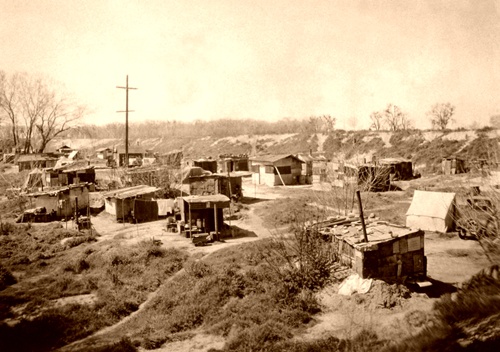
What was the main reason for the emergence of “Hoovervilles” like the one shown in the photograph?
a)
Many Americans had lost jobs during the Great Depression.
b)
Thousands of homes had been destroyed by the effects of the Dust Bowl.
c)
Housing projects could not keep up with the demand for homes needed by the poor.
d)
Preparations for World War I had created a shortage of building materials.
25.
FDR addressed the American public in weekly broadcasts known as:
a)
FDR Hour
b)
Hangin' With Franklin
c)
Fireside Chats
d)
Around the Fire
26.
A major reason that President Franklin D. Roosevelt proposed adding Justices to the Supreme Court in 1937 was to
a)
make the Court processes more democratic
b)
end corruption and favoritism in handling cases
c)
influence Court decisions related to New Deal programs
d)
ensure the appointment of members of minority groups
27.
What was a guiding principle of the New Deal economic policies?
a)
Pro-business tax breaks would solve the problems associated with urban poverty.
b)
Antitrust legislation would destroy the free market economy of the United States.
c)
Rugged individualism must be allowed to solve social inequality.
d)
Government must assume more responsibility for helping the poor.
28.
Passage of the Social Security Act (1935) helped American workers by
a)
creating jobs for the unemployed
b)
guaranteeing a minimum wage
c)
legalizing the right to join labor unions
d)
providing financial assistance after retirement
29.
Senator Huey Long, Dr. Francis Townsend, and Father Charles Coughlin are best known as
a)
members of President Franklin D. Roosevelt’s cabinet
b)
outspoken critics of President Franklin D. Roosevelt’s New Deal
c)
supporters of President Franklin D. Roosevelt’s reelection campaign in 1940
d)
members of the Supreme Court nominated by President Franklin D. Roosevelt
30.
A major result of the New Deal was that it
a)
eliminated poverty in the US
b)
extended the merit system in the civil service
c)
destroyed the private enterprise system
d)
greatly increased the size and power of the Federal Government
31.
A way to supply Britain by "loaning" them supplies in a way that wouldn't violate neutrality . . .
a)
Cash and Carry
b)
Destroyers for Bases
c)
Lend-Lease Act
d)
Atlantic Charter
32.
Which was NOT an argument against the United States aiding Britain in the war?
a)
Not America's concern
b)
Hitler wasn't a real threat to the U.S.
c)
Britain is our enemy
d)
We'd be drawn into an unnecessary war
33.
A 1980s congressional committee concluded that Japanese Internment happened for what reason?
a)
Racism
b)
Military necessity
c)
Personal safety of the Japanese
d)
To avoid sabotage
34.
What group of people on the homefront were affected most by the war?
a)
African-Americans
b)
Hispanic-Americans
c)
White Men
d)
Women
35.
On which city was the first atomic bomb dropped?
a)
Hiroshima
b)
Nagasaki
c)
Tokyo
d)
Kyoto
36.
The president of the United States who decided to drop the atomic bombs was . . .
a)
Franklin D. Roosevelt
b)
Dwight D. Eisenhower
c)
John F. Kennedy
d)
Harry Truman
37.
What happened on December 7, 1941?
a)
Pearl Harbor was bombed
b)
D-Day
c)
Atomic bomb dropped
d)
Germany invades Poland
38.

The two sides that fought in World War II were the
a)
Allied & Central Powers
b)
Allied & Axis Powers
c)
Central & Axis Powers
d)
Allied & Associated Powers
39.
What was the role of the War Production Board during World War II?
a)
Controlling the prices of American consumer goods
b)
Managing the recruitment and draft of military personnel
c)
Providing upbeat information to magazines and newspapers
d)
Transforming the nation’s factories to create military supplies
40.
What event led to the US joining World War II?
a)
Germany invaded Poland.
b)
Germany sent Mexico a secret telegram.
c)
Japan bombed Pearl Harbor.
d)
Germany bombed Pearl Harbor.
41.
This is the name remembered for the Allied attack on France on June 6, 1944.
a)
Operation Dumbo Drop
b)
Operation Torch
c)
D-Day
d)
Omaha
42.
What was the Allied strategy in the Pacific known as?
a)
island-hopping
b)
island-jumping
c)
appeasement
d)
rationing
43.
Which battle was the turning point of the war in the Pacific?
a)
Battle of Singapore
b)
Battle of the Coral Sea
c)
Battle of Guadalcanal
d)
Battle of Midway
44.
To help pay for World War II, the United States government relied heavily on the
a)
money borrowed from foreign governments
b)
sale of war bonds
c)
sale of United States manufactured goods to neutral nations
d)
printing of additional paper money
45.
During World War II, the federal government used rationing to
a)
hold down prices of military weapons
b)
increase educational benefits for veterans
c)
increase imports of scarce products
d)
provide more resources for the military
46.
What role did African Americans serve in the military by the end of the war?
a)
They were not allowed in the military.
b)
They served in segregated combat units.
c)
They only served in non-combat positions.
d)
They served in fully integrated combat units.
47.
During World War II, many Japanese Americans living on the West Coast were relocated to detention centers primarily because they
a)
were known spies for Japan
b)
were seen as a security threat
c)
refused to serve in the United States military
d)
expressed their support for Italy and Germany
48.
Shortly after entering World War II, the United States began the Manhattan Project to
a)
work on the development of an atomic bomb
b)
increase economic production to meet wartime demands
c)
defend New York City against a nuclear attack
d)
recruit men for the military services
49.
Which two Japanese cities were destroyed by atom bombs?
a)
Hiroshima and Nagasaki
b)
Kyoto and Tokyo
c)
Nagasaki and Kyoto
d)
Tokyo and Hiroshima
50.
The experiences of African Americans serving in the military forces during World War II influenced their postwar decision to
a)
renew support for the principle of separate but equal
b)
join the armed forces in record numbers
c)
increase efforts to end racial discrimination
d)
move back to the rural south
51.
Eleanor Roosevelt was called "Eleanor Everywhere" because
a)
she was FDR's eyes and ears
b)
she liked to fly airplanes
c)
she was nosey
52.
What is tolerance?
a)
willing to accept feelings, habits, or beliefs that are different from your own
b)
saying what you think
c)
courage
53.
Eleanor Roosevelt believed that people should accept other's differences. What character trait does this describe?
a)
liberty
b)
justice
c)
tolerance
54.
What did Eleanor Roosevelt work for?
a)
civil rights
b)
human rights
c)
rights for slaves
100 %

