Wayground logo

Free Printable Worksheets

Font size

S
M
L
XL
Worksheets

CP Evolution Review

Total questions: 90

Worksheet time: 2hrs 37mins

Name
Class
Date
1.
Charles Darwin came up with this theory 
a)
Natural Selection
b)
Mutation
2.
Darwin wrote that organisms with traits that are best suited to the environment will ________________
a)
increase in number
b)
become extinct
3.
Which of the following is NOT an example of natural selection? 
a)
People selectively breeding hamsters.
b)
Insect populations developing resistance to certain pesticides.
c)
Bacteria becoming resistant to antibiotics.
d)
Male birds of certain species developing colorful feathers to attract female mates.
4.
What characteristic did Darwin observe about the finches on the Galapagos Islands?
a)
Their feathers 
b)
Genotypes 
c)
Their beaks
d)
Their body sizes
5.
Which term refers to the process by which individuals that are better suited to the environment survive and reproduce therefore passing down their genes to their offspring? 
a)
Evolution 
b)
Variation 
c)
Adaptation
d)
Natural Selection 
6.
Which species’ DNA is most similar to the DNA of the toothed whale? 
a)
Hippopotamus 
b)
Baleen Whale
c)
Grazing Mammals
d)
Camels
7.
When an organism completely dies out, it is called.....
a)
Adaption
b)
Extinction
c)
Fossilization
d)
Mutation
8.
Change over time...
a)
Evolution
b)
Nucleotide 
9.
Who is the father of evolution?
a)
Darwin
b)
Mendel
c)
Newton
d)
Einstein
10.
What is another name for natural selection?
a)
survival of the smartest
b)
survival of the fastest
c)
survival of the biggest
d)
survival of the fittest
11.
What is a change in an organism that allows for it to survive in its environment?
a)
homologous
b)
vestigial
c)
variation
d)
adaptation
12.
What is the study of organisms at the early stages of development?
a)
DNA studies
b)
embryology 
c)
extinction
d)
fossil record
13.
What is an organism that has similar characteristics and can reproduce?
a)
species
b)
organism
c)
embryology
d)
vestigial 
14.
What is this an example of?
a)
diversity of species
b)
variation
c)
vestigial structures
d)
DNA studies
15.
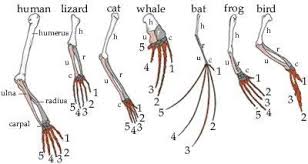
What is this an example of?
a)
vestigial structures
b)
embryology
c)
homologous structures
d)
fossil record
16.
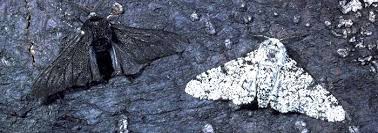
Predict which moth would increase in population
a)
light 
b)
dark
17.
Why are advantageous traits more likely to be passed onto offspring?
a)
Because they are more likely to survive and reproduce.
b)
Because they come from dominant alleles.
c)
Because they come from recessive alleles.
d)
Because the trait is an acquired phenotype.
18.
The ability of an organism to survive and reproduce in its specific environment 
a)
diversity.
b)
evolution
c)
adaptation
d)
 fitness
19.
The white feathers of a snowy owl allow it to blend in with its environment during the winter months (snow). This is an example of ________________
a)
Species
b)
Environmental Change
c)
Adaptation
d)
Variation
20.
What is the advantage of having different shaped beaks?
a)
To look different from other species.
b)
To be able to eat the food readily available in the environment.
c)
To protect itself against predators.
d)
To protect itself against prey.
21.
Darwin's expedition took how many years?
a)
3
b)
4
c)
5
d)
6
22.
Darwin's expedition was called the Voyage of the _________.
a)
Titanic
b)
Beagle
23.
Remains of ancient organisms are called
a)
Extinctions
b)
Fossils
c)
Mutations
d)
Variations
24.
what did Charles Darwin observe in finch populations of the Galapagos Islands off the coast of South America?
a)
different species on different islands
b)
all species on one of the islands
c)
identical species on all the islands
d)
the same species as North America
25.

What is suggested by the anatomical similarity of different species of vertebrates?

a)

no evolutionary relationships between the groups

b)

recent common ancestry

c)

similar environments in the past

d)

evolution from a distant common ancestor

26.
Some organisms that share a common ancestor have features that have different functions, but similar structures.  These are known as
a)
vestigial structures
b)
analogous structures
c)
homologous structures
d)
fossil structures
27.
If an organism has a vestigial structure, that structure likely once had a function in a(n)
a)
close relative
b)
early ancestor
c)
unrelated organism
d)
embryological stage
28.
What is speciation?
a)
combining of tow species to form one with different traits
b)
isolation that affects mating behaviors
c)
timing of mating that prevents normal sexual selection
d)
divergence of two or more species from an existing one
29.
An earthquake causes an ocean channel top open and separate an island into two.  the species on each section are now in
a)
geographic isoliation
b)
behavioral isolation
c)
disruptive selection
d)
temporal isolation
30.
What kid of isolation occurs when two populations of birds have different courtship dances?
a)
geographic
b)
sexual
c)
temporal
d)
behavioral
31.
Natural selection results in change over time by acting on traits that are
a)
heritable
b)
new
c)
mutated 
d)
better than the best
32.

Natural selection could not occur without

a)

geographic isolation

b)

variation in the population

c)

stable environments

d)

competition for unlimited resources

33.
Which two species are most related?
a)
B&C
b)
A&B
c)
A&C
d)
C&B
34.
Similar DNA sequences between organisms illustrate
a)
natural selection
b)
common ancestry
c)
population bottlenecks
35.
Study of embryos of various organisms to show a common ancestor because of similarities in development
a)
natural selection
b)
embryology
c)
speciation
d)
evolution
36.
What does Darwin's theory of evolution suggest?
a)
species change over time
b)
extinct species are not related to living species
c)
different species can interbreed
d)
animals that look alike are most closely related
37.
Whales are aquatic mammals that contain a pelvis bone.  Even though it does not aid in its movement, the function must have been used by a common ancestor of the whale.  Thus, the pelvis is referred to as a(n)
a)
vestigial structure
b)
analogous structure
c)
homologous structure
38.
If species A and B have very similar genes and proteins, what is probably TRUE?
a)
species A and B share a relatively recent common ancestor
b)
species A evolved independently of species B for a long period
c)
species A is younger than species B
d)
species A is older than species B
39.
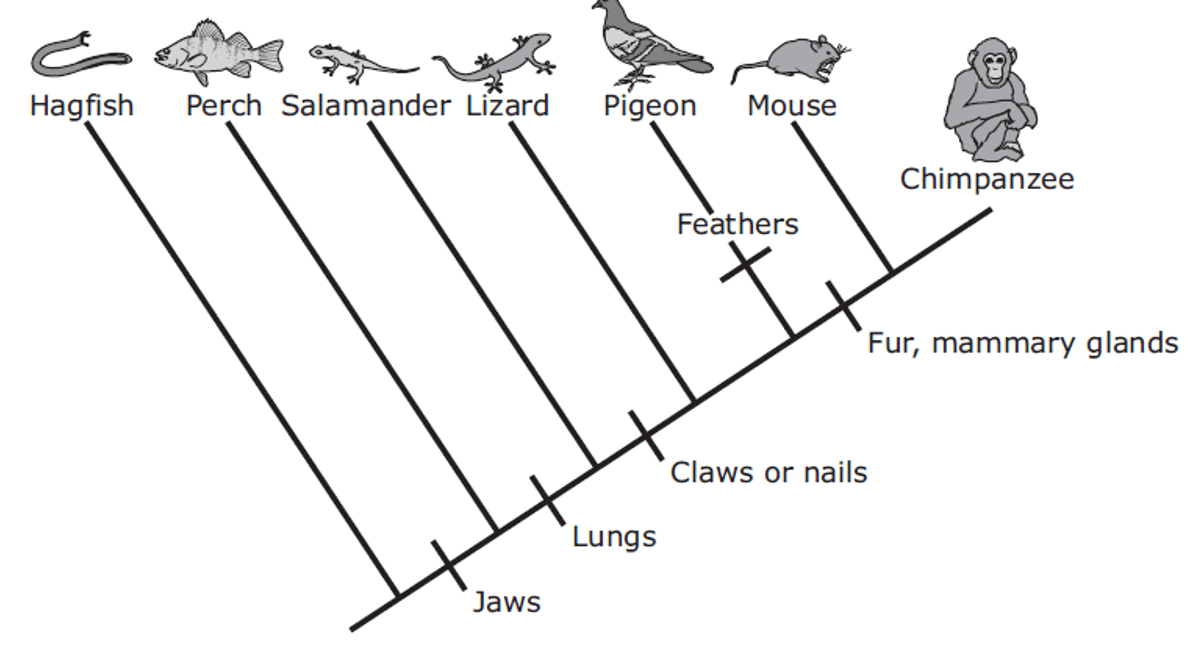
All the animals to the right of the hagfish would have the common characteristic of -
a)
Fur
b)
Claws or nails
c)
Lungs
d)
Jaws
40.
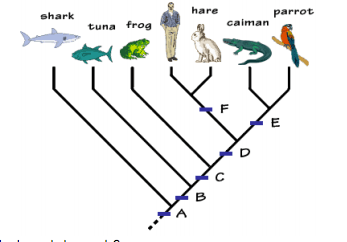
According to this cladogram, birds are LEAST related to -
a)
Amphibians
b)
Sharks
c)
Ray Finned Fish
d)
Crocodiles
41.
On the cladogram, which organism is the closest relative of the human?
a)
Frog
b)
Hare
c)
Caiman
d)
Parrot
42.
Which trait do only humans have, according to the cladogram?
a)
jaws
b)
mammary glands & hair
c)
terrestrial during all life stages
d)
opposable thumbs
43.
According to the cladogram, which organism is most distantly related to the human?
a)
crayfish
b)
rat
c)
perch
d)
frog
44.
A fossil of an extinct dinosaur is found and the anatomy of the fossil shows similarities to that of a bird. What could this mean?
a)
This is purely by chance and isn't significant
b)
The extinct dinosaur and modern bird share a common ancestor
c)
All dinosaurs evolved into birds and that's why there aren't any dinosaurs alive today
d)
Dinosaurs choose to fly, and evolved into birds to escape predation and capture food
45.
Genetic differences between organisms of the same species
a)
Variation
b)
Adaptation
c)
Behavior
d)
Environment
46.
What is a diagram that shows characteristic relationships among organisms called?
a)
Cladogram
b)
Karyotype chart
c)
Punnet square
d)
Biogeography
47.
Which of the following must occur for speciation to happen?
a)
geographic isolation
b)
reproductive isolation
c)
temporal isolation
d)
behavioral isolation
48.
Which of the following is an example of reproductive isolation?
a)
two populations of finches that cannot produce viable offspring
b)
two populations of finches that have different feather colors
c)
two populations of salamanders that live in different lakes
d)
two populations of salamanders that have different tail lengths
49.
Which is an example of temporal isolation?
a)
flowers that bloom in different months 
b)
birds that have different mating calls
c)
fruit flies that mate in different locations
d)
squirrels that have different fur colors
50.
Gentoo penguins will present a mate with a pebble that they find to attract a mate. Emperor penguins have a specific call and movement that they make to attract a mate. Which type of isolation do these penguins demonstrate?
a)
temporal isolation 
b)
behavioral isolation
c)
geographical isolation
d)
anatomical isolation
51.
Gentoo penguins will present a mate with a pebble that they find to attract a mate. Emperor penguins have a specific call and movement that they make to attract a mate. Which type of isolation do these penguins demonstrate?
a)
temporal isolation 
b)
behavioral isolation
c)
geographical isolation
d)
anatomical isolation
52.
Does genetic drift decrease genetic diversity?
a)
No, because you are gaining alleles
b)
No, because new traits are formed
c)
Yes, because you lose alleles
d)
Yes, because you gain alleles
53.
What type of speciation involves geographic isolation?
a)
Allopatric
b)
Sympatric
c)
Both
54.
What type of speciation involves isolation due to behavior such as sexual selection or habitat differentiation?
a)
Allopatric
b)
Sympatric
c)
Both
55.
What type of speciation involves reproductive isolation?
a)
Allopatric
b)
Sympatric
c)
Both
56.
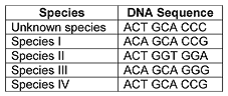
According to this data, the unknown bacterial species is most closely related to: 
a)
Species I
b)
Species II
c)
Species III
d)
Species IV
57.
The hypothesis that evolution of a species occurs in periods of rapid change separated by periods of little or no change is called
a)
divergence
b)
gradualism
c)
punctuated equilibrium
d)
isolation
58.
The hypothesis that evolution of a species occurs gradually over time as a slow and constant process is known as
a)
speciation
b)
punctuated equilibrium
c)
gradualism
d)
microevolution
59.
This scientist stated that by using or not using a certain body part, organisms could change in their lifetime and that the trait gained would be passed down to their offspring.
a)
James Hutton
b)
Charles Lyell
c)
Jean-Baptiste Lamarck
d)
Thomas Malthus
60.
Because of an environmental change, organisms develop mutations to survive in that environment.
a)
True
b)
False
61.
Ten brown mice and ten white mice are placed in a desert environment. What will happen to the white population over time?
a)
It will increase
b)
It will decrease
c)
It will stay the same
d)
There is no way to tell
62.
When has speciation occurred?
a)
When populations no longer look the same
b)
When populations no longer have the same frequency of alleles
c)
When populations are living in different environments
d)
When populations can no longer interbreed
63.
A rabbit that can easily outcompete other rabbits for food and that can produce many offspring has a high
a)
sexuality
b)
mutation rate
c)
fitness
d)
adaptability
64.
Humans, birds, whales, and lizards all have similar arm bones. What is the reason for this?
a)
The function of these bones is the same in all animals
b)
They live in similar environments
c)
They have a common ancestor
d)
All organisms resemble humans
65.
Individuals within a population can evolve.
a)
True
b)
False
66.

Two organisms that are closely related but not clones would have...

a)

very similar DNA sequences

b)

exactly the same DNA sequences

c)

no proteins in common

d)

completely different DNA sequences

67.

In a population of ladybugs, black bugs are more successful in escaping predators. Overtime, this gene becomes more popular in the population and the ladybug population loses its red color. This is an example of?

a)

Natural Selection

b)

Mutation

c)

Genetic Drift

d)

Gene Flow

68.

Lamarck’s ideas about evolution include the concept that differences among the traits of organisms happen as a result of

a)

increases in population size.

b)

the actions of organisms as they use or do not use body structures

c)

an unchanging local environment

d)

the natural variations already present within the population of organisms

69.
Which species’ DNA is most similar to the DNA of the toothed whale? 
a)
Hippopotamus 
b)
Baleen Whale
c)
Grazing Mammals
d)
Camels
70.
Which of the following is NOT an example of Prezygotic Reproductive Isolation?
a)
Geographic
b)
Behavioral
c)
Low Hybrid Viability
d)
Gametic
71.
Which kind of RIMs happens because offspring die very early in their life? 
a)
Low hybrid reproductive capacity
b)
Chromosomal mismatch
c)
Hybrid breakdown
d)
Low hybrid viability
72.
Do prezygotic isolating mechanisms occur:
a)
before the zygote
b)
after the zygote
c)
at the same time as the zygote
d)
none of these
73.
Which of the three graphs shows stabilizing selection?
a)
A
b)
B
c)
C
74.
Which of the three graphs shows disruptive selection?
a)
A
b)
B
c)
C
75.
On the Galapagos islands, Charles Darwin observed:
a)
completely unrelated birds on each of the islands
b)
birds exactly like those found in south america
c)
somewhat similar birds, with different beaks for different foods
d)
birds completely unrelated to those found in south america
76.
What type of selection is depicted in the picture? 
a)
stabilizing 
b)
directional 
c)
disruptive 
d)
the answer is not here
77.
Robins typically lay fours eggs. If more then four eggs are produced then the baby chicks are malnourished while smaller egg numbers result in no viable (able to live) baby chicks. This is an example of
a)
stabalizing
b)
disruptive
c)
direction
d)
none of the above
78.

Frogs living around a pond eat flies that are 3 mm in length. Flies range in size from 1 mm to 5 mm. The majority of the fly population is around 3 mm. Cold weather caused most of the 3mm flies to die off. What will happen to the population after this happens?

a)

The flies will move to another environment

b)

Fitness remains the same and the population continues to grow.

c)

The species will diverge into two new species. One that eats small flies and one that eats large flies.

d)

The flies will become extinct and the frogs will move to another pond

79.

Two islands are represented above. What type of environment can you infer might exist on these islands?

a)

Island A is loaded with predators.

b)

Island B has selection against dark colored mice.

c)

Island A must have environments where both light color and dark color mice are selected for.

d)

Island A is a peninsula while island B is a volcano.

80.

Based on this cladogram (also known as a dendrogram) which organisms are most closely related?

a)

the gazelle and the desert toad

b)

the ostrich and the rattlesnake

c)

the Guila monster and the Chuckwala

d)

the desert toad and the rattlesnake

81.

When organisms can no longer mate, especially due to geographic isolation mechanisms, the outcome might be

a)

Speciation - the two populations can no longer reproduce.

b)

bottle neck - a small population leaves to form a new population

c)

Genetic Drift - many organisms move into and out of the population

d)

Founder effect - a natural disaster reduces the size of the population

82.

According to the differences in the chart, which of these pairs of animals are more closely related?

a)

Human and Chimp

b)

Human and Lemur

c)

Baboon and Lemur

d)

Lemur and Chimp

83.

Which trait do the Chimp and pigeon share from their most recent common ancestor?

a)

jaw

b)

fur and mammary glands

c)

feathers

d)

claw and nails

84.

The effect of genetic drift on a population is

a)

reduction in genetic diversity

b)

increase in mutations

c)

the birth of more males

d)

a tendency to forage for food

85.

The evidences of evolution such as the fossil record, embryology and biogeography all indicate

a)

a common ancestor

b)

mutations occurred long ago

c)

organisms could will new traits when they wanted them

d)

most organisms are not related

86.

The diagram is an example of

a)

humans inability to get along with nature

b)

natural selection

c)

how pesticide is ineffective

d)

founder effect

87.

When organisms mate during different seasons that is an example of which reproductive barrier?

a)

behavioral

b)

gametic

c)

temporal

d)

mechanical

88.

When two related species of flowering plants have different structures so that each is pollinated by a different species of insect, what type of reproductive barrier is this?

a)

mechanical isolation

b)

behavioral isolation

c)

temporal isolation

d)

gametic isolation

89.

Which rate of evolution says that organisms change the most when they first appear and then stay relatively the same for the rest of their existence?

a)

gradualism

b)

punctuated equilibrium

c)

inclusive fitness

d)

genetic drift

90.

The change in allele frequencies in a population over time is referred to as...

a)

microevolution

b)

macroevolution

c)

speciation

d)

gametic isolation