
 Worksheets
PMA Review Quarter 1
Total questions: 30
Worksheet time: 2hrs 15mins
Name
Class
Date
1.

Which gas is MOST likely being released into the test tube?
a)
Carbon dioxide
b)
Oxygen
c)
Nitrogen
d)
Hydrogen
2.
Which statement BEST describes the roles of photosynthesis and respiration in the carbon cycle?
a)
A. Respiration and photosynthesis both add carbon to the atmosphere.
A. Respiration and photosynthesis both add carbon to the atmosphere.
b)
B. Respiration and photosynthesis both remove carbon from the atmosphere.
c)
C. Respiration adds carbon to the atmosphere, while photosynthesis removes carbon from the atmosphere.
d)
D. Photosynthesis adds carbon to the atmosphere while respiration removes carbon from the atmosphere.
3.

The following equation represents the process of photosynthesis in green plants. What happens to most of the light energy during photosynthesis?
a)
It is transformed into heat energy.
b)
It is transformed into chemical energy.
c)
It is changed into carbon dioxide.
d)
It is changed into oxygen.
4.

What element would fill in the dots in this picture?
a)
Carbon
b)
Phosphorus
c)
Nitrogen
d)
Sulfur
5.

Optimal temperature is 40*C. Which graph shows how activity is related to temperature?
a)
A
b)
B
c)
C
d)
D
6.
The waxy cuticle on the outside of plant leaves are made up of ...
a)
Carbohydrates
b)
Lipids
c)
Proteins
d)
Nucleic Acids
7.

In the picture, X is what?
a)
enzyme
b)
water
c)
substrate
d)
product
8.
If I'm looking under a microscope and I notice that my cell has DNA not located in a nucleus I can assume that this is a...
a)
Animal Cell
b)
Prokaryotic Cell
c)
Plant Cell
d)
Eukaryotic Cell
9.

What type of cell is this?
a)
Plant Cell
b)
Animal Cell
c)
Bacteria Cell
d)
Prokaryotic Cell
10.

The cell below is in a _________ solution.
a)
Hypotonic
b)
Hypertonic
c)
Isotonic
11.
Which of these statements cannot be used as evidence for life on earth
a)
All cells come from pre-existing cells.
b)
All living organisms are made up of one or more cells.
c)
All cells are important in maintaining homeostasis.
d)
The cell is the basic functional unit of life.
12.
Which of these statements cannot be used as evidence for life on earth
a)
All cells come from pre-existing cells.
b)
All living organisms are made up of one or more cells.
c)
All cells are important in maintaining homeostasis.
d)
The cell is the basic functional unit of life.
13.

This image shows the detailed structure of the tiny mitochondria organelle. Which microscope most likely took this image?
a)
Compound Light
b)
Scanning Electron
c)
Dissecting
d)
Transmission Electron
14.

Which microscope would you use to see the outside of a bee with a magnification under 100X.
a)
Compound Light
b)
Scanning Electron
c)
Dissecting
d)
Transmission Electron
15.
Capillary action is the result of adhesion. Which aspect of water is responsible for this?
a)
Nonpolar covalent bonds that enable water to dissolve other substances
b)
Polar covalent bonds that join molecules of water to other substances
c)
Hydrogen bonds between water and another substance
d)
Ionic bonds that enable electrons to flow through water and into another substance
16.
Which of the following properties of water enables transpiration in plants?
a)
Water expands as it freezes.
b)
Water is an excellent solvent.
c)
Water exhibits cohesive behavior.
d)
Water moderates temperature.
17.
Large bodies of water do not quickly fluctuate in temperature. Why?
a)
Water is a solvent.
b)
Water has a high specific heat.
c)
Water acts as a buffer.
d)
Water is non-polar.
18.

Where does this reaction take place.
a)
ribosome
b)
mitochondria
c)
chloroplast
d)
nucleus
19.

Hydrophobic portion of cell membrane?
a)
A
b)
C
c)
D
d)
E
20.
If there was mutation in the cell and the mitochondria stopped functioning, which product would stop being produced and why?
a)
ATP because cellular respiration would not take place
b)
ATP because photosynthesis would not take place.
c)
Glucose because cellular respiration would not take place
d)
Glucose because photosynthese would not take place.
21.
What is the proper order in which energy is transformed.
a)
Sunlight > Glucose > ATP
b)
Sunlight >Carbon dioxide > ATP
c)
Sunlight > ATP > Glucose
d)
ATP > Sunlight > Carbon dioxide
22.
_________ are composed out of carbon (C), hydrogen (H), oxygen (O), nitrogen (N), and phosphorus (P)
a)
Carbohydrates
b)
Lipids
c)
Proteins
d)
Nucleic Acids
23.
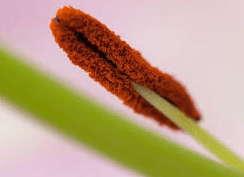
The part of a flower that produces the male reproductive cells.
a)
anther
b)
style
c)
stigma
d)
filament
24.
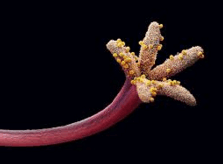
The part of the flower on which the pollen grains land.
a)
pistil
b)
stamen
c)
style
d)
stigma
25.

Which macromolecule is shown?
View Figure 1 (if not visible)
View Figure 1 (if not visible)
a)
lipid
b)
protein
c)
nucleic acid
d)
carbohydrate
26.

Which macromolecule is shown?
View Figure 2 (if not visible)
View Figure 2 (if not visible)
a)
lipid
b)
protein
c)
nucleic acid
d)
carbohydrate
27.

Which macromolecule is shown?
View Figure 3 (if not visible)
View Figure 3 (if not visible)
a)
lipid
b)
protein
c)
nucleic acid
d)
carbohydrate
28.
What is the monomer of a carbohydrate?
a)
Carbon, Hydrogen and Oxygen
b)
Carbon, Hydrogen, Oxygen and Nitrogen
c)
Monosaccharides
d)
Amino Acids
29.
What are the elements that make up our proteins ?
a)
Carbon, Hydrogen and Oxygen
b)
Carbon, Hydrogen, Oxygen and Nitrogen
c)
Monosaccharides
d)
Amino Acids
30.
Which organelle is incorrectly paired with its function.
a)
Nucleus- Control center.
b)
Ribosomes- DNA synthesis.
c)
Gogli Apparatus- packaging and transporting proteins
d)
Mitochondria- Cellular Respiration
100 %

