
 Worksheets
Marine Invertebrates
Total questions: 51
Worksheet time: 35mins
Name
Class
Date
1.

a)
A=stomach
B=anus
C=tube foot
D=radial canal
E=ring canal
F=mouth
G=digestive glands
B=anus
C=tube foot
D=radial canal
E=ring canal
F=mouth
G=digestive glands
b)
G=stomach
F=anus
D=tube foot
E=radial canal
E=ring canal
F=mouth
A=digestive glands
F=anus
D=tube foot
E=radial canal
E=ring canal
F=mouth
A=digestive glands
c)
B=stomach
A=anus
C=tube foot
D=radial canal
G=ring canal
F=mouth
G=digestive glands
A=anus
C=tube foot
D=radial canal
G=ring canal
F=mouth
G=digestive glands
2.
What does the term echinoderm mean?
a)
tube feet
b)
star shaped
c)
spiny skin
d)
stomach foot
3.
What type of symmetry do adult echinoderms exhibit?
a)
Asymmetry
b)
Pentaradial symmetry
c)
Bilateral symmetry
d)
Trilateral symmetry
4.
Echinoderms have an internal skeleton and a system of fluid-filled tubes called a(n)...
a)
water vascular system
b)
nervous system
c)
notochord
d)
ampulla
5.
What phylum do echinoderms belong to?
a)
Cnidaria
b)
Porifiera
c)
Echinodermata
d)
Chordata
6.
Which is an example of an Asteroidea member?
a)
sea star
b)
sea cucumber
c)
sea urchin
d)
sand dollar
7.
Which is an example of an Ophiuroidea member?
a)
basket star
b)
sea lily
c)
sea cucumber
d)
sea star
8.
Which side of the sea star is the top side?
a)
aboral surface
b)
oral surface
9.
Tiny pincers that surround the spines that help keep foreign objects off the sea star are called ________
a)
tube feet
b)
pedicellariae
c)
madreporite
d)
ampulla
10.

What echinoderm is this?
a)
sea lily
b)
sea urchin
c)
sea cucumber
d)
sand dollar
11.
Which is an example of an Echinoidea member?
a)
sea star
b)
sand dollar
c)
sea cucumber
d)
sea lilies
12.
all have radial symmetry
a)
univalve
b)
bivalve
c)
head-footed
d)
echinoderms
13.
Which part of the Mollusk body is specialized for burrowing, feeding, and movement?
a)
trochophores
b)
visceral mass
c)
mantle
d)
foot
14.
What type of symmetry do MOST mollusks have?
a)
Bilateral
b)
Radial
c)
Circular
d)
Asymmetrical
15.
Which class of Mollusks include clams, oysters, and mussels?
a)
Gastropods
b)
Bivalves
c)
Cephalopods
16.
Which class of Mollusks include squid, cuttlefish and octopus?
a)
Gastropods
b)
Bivalves
c)
Caphalopods
17.
Which class of Mollusks includes snails, slugs, or nudibranches?
a)
Cephalapods
b)
Bivalves
c)
Gastropods
18.
Which class of Mollusks include organisms that all have two shells?
a)
Gastropods
b)
Bivalves
c)
Cephalopods
19.
Which part of the Mollusk body is the tissue covering the body and secretes the shell?
a)
Mantle
b)
Trochophore
c)
Foot
d)
Visceral Mass
20.
Which part of the Mollusk body contains organs?
a)
Foot
b)
Visceral Mass
c)
Trochophore
d)
Mantle
21.
Which class of Mollusks include clams, oysters, and mussels?
a)
Gastropods
b)
Bivalves
c)
Cephalopods
d)
Arthropods
22.
All arthropods have segmented bodies, jointed appendages, and ________________.
a)
tails
b)
lungs
c)
wings
d)
an exoskelton
23.
Which of the following is a correct description of the polyp body form?
a)
It is sessile and the tentacles and mouth point downward.
b)
It is sessile and the mouth and tentacles point upward.
c)
It is mobile and the tentacles and mouth point downward.
d)
It is mobile and the tentacles and mouth point upward.
24.
Phylum Porifera is known as
a)
"stinging cells"
b)
"Tentacles"
c)
"Cleaners"
d)
"Sponges"
25.

To which group of mollusks does this animal belong?
a)
Class Gastropoda
b)
Class Bivalvia
c)
Class Cephalopoda
d)
Class Polyplacophora
26.

What type of symmetry do sponges (Porifera) have?
a)
asymmetry
b)
radial
c)
bilateral
d)
medial
27.
Phylum Cnidaria is known as
a)
"stinging cells"
b)
"Tentacles"
c)
"Cleaners"
d)
"Sponges"
28.
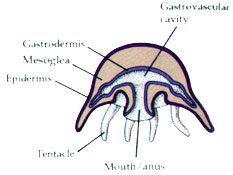
Which body form is represented by this diagram?
a)
Mesoglea
b)
Medusa
c)
Polyp
d)
Nematocyst
29.
Which of the following is an example of a crustacean?
a)
squid
b)
crab
c)
earth worm
d)
bumble bee
30.

Which is not a main class within the phylum of mollusca?
a)
crustacean
b)
cephalopod
c)
gastropod
d)
bivalve
31.

cells that make up pores all over the sponges body and allow water to enter the sponge.
a)
amoebocyte
b)
porocyte
c)
pinacocyte
d)
ostiocyte
32.

cells have sticky, funnel-shaped collar to collect food particles and a flagellum that creates a water current
a)
amoebocyte
b)
ostiocyte
c)
pinacocyte
d)
choanocyte
33.

large opening at the top of a sponge where water exits.
a)
ostia
b)
osculum
c)
orifice
d)
opening
34.

skeleton structures made of silica or calcium carbonate
a)
spicules
b)
spongin
c)
sessile
d)
something
35.
Asexual sponge reproduction where a piece of the adult sponge breaks off and settles in a new area growing to adulthood.
a)
broadcast spawning
b)
branching
c)
budding
d)
forcast spawning
36.
Which of the following is NOT a class of cnidarians?
a)
Mesoglea
b)
Anthozoa
c)
Scyphozoa
d)
Cubozoa
37.
When a jellyfish attacks its prey, it uses stinging cells called...
a)
Colloblasts
b)
Stingers
c)
Cnidocytes
d)
Blastoscytes
38.
What surrounds the mouth of cnidarians?
a)
arms
b)
combs
c)
tentacles
d)
spines
39.

What form is this organism?
a)
Polyp
b)
Medusa
c)
Comb jelly
d)
Coral
40.
What body form do members of Class Anthozoa have?
a)
medusa
b)
polyp
c)
medusa and polyp
d)
neither medusa nor polyp
41.

What is this organism? What Class does it belong to?
a)
jellyfish:scyphozoa
b)
Portuguese man-of-war:hydrozoa
c)
hydra:hydrozoa
d)
coral:anthozoa
42.
zooxanthellae are:
a)
a class of cnidarians
b)
microscopic algae that live symbiotically with corals
c)
the mesoglea of jellyfish
d)
microscopic plankton
43.
The body opening of a gastropod's shell is called the:
a)
aperture
b)
spiral whorl
c)
apex
d)
jumbo
44.
The bulge at the hinge end of a bivalve shell is called the:
a)
umbo
b)
aperture
c)
whorl
d)
rib
45.
Why do arthropods have to shed their exoskeletons?
a)
it wears out
b)
they don't shed
c)
it limits the size they can grow
d)
to go from water to land environments
46.
The only type of crustacean that attaches to a substrate and is not free-swimming is the
a)
copepod
b)
brine shrimp
c)
barnacle
d)
hermit crab
47.
What unique system of internal canals and external tube feet help starfish move and feed?
a)
spicules
b)
tentacles
c)
water vascular
d)
water recycling
48.
Cephalopods move quickly by
a)
using jet propulsion
b)
creeping on their muscular foot
c)
digging into the sand
d)
waving their tentacles to swim
49.
The function of the Mollusk's radula is to
a)
reproduce
b)
obtain food by scraping or tearing
c)
remove oxygen from the water
d)
remove ex
50.
How does a starfish obtain its food?
a)
diffusion across its skin
b)
By using a radula
c)
Dropping its stomach into its prey
d)
filter feeding
51.
What phylum are crustaceans a part of?
a)
Arachnids
b)
Arthropods
c)
Animals
d)
Invertebrates
100 %

