
 Worksheets
Geology
Total questions: 55
Worksheet time: 56mins
Name
Class
Date
1.
What is the correct order (starting from the surface) of Earth's layers?
a)
crust, outer core, inner core, mantle
b)
mantle, outer core, inner core, crust
c)
crust, mantle, outer core, inner core
d)
outer core, inner core, crust, mantle
2.

Layer 1 is the Earth's ______ core.
a)
Inner Core
b)
Outer Core
c)
Mantle
d)
Asthenosphere
3.

What is the thinnest layer of the earth?
a)
mantle
b)
inner core
c)
crust
d)
outer core
4.
The layer of liquid rock between the Earth's crust and core
a)
Inner Core
b)
Outer Core
c)
Crust
d)
Mantle
5.
What was the name given to all the continents when they were joined as one super continent?
a)
Supreme Continent
b)
Eurasia
c)
Plate tectonics
d)
Pangea
6.
Mountains form from ...
a)
plates sliding past one another
b)
collision of plates
c)
plates moving away from each other
7.
How many major rock types are there
a)
2
b)
4
c)
3
d)
5
8.
___________________ rock means FIRE and is formed from melted rock either from magma below Earth's crust or from lava above it
a)
sedmetary
b)
igneous
c)
metamorphic
d)
magma
9.
Sedimentary and igneous rocks go through _____________________________ to become metamorphic rocks.
a)
weathering and erosion
b)
heat and pressure
c)
compacting and cementing
d)
melting and cooling
10.
Lava which cools on Earth's surface forms an
a)
metamorphic rock
b)
intrusive igneous rock
c)
extrusive igneous rock
d)
foliated metamorphic rock
11.

Which type of rock is made from magma cooling inside Earth?
a)
cool rock
b)
igneous
c)
metamorphic
d)
sedimentary
12.

Which type of rock is made by small bits of rock, mud, or sand compacted and cemented together?
a)
coal
b)
igneous
c)
metamorphic
d)
sedimentary
13.
The process by which water, wind, ice, and changes in temperature break down rock into fragments called sediments.
a)
Deposition
b)
Erosion
c)
Weathering
d)
Igneous Rock
14.

What does it mean for a rock to be extrusive
a)
Have layers
b)
Have Rounded Edges
c)
Form from Lava
d)
Form By Sediment
15.
Alfred Wegener suggested continental drift caused a single large continent to break apart into smaller land masses millions of years ago. What modern theory has been developed to explain this process?
a)
The theory of gravity
b)
The theory of relativity
c)
The theory of plate tectonics
d)
The theory of evolution
16.

Name the boundary
a)
convergent boundary
b)
divergent boundary
c)
transform boundary
17.

Name the boundary
a)
convergent boundary
b)
divergent boundary
c)
transform boundary
18.
What is it called when one plate goes under another plate?
a)
submarine zone
b)
divergence zone
c)
subduction zone
19.
Mountains form from ...
a)
plates sliding past one another
b)
collision of plates
c)
plates moving away from each other
20.
Islands can be created by plate subduction and
a)
volcanic activity
b)
faults
c)
currents
21.
What are the two types of crust
a)
continental and oceanic
b)
ocean and upper
c)
lower and upper
d)
pizza and subway
22.

The four layers that make-up the earth’s composition are
a)
Crust,
Lithosphere, Mesosphere and Core
b)
Lithosphere,
Asthenosphere, Mantle and Core
c)
Crust,
Mantle, Outer Core and Inner Core
d)
Mantle,
Outer Core, Lithosphere and Crust
23.

Who is the person credited with developing the theory of continental drift?
a)
Harry Hess
b)
Galileo
c)
Alfred Wegener
d)
Newton
24.
What is molten rock that has formed deep within the Earth?
a)
Hot Spot
b)
Magma
c)
Lava
d)
Volcano
25.
What is molten rock that has reached the Earth's surface?
a)
Aa
b)
Lava
c)
Magma
d)
Pahoehoe
26.
What is the opening in Earth's crust through which molten rock, gases, and ash erupt?
a)
Divergent Boundary
b)
Magma
c)
Subduction Boundary
d)
Volcano
27.

What is Magma called when it reaches the surface of Earth?
a)
Lava
b)
Mafic Magma
c)
Felsic Magma
d)
None of these
28.

A volcano that has gentle sloping sides and is formed from runny lava
a)
Shield volcano
b)
Cinder cone
c)
Composite
d)
None of these
29.
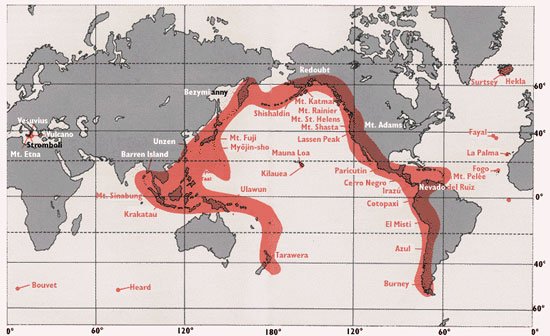
This is the name for the chain of volcanos around the edge of the Pacific Plate.
a)
Circle of Fire
b)
Ring of Lava
c)
Ring of Fire
d)
Circle of Magma
30.

How would you describe the magma below a volcano this?
a)
Thick and full of trapped gases
b)
Thick with no trapped gases
c)
Thin and Runny with lots of trapped gases
d)
Thin and Runny with no trapped gases
31.
The difference between magma and lava is _____
a)
where it is found (above or below the surface)
b)
how hot the molten rock is (lava is hotter than magma)
c)
the type of boundary where it forms
d)
the viscosity of the molten rock (lava has a lower viscosity)
32.
Where are most volcanoes found?
a)
Southern Hemisphere
b)
Ring of Fire
c)
Mid-Atlantic Ridge
d)
Hot Spots
33.

The movement of plates at a divergent boundary
a)
move towards each other
b)
slide past each other
c)
move up and down
d)
move away from each other
34.

Sand Andreas Fault formed at this type of boundary-
a)
Transform Boundary
b)
Convergent Boundary
c)
Divergent Boundary
d)
Hot Spot
35.

Himilayan Mountains because of:
a)
converging continent to continent
b)
an earthquake in subduction zone
c)
converging ocean to continent
d)
transformational
36.

This is an example of -
a)
convergent
b)
divergent
c)
transform
37.

This is an example of -
a)
convergent
b)
divergent
c)
transform
38.
The Great Rift Valley in Africa and the Mid-Ocean Ridge were all created by this boundary
a)
Divergent
b)
Convergent
c)
Reform
d)
Transform
39.
What was the name given to all the continents when they were joined as one super continent
a)
Supreme Continent
b)
N.A.S.E.A.A.A
c)
Wegener World
d)
Pangea
40.
Earth's crust is constantly being recycled. New crust is formed when molten rock comes to the surface and is cooled.
a)
True
b)
False
41.
What is a major geological event that occurs when plates shift suddenly and release stored energy?
a)
earthquakes
b)
volcanic eruptions
c)
divergent boundaries
42.
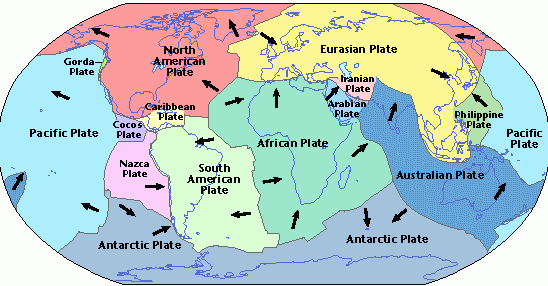
Many earthquakes happen along the borders of...
a)
Countries
b)
Tectonic Plates
c)
Climate Zones
d)
None of the above.
43.

Earthquakes happen every day. Most are too small for humans to notice.
a)
True
b)
False
44.
________________ measures the strength of an earthquake on a scale of 1-10.
a)
Seismometer
b)
Richter Scale
c)
Magnitude
d)
Seismology
45.

What are the three types of plate boundaries?
a)
Transform, Convergent, Divergent
b)
Apart, Together, Slide
c)
Slide, Pull away, Push together
46.
What are the 3 major types of rocks?
a)
Igneous, Metamorphic, Sedimentary
b)
Metamorphic, Igneous, Cementation
c)
Brown, Red, Gray
d)
Streak, Hardness, Breakage
47.
Two ways to describe types of igneous rocks are _____
a)
Extrusive and Intrusive
b)
Foliated and Non-Foliated
c)
Clastic and Biochemical
d)
Black and Gray
48.
Which of the words below describe mud, sand, and tiny bits of rocks that cement together to form a type of rock?
a)
stalactites
b)
magmas
c)
metamorphs
d)
sediments
49.
Extreme Heat and Pressure creates a _________ rock.
a)
Igneous
b)
Metamorphic
c)
Sedimentary
d)
Mineral
50.
What two processes make sediment?
a)
Melting
b)
Freezing
c)
Weathering & Erosion
d)
Heat & Pressure
51.

The melting of metamorphic or igneous rocks form what substance?
a)
Lave
b)
Magma
c)
Pebbles
d)
Sediment
52.

Which characteristic is found in sedimentary rocks?
a)
Crystals
b)
Fossils
c)
Gas bubbles
d)
Glassy surface
53.

What is represented by the picture?
a)
Sea-floor spreading
b)
Pangea
c)
How the continents are arranged today
d)
Volcanoes
54.

Name the boundary
a)
Divergent
b)
Convergent
c)
Transform
55.

Name the boundary
a)
Divergent
b)
Convergent
c)
Transform
100 %

