
 Worksheets
Physics Q1 Final
Total questions: 74
Worksheet time: 2hrs 13mins
Name
Class
Date
1.
Velocity
a)
Vector
b)
Scalar
2.
Speed
a)
Vector
b)
Scalar
3.
Acceleration
a)
Vector
b)
Scalar
4.
Force
a)
Vector
b)
Scalar
5.
Distance
a)
Vector
b)
Scalar
6.
Mass
a)
Vector
b)
Scalar
7.
Area
a)
Vector
b)
Scalar
8.
Displacement
a)
Vector
b)
Scalar
9.
Which statement describes a vector?
a)
It has magnitude but no direction
b)
It has direction but no magnitude
c)
It has both direction and magnitude
d)
It has constant magnitude but no
direction
direction
10.
Is this a scalar quantity or a vector quantity?
Wind blowing at 20 knots
Wind blowing at 20 knots
a)
Scalar
b)
Vector
11.
Is this a scalar quantity or a vector quantity?
A deer running 15 meters per second due west
A deer running 15 meters per second due west
a)
Scalar
b)
Vector
12.

How do you combine vectors if they are in the same direction?
a)
Add
b)
Subtract
c)
Pythagorean Theorem
d)
Use Trigonometry
13.

How do you combine vectors if they are in opposite directions?
a)
Add
b)
Subtract
c)
Pythagorean Theorem
d)
Use trigonometry
14.
Cole travels north 5 miles and then goes west 3 miles before coming straight back south 2 miles. What is his distance?
a)
10
b)
7
c)
8
d)
6
15.
Distance and direction of an object's change in position from a starting point
a)
displacement
b)
distance
c)
motion
d)
reference point
16.
Nayzett runs exactly 2 laps around a 400 meter track. What is the displacement?
a)
800
b)
400
c)
0
d)
200
17.
How far an object has moved?
a)
displacement
b)
distance
c)
motion
d)
reference point
18.
Mateo walks 3 km north, and then turns east and walks 4 km. What is the distance?
a)
7 km
b)
3 km
c)
4 km
d)
1 km
19.
Harper runs 2 miles south, then turns around and runs 3 miles north. What is her displacement?
a)
5 miles
b)
1 miles
c)
2 miles
d)
3 miles
20.
Samantha runs 30 feet north, 30 feet west, and then 30 feet south. What is the distance?
a)
90 feet
b)
30 feet
c)
60 feet
d)
0 feet
21.
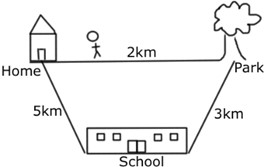
Joaquilya walked from home to school, then from the school to the park. What is her total distance?
a)
2 km
b)
5 km
c)
8 km
d)
10 km
22.
Joaquin walked from home to school, then from the school to the park. What is his total displacement?
a)
2 km
b)
5 km
c)
8 km
d)
10 km
23.

Which of the following describes distance and displacement correctly?
a)
The blue arrow shows distance and the orange arrows show displacement
b)
The blue arrow shows displacement and the orange arrows show distance
c)
Both arrows show distance only
d)
Both arrows show distance and displacement
24.
Can displacement be negative?
a)
Yes
b)
No
25.
Can distance be negative?
a)
Yes
b)
No
26.
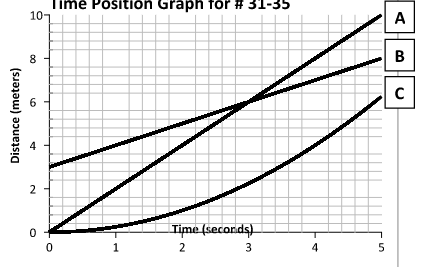
Which runner had a head start?
a)
A
b)
B
c)
C
27.

What is this graph showing?
a)
Constant Speed
b)
Acceleration (speeding up)
c)
Deceleration (slowing down)
d)
No motion
28.

Which runner won the race?
a)
A
b)
B
c)
C
29.
A car driving at 50 miles per hour drives for 2 hours. What distance did it cover?
a)
50 miles
b)
25 miles
c)
100 miles
d)
75 miles
30.
Velocity is
a)
speed
b)
direction
c)
speed with a direction
31.
A runner races in the 100 meter dash. It takes her 10 seconds to finish. What is her average speed?
a)
10 m/s
b)
1000 m/s
c)
100 seconds
d)
10 seconds
32.
What two measurements are necessary for calculating speed?
a)
Mass and time
b)
Temperature and mass
c)
Mass and distance
d)
Distance and time
33.

What kind of acceleration is shown here?
a)
positive
b)
negative
c)
none
d)
varies
34.

What kind of acceleration is shown here?
a)
positive
b)
negative
c)
none
d)
varies
35.

What is happening in this graph from point B to C?
a)
The object is going down a hill.
b)
The object is returning to its starting location.
c)
The object is slowing down.
d)
The object is staying still.
36.

What is happening in this graph from point A to B?
a)
The object is accelerating.
b)
The object is not moving.
c)
The object is decelerating.
d)
The object is moving at a constant speed.
37.
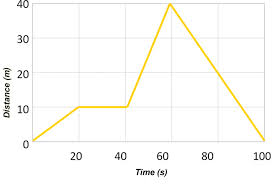
How long did it take this object to travel 10 m?
a)
0 s
b)
10 s
c)
15 s
d)
20 s
38.

How long did it take this object to travel back to its reference/starting point?
a)
20 s
b)
30 s
c)
60 s
d)
100 s
39.

At 60 seconds, how far had this object traveled?
a)
0 m
b)
10 m
c)
20 m
d)
40 m
40.

How many times does this object STOP moving?
a)
None
b)
Once
c)
Twice
d)
Three times
41.

The diagram shows a man using a rope to pull a cart. The man's pull on the handle of the cart
is a tension force that
is a tension force that
a)
has magnitude and direction
b)
has magnitude only
c)
has direction only
d)
has no magnitude nor direction.
42.
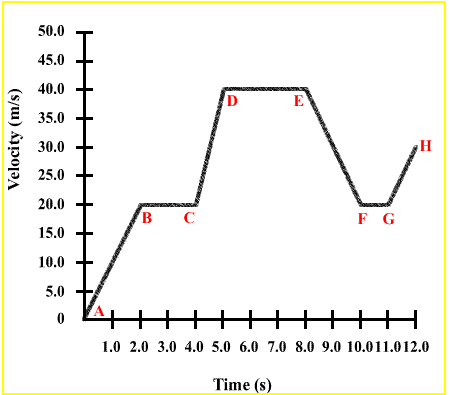
Which section of the graph shows constant velocity?
a)
AB
b)
BC
c)
EF
d)
GH
43.
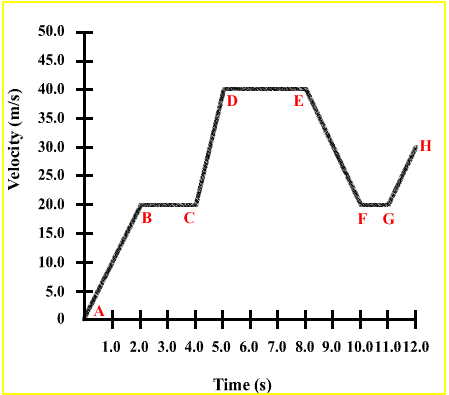
Which section of the graph shows acceleration?
a)
AB
b)
BC
c)
EF
d)
FG
44.

Which section of the graph shows deceleration?
a)
AB
b)
BC
c)
EF
d)
GH
45.

Which section of the graph shows increasing velocity?
a)
AB
b)
BC
c)
DE
d)
EF
46.

Which graph represents zero acceleration (constant velocity)?
a)
A
b)
B
c)
C
d)
D
47.

"For every action, there is an equal and opposite reaction."
a)
Newton's 1st Law
b)
Newton's 2nd Law
c)
Newton's 3rd Law
d)
Newton's 4th Law
48.

Force = Mass x Acceleration
a)
Newton's 1st Law
b)
Newton's 2nd Law
c)
Newton's 3rd Law
d)
Newton's 4th Law
49.

"An object in motion (or at rest) will to stay in motion (or at rest) until an outside force acts upon it."
a)
Newton's 1st Law
b)
Newton's 2nd Law
c)
Newton's 3rd Law
d)
Newton's 4th Law
50.

The tendency of an object to resist changes in its motion is...
a)
inertia
b)
force
c)
acceleration
d)
velocity
51.

The tendency of a moving object to resist changes in its motion is...
a)
momentum
b)
force
c)
acceleration
d)
velocity
52.

Any push or pull on an object.
a)
force
b)
velocity
c)
inertia
d)
momentum
53.

The force that opposes motion between two surfaces in contact with each other.
a)
inertia
b)
friction
c)
momentum
d)
gravity
54.

The force of attraction between all matter.
a)
inertia
b)
friction
c)
net force
d)
gravity
55.

A force that opposes motion between a surface in contact with the atmosphere.
a)
air resistance
b)
gravity
c)
momentum
d)
terminal velocity
56.

When all the forces on an object are equal and opposite, & the net force is zero, that's...
a)
balanced forces
b)
unbalanced forces
c)
terminal velocity
d)
reaction forces
57.

The combination of all the forces acting on an object is the...
a)
net force
b)
action force
c)
reaction force
d)
balance force
58.

An archer pulls the bowstring back, then releases the string and the arrow flies forward. Pulling the string back is the...
a)
action force
b)
reaction force
c)
net force
d)
inertia
59.

An archer pulls the bowstring back, then releases the string and the arrow flies forward. The arrow flying forward is the...
a)
action force
b)
reaction force
c)
net force
d)
inertia
60.
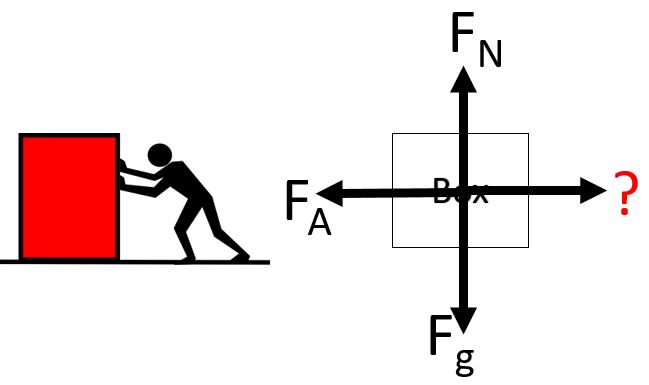
Name the missing force...
a)
frictional force
b)
weight force
c)
thrust
d)
buoyant force
61.

Name the missing force...
a)
normal force
b)
applied force
c)
frictional force
d)
tension force
62.

Name the missing force...
a)
applied force
b)
weight force
c)
tension force
d)
drag
63.
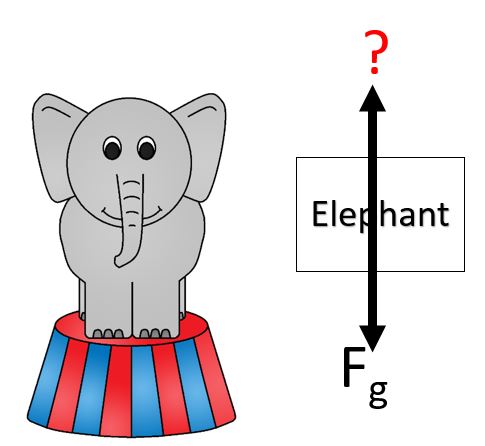
Name the missing force...
a)
weight force
b)
normal force
c)
applied force
d)
frictional force
64.

What is the net force?
a)
5000 N right
b)
4000 N right
c)
40 N left
d)
4000 N left
65.

What is the net force in this diagram?
a)
8N right
b)
2 N right
c)
8N left
d)
2N left
66.
What is the net force of an object that is not moving?
a)
0N
b)
100N
c)
Upward force
67.

Forces that have a net force of zero ( the object is still).
a)
Balanced force
b)
Unbalanced force
68.
If there are two forces going in the same direction how would you find the net force?
a)
Subtract
b)
Add
c)
Neither
d)
Multiply
69.

Calculate the net force acting upon the object.
a)
10 N north
b)
10 N south
c)
14.1 N east
d)
0 N
70.

Calculate the net force acting upon the object.
a)
10 N north
b)
20 N south
c)
10 N south
d)
22.4 N north
71.

Calculate the net force acting upon the object.
a)
10 N east
b)
0 N
c)
14.1 N east
d)
20 N north
72.

Calculate the net force acting upon the object.
a)
0 N
b)
32 N northeast
c)
8.5 N southeast
d)
12 N southwest
73.

Calculate the net force acting upon the object.
a)
8.5 N southeast
b)
12 N southeast
c)
0 N
d)
17.7 N east
74.

a)
1.)
A surf boarder, on his surfboard, is coasting to the right sliding
into a sandy beach.
b)
1.)
A motorcycle is driving at a constant velocity down the highway.
c)
1.)
A dog is pulling on his leash, dragging his small owner across the
porch.
d)
1.)
A bowl of tomatoes is resting on the kitchen counter.
100 %

