
 Worksheets
Unit 2B R1
Total questions: 38
Worksheet time: 38mins
Name
Class
Date
1.
Why is July 4, 1776 an important date in U.S. history?
a)
Common Sense was published.
b)
The Olive Branch Petition sent to King George III.
c)
The American Revolution ends.
d)
The Declaration of Independence is signed.
2.

Why was the Declaration of Independence written?
a)
To stop taxes from the British Empire.
b)
To make a United States army.
c)
To gain independence from the British Empire
d)
To install their own king in America
3.
The List of Grievances were the part of the Declaration that
a)
detailed the colonists' complaints with King George.
b)
listed a man's natural rights.
c)
introduced the Declaration.
d)
concluded the Declaration, declaring America a free country.
4.
Who was the main author of the Declaration of Independence?
a)
Benjamin Franklin
b)
Samuel Adams
c)
Thomas Jefferson
d)
Paul Revere
5.

What are our natural rights according to Jefferson? (He got the idea from John Locke, but he changed the last right.)
a)
Freedom of speech, religion, and press
b)
Life, liberty, and property
c)
Life, liberty, and the pursuit of happiness
d)
Voting, rebelling, and health
6.
What document says, "We hold these truths to be self evident..."
a)
Magna Carta written by the king
b)
Declaration of Independence written by the king
c)
Declaration of Independence written by Jefferson
d)
Common Sense written by Thomas Paine
7.
Which French nobleman enlisted in the Continental Army, became an aide to General Washington, and was present at Valley Forge, and even gave his own money to help finance the war?
a)
Henry Knox
b)
the Marquis de Lafayette
c)
Alexander Hamilton
d)
Baron Friedrich von Steuben
8.
What did George Washington read to his men at Valley Forge to encourage them to get through the difficult winter?
a)
Common Sense by Thomas Paine
b)
The Crisis by Thomas Paine
c)
The Declaration of Independence by Thomas Jefferson
d)
The letters that Abigail Adams asked him to take to her husband, John Adams.
9.

Who was the author of the essay read at Valley Forge to drum up support for the Continental Army
"These are the times that try men's souls..."
"These are the times that try men's souls..."
a)
Thomas Jefferson
b)
Thomas Paine
c)
John Locke
d)
John Adams
10.
Which of the following was a hardship faced by the soldiers at Valley Forge?
a)
Lack of food
b)
Lack of good shelter
c)
Disease
d)
All of the above
11.
Who was the Commander of the Continental Army commissioned by the Continental Congress?
a)
Lord Cornwallis
b)
Marquis de Lafayette
c)
George Washington
d)
Samuel Adams
12.
The colonists tried to stall the British to hide their weapons. This battle is often called "The Shot Heard Round the World".
a)
Battle of Concord
b)
Battle of Lexington
c)
Battle of Trenton
d)
Battle of Yorktown
13.
This battle was the turning point of the war-from this point on the colonists were winning. This battle also convinced France and Spain to help support us in the war. This battle was also the first time that the Continental Army shot officers in battle.
a)
Battle of Yorktown
b)
Battle of Saratoga
c)
Battle of Trenton
d)
Battle of Bunker Hill
14.
What was NOT an advantage the colonists had during the war>
a)
They cared about their cause
b)
A strong navy
c)
Home field advantage-they know the land
d)
Better war tactics-snipers, guerilla warfare
15.
What is the correct order of the Battles in the Revolutionary War?
a)
Lexington, Concord, Bunker Hill, Trenton, Saratoga, Yorktown
b)
Concord, Bunker Hill, Lexington, Trenton, Saratoga, Yorktown
c)
Yorkown, Saratoga, Trenton, Lexington, Concord, Bunker Hill,
d)
Saratoga, Bunker Hill, Trenton, Yorktown, Lexington, Concord
16.
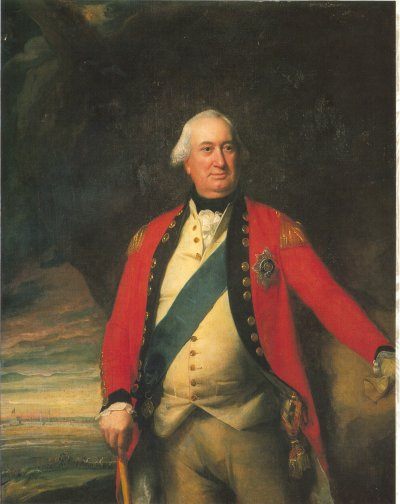
General Cornwallis surrenders to General Washington during this battle
a)
Yorktown
b)
Lexington and Concord
c)
Saratoga
d)
Bunker Hill
17.
All of the following are conditions of the Treaty of Paris EXCEPT:
a)
British would continue to make laws for the United States.
b)
British recognized the U.S. as an independent country.
c)
Britain had to give the Americans the land from the Atlantic Coast to the Mississippi River.
d)
The U.S. had to return all property that had been taken during the war to the Loyalists.
18.
At the Seige of Yorktown, who was helping the Americans surround the British
a)
The French
b)
the Spanish
c)
No one, just the Americans
19.
Why couldn't the British escape by land?
a)
they were surrounded by enemies
b)
They didn't have enough horses
c)
Their roads weren't good enough
d)
it would have been to much work
20.
What was the turning point in the American Revolution?
a)
Lexington Concord
b)
Saratoga
c)
Yorktown
d)
Valley Forge
21.
What was the place in the American Revolution where the Patriots and George Washington had to overcome disease and smallpox?
a)
Lexington Concord
b)
Saratoga
c)
Yorktown
d)
Valley Forge
22.
In the phrase "consent of the governed," the word consent means
a)
permit
b)
to play
c)
permission
23.
Which of the following provided military support during the Revolution?
a)
Haym Solomon
b)
John Adams
c)
James Armistead
d)
Thomas Jefferson
24.
Which title would best fit this list of people:
King George III
Thomas Jefferson
John Adams
King George III
Thomas Jefferson
John Adams
a)
Key Military Individuals of the American Revolution
b)
Founding Fathers
c)
Important Political People During the Revolutionary Era
d)
Dudes Who Bore Me
25.
Who was a patriot and a states' rights advocate who stated -
"Give me liberty or give me death"?
"Give me liberty or give me death"?
a)
George Washington
b)
Patrick Henry
c)
Thomas Paine
d)
John Paul Jones
26.
Free black who rode all night to warn of British invasion
a)
Crispus Attucks
b)
Wentworth Cheswell
c)
James Armistead
d)
Paul Revere
27.
How did the Battles of Lexington and Concord change the situation between the British and the Americans?
a)
Americans now knew they could stand firm against the British
b)
Americans were hopeless and did not think they could beat the British
c)
King George was scared of the Americans now and wanted to get all his soldiers out of America
d)
The British and King George now wanted to establish peace with the colonists and do whatever they wanted them to do
28.
What is the meaning of the word minuteman?
a)
Were born in a minute or under
b)
Only last one minute in battle
c)
Can gather together at a minutes notice
d)
Understand what a minute is
29.

Who was the King of England who the colonies wanted independence from?
a)
King William
b)
King George III
c)
George Washington
d)
King Henry VIII
30.
Who is considered the "Father of the Navy"?
a)
John Paul Jones
b)
John Smith
c)
Wentworth Cheswell
d)
John Adams
31.

Paul Revere is most famously known for his midnight ride to warn the colonists that the British were coming. However, he was caught before he could complete the mission.
a)
True
b)
False
32.
What country became an American ally after the victory at Saratoga?
a)
Germany
b)
Ireland
c)
France
d)
Mexico
33.
What was NOT part of the Treaty of Paris?
a)
America gained the land East of the Mississippi River
b)
Loyalists were given back their land and rights
c)
Britain had to pay America for the cost of the war
d)
America was given its independence
34.
Most people at the beginning of the war were
a)
Loyalists
b)
Patriots
c)
Unsure
35.
Who negotiated an alliance with France to help America win the war?
a)
Lafayette
b)
Jefferson
c)
Franklin
d)
King George
36.
Washington probably would have won more early battles if....
a)
he had been a better leader
b)
he had a more stable and better trained army
c)
he had used spy tactics
d)
he had more military experience
37.
The battle of Bull Run
a)
proved it would be a long war because both sides were determined to win.
b)
was the final battle of the war.
c)
was the turning point of the war.
d)
was when everyone looked at the whites of each others' eyes.
38.
Which of the following words mean "an effort to cut off supplies"?
a)
embargo
b)
blockade
c)
siege
d)
battle
100 %

