
 Worksheets
Solar System
Total questions: 67
Worksheet time: 56mins
Name
Class
Date
1.

The __________ has planets, moons, comets, and asteroids.
a)
solar system
b)
Earth
c)
rotation
d)
United States
2.
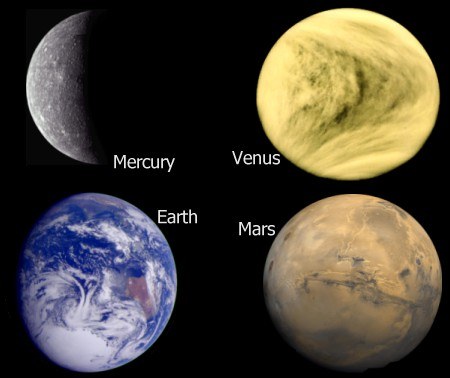
Earth and the other planets closest to the Sun are made mostly of _______
a)
gas
b)
metal
c)
water
d)
rock
3.

The moon is a natural ______ of Earth.
a)
comet
b)
axis
c)
satellite
d)
space probe
4.

Earth's ________ on its axis causes day and night.
a)
rotation
b)
revolution
c)
phase
d)
comet
5.

One full orbit of an object around another object is called a ________.
a)
axis
b)
rotation
c)
revolution
d)
satellite
6.

Which planet is covered in water?
a)
Mercury
b)
Venus
c)
Earth
d)
Mars
7.

Mercury, Venus, Earth and Jupiter are the inner planets
a)
True
b)
False
8.

The order of the planets is:
a)
Mars,Venus,Earth,
Mercury,Saturn
Jupiter, Uranus, Neptune
Mercury,Saturn
Jupiter, Uranus, Neptune
b)
Earth,Venus,Mars
Jupiter, Neptune,
Mercury,Saturn,
Uranus
Jupiter, Neptune,
Mercury,Saturn,
Uranus
c)
Mercury,Venus,Earth
Mars,Jupiter,
Saturn,Uranus
Neptune
Mars,Jupiter,
Saturn,Uranus
Neptune
9.

What is NOT a common characteristic of the outer planets?
a)
Gaseous
b)
Giant
c)
Rings
d)
Smaller than Earth
10.

Which planet is the largest?
a)
Jupiter
b)
Saturn
c)
Uranus
d)
Neptune
11.

True or False
The Earth is the center of the solar system.
The Earth is the center of the solar system.
a)
True
b)
False
12.

Which season is taking place in the Northern Hemisphere in Position 3?
a)
Winter
b)
Spring
c)
Summer
d)
Fall
13.

Which season is taking place in the Southern Hemisphere in Position 1?
a)
Winter
b)
Spring
c)
Summer
d)
Fall
14.

Which of the following list include all the 4 outer planets ?
a)
Mars, Saturn, Uranus, and Neptune
b)
Saturn, Uranus, Neptune, Pluto
c)
Jupiter, Saturn, Uranus, Neptune
d)
Venus, Jupiter, Uranus, Nepturne
15.

What Moon phase is this?
a)
Full Moon
b)
Waxing Gibbous
c)
New Moon
d)
Half Moon
16.

Which planet has the biggest rings?
a)
Jupiter
b)
Saturn
c)
Uranus
d)
Neptune
17.

What eclipse is shown here?
a)
Solar Eclipse
b)
Lunar Eclipse
18.

What eclipse is shown here?
a)
Solar
b)
Lunar
19.

What do all outer planets have in common?
a)
They were discovered with telescopes
b)
They are named for presidents
c)
They have multiple natural satellites
d)
They have solid rocky surfaces
20.

Which planet(s) are not part of the outer planets?
a)
Gas giants
b)
Jupiter
c)
Uranus
d)
Mars
21.

Which Planet is not a terrestrial planet?
a)
Jupiter
b)
Mars
c)
Venus
d)
Earth
22.

What object is at the center of our solar system?
a)
Jupiter
b)
Oort cloud
c)
Kuiper belt
d)
The Sun
23.

What object is not in our solar system?
a)
The Sun
b)
Andromeda Galaxy
c)
Asteroid Belt
d)
Pluto
24.

Mars is known as the _____ planet.
a)
lonely
b)
red
c)
party
d)
brown
25.

I am the brightest of the planets, and am 2nd from the sun. Who am I?
a)
Earth
b)
Mars
c)
Venus
d)
Saturn
26.

What do scientists use to study stars and planets?
a)
telephone
b)
telescope
c)
microscope
d)
magnifying glass
27.

What does the earth do on its axis?
a)
twist
b)
revolve
c)
bounce
d)
tilt
28.

Which letter or letters represent daytime on Earth?
a)
B
b)
C
c)
B and C
d)
A and B
29.

The planet spins around an imaginary line called its _____.
a)
satellite
b)
axis
c)
equator
d)
revolution
30.

What is The Solar System
a)
All of the planets,stars,and other objects in spaces
b)
Simpsons House
c)
The outermost part of the sun
d)
The moon's satellite
31.

Which planets are terrestrial planets
a)
Inner planets
b)
Outer planets
c)
Both
d)
Asteroid belt
32.

What is located between the inner and outer planets.
a)
Sun
b)
Asteroid belt
c)
Uranus
d)
Moons
33.

An ice ball that has a very long elliptical orbit is called a _________.
a)
phase
b)
asteroid
c)
axis
d)
comet
34.

The most common place to find an ________ is between Mars and Jupiter.
a)
Asteroid
b)
Satellite
c)
Moon
d)
Comet
35.

What is the red planet?
a)
Earth
b)
Mars
c)
Jupiter
36.

Does the sun make energy?
a)
Yes
b)
No
37.

What kind of object is in the center of our solar system?
a)
The planet Earth is at the center of our solar system.
b)
The moon is at the center of our solar system.
c)
The sun is in the center of our solar system.
38.

Which sentence uses the word orbit correctly?
a)
An orbit is a planet.
b)
The Earth orbits around the sun.
c)
An orbit is a star.
39.

The inner planets are made mostly of........
a)
rock and metal.
b)
grass and dirt.
c)
water and gas.
40.

How many planets are in our solar system?
a)
There are 5 planets in our solar system.
b)
There are 10 planets in our solar system.
c)
There are 8 planets in our solar system.
41.

What are the outer planets made out of?
a)
They are made out of gases.
b)
They are made out of fire.
c)
They are made out of rocks.
42.

Why is Mercury such a hot planet?
a)
Mercury is made of gas.
b)
Mercury is closest to the sun.
c)
Mercury is made of hot water.
43.

Why do we have day and night?
a)
Because the earth revolves around the sun.
b)
Because the sun revolves around the earth
c)
Because the earth rotates on an axis
d)
Because sun rotates on an axis
44.

What is the largest planet in the solar system?
a)
Earth
b)
Mars
c)
Jupiter
45.

Who was the first man to walk on the moon?
a)
Mr. Crab
b)
Neil Armstrong Jr.
c)
Ken Wise
46.

What do you call a large chunk of rock or metal that orbits the sun?
a)
Asteroid
b)
Meteoroid
c)
Meteorite
47.

Which planet is farthest from the sun?
a)
Neptune
b)
Saturn
c)
Uranus
48.

What is the third planet from the sun?
a)
Earth
b)
Venus
c)
Mars
d)
the Moon
49.

Which 2 planets are in between the sun and Earth?
a)
Mars and Jupiter
b)
Saturn and Uranus
c)
Neptune and Mercury
d)
Mercury and Venus
50.

How is the Earth different from all of the other planets?
a)
It has a rocky surface.
b)
It has a breathable atmosphere.
c)
It rotates on its axis.
d)
It is warmed by the sun.
51.

What is a terrestrial planet made of?
a)
metals and moons
b)
moons and rocks
c)
gases and heat
d)
rocks and metals
52.

What is the speed of light?
a)
300,000 mi/hr
b)
300,000 km/sec
c)
300,000 mi/min.
d)
1,000,000,000
53.

Day = Night
a)
Summer
b)
Equinox
c)
Solstice
d)
August 20
54.

The Moon's _________ causes _________ on Earth.
a)
tides, gravity
b)
reflection, blindness
c)
gravity, tides
d)
light, heat
55.

Which planet is the hottest planet in the Solar System?
a)
Mercury
b)
Mars
c)
Venus
d)
Earth
56.

This planet is known for its beautiful rings.
a)
Venu
b)
Uranus
c)
Neptune
d)
Saturn
57.

Which planet is the coldest?
a)
Neptune
b)
Saturn
c)
Earth
d)
Antarctica
58.

Which planet has the most mass?
a)
Saturn
b)
Jupiter
c)
Mars
d)
Earth
59.

Which planet is the smallest?
a)
Mars
b)
Neptune
c)
Mercury
d)
Earth
60.

The path a planet takes as it revolves around the sun is called its
a)
rotation.
b)
phase.
c)
orbit.
d)
trail.
61.

The Earth revolves around the sun. It takes about ________ for the Earth to complete one revolution.
a)
28 days
b)
365 days
c)
24 hours
d)
3 years
62.

The Earth rotates (spins) on its axis. It takes about ______ for the Earth to complete one rotation.
a)
24 hours
b)
28 days
c)
a week
d)
365 days
63.

The Earth's revolution around the sun gives us _____.
a)
day and night
b)
weeks
c)
years
d)
months
64.

The force that keeps the planets in orbit is _____.
a)
friction
b)
sunlight
c)
gravity
d)
static electricity
65.
The correct order of the planets is _____.
a)
Jupiter, Saturn, Uranus, Neptune, Mercury, Venus, Earth, Mars
b)
Mars, Venus, Earth, Mercury, Jupiter, Saturn, Uranus, Neptune
c)
Earth, Mars, Mercury, Venus, Jupiter, Saturn, Neptune, Uranus
d)
Mercury, Venus, Earth, Mars, Jupiter, Saturn, Uranus, Neptune
66.

How many degrees is the Earth tilted on its axis?
a)
23.5
b)
32.5
c)
53.2
d)
35.2
67.

A solar eclipse occurs when
a)
the moon is in the Earth's shadow
b)
the Moon is out of alignment with the Earth and the Sun
c)
the Sun is covered by the Moon
d)
the Sun is out of alignment with the Moon and the Earth
100 %

