wayground logo

Free Printable Worksheets

NEW

Font size

S
M
L
XL
Worksheets

Cellular Energy: Photosynthesis & Cellular Respiration

Total questions: 35

Worksheet time: 1hrs 8mins

Name
Class
Date
1.
Which gas is removed from the atmosphere during photosynthesis?
a)
hydrogen
b)
oxygen
c)
nitrogen
d)
carbon dioxide
2.
What are the products of photosynthesis?
a)
water and carbon dioxide
b)
oxygen and glucose
c)
oxygen and carbon dioxide
d)
oxygen and water
3.
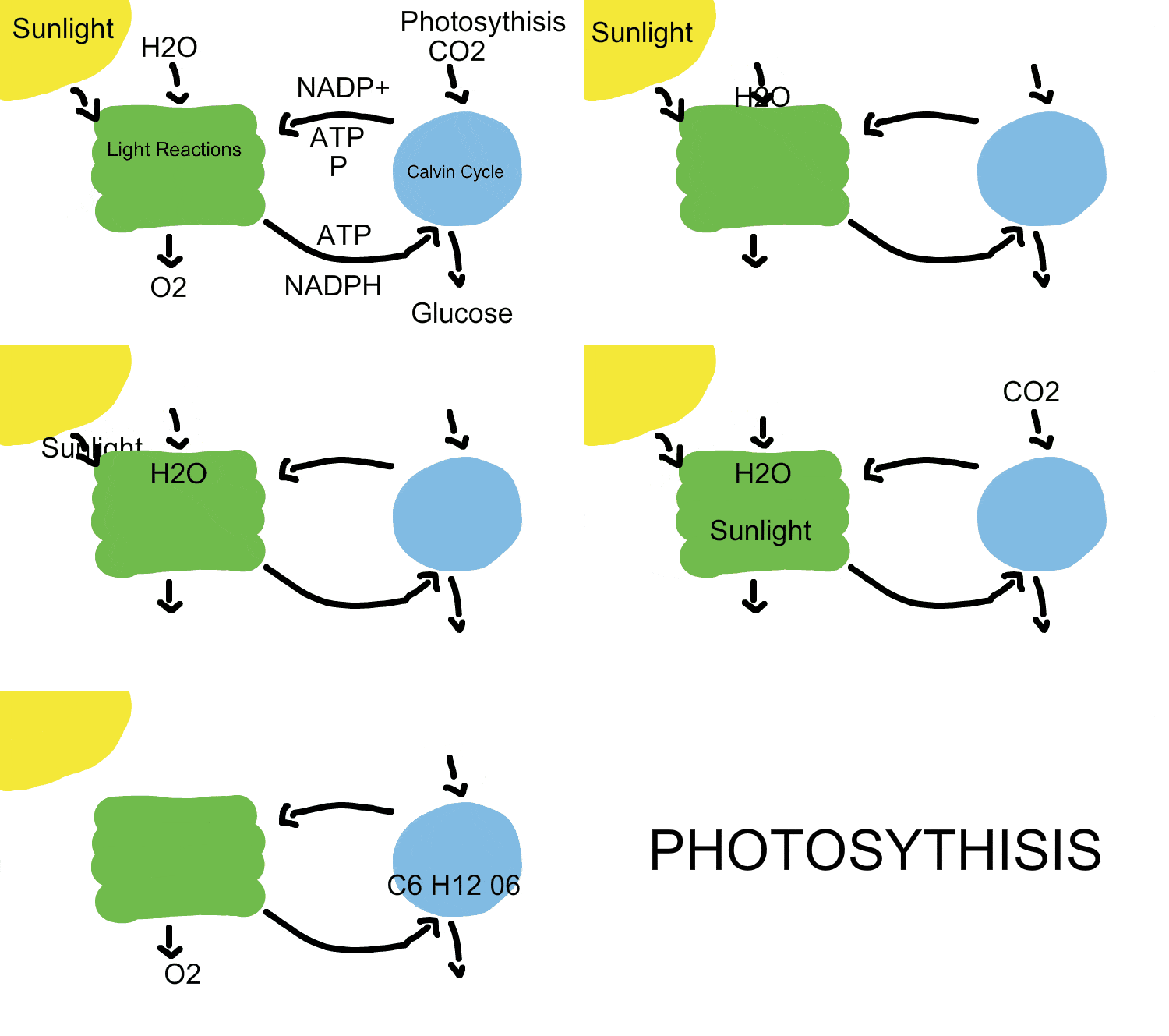
Which organelle performs PHOTOSYNTHESIS?
a)
Chloroplast
b)
Mitochondria
c)
Leaf
d)
Cell membrane
4.

The main source of energy for living things can be traced back to

a)

the earth

b)

Oxygen

c)

the sun

d)

Glucose

5.
Chlorophyll absorbs a higher percentage of _____ and _______ light.
a)
purple and green
b)
red and blue
c)
black and orange
d)
yellow and green
6.
Which of the following is the correct equation for PHOTOSYNTHESIS?
a)
6CO2 + 6H2O --> 6O+ C6H12O6
b)
6CO+ C6H12O6 + 6H2O --> O
c)
6O2 + 6H2O --> 6CO+ C6H12O6
d)
C6H12O6 + 6O2 ---> 6H2O + 6CO2 
7.

Which of the following is NOT a product of the light-dependent reactions?

a)

ATP

b)

NADPH

c)

Oxygen

d)

Glucose

8.
Which substance from the light-dependent reactions of photosynthesis is a source of energy for the light-independent reactions?
a)
ADP
b)
Oxygen
c)
NADPH
d)
Carbon dioxide
9.

Most plants appear green because chlorophyll

a)

absorbs green light.

b)

absorbs violet light.

c)

reflects green light.

d)

does not absorb violet light.

10.

Plants need carbon dioxide from their environment to produce glucose. During which stage of photosynthesis is carbon dioxide used to make glucose?

a)

The light-dependent reactions

b)

The light-independent reactions (The Calvin Cycle)

11.
Which of the following best describes photosynthesis?
a)
Photosynthesis converts light energy into chemical energy.
b)
Photosynthesis breaks down glucose.
c)
Photosynthesis creates energy
d)
Photosynthesis uses up energy to make glucose.
12.

Which product is produced during the light-dependent reactions?

a)

water

b)

oxygen

c)

glucose

d)

carbon dioxide

13.
What happens to glucose once it is produced by plants?
a)
It can be stored in the form of starch 
b)
It can be broken down through cellular respiration
c)
It can be used to build new cells and plant structures
d)
All of these are uses of glucose
14.
Which of these is NOT A TRUE statement about why photosynthesis is important:
a)
It transforms the sun's energy and makes it available for all living things
b)
It produces oxygen for us to breath
c)
It helps make food for the rest of the food chain
d)
It makes the carbon dioxide for our planet
15.
Glucose is broken down during which process
a)
Krebs cycle
b)
Calvin cycle
c)
Glycolysis
d)
ETC
16.
Bacteria that produce food from hydrogen sulfide where no light is available are called
a)
Photoautotrophs
b)
Chemoautotrophs
c)
Heterotrophs
d)
Decomposers
17.
What is cellular respiration?
a)
the breakdown of glucose to release energy and transfer it into ATP
b)
transferring energy from the sun into chemical energy within glucose
c)
the breakdown of oxygen to release energy
d)
the formation of glucose
18.
Which of the following is a product of the Krebs Cycle?
a)
glucose
b)
carbon dioxide
c)
water
d)
pyruvate
19.
This molecule stores energy in a form that cells can use directly
a)
ATP
b)
NADH
c)
FADH2
d)
glucose
20.
Which step of cellular respiration makes the most ATP?
a)
Glycolysis
b)
Krebs Cycle
c)
Electron Transport Chain
d)
Light Dependent Reactions
21.
Using the figure, which parts of the molecule must the bonds be broken to form an ADP molecule?
a)
Between A and B
b)
Between B and C
c)
Between C and D
d)
all of the above
22.
This process does not make ATP alone, but it allows glycolysis to continue making ATP when oxygen is unavailable for cellular respiration.
a)
Fermentation
b)
Electron Transport Chain
c)
Glycolysis
d)
Kreb's cycle
23.
Which statement best compares aerobic and anaerobic respiration? 
a)
Less ATP is generated during anaerobic respiration than during aerobic respiration. 
b)
More water is generated during anaerobic respiration than during aerobic respiration. 
c)
More oxygen is generated during anaerobic respiration than during aerobic respiration. 
d)
Less lactic acid is generated during anaerobic respiration than during aerobic respiration. 
24.
_______ energy is converted into ________ energy during cellular respiration.
a)
chemical, chemical
b)
light, chemical
c)
chemical, light
d)
light, light
25.

Some organisms, such as yeast, continue to break down glucose and make ATP in environments where there is no oxygen through the process of

a)

aerobic respiration

b)

anaerobic respiration

c)

photosynthesis

d)

chemosynthesis

26.
Which statement best describes the interdependence of photosynthesis and cellular respiration? 
a)
the products of photosynthesis are carbon dioxide and water and these are used in cellular respiration 
b)
the reactants of photosynthesis are the reactants of cellular respiration 
c)
the products of photosynthesis are sugar and oxygen and are used in cellular respiration 
d)
the products of photosynthesis are the products of cellular respiration 
27.
Photosynthesis and cellular respiration occur within a plant cell. How are the energy transformations in these two processes related? 
a)
cellular respiration traps solar energy for use in photosynthesis
b)
photosynthesis produces glucose that the cells use for cellular respiration 
c)
photosynthesis transfers solar energy to cellular respiration for glucose production 
d)
cellular respiration occurs only during the daytime and allows photosynthesis to occur at night 
28.
When muscles work at their maximum ability, blood flow is often unable to provide enough oxygen to continue to produce ATP. Which process allows muscles to continue ATP production in this situation? 
a)
beta oxidation 
b)
aerobic respiration 
c)
lactic acid fermentation 
d)
alcoholic fermentation 
29.
Two different species of bacteria are examined. Scientists find that species X always produces CO2 and H2O during cellular respiration. Species Y always produces ethyl alcohol and CO2. Which conclusion can be made from these observations?
a)
Only species Y is aerobic.
b)
Only species Y is anaerobic
c)
Both species X and Y are aerobic.
d)
Both species X and Y are anaerobic.
30.
After the Krebs Cycle only a small portion of the energy of glucose has been converted to ATP. At this point the majority of usable energy is contained in
a)
NADH and FADH2
b)
Carbon Dioxide 
c)
Pyruvate
d)
Glucose
31.
A heterotroph is
a)
an organism that must eat other organisms for energy
b)
an organism that makes its own food
c)
a plant
d)
an organism that has cells with chloroplasts
32.
An autotroph is...
a)
An organism that makes its own food
b)
An organism that gets its food from other living organisms
33.
Autotrophs that convert light energy into chemical energy are called _____________.
a)
Photoautotrophs
b)
Chemoautotrophs
c)
Heterotrophs
d)
Omnivores
34.
True or false: All autotrophs make food through the process of photosynthesis
a)
True
b)
False
35.
Glcolysis, Kreb´s Cycle, and the ETC all involve
a)
the production of ATP
b)
the production of carbon dioxide
c)
the production of water
d)
the production of glucose