
NEW
Font size
S
M
L
XL
 Worksheets
Digestion and Excretion
Total questions: 29
Worksheet time: 16mins
Name
Class
Date
1.
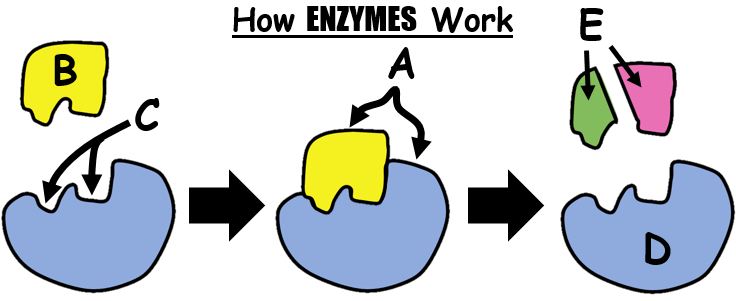
In the diagram, what is letter A?
a)
product
b)
substrate
c)
enzyme-substrate complex
d)
active site
2.
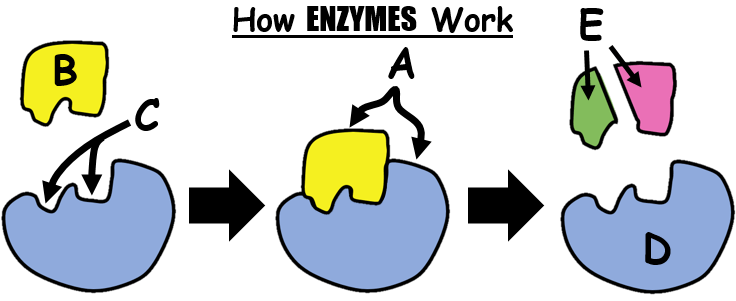
Letter C...
a)
active site
b)
enzymes
c)
substrate
d)
products
3.

As waste moves through the digestive system, the ______ absorbs water before storing waste in the rectum.
a)
Small intestine
b)
Stomach
c)
Esophagus
d)
Large intestine
4.

The part of the digestive system which is highlighted represents:
a)
Oesophagus
b)
Small intestine
c)
Stomach
d)
Trachea
5.

Identify
a)
Large Intestine
b)
Small Intestine
c)
Stomach
d)
Rectum
6.

Bile is made by which digestive organ?
a)
Gallbladder
b)
Stomach
c)
Rectum
d)
Liver
7.

Which digestive organ makes digestive juices to help the small intestine absorb nutrients?
a)
Liver
b)
Gallbladder
c)
Pancreas
d)
Esophagus
8.

Bile is stored in which secondary digestive organ?
a)
Stomach
b)
Liver
c)
Gallbladder
d)
Pancreas
9.
Chewed food mixed with gastric juice is known as...
a)
Bolus
b)
Chyme
c)
Renin
d)
Villi
10.
What structures in the small intestines makes absorption of nutrients possible?
a)
Duodenum
b)
Colon
c)
Sigmoid
d)
Villi
11.
Which of the following is NOT an accessory organ?
a)
liver
b)
gallbladder
c)
pancreas
d)
duodenum
12.
The jejunum is part of this structure:
a)
large Intestine
b)
Stomach
c)
Small Intestine
d)
Esophagus
13.
The majority of the absorption of digested nutrients occurs in the:
a)
Stomach
b)
Small Intestine
c)
Large Intestine
d)
Cecum
14.
Which sphincter muscle keeps food in the stomach from going back into the esophagus?
a)
Alimentary sphincter
b)
Esophageal sphincter
c)
Pyloric sphincter
d)
Anal sphincter
15.

a)
purging
b)
peristalsis
c)
platinum
d)
paralysis
16.
This is the process of nutrients leaving your digestive system and moving into your blood, carrying nutrients to the rest of your body.
a)
Absorption
b)
Acidification
c)
Digestion
d)
Nutrification
17.
Your liver also stores these:
a)
Fats
b)
Carbohydrates
c)
Proteins
d)
Alcohols
18.
Absorption of nutrients into the bloodstream happens through:
a)
diffusion
b)
active transport
c)
both of these
d)
neither of these
19.
Which organ of the excretory system stores urine until the body is ready to eliminate it?
a)
ureters
b)
urethra
c)
urinary bladder
d)
urea
20.
Tiny filtering structures where urine is produced in the kidneys are called
a)
ureters.
b)
alveoli.
c)
nephrons.
d)
bronchi.
21.

These organs are responsible for what?
a)
storing urine
b)
storing water
c)
filtering blood
d)
they don't have a particular job
22.

Identify Letter H
a)
Ureter
b)
Renal Capsule
c)
Renal Coretx
d)
Renal Medulla
23.

Identify Letter G
a)
Ureter
b)
Renal Capsule
c)
Renal Coretx
d)
Renal Medulla
24.
What C-shaped structure in the nephron surrounds the glomerulus?
a)
Bowman's capsule
b)
bladder
c)
renal pelvis
d)
hilum
25.
Fluid normally found inside the Bowman's capsule is called?
a)
blood
b)
plasma
c)
urine
d)
filtrate
26.

Identify Letter N
a)
Ascending Loop of Henle
b)
Vasa Recta
c)
Loop of Henle
d)
Collecting Duct
27.
What are the three types of nitrogenous waste?
a)
urea, excess water, ammonia
b)
urea, uric acid, ammonia
c)
salt, uric acid, urea
d)
solutes, uric acid, ammonia
28.
What excretory organs do insects have?
a)
kidneys
b)
protonephridia
c)
malphigian tubules
d)
nephridia
29.
Promote water retention in the kidneys
a)
Oxytocin
b)
Follicle-Stimulating hormone
c)
Antidiuretic hormone
d)
Thyroid-Stimulating hormone
Reset

