
 Worksheets
Meiosis / Genetics
Total questions: 55
Worksheet time: 39mins
Name
Class
Date
1.
The cells produced via meiosis are called:
a)
sex cells
b)
somatic cells
c)
body cells
d)
skin cells
2.
This produces 2 identical cells.
a)
mitosis
b)
meiosis
3.
What is it called when a sperm and egg meet?
a)
meiosis
b)
fertilization
c)
cell division
d)
mitosis
4.

Meiosis makes sperm and egg cells. In humans, sperm and egg cells each have _____ chromosomes. Therefore a fertilized human egg cell (sperm and egg cell combined) would create a cell with _____ chromosomes.
a)
23, 46
b)
46, 23
c)
2, 4
d)
50, 100
5.
What causes genetic variation in meiosis?
a)
chromosomes lining up
b)
crossing over of chromosomes
c)
separation of chromosomes
d)
chromosomes pulling apart
6.

When an area of a chromatid is exchanged with the matching area on a chromatid of its homologous chromosome, _________________ occurs
a)
crossing over
b)
mutagenesis
c)
hybridization
d)
fertilization
7.
What kind of cells are made in MEIOSIS?
a)
Haploid Gametes
b)
Diploid Somatic Cells
c)
Skin Cells
d)
Liver Cells
8.
Diploid Cells are represented by
a)
2n
b)
n
c)
4n
d)
1/2 n
9.
If the Diploid number of Carrots is 18, the haploid number is
a)
18
b)
9
c)
27
d)
36
10.

Which process and type of resulting cells are represented?
a)
mitosis, gametes
b)
mitosis, body cells
c)
meiosis, gametes
d)
meiosis, body cells
11.
Which of these cells would be produced through meiosis?
a)
skin cells
b)
liver cells
c)
brain cells
d)
sperm cells
12.
The chromosomes that pair up during meiosis, are called __________ chromosomes.
a)
homozygous
b)
asexual
c)
homologous
d)
genes
13.
Crossing over helps promote
a)
male genotype
b)
genetic variation
c)
DNA replication
d)
mitosis
14.

Structure A refers to the _____.
a)
chromatid
b)
chromosome
c)
centromere
15.

Structure C is pointing to one ____.
a)
chromatid
b)
chromosome
c)
centromere
d)
DNA
16.
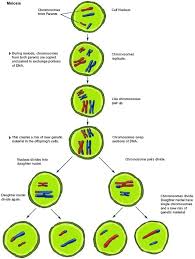
This diagram shows which cellular process that occurs in organisms?
a)
endocytosis
b)
mitosis
c)
meiosis
d)
phagocytosis
17.
products of meiosis are genetically
a)
different
b)
identical
18.
The man who studied genetics and came up with genetics is
a)
Watson
b)
Crick
c)
Mendel
d)
Darwin
19.
Which of the following is a phenotype?
a)
BB
b)
Bb
c)
bb
d)
Blue eyes
20.
What is a phenotype
a)
The genetic make up (code)
b)
The physical trait
21.
the passing of genetic traits from parent to offspring.
a)
heredity
b)
trait
c)
gene
d)
allele
22.
having two of the same genes for the trait (sometimes called purebred).
a)
homozygous
b)
hetrozygous
c)
protein
d)
chromosome
23.
having two different genes for a trait (sometimes called hybrid).
a)
protein
b)
homozygous
c)
heterozygous
d)
genotype
24.
Two brown eyed parents (Bb) have a baby. What is the chance the baby is blue eyed? (You will need to do a punnett square)
a)
0 %
b)
25%
c)
50%
d)
75%
25.
G = green, g = yellow
The genotype for a yellow plant is...
The genotype for a yellow plant is...
a)
GG
b)
Gg
c)
gg
d)
all of the choices result in yellow
26.
Two heterozygous (Tt) tall pea plants are crossed. Which describes their offspring? (You will need to do a punnet square)
a)
50% tall and 50% short
b)
75%tall and 25% short
c)
100%short
27.
What does heterozygous mean?
a)
An organism that has the same genes for a trait (TT or tt)
b)
An organism that has different genes for a trait (Tt)
c)
When neither gene is fully dominant; offspring is a mixture of both
d)
the different forms of a trait (hair color--> brown, blonde, red
28.

If T=Tall & t=short, what is the genotypic ratio? (Complete the punnet square)
a)
1:3
b)
3:1
c)
1:2:1
d)
2:2
29.
How many times in meiosis does the cell divided?
a)
2
b)
4
c)
3
d)
1
30.

If green is dominant over purple, then what is the genotype for this individual?
a)
Purple
b)
Green
c)
GG
d)
gg
31.

Which is the correct phenotype for this organism?
a)
BB
b)
blue
c)
green
d)
bb
32.

What is the genotype for this organism?
(E= 3 eyes, e= 1 eye)
(E= 3 eyes, e= 1 eye)
a)
EE
b)
Ee
c)
ee
d)
EE or Ee
33.
B - black, b - brown. Two black mice mate and have some black and some brown mice. What is the genotype of the parents? (You will need to do a punnet square)
a)
BB x Bb
b)
BB x bb
c)
Bb x Bb
d)
Bb x bb
34.
Which of the following terms refers to the different possibilities of a gene?
a)
chromosome
b)
DNA
c)
Punnett Squares
d)
allele
35.
If something is heterozygous, it is also...
a)
purebred
b)
hybrid
c)
dominant
d)
recessive
36.

This image shows a...
a)
Punnett Square
b)
Phenotype
c)
Genotype
d)
Dominant allele
37.
A phenotype is the...
a)
letter combination
b)
dominant gene
c)
recessive gene
d)
physical appearance
38.
Another word for homozygous is...
a)
purebred
b)
hybrid
c)
heterozygous
d)
dominant
39.
Dominant alleles are-
a)
capital
b)
lowercase
c)
both
d)
neither
40.
Recessive alleles are-
a)
capital
b)
lowercase
c)
both
d)
neither
41.
Tt is-
a)
homozygous dominant
b)
homozygous recessive
c)
heterozygous
d)
none of these
42.
If a pea plant were homozygous recessive for height, how would its alleles be represented?
a)
TT
b)
Tt
c)
tt
d)
tT
43.
Which represents the genotype of a homozygous condition?
a)
Bb
b)
BC
c)
bb
d)
bc
44.
An organism’s genetic makeup, or allele combinations
a)
Recessive
b)
Genotype
c)
Phenotype
d)
Heterozygous
45.
Having two of the SAME alleles for a trait (example HH or hh):
a)
homozygous
b)
heterozygous
c)
recessive
d)
dominant
46.

bb crossed with BB, what is the probability of Bb?
a)
0%
b)
25%
c)
50%
d)
100%
47.
Which of the following is a phenotype?
a)
Aa
b)
red hair
c)
heterozygous
d)
BB
48.

Which law states that organisms inherit 2 copies of each gene and donate one to their offspring
a)
law of independent assortment
b)
law of segregation
c)
law of genetic linkage
d)
law of inheritance
49.
In Mendel's monohybrid cross of a purebred white-flowered plant and a purebred purple-flowered plant, the F1 generation
a)
showed only the dominant trait
b)
showed only the recessive trait
c)
did not receive any recessive alleles
d)
remained purebred
50.

Purebred is another word for __________, while hybrid is another word for __________.
a)
dominant; recessive
b)
recessive; dominant
c)
homozygous; heterozygous
d)
heterozygous; homozygous
51.
Bb
a)
Homozygous
b)
Heterozygous
52.
Aa
a)
Phenotype
b)
Genotype
53.
Purple
a)
Genotype
b)
Phenotype
54.
Bb and BB are both called...
a)
Genotypes
b)
Phenotypes
55.
The allele that is expressed over another.
a)
Dominant
b)
Recessive
c)
Genotype
d)
Phenotype
100 %

