
 Worksheets
Semester 1 Final Exam Review
Total questions: 100
Worksheet time: 2hrs 40mins
Name
Class
Date
1.
Which of the following is a fossil fuel?
a)
Wind
b)
Coal
c)
Solar
d)
Biomass
2.
Hydroelectric power produces electricity using.....
a)
Wind
b)
Sunlight
c)
Moving water
d)
Dung
3.
Energy from the sun is known as.........
a)
hydroelectric energy
b)
geothermal energy
c)
solar energy
d)
wind energy
4.
Fossil fuels are classified as nonrenewable because they.......
a)
require expensive equipment
b)
take millions of years to replace
c)
can be found all over
d)
provide all the energy we use
5.
What are two advantages of geothermal energy?
a)
cheap and a lot pollution
b)
expensive and a lot of pollution
c)
cheap and little pollution
d)
expensive and little pollution
6.
Wind, geothermal, and solar energy are all what type of energy resources?
a)
nonrenewable
b)
potential
c)
renewable
d)
chemical
7.
An Alternative Energy Resource is...
a)
Energy that comes from harnessing the movement of the air
b)
Energy that comes from the Sun
c)
A source of renewable energy, such as solar, wind, or geothermal energy
d)
Fuel from plant material
8.
What is biomass?
a)
energy from the sun
b)
energy from water
c)
energy from wind
d)
energy from plant and animal waste
9.
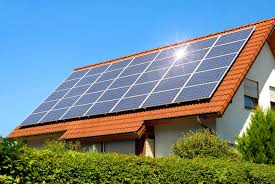
Why aren't American's roofs crammed with more solar panels?
a)
They are ugly.
b)
They are uninformed.
c)
They have expensive start-up costs
d)
People enjoy paying bills.
10.
What are the 3 main fossil fuels?
a)
Coal, Oil, and Gasoline
b)
Coal, Oil, and Natural Gas
c)
Electricity, Gasoline, Petroleum
d)
Coal, Oil, Non-renewable Resources
11.
The formation of fossil fuels is a process that takes millions of years and starts with energy from the sun. The sun contributes to the formation of fossil fuels by
a)
heating up the Earth's core where fossil fuels form
b)
generating winds so humans use less fossil fuels
c)
giving energy to the living things that become fossil fuels
d)
giving off heat, similar to burning fossil fuels
12.
Geothermal energy is energy from
a)
the sun
b)
heat deep within the earth
c)
wind
d)
inexhaustible
13.
What is a major advantage that alternate energy has over fossil fuels?
a)
alternate energy does not produce radioactive waste
b)
alternate energy is more efficient than fossil fuels
c)
alternate energy increases the amount of sulfur dioxide ejected into the atmosphere
d)
alternate energy reduces the amount of carbon dioxide ejected into the atmosphere
14.

Why are fossil fuels more widely used than solar energy?
a)
Solar energy is harder to find
b)
Fossil fuels are much cheaper
c)
Fossil fuels are more abundant
d)
The sun's energy can never be harnessed
15.
Which methods of generating electricity does NOT use alternative energy resources?
a)
Burning coal in a power plant
b)
Turbines spinning in dam
c)
Solar panels taking in light energy
d)
Drilling wells to reach hot rocks deep inside the earth
16.

Trees, crops, garbage, & landfill gas are all examples of
a)
Energy
b)
Biomass
c)
Heat
d)
Nuclear waste
17.
Why is the Sun considered the ultimate energy source?
a)
The Sun is the center of our solar system.
b)
The Sun provides energy for the water cycle and plants.
c)
The Sun is limited in the amount of energy released daily.
d)
The Sun rises and sets each day as seen from Earth.
18.

The poster shown below advertises tours of a power plant.
This power plant produces electricity most likely by using-
This power plant produces electricity most likely by using-
a)
fossil fuels
b)
biofuels
c)
solar energy
d)
geothermal energy
19.
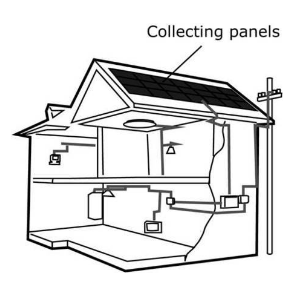
The house illustrated here uses panels on the roof to collect a natural resource and convert it into electricity that can be used.
Which alternative energy source does this house use?
Which alternative energy source does this house use?
a)
Water
b)
Wind
c)
Solar
d)
Geothermal
20.
An energy company wants to build a hydroelectric power plant. Which of these characteristics of an area is most important to the development of a hydroelectric power plant?
a)
The area has a cool, rainy climate.
b)
The area is located in a valley with very little wind and frequent heavy fog.
c)
The area has a river that flows rapidly from nearby mountains through a valley
d)
The area has no geysers or hot springs.
21.
Corn, wheat, and soybeans can be made into a substance called ethanol. In some places, ethanol is part of a mixture used to power cars and trucks. What type of alternative energy resource is ethanol?
a)
Hydroelectric
b)
Geothermal
c)
Biofuel
d)
Solar
22.

This power plant produces electricity most likely by using -
a)
fossil fuels
b)
biofuels
c)
solar energy
d)
geothermal energy
23.

Based on the data collected, which source of alternative energy is most efficient?
a)
Coal
b)
Wind
c)
Natural gas
d)
Solar
24.
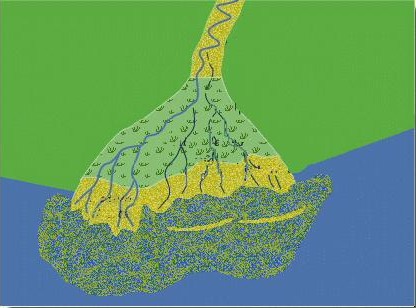
The type of landform shown is at the mouth of the Mississippi River. What is it called?
a)
coastal erosion
b)
a delta
c)
a loess
d)
sand dunes
25.
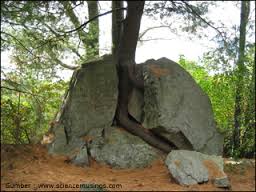
How do plants weather rocks?
a)
when the leaves dissolve the rocks
b)
when roots grow into cracks of rocks and expand the rock
c)
when the plant moves water from the roots to the leaves
26.
How is mechanical weathering different from chemical weathering?
a)
Chemical weathering happens over much shorter time frame than mechanical weathering.
b)
Chemical weathering changes the chemical composition of rocks; mechanical weathering does not.
c)
Chemical weathering occurs only in tropical climates; mechanical weathering occurs only in cool climates.
d)
Chemical weathering occurs only in the mountains; mechanical weathering occurs only on flat land.
27.

The diagrams show a natural process that weathers rock.
Which statement best explains why this process results in weathering?
Which statement best explains why this process results in weathering?
a)
water boils and pushes against the rocks
b)
water expands when it freezes
c)
the mass of water increases when it freezes
d)
water dissolves most types of rock
28.
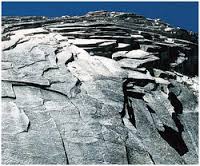
What is mechanical weathering?
a)
Process through which rocks are physically broken into smaller pieces.
b)
Rocks are broken down through chemical changes.
c)
Rocks are worn away from acid in plant roots.
d)
Rocks broken down by machinery.
29.
If the same type of rock were placed in a rainforest, desert, a forest in Tennessee, and the North Pole, in which area would the rock weather the fastest?
a)
rainforest
b)
desert
c)
North Pole
d)
forest in Tennessee
30.
Which factors are the most important for determining the rate of weathering?
a)
Erosion and deposition
b)
Climate and type of rock
c)
Humidity and climate
d)
Humidity and temperature
31.
In which type of climate would weathering happen the fastest to a rock?
a)
wet and warm
b)
dry and cold
c)
wet and cold
d)
dry and warm
32.
As you were climbing a mountain, you noticed that rocks were crumbling below your feet and moving down the mountain. What 2 processes did you observe?
a)
Weathering and erosion
b)
Erosion and deposition
c)
Abrasion and chemical weathering
d)
Abrasion and ice wedging
33.
Your teacher filled a box with sand. She put a fan at one end and turned the fan on. The sand was blown to the opposite side of the box and collected at that side. What processes was the teacher demonstrating?
a)
Weathering and erosion
b)
Weathering and deposition
c)
Erosion and deposition
d)
Chemical and mechanical weathering
34.

These rocks were broken apart from the continuous freeze/thaw of water in the cracks of the rocks. This is an example of:
a)
ice wedging
b)
acid rain
c)
permeability
d)
abrasion
35.
How might a weathered mountain appear different than an unweathered mountain?
a)
Weathered mountain would be taller.
b)
Weathered mountain would be rounder and less jagged.
c)
Weathered mountain would be more jagged and less rounded.
d)
Weathered mountain would have no trees.
36.
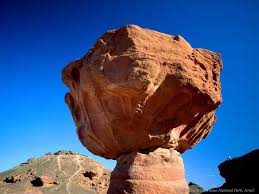
The process that breaks down rocks and other materials on Earth's surface is called
a)
Weathering
b)
Erosion
c)
Deposition
d)
Decomposition
37.

Over long periods of time, deposition may change the Earth’s surface by _____.
a)
forming new land features.
b)
breaking down large rocks into smaller ones.
c)
washing away beaches.
d)
moving topsoil.
38.

A cliff formed near the ocean. Which statement best describes how this cliff formed?
a)
Warm air melted the rock.
b)
Sun rays evaporated the rock.
c)
Ocean waves washed away rock.
d)
Plant roots pushed away the rock.
39.

What is the process that picks up and moves weathered rocks?
a)
Deposition
b)
Landslide
c)
Weathering
d)
Erosion
40.

Layers of sediment forming at the bottom of the ocean floor is an example of
a)
Weathering
b)
Erosion
c)
Deposition
d)
Awesome Science
41.

Which of these is an example of erosion?
a)
Light shining onto a mountain.
b)
Rain breaking down rocks on a mountain into smaller pieces.
c)
Wind blowing away sediment to a new place on the mountain.
d)
All of the above.
42.
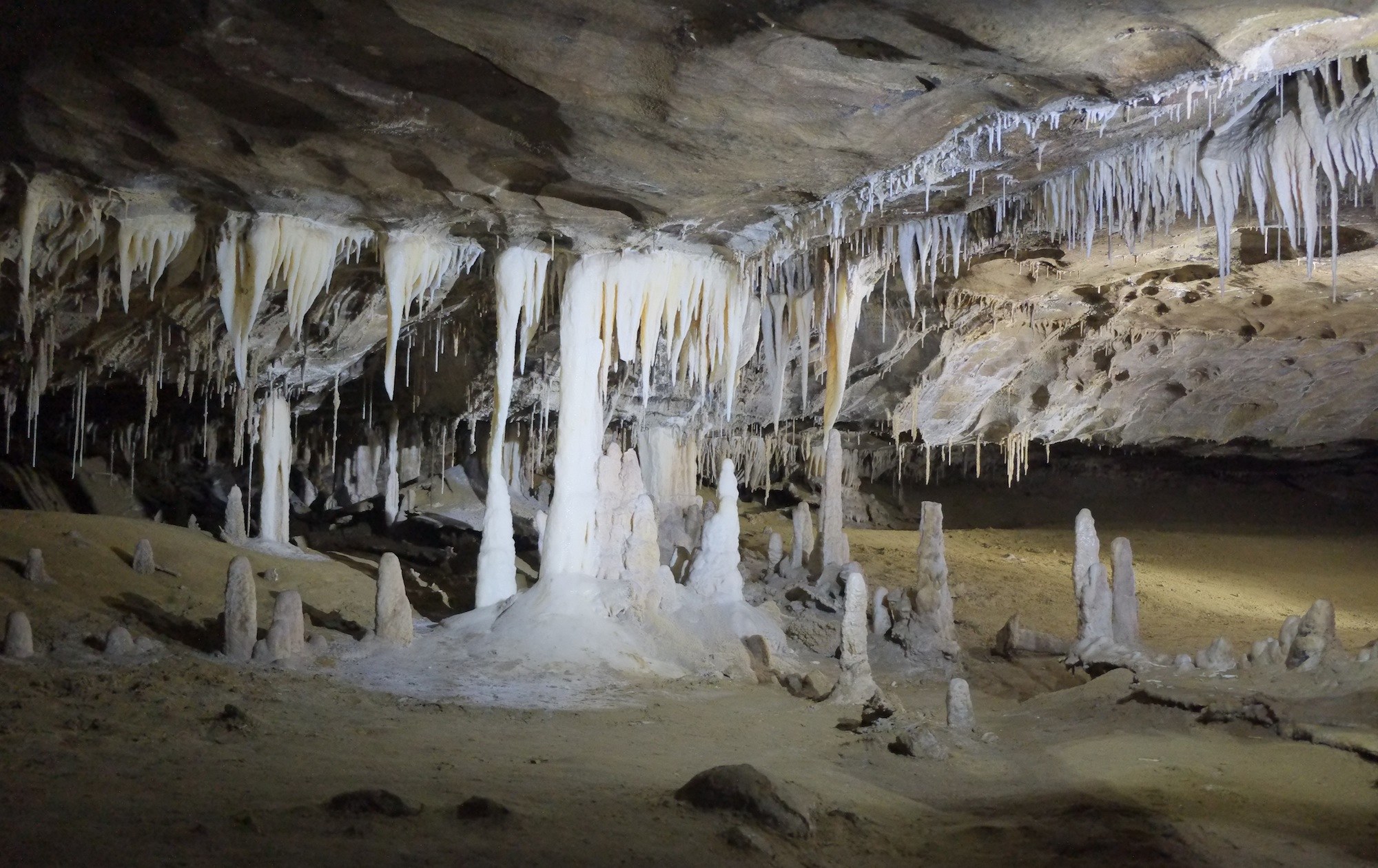
Deposition changes the Earth’s surface because bits of broken rock and soil _____.
a)
stop rivers from flowing.
b)
make rich farmlands.
c)
are dropped in new places.
d)
move very slowly.
43.

What are the four soil components?
a)
Sand, rock, humus, air
b)
Rock, humus, air, water
c)
Rock, humus, roots, water
d)
Rock, humus, animals, plants
44.

What soil horizon is A
a)
Topsoil
b)
Subsoil
c)
Bedrock
d)
Parent Rock
45.
Decayed organic material in soil is called______.
a)
Litter
b)
Silt
c)
Humus
d)
Clay
46.
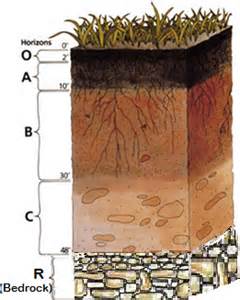
Which horizon is made up of partially weathered rocks?
a)
Horizon A
b)
Horizon B
c)
Horizon C
d)
Horizon D or R
47.

When sediments are pressed together tightly, this is called ____________.
a)
Compaction
b)
Cementation
c)
Weathering
d)
Erosion
48.
Fossils are often found in ____________ because it is formed from the remains of once living things.
a)
metamorphic
b)
magma
c)
igneous
d)
sedimentary
49.
What is the MAIN way rocks are classified?
a)
Their color and shapes
b)
How they form
c)
Mineral bands
d)
Where they form
50.
What do we call the powder left behind when a mineral is scratched on a plate?
a)
Hardness
b)
Luster
c)
Cleavage
d)
Streak
51.
A mineral is broken into pieces using a hammer. The rocks edges are straight and even. What property does this mineral have?
a)
Fracture
b)
Hardness
c)
Cleavage
d)
Luster
52.
Which is not a characteristic of a mineral?
a)
Organic
b)
Naturally Formed
c)
Inorganic
d)
Definite crystalline structure
53.
Rock that forms when pressure, temperature, or chemical processes change existing rock.
a)
Igneous Rock
b)
Sedimentary Rock
c)
Metamorphic Rock
d)
Rock Cycle
54.
The name rock is given when it is broken down into smaller pieces.
a)
texture
b)
weathering
c)
sediment
d)
erosion
55.
Rock that forms when minerals form from solutions or sediment from older rocks get pressed and cemented together.
a)
Sedimentary Rock
b)
Metamorphic Rock
c)
Igneous Rock
56.
The process by which water, wind, ice, and changes in temperature break down rock into fragments called sediments.
a)
Deposition
b)
Erosion
c)
Weathering
d)
Igneous Rock
57.
Which rock group makes up most of Earth's crust?
a)
Igneous
b)
Metamorphic
c)
Basalt
d)
Sedimentary
58.
From your knowledge of Earth's crust, where would you most likely find igneous rocks like basalt?
a)
Within mountain ranges
b)
In my backyard
c)
On the ocean floor
d)
Sandy Beaches
59.
What is molten or liquid rock material that is deep beneath the Earth's surface?
a)
grain
b)
lava
c)
magma
d)
rock
60.
The process in which dissolved minerals crystallize and glue sediment together.
a)
compaction
b)
deposition
c)
organic rock
d)
cementation
61.

This rock cooled on the outside of a volcano and contained air bubbles when it was forming. What type of rock is this?
a)
Sedimentary
b)
Igneous
c)
Metamorphic
62.

This rock was molten magma that slowly cooled under the ground. What type of rock is this?
a)
Sedimentar
b)
Igneous
c)
Metamorphic
63.
What does Mohs Chart measure?
a)
The Density of Liquid
b)
The Density of Air
c)
The Hardness of Minerals
d)
The Hardness of Atoms
64.
What mineral is the highest on the Mohs Scale?
a)
Topaz
b)
Feldspar
c)
Diamond
d)
Granite
65.
Process when sediments settle out of wind or water
a)
erosion
b)
deposition
c)
compaction
d)
cementation
66.
Acid from rain water reacts chemically with minerals dissolving them or turning them into other minerals, often through the processes of oxidation or hydration. Which term describes the process when chemicals dissolve and break up rock to form sedimentary rock?
a)
A) Deposition
b)
B) Lithification
c)
C) Physical weathering
d)
D) Chemical weathering
67.
a natural, nonliving substance that makes up rock
a)
mineral
b)
rocks
c)
plasma
d)
lava
68.

This rock was formed by smaller pieces of rock that settled at the bottom of a lake millions of years ago. What type of rock is this?
a)
Sedimentary
b)
Igneous
c)
Metamorphic
69.
The series of processes in which rock changes from one type to another.
a)
Metamorphic Rock
b)
Sedimentary Rock
c)
Igneous Rock
d)
Rock Cycle
70.

What type of boundary is this?
a)
Convergent
b)
Divergent
c)
Transform
71.
This is the layer of the Earth that the plates move on
a)
Lithosphere
b)
Asthenosphere
c)
Crust
d)
Core
72.

What type of boundary is this?
a)
Transform
b)
Convergent
c)
Divergent
73.
As depth beneath the Earth's surface increases, temperature and density
a)
Both decrease
b)
Approach Zero
c)
Both increase
d)
Stay the same
74.
This is the hottest layer of the Earth
a)
Crust
b)
Mantle
c)
Core
75.

What is the effect of this boundary?
a)
Mid-Ocean Ridge
b)
Trench
c)
Earthquake
d)
Volcano
76.
Which layer of the Earth do we live on?
a)
Mantle
b)
Crust
c)
Inner Core
d)
Asthenosphere
77.

Which of the following is the inner core?
a)
Layer 1
b)
Layer 2
c)
Layer 3
d)
Layer 4
78.
According to Alfred Wegener's theory of Continental Drift
a)
Earth's surface is made up of seven major landmasses
b)
the continents once joined together in a single land mass
c)
the continents do not move
d)
Earth is slowly cooling and shrinking
79.

What type of boundary is this?
a)
Transform
b)
Convergent
c)
Divergent
80.
What is Pangaea?
a)
the name of a German scientist
b)
name of a supercontinent that existed millions of years ago
c)
another name for continental drift
d)
the name of an ancient fossil
81.
Scientist's think that convection currents flow in Earth's
a)
Continents
b)
Lithosphere
c)
Asthenosphere
d)
Atmosphere
82.

Which of the following is the crust?
a)
Layer 1
b)
Layer 2
c)
Layer 3
d)
Layer 4
83.
Earth's mantle is
a)
a dense ball of solid metal
b)
a layer of hot rock
c)
a layer of rock that forms Earth's outer skin
d)
a layer of molten metal
84.

What type of land form is this?
a)
Mid-Ocean Ridge
b)
Mountain Range
c)
Rift Valley
d)
Volcano
85.
A collision between two pieces of continental crust at a converging boundary produces a
a)
Rift Valley
b)
Mid-Ocean Rigde
c)
Volcano
d)
Mountain Range
86.

What type of land form is created here?
a)
Trench
b)
Rift Valley
c)
Mid-Ocean Ridge
d)
Mountain Range
87.
This is the least dense layer of the Earth?
a)
Crust
b)
Mantle
c)
Inner Core
d)
Mesosphere
88.

What type of land forms are created by this boundary?
a)
Trench, Mid-Ocean Ridge
b)
Trench, Mountain Range, Volcano
c)
Volcano, earthquake
d)
Mid-Ocean Ridge, Rift Valley
89.
Which layer is the heat source for convection currents that take place deep inside the earth?
a)
Litosphere
b)
Core
c)
Mantle
d)
Crust
90.

What type of land form is created in this image?
a)
Rift Valley
b)
Mountain Range
c)
Volcano
d)
Earthquake
91.
A place where two plates come together is known as...
a)
transform boundary
b)
divergent boundary
c)
convection boundary
d)
convergent boundary
92.
Many geologists think that the movement of Earth's plates is caused by
a)
Gravity
b)
Continental Drift
c)
Subduction
d)
Convection Currents in the Asthenosphere
93.

What is happening at the red dot in this image?
a)
Convection Current
b)
Subduction Zone
c)
Mountains forming
d)
Divergent Zone
94.
They cause the movement of plate by heating to the crust Earth, cooling, and moving to the core
a)
Convection Currents
b)
Radioactive Waves
c)
Concentrated Currents
d)
Convection Controls
95.
A rift valley forms where two plates
a)
sink towards the mantle
b)
slide past each other
c)
diverge
d)
converge
96.
Which of the following is a destructive effect of plate tectonics?
a)
Earthquake
b)
Mid-Ocean Ridge
c)
Rift Valley
d)
Trench
97.
Which of the following is NOT a constructive effect of plate tectonics?
a)
Trench
b)
Mid-Ocean Ridge
c)
Mountain Range
d)
Earthquake
98.

What type of boundary is this?
a)
Transform
b)
Convergent
c)
Divergent
99.
A farmer decides that he is going to produce his own energy on the farm by using a type of renewable energy. The renewable energy could come from--
a)
setting up wind turbines
b)
having a coal furnace
c)
using natural gas
d)
burning oil
100.
Which statements describe global warming?
a)
Global warming can be decreased through deforestation.
b)
Global warming results from the buildup of nutrients in runoff
c)
Global warming is likely increased by humans
d)
Global warming is enhanced by nonnative species
100 %

