wayground logo

Free Printable Worksheets

Font size

S
M
L
XL
Worksheets

2018/2019 Trimester 1 and 2 review

Total questions: 104

Worksheet time: 2hrs 29mins

Name
Class
Date
1.
Oceans, rivers, lakes and even glaciers belong to this sphere
a)
Atmosphere
b)
Hydrosphere
c)
Biosphere
d)
Geosphere
2.
This sphere contains all life on Earth
a)
Geosphere
b)
Hydrosphere
c)
Atmosphere
d)
Biosphere
3.
This sphere contains all the rocks, minerals and ground
a)
Geosphere
b)
Hydrosphere
c)
Atmosphere
d)
Biosphere
4.
This sphere contains the air around the Earth
a)
Geosphere
b)
Hydropshere
c)
Atmosphere
d)
Biosphere
5.
How many parts form the Earth's System?
a)
5
b)
6
c)
4
d)
3
6.
The Whole Earth (all four connected parts), is an example of a(n):
a)
closed system
b)
open system
7.
What are the two most abundant gases in atmosphere?
a)
Hydrogen and Carbon Monoxide
b)
Nitrogen and Oxygen 
c)
Nitrogen and Hydrogen
d)
Hydrogen and Oxygen
8.
What is Earth's outermost system? 
a)
Atmosphere
b)
Hydrosphere
c)
Cryosphere
d)
Geosphere
9.

What does GPS stand for?

a)

Global Persons Society

b)

Georgia Palentolgist System

c)

Global Positioning System

d)

Global People System

10.

How many total satellites are in space for GPS?

a)

4

b)

5

c)

95

d)

24

11.
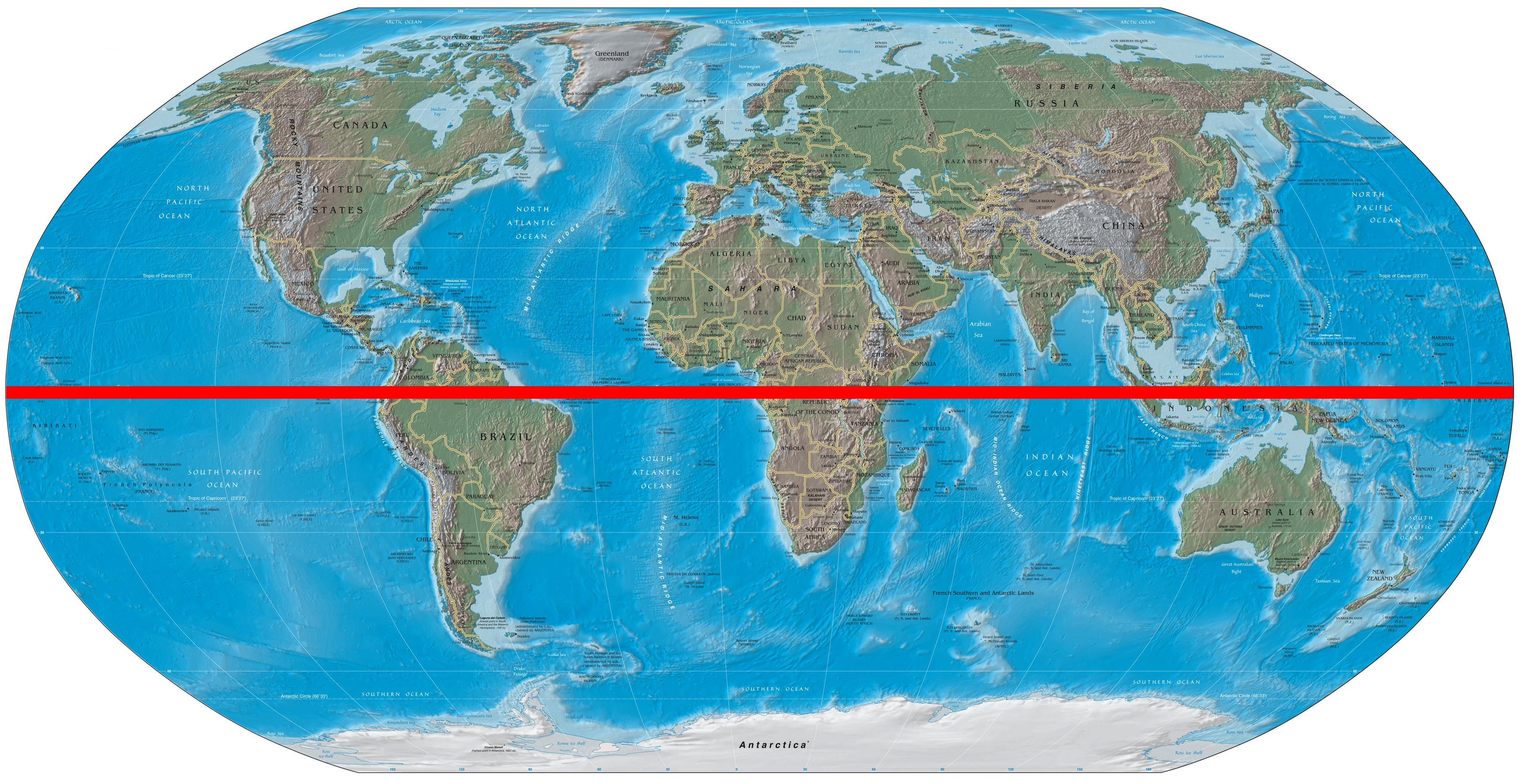
What is the name of this line at 0 degrees latitude?
a)
Prime Meridian
b)
Equator
c)
North Pole
d)
South Pole
12.

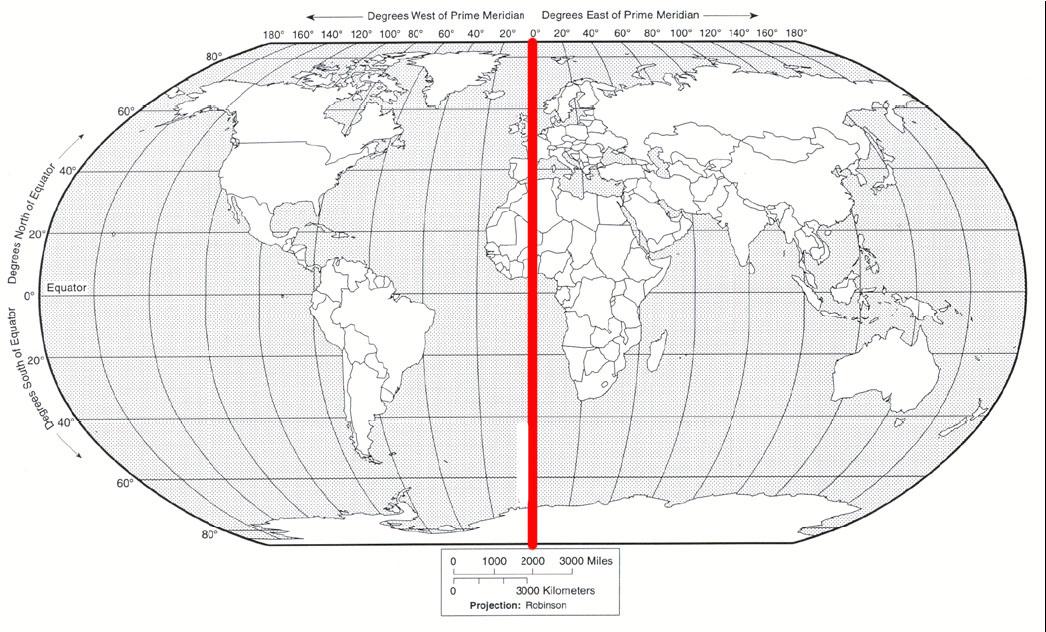
What is the name of the line at zero degrees longitude (travels through Greenwich, England)?

a)

Equator

b)

Prime Meridian

c)

North Pole

d)

South Pole

13.

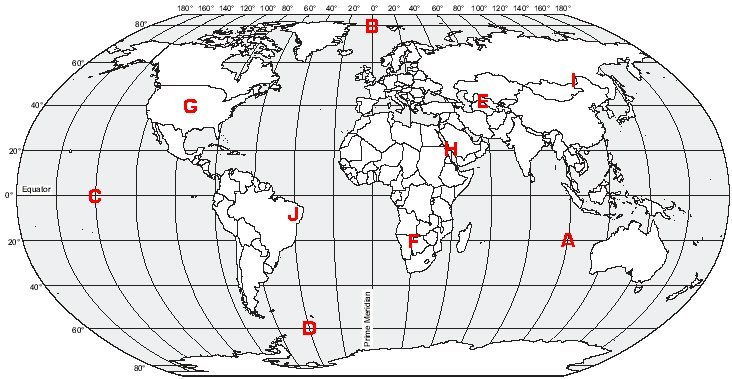
What is the approximate location of AV-W School?

a)

450 N, 90oW

b)

0o, 80oW

c)

45oS, 90oE

d)

0o, 80oE

14.
What is this object known as?
a)
map symbol
b)
map key
c)
map scale
d)
compass rose
15.
a box in which symbols on a map are explained is called
a)
compass rose
b)
map scale
c)
legend/key
d)
physical map
16.
97% of the water on earth is _________, making it undrinkable for humans.
a)
fresh water
b)
ground water
c)
salt water
d)
surface water
17.

What is the % of fresh water in the world

a)

50%

b)

30%

c)

5%

d)

3%

18.

What percent of all the water on Earth is usable as freshwater?

a)

3 %

b)

1 %

c)

50 %

d)

25 %

19.
Most freshwater is ........
a)
water vapor
b)
liquid
c)
on the surface
d)
frozen
20.

Most people in northern Wisconsin get their drinking water from....

a)

Lake Superior

b)

Lake Michigan

c)

Underground

d)

The Wisconsin River

21.
Pure water has a neutral pH of _____, which means it is not acidic or basic.  
a)
3
b)
5
c)
7
d)
9
22.

True of False: Water from a septic tank gets cleaned by the ground and reused.

a)

True

b)

False

23.

ppm stands for.....

a)

pacific penguins marching

b)

people practicing math

c)

parts per million

d)

pandas panting mildly

24.

This tools helps measure the turbidity (how far light penetrates) in a body of water..

a)

Ammonia

b)

Graduated Cylinder

c)

Secchi Disk

d)

Flash Drive

25.
Which of the following characteristics is NOT true for a substance to be considered a mineral?
a)
solid
b)
occurs naturally
c)
living
d)
has a definite chemical composition
26.
The majority of minerals in Earth's crust belong to what family?
a)
iron ores
b)
carbonates
c)
silicates
d)
oxides
27.
What does it mean if a mineral has a hardness of one?
a)
it is very hard
b)
it is very soft
28.
A mineral's resistance to being scratched is its....
a)
Fluorescence
b)
Hardness
c)
Luster
d)
Streak
29.
Moh's scale measures the ___________________ of minerals.
a)
Hardness
b)
Luster
c)
Streak
d)
Specific gravity
30.
The color of a mineral's powder
a)
Cleavage
b)
Luster
c)
Streak
d)
Specific gravity
31.
The tendency of a mineral to split along a flat surface is called....
a)
Breakage
b)
Cleavage
c)
Fracture
d)
Separation
32.

Which type of rock is made from lava or magma cooling?

a)

igneous

b)

sedimentary

c)

metamorphic

33.
Which type of rock is made by small bits of rock, mud, or sand compacted and cemented together?
a)
Coal
b)
igneous
c)
metamorphic
d)
sedimentary
34.
Which type of rock is made from a rock being changed by heat and pressure?
a)
Smooshed Rock
b)
igneous
c)
metamorphic
d)
sedimentary
35.
Sediment goes through _________________ to become sedimentary rock.
a)
heat and pressure
b)
compacting and cementing
c)
weathering and erosion
d)
melting and cooling
36.

Fossils are found in ____________ rocks.

a)

metamorphic

b)

magma

c)

igneous

d)

sedimentary

37.
Lava which cools on Earth's surface forms an
a)
metamorphic rock
b)
intrusive igneous rock
c)
extrusive igneous rock
d)
foliated metamorphic rock
38.

Which type of rock is made from magma cooling inside Earth?

a)

cool rock

b)

intrusive igneous

c)

non-foliated metamorphic

d)

sedimentary

39.
Which type of metamorphic rock has minerals in bands or stripes?
a)
Nonfoliated
b)
Coarse grained
c)
Fine grained
d)
Foliated
40.
When water freezes and thaws causing rocks to weather it is called
a)
weathering
b)
ice wedging
c)
chemical weathering
d)
erosion
41.
Which will cause faster weathering
a)
Less surface area 
b)
More surface area
c)
No surface area
d)
Surface area is not a factor
42.

The weathering of rock starts the process of ___________ formation

a)

Litter

b)

Soil

c)

Garbage

d)

Water

43.
These four components -
air                 water       
weathered rock            organic material
create what?
a)
Rock
b)
Silt
c)
Soil
d)
Garden waste
44.
The decayed organic matter in soil is called
a)
Humus
b)
Pebbles
c)
Bedrock
d)
Horizon
45.
Layers of soil are also known as:
a)
Soil layers
b)
Soil Horizons
c)
Soil sheets
d)
Soil cores
46.
The definition of weathering is _______________________.
a)
the carrying away of rock
b)
the leaching of rock
c)
the breaking down of rock
d)
the permeability of rock
47.
What do you call the planting of crops on slopes, hills, or mountains in level sections?
a)
contour plowing
b)
subsoil
c)
terrace farming
d)
topsoil
48.
Soil that forms in regions with moderate rainfall and temperatures ~ rich soil, arable
a)
tropical
b)
desert
c)
temperate
d)
arctic
49.
A property of soil that measures the size of soil particles.
a)
Pore Space
b)
Texture 
c)
Chemistry
d)
Bigness 
50.

Which of the following is(are) a type(s) of mechanical weathering?

a)

abrasion

b)

plant growth

c)

ice wedging

d)

all of the above

51.
Which of the following is NOT a fast change in Earth's surface?
a)
Landslides
b)
Erosion
c)
Volcanoes Erupting
d)
Earthquakes
52.
What causes the greatest erosion effect on our beaches?
a)
Waves
b)
Gravity
c)
Glaciers
d)
Wind
53.
What is the wearing away or breaking down of rocks called?
a)
Deposition
b)
Erosion
c)
Glaciers
d)
Weathering
54.
Which of the following is NOT a slow change to Earth's surface?
a)
Weathering
b)
Erosion
c)
Deposition
d)
Landslides
55.
What is this a picture of?
a)
alluvial fan
b)
sinkhole
c)
glacier
d)
chemical weathering
56.
What erosion/deposition event caused this? 
a)
sinkhole
b)
alluvial fan
c)
mass wasting
d)
glacier
57.
Very fine wind-blown sediment is called......
a)
loess
b)
sand dune
c)
barrier island
d)
longshore current
58.
Bowl shaped depressions left by glaciers that fill with water. 
a)
till
b)
glaciers
c)
kettle lakes
d)
erosion
59.
These large sheets of snow and ice break rocks (weather), carry the sediment away (erosion) and place the sediments somewhere else (deposition)
a)
till
b)
moraine
c)
kettle lake
d)
glacier
60.
What is the process that picks up and moves weathered rocks?
a)
Deposition
b)
Landslide
c)
Weathering
d)
Erosion
61.
The interaction of tectonic plate boundaries is associated with which of the following events?
a)
Hurricanes
b)
Tropical storms
c)
Earthquakes
d)
Tornadoes 
62.
At which type of plate boundary will an ocean trench most likely form?
a)
Divergent
b)
Transform
c)
Earthquake
d)
Convergent 
63.
The layer of Earth that is found directly below the lithosphere is called the -
a)
asthenosphere.
b)
inner core.
c)
outer core.
d)
crust.
64.
Which layer of Earth is broken up into giant moving plates?
a)
Asthenosphere
b)
Lithosphere
c)
Inner core
d)
Outer core
65.

Earth’s crust would be best modeled by using a material that is -

a)

liquid and hot.

b)

dense and smooth.

c)

soft and flexible.

d)

thin and solid.

66.

Which of Earth’s layers would be best modeled as a solid metallic sphere?

a)

Mantle

b)

Inner core

c)

Outer core

d)

Crust

67.
What layer is the hottest "they think"?
a)
Core
b)
Crust
c)
Mantle
68.
Plate movement is caused by ______________.
a)
the rotation of the Earth
b)
Posiden's trident
c)
convection currents in the mantle
d)
the moon's gravity
69.
A subduction zone is formed...
a)
when one tectonic plate sinks below another
b)
after lunch recess occurs 
c)
 when plates diverge
d)
at transform boundaries
70.

What type of boundary creates new seafloor?

a)

convergent oceanic - oceanic subduction

b)

transform

c)

convergent continental continental

d)

divergent

71.

Plates coming together to form mountains is an example ____________ boundary

a)

convergent

b)

divergent

c)

transform

72.
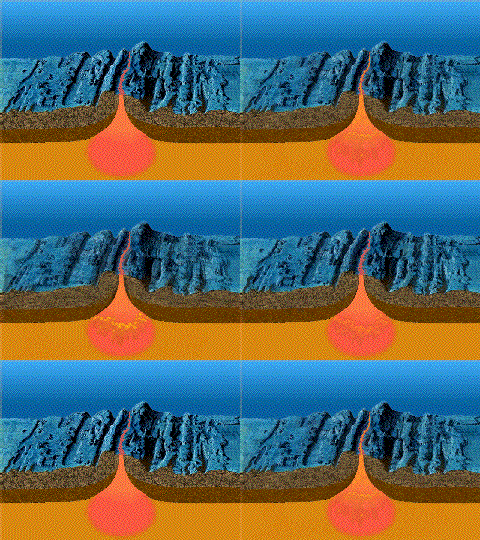
Name the boundary
a)
convergent boundary
b)
divergent boundary
c)
transform boundary
73.
Earthquakes and volcanoes are most likely found in which locations? 
a)
at plate boundaries
b)
in oceans
c)
on continents
d)
in the middle of plates
74.

States that Earth is broken into huge plates that are slowly moving over Earth's surface.

a)

lithosphere

b)

theory of plate tectonics

c)

Galileo

d)

Pangaea

75.

About how many people have died on Mt. Everest?

a)

about 300

b)

around 500

c)

about 10

d)

around 30

76.

What group of people, who are native to Nepal, are the biggest help in getting people to the top of Mt. Everest?

a)

Sherpas

b)

Tibetans

c)

People from India

d)

North Americans

77.

In what mountain range is Mt. Everest located in?

a)

The Himalayas

b)

The Rockies

c)

The Andes

d)

The Appalachians

78.

In what year did the first people make it to the top of Mt. Everest?

a)

1953

b)

2001

c)

1900

d)

1975

79.
What type of volcano is Mt. St. Helens?
a)
shield
b)
composite
c)
cinder cone
d)
dormant
80.
A volcano that is erupting or has shown signs that it may erupt in the future is called _____.
a)
sleeping
b)
extinct
c)
active
d)
dormant
81.
A volcano that has gentle sloping sides and is formed from low-silica lava:
a)
Shield volcano
b)
Cinder cone
c)
Composite
d)
None of these
82.
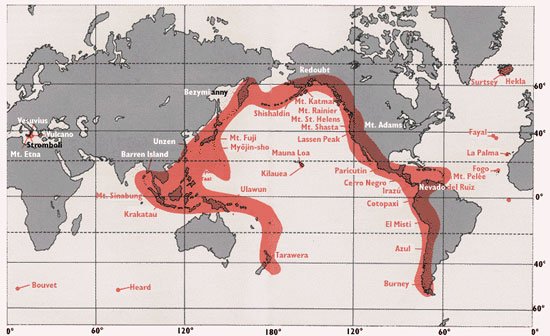
This is the name for the chain of volcanoes around the edge of the Pacific Plate.
a)
Circle of Fire
b)
Ring of Lava
c)
Ring of Fire
d)
Circle of Magma
83.

A Tsunami is

a)

Sushi

b)

A massive wave

c)

A funny movie

d)

A big truck

84.
A constellation is a group of visible ____ that form a pattern when viewed from Earth.  
a)
planets
b)
stars
c)
patterns
d)
creatures
85.
Which constellation is best known because it contains the “big dipper,” which looks like a ladle.
a)
Ursa Major
b)
Ursa Minor
c)
Orion
d)
Polaris
86.

STEAM stands for.......

a)

Science Technology Engineering Art(s) Math

b)

Science Teaching Earth Agriculture Modules

c)

Someone Texting Emojis At Me

d)

Sasquatches Together Eating At McDonald's

87.

Willie Wonka wanted you to create ........

a)

A Marshmallow structure

b)

Jell-O

c)

A poem

d)

A New candy

88.

This Composite Volcano Violently erupted in 1980 and is located in Washington State...

a)

Mt. Shasta

b)

Mauna Loa

c)

Mt. Saint Helen's

d)

Mt. Everest

89.

Low Silica Magma ....

a)

is sticky

b)

flows easily

c)

has low viscosity

d)

can travel quickly

90.

Name this constellation that is the brightest constellation in the winter.

a)

Ursa Major

b)

Betelgeuse

c)

Orion

d)

Andromeda

91.

Mt. Everest is an example of a(n) _____________

a)

Fault-Block Mountain

b)

Folded Mountain

c)

Volcanic Mountain

d)

old mountain

92.

Mountains typically form over ___________.

a)

hundreds of years

b)

thousands of years

c)

millions of years

d)

weeks

93.
Describe these mountains.  
a)
Young
b)
Old
94.
Describe these mountains
a)
Young
b)
Old
95.

What is the process that breaks mountains down called?

a)

erosion (carrying)

b)

deposition (placing)

c)

weathering (breaking)

d)

wrinkling (aging?)

96.

Where are the tallest mountains in the world located?

a)

Alaska

b)

The Rocky Mountain Belt

c)

The Himalayas

d)

The Appalachian Mountains

97.

Where are the tallest mountains in the United States located?

a)

Wisconsin

b)

California

c)

Maine

d)

Alaska

98.

What is the name of the tallest mountain in The United States?

a)

Mount Wauters

b)

Pike's Peak

c)

Denali

d)

K2

99.

Who were the first to successfully climb Mt. Everest.

a)

Tenzing Norgay

b)

Jeremy Jorgensen

c)

Edmund Hillary

d)

Rich Fortier

100.

Which type of Magma leads to an explosive eruption?

a)

high silica magma

b)

low silica magma

c)

Mauna Loa

d)

Mount Fuji

101.

The Ring of Fire is ............

a)

Around the Pacific Plate

b)

A song by Johnny Cash

c)

Roughly 400 volcanoes that have the potential to erupt

d)

located in the Midwest

102.

One of the most deadly immediate effects of a volcanic eruption. They move fast and are made of super-heated rock fragments, poisonous gases, and volcanic ash.

a)

mudslides

b)

lava flows

c)

pyroclastic flows

d)

steam explosions

103.

Made of tiny rocks, can travel hundreds or thousands of miles, can suffocate plants, collapse roofs, seize engines....

a)

pyroclastic flows

b)

volcanic ash

c)

steam explosions

d)

lava

104.

A large, ancient landmass that was composed of all the continents joined together

a)

seafloor spreading

b)

continental drift

c)

Pangaea

d)

Alfred Wegener