wayground logo

Free Printable Worksheets

Font size

S
M
L
XL
Worksheets

Physical Science Midterm Review

Total questions: 74

Worksheet time: 1hrs 1mins

Name
Class
Date
1.
Which particle has a positive charge?
a)
electron
b)
orbital
c)
proton
d)
neutron
2.
Choose the particle that has no charge.
a)
nucleus
b)
neutron
c)
proton
d)
electron
3.
This particle determines what element you have - the elements identity.
a)
electron
b)
proton
c)
neutron
d)
valence shell
4.
What is the mass of a proton and a neutron?
a)
1amu
b)
2grams
c)
13amu
d)
10cm
5.
An electron has a _____ charge.
a)
negative
b)
positive
c)
neutral
6.
What are valence electrons?
a)
electrons on the first orbital always
b)
nucleus
c)
the outermost shell
d)
the number of electrons on the outermost orbital
7.
Which particles make up the nucleus of an atom?
a)
protons and neutrons
b)
electrons and protons
c)
electrons, protons, and neutrons
d)
electrons and neutrons
8.
The particles of the atom you can find by knowing the atomic number.
a)
neutrons
b)
protons and electrons
c)
protons and neutrons
d)
atomic mass
9.
Matter that cannot be broken down into a simpler substance – building blocks of life.
a)
neutron
b)
atom
c)
electron
d)
quarks
10.
Elements on the periodic table increase by...
a)
atomic mass
b)
size
c)
mass number
d)
atomic #
11.
An atom has 13 protons, 15 neutrons and ___ electrons what is its mass number?
a)
13
b)
26
c)
28
d)
15
12.
Most of the mass of an atom is contained here.
a)
electron orbitals 
b)
nucleus
c)
shells
d)
atomic #
13.
Which scientist discovered the electron, which helped him develop a model of the atom?
a)
Niels Bohr
b)
John Dalton
c)
Ernst Rutherford
d)
J.J Thompson
14.
Which scientist conducted experiments using alpha particles and thin gold foil, which later helped him develop his model for the atom? 
a)
Ernest Rutherford
b)
Kneels Bore
c)
Niels Bohr
d)
Earnest Rutherfraud
15.
Which elements have the most similar chemical properties?
a)
K and Na
b)
K and Ca
c)
K and Cl
d)
K and S
16.
What is the term for the horizontal rows on the periodic table?
a)
groups
b)
periods
c)
families
17.
A vertical column is called...
a)
group
b)
tower
c)
period
d)
crew
18.
Most of the elements on the periodic table are classified as _____.
a)
Metals
b)
Nonmetals
c)
Metalloids
d)
Periods
19.
How did Mendeleev arrange the elements?
a)
alphabetical 
b)
density
c)
melting point
d)
atomic mass
20.
Which atom has the largest atomic radius?
a)
potassium
b)
rubidium 
c)
francium
d)
cesium
21.
Which element is a halogen?
a)
Iron
b)
Nitrogen
c)
Iodine
d)
Neon
22.
How many electrons can the 2nd electron shell hold?
a)
2
b)
3
c)
8
d)
18
23.
Blue Color: Chemical or Physical Property
a)
Chemical Property
b)
Physical Property
24.
Flammability (burns): Chemical or Physical Property
a)
Chemical Property
b)
Physical Property
25.
Reacts with Acid: Chemical or Physical Property
a)
Chemical Property
b)
Physical Property
26.
Luster: Chemical or Physical Property
a)
Chemical Property
b)
Physical Property
27.
Anything that has mass and takes up space is called
a)
volume
volume
b)
matter
c)
magnetism
d)
electricity
28.
Which physical property is the amount of space something takes up and can be measured with a graduated cylinder?
a)
conductivity
b)
relative density
c)
thermal energy
d)
volume
29.
ability for a solid to be hammered without shattering
a)
Density
b)
Conductivity
c)
Malleability
d)
Viscosity
30.
Definition of Physical property
a)
properties are those that can be observed without changing the identity of the substance
b)
Properties that describe how a substance changes into a completely different substance
c)
only observations that can be measured quantitatively
d)
Only observations that can be made qualitatively
31.
Density is
a)
matter/solids
b)
volume/mass
c)
gas/liquid
d)
mass/volume
32.
In which state does matter completely fill its closed container?
a)
Gas
b)
Liquid
c)
Solid
d)
Ice
33.
Which state of matter has a fixed shape and volume and it's molecules move very slowly?
a)
Liquid
b)
Gas
c)
Solid
d)
Plasma
34.
When a gas turns into a liquid, it is called ___________________.
a)
Condensation
b)
Evaporation
c)
Melting
d)
Freezing
35.
5 grams of salt was mixed with 50 mL of water to form a solution. In the solution, the water was which of the following?
a)
Solvent
b)
Saturate
c)
Solute
d)
Transparent
36.
How would you measure the volume of an oddly-shaped object, like a teacup?
a)
by placing it in a room without any gravity
b)
by placing the cup in water and measuring how high the water rises
c)
by placing it on a scale
d)
by breaking the cup into tiny pieces and placing those pieces in a beaker
37.
A liquid is
a)
a substance that does not have a definite shape or volume
b)
a substance with a definite volume, but no definite shape
c)
a substance with a definite shape and volume
d)
a substance whose particles vibrate
38.
Molecules in a solid are
a)
close together
b)
glide past each other
c)
far apart
39.
Water is an example of a compound because: 
a)
Water isn't an example of a compound
b)
The hydrogen and oxygen atoms can only be separated through a chemical reaction
c)
It can't be separated through a filter.
d)
It is able to evaporate.
40.
Two or more elements combined chemically are:
a)
Compounds
b)
Elements
c)
Mixtures
d)
Homogenous 
41.
A mixture where the parts can be easily seen and separated is a(n)
a)
Heterogeneous 
b)
Homogeneous 
c)
Solution
d)
Compound
42.
As temperature increases particles
a)
Speed up and space out
b)
Slow down and move closer together
43.
What is Solubility? 
a)
What is dissolved 
b)
What does the dissolving
c)
A measure of how much solute can dissolve in solvent 
d)
a charged ion 
44.
The Y axis is _______?
a)
Vertical
b)
Horizontal
c)
criss-cross
d)
diagonal
45.
The energies of electrons as they orbit the nucleus of an atom
a)
energy levels
b)
orbits
c)
shells
d)
electron area
46.

Groups/Families on the PTE all have similar 

a)
Names
b)
atomic numbers
c)
atomic masses
d)
properties
47.
Which of the following is a compound?
a)
Oxygen
b)
Helium
c)
Salt
d)
Chlorine
48.

One way to tell how many elements a compound is made of is to -

a)

Count the capital letters

b)

count all of the letters

c)

add up all the numbers

d)

take the square root of the sum of all the numbers

49.
What is the Law of Conservation of mass?
a)
Mass is created in a chemical reaction
b)
Mass is created in a physical change
c)
New chemicals formed from a chemical reaction have a larger overall mass than the original reactants
d)
Mass is never created or destroyed
50.
How many Hydrogen are in 4H2O?
a)
6
b)
8
c)
2
d)
4
51.
an atom with atomic number 6 would have how many protons 
a)
6
b)
12
c)
3
d)
cannot be determined 
52.
What is an isotope? 
a)
A charged atom
b)
An atom with different amounts of neutrons
c)
An atom with different amounts of protons
d)
A neutral atom
53.

Electrons are:

a)

Positive

b)

Neutral

c)

Negative

54.
Mg
a)
Metal
b)
Non-metal
55.

What is the term for the number of protons plus neutrons in an atom?

a)

Atomic number

b)

Mass #

c)

Average Atomic Mass

d)

Valency

56.

Quick Review: Which phase change is from solid to liquid?

a)

freezing

b)

melting

c)

condensation

d)

boiling

57.

Quick Review: Which phase change is from gas to liquid?

a)

freezing

b)

melting

c)

condensation

d)

boiling

58.

Which state of matter is represented here?

a)

solid

b)

liquid

c)

gas

59.

Which part of the heating curve is the point when the substance is gaining kinetic energy?

a)

A

b)

B

60.

Which part of the heating curve is the point when the substance is changing phases?

a)

C

b)

D

61.
How many Magnesium are in 10MgCl2?
a)
10
b)
5
c)
20
62.
How many O's are in Al₂(SO₄)₃
a)
4
b)
12
c)
7
d)
24
63.
How many atoms are there TOTAL in:
H2SO4
a)
6
b)
5
c)
7
d)
3
64.
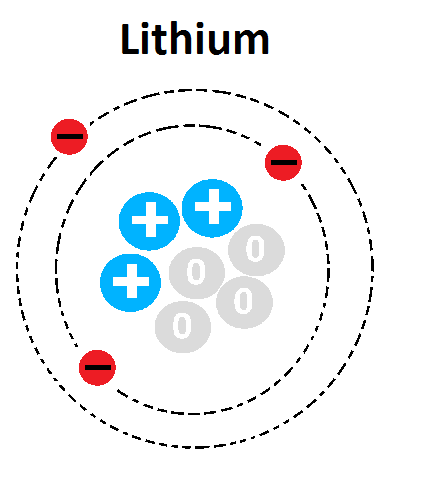
What is the atomic number of this atom?
a)
1
b)
3
c)
4
d)
7
65.

Which ones can be units for density?

(Multiple responses)

a)

g/ mL

b)

g

c)

gcm3\frac{g}{cm^3}  

d)

cm4cm^4  

66.

What is the mass of a 25 cm3  liquid if it has a density of 5 g/cm3?

a)

125 g

b)

5 g

c)

5gcm3\frac{5g}{cm^3}  

d)

0.2 cm30.2\ cm^3  

67.
Helium balloons rise on earth because
a)
helium is less dense than air
b)
helium is more dense than air
c)
helium is cooler than air
d)
helium is warmer than air
68.

A block of aluminum occupies a volume of 15.0 mL and weighs 45.0 g. What is its density?

a)

3 g/mL

b)

0.3333 g/mL

c)

675 g/mL

d)

I have no idea

69.

Which diagram shows the MOST dense object?

a)

left

b)

center

c)

right

70.

The smallest unit of matter.

a)

element

b)

atom

c)

nucleus

71.
Vinegar
a)
Heterogeneous
b)
Homogeneous
72.
Stainless steel
a)
Heterogeneous
b)
Homogeneous
73.
Soup
a)
Heterogeneous
b)
Homogeneous
74.
A substance is __________.
a)
a homogeneous mixture
b)
matter that has different compositions and properties throughout
c)
matter that has the same composition and properties throughout
d)
a heterogeneous mixture