
 Worksheets
8.4 Practice Quiz
Total questions: 60
Worksheet time: 2hrs 21mins
Name
Class
Date
1.
Water vapor is one of the components of the air in the atmosphere. What change causes the vapor in the air to form clouds?
a)
A. As air rises in the atmosphere, it becomes warmer and cannot hold as much water.
b)
B. As air cools, water vapor in the air condenses to liquid or solid state.
c)
C. Air rises, the water becomes heavier and changes form.
2.
What do we call a collection of millions of tiny water droplets or ice crystals?
a)
Fog
b)
Humidity
c)
Clouds
d)
Weather
3.
As the sun rises in the morning, fog will begin to ____________ into the air creating water vapor.
a)
condense
b)
precipitate
c)
transpire
d)
evaporate
4.
Water droplets that condense from the air onto cool surfaces near the ground are called....
a)
fog
b)
precipitation
c)
dew
d)
icicles
5.
What is relative humidity?
a)
humidity that is related to other humidity
b)
condensation
c)
clouds
d)
the amount of water in the air compared to the amount of water the air can hold - a ratio
6.
Air with a relative humidity of 100 percent is said to be __________________.
a)
Saturated
b)
Unsaturated
c)
Dry
d)
warm
7.

Which weather instrument is useful in measuring relative humidity?
a)
barometer
b)
anemometer
c)
psychrometer
d)
wind vane
8.

Air has a dry-bulb temperature of 6 °C and a wet-bulb temperature of 2 °C, what is the relative humidity?
a)
6%
b)
72%
c)
28%
d)
46%
9.
Warm saturated air contains _______ water vapor than cold saturated air.
a)
more
b)
less
c)
the same
10.
The colder the air the __________ water vapor it can hold.
a)
less
b)
more
c)
same amount of
11.

Identify this cloud type
a)
cirrus
b)
cumulus
c)
stratus
d)
cumulonimbus
12.

What type of cloud is shown?
a)
cumulus
b)
cirrus
c)
nimbostratus
d)
cumulonimbus
13.

Identify this cloud type
a)
cirrus
b)
cumulus
c)
stratus
d)
cumulonimbus
14.

How do clouds form?
a)
Liquid water is heated and evaporates and becomes water vapor in the atmosphere.
b)
Water vapor in the atmosphere cools and condenses to become tiny liquid water droplets in the atmosphere.
c)
Tiny liquid water droplets float upwards and gather together in the atmosphere to form a cloud.
15.

Cumulonimbus clouds usually have what kind of weather associated with it?
a)
fair weather
b)
thunderstorms
c)
snow
d)
nice weather
16.

What type of weather do Cumulus clouds have?
a)
fair weather (nice)
b)
thunderstorms
c)
rain/storms coming
d)
snow
17.

Cirrus clouds have what form of weather occur with them?
a)
fair weather
b)
thunderstorms
c)
fair weather now, but rain/snow within 24-26 hours
d)
long periods of rain
18.
During which part of the water cycle do clouds form?
a)
Evaporation
b)
Precipitation
c)
condensation
d)
Run off
19.
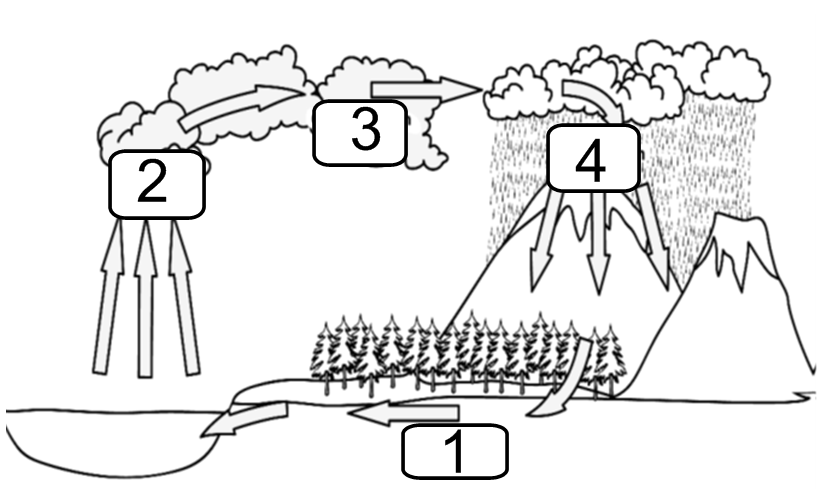
Which stage does the #2 show in the diagram?
a)
condensation
b)
evaporation
c)
precipitation
d)
run off
20.

Dew also forms directly onto items, as water droplets. What part of the water cycle is this?
a)
run-off
b)
condensation
c)
evaporation
d)
precipitation
21.

Which stage does the #3 show in the diagram?
a)
condensation
b)
evaporation
c)
precipitation
d)
run off
22.

What does the #4 show in the diagram?
a)
condensation
b)
evaporation
c)
precipitation
d)
run off
23.

What does this illustration show?
a)
Land breeze
b)
The Water Cycle
c)
The carbon cycle
d)
the recycling of snow
24.

This is what heats up the water to start the water cycle.
a)
sun
b)
moon
c)
stars
d)
Mars
25.

What is the relative humidity of this cloud?
a)
500%
b)
50%
c)
7%
d)
14%
26.
What kind of pressure predicts good weather?
a)
rising pressure
b)
falling pressure
c)
steady pressure
d)
stationary
27.
This type of front can bring strong storms
a)
cold
b)
warm
c)
stationary
d)
occluded
28.
This type of front results in the same weather for several days
a)
warm
b)
cold
c)
stationary
d)
occluded
29.
Which front would you possibly see cooler temperatures, heavy rain or snowfall?
a)
warm front
b)
cold front
c)
stationary front
d)
occluded front
30.
At which humidity is it more likely to rain?
a)
50%
b)
20%
c)
77%
d)
99%
31.
When water vapor condenses and turns back to water droplets to form clouds. This process is called
a)
Evaporation
b)
Precipitation
c)
Condensation
d)
Elevation
32.
The weather forecast is 95* F with 80% humidity and the air pressure will be high. Which three instruments will you use to predict this forecast?
a)
hygrometer, wind vane, satellite image
b)
barometer, anemometer, hygrometer
c)
thermometer, barometer, hygrometer
d)
thermometer, wind vane, anemometer
33.
It is a nice, sunny day. There is a large drop in pressure. What weather condition will LIKELY occur in the next 6-8 hours?
a)
Partly sunny and breezy
b)
Partly cloudy and breezy
c)
Sunny and calm
d)
Rainy and windy
34.

Observe the cloud types shown in the pictures below. Which kind of clouds would be MOST likely to produce a thunderstorm?
a)
A
b)
B
c)
C
d)
D
35.

How do we name air masses?
a)
Water and temperature
b)
Air pressure
c)
Humidity (moisture) and temperature
d)
Cold and warm
36.

How do we characterize an air mass that forms over the ocean?
a)
Dry
b)
Moist
c)
Cold
d)
Warm
37.

How do we characterize an air mass that forms over land?
a)
Dry
b)
Wet
c)
Cold
d)
Warm
38.

What's the humidity and temperature of a continental tropical air mass?
a)
Wet and cold
b)
Dry and warm
c)
Wet and warm
d)
Dry and cold
39.

What's the humidity and temperature of a maritime tropical air mass?
a)
Wet and cold
b)
Dry and warm
c)
Wet and warm
d)
Dry and cold
40.

Which abbreviation of an air mass can be identified as cold and moist?
a)
cP
b)
mP
c)
cT
d)
mT
41.

Which abbreviation of an air mass can be identified as dry and cold?
a)
cP
b)
mP
c)
cT
d)
mT
42.

Which abbreviation of an air mass can be identified as warm and moist?
a)
cP
b)
mP
c)
cT
d)
mT
43.

Which abbreviation of an air mass can be identified as dry and hot?
a)
cP
b)
mP
c)
cT
d)
mT
44.

Which type of air would you find at air mass D?
a)
cold, dry
b)
warm, humid
c)
warm, dry
d)
cold, humid
45.

Which type of air would you find at air mass C?
a)
cold, dry
b)
warm, humid
c)
warm, dry
d)
cold, humid
46.

Which type of air would you find at air mass A?
a)
cold, dry
b)
warm, humid
c)
warm, dry
d)
cold, humid
47.
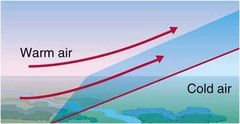
Which type of front is displayed?
a)
Cold
b)
Warm
c)
Stationary
d)
Occluded
48.

Which type of front is displayed?
a)
Cold
b)
Warm
c)
Stationary
d)
Occluded
49.

A __________ is a boundary separating two air masses of different densities.
a)
front
b)
air mass
c)
pressure
d)
land
50.

Which type of weather would you expect near Tulsa?
a)
stormy
b)
sunny
c)
several days of rain
d)
fair
51.

Which type of weather would you expect near Seattle?
a)
cooler temperatures
b)
rain for several days
c)
sunny
d)
warmer temperatures
52.

Instruments used to measure air pressure are called
a)
thermometers
b)
hygrometers
c)
hydrometers
d)
barometers
53.
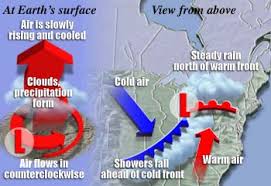
Which system results in rainy or stormy weather?
a)
high pressure
b)
low pressure
c)
hurricane
d)
weather system
54.

High pressure is associated with what kind of weather (picture on right side)?
a)
Fair
b)
Warmer
c)
Rainy
d)
Cloudy
55.

Low pressure is associated with what kind of weather (picture on left side)?
a)
Nice
b)
Sunny
c)
Cloudy
d)
No weather
56.

Yesterday's air pressure reading was 30.14. Today the barometric pressure is 29.75. What can you predict will happen with the weather if the pressure continues to drop?
a)
maybe rain
b)
temperature drop
c)
more clouds
d)
all of these are possible
57.

How do winds move around different areas of pressure?
a)
clockwise around a Low and into a High
b)
clockwise around a High and into a Low
c)
counterclockwise around a Low and into a High
d)
counterclockwise around a High and into a High
58.

What does this tool measure?
a)
Wind speed
b)
Wind direction
c)
relative humidity
Air pressure
Air pressure
d)
pressure
Temperature
Temperature
59.

This weather instrument is a(n)____________ and measures ______________.
a)
wind vane; wind speed
b)
anemometer; wind speed
c)
barometer; pressure
d)
thermometer; temperature
60.

Which tool measures humidity or the amount of moisture in the air?
a)
wind vane
b)
barometer
c)
anemometer
d)
hygrometer/psychrometer
100 %

