
NEW
Font size
S
M
L
XL
 Worksheets
Chem Chap 4: Electron Configurations
Total questions: 42
Worksheet time: 37mins
Name
Class
Date
1.
Which has the LONGEST wavelength and, therefore, the lowest frequency/energy
a)
Gamma Rays
b)
Radio Waves
c)
Visible Light
d)
Infrared rays
2.
Which has the SHORTEST wavelength and, therefore, the highest frequency/most energy
a)
Radio waves
b)
Ultraviolet Rays
c)
Gamma Rays
d)
X-rays
3.
Which section of the spectrum is the ONLY one we can see?
a)
X-rays
b)
Visible Light
c)
Gamma Rays
d)
Ultraviolet Rays
4.
Put the visible light colors in order from longest wavelength to shortest wavelength
a)
Violet, Indigo, Blue, Green, Orange, Yellow, Red
b)
Red, Yellow, Green, Orange, Violet, Blue, Indigo
c)
Red, Orange, Yellow, Green, Blue, Indigo, Violet
5.
How are electromagnetic waves different from other waves?
a)
They have very short wavelengths
b)
They transmit energy instead of matter
c)
They can travel through a vacuum
d)
They can change direction by reflection
6.
As the frequency of an electromagnetic wave increases, the amount of energy in that wave...
a)
increases.
b)
decreases.
c)
stays the same.
7.
Which color has the highest frequency?
a)
red
b)
orange
c)
green
d)
blue
8.
Which color has the least amount of energy?
a)
red
b)
orange
c)
green
d)
blue
9.

High frequency waves have _________ wavelengths.
a)
varying
b)
long
c)
the same
d)
short
10.
What electron configuration matches an oxygen ion?
a)
1s22s22p63s2, 3p64s23d104p5
b)
1s22s22p4
c)
1s22s22p6
d)
1s22s22p63s23p64s23d1
11.

Which element is depicted from this orbital diagram
a)
Fluorine
b)
Neon
c)
Chlorine
d)
Argon
12.
What atom matches this electron configuration?
1s22s22p63s2
1s22s22p63s2
a)
Neon
b)
Magnesium
c)
Aluminum
d)
Potassium
13.
For an electron to change from ground state to an excited stated it must...
a)
Absorb energy
b)
Release energy
14.

This image is an illustration of
a)
photoelectric effect
b)
Dalton's atomic theory
c)
Bohr model
d)
Quantum mechanical model
15.
In the Bohr model, the orbit closest to the nucleus is
a)
called the ground state and is lowest in energy
b)
called the ground state and is highest in energy
c)
called the excited state and is lowest in energy
d)
called the excited state and is highest in energy
16.
Quantized means that only certain values are allowed.
a)
True
b)
False
17.
Both light and electrons have dual nature. That is, they both may have properties of waves and particles.
a)
True
b)
False
18.
Define "quantized"
a)
The electron's mass is very small.
b)
The electron is actually a wave.
c)
The position & momentum of the electron cannot be known at the same time.
d)
The electron is limited to certain positions in the atom.
19.
"Electrons in the same orbital have opposite spin."
a)
Aufbau principle
b)
Hund's Rule
c)
Pauli Exclusion Principle
d)
Uncertainty Principle
20.
"Electrons fill lower energy orbitals before filling higher energy orbitals."
a)
Aufbau principle
b)
Hund's Rule
c)
Pauli Exclusion Principle
d)
Uncertainty Principle
21.
"Electrons fill equal energy orbitals singly before pairing."
a)
Aufbau principle
b)
Hund's Rule
c)
Pauli Exclusion Principle
d)
Uncertainty Principle
22.
True or False: The majority of an atom is made up of empty space
a)
True
b)
False
23.
What is the experiment where light is shone on the surface of metal, causing electrons to be emitted?
a)
photoelectric effect
b)
photon effect
c)
quantum mechanical effect
d)
quantized effect
24.
Emission of light from an atom occurs when an electron
a)
drops from a higher to a lower energy level.
b)
jumps from a lower to a higher energy level.
c)
moves within its atomic orbital.
d)
falls into the nucleus.
25.
The _______________ determines the color of visible light.
a)
wavelength
b)
speed
c)
amplitude
d)
light
26.

a)
helium and hydrogen
b)
helium and calcium
c)
hydrogen and calcium
d)
hydrogen and helium
27.

The characteristic color bands that a hot, dilute gas emits are called...
a)
emission spectra
b)
absorption spectra
c)
continuous spectra
d)
black body radiation
28.

This picture is an example of a(n)...
a)
absorption spectrum
b)
emission spectrum
c)
continuous spectrum
d)
black body spectrum
29.
All moving particles have wavelike characteristics
a)
de Broglie Equation
b)
Heisenberg Uncertainty Principle
c)
Schrodinger Equation
d)
Pauli Exclusion Principle
30.
Maximum number of electrons that can be placed in an s orbital.
a)
2
b)
6
c)
10
d)
14
31.
The maximum number of electrons that can be placed in an p orbital.
a)
2
b)
6
c)
10
d)
14
32.
The maximum number of electrons that can be placed in an d orbital.
a)
2
b)
6
c)
10
d)
14
33.
The maximum number of electrons that can be placed in an f orbital.
a)
2
b)
6
c)
10
d)
14
34.
Spherical orbital, also the lowest energy orbital.
a)
s
b)
p
c)
d
d)
f
35.
This orbital fill after the s, the shape is a dumbbell.
a)
s
b)
p
c)
d
d)
f
36.
In an orbital diagram, an arrow represents:
a)
an electron
b)
an orbital
c)
an element
37.

This orbital diagram represents:
a)
C
b)
B
c)
N
d)
O
38.
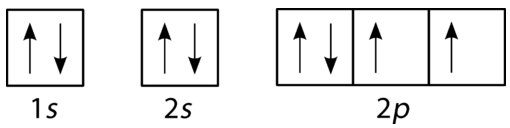
This orbital diagram represents:
a)
C
b)
B
c)
N
d)
O
39.

What is incorrect about this orbital diagram?
a)
Both arrows in the 2p box should be pointing up
b)
There is nothing incorrect with this diagram
c)
In the there should only be 1 orbital in the first 2p box and one in the 2nd 2p box
d)
All the arrows should be pointing up.
40.
What are the sublevels that make up the n=3 energy level?
a)
s
b)
s, p
c)
s, p, d
d)
s, p, d, f
41.
What is the maximum number of electrons that an orbital can have?
a)
1 electron
b)
2 electrons
c)
3 electrons
d)
4 electrons
42.

Which is associated with the most energy?
a)
2p
b)
2s
c)
3p
d)
1s
Reset

