
 Worksheets
HS/Honors Midterm Review Semester 1
Total questions: 100
Worksheet time: 1hrs 29mins
Name
Class
Date
1.
Why are approved eye protection devices (such as goggles) are worn in the lab?
a)
A. To improve your vision
b)
B. To make you look like a bug
c)
C. To give you headaches
d)
D. To protect eyes around chemicals, heat, or glassware
2.
What should you do when gathering materials for an experiment?
a)
A. Read all directions carefully
b)
B. Check all materials for chips or cracks (or broken)
c)
Clean the materials if they seem dirty/used
d)
D. All of the above
3.

You may eat or drink in the science laboratory...
a)
after you have washed your hands.
b)
on the days you are not doing a lab.
c)
only from the beakers.
d)
at no time unless given teacher approval.
4.
A possible explanation to a problem that has not yet been tested.
a)
data
b)
theory
c)
hypothesis
d)
fact
5.
This variable in an experiment is the one being deliberately changed by the scientist.
a)
dependent variable
b)
independent variable
c)
data
d)
control group
6.
Should experiments be repeated over and over to see if the results are the same each time?
a)
yes
b)
no
7.
The summary at the end of an experiment that explains the results.
a)
conclusion
b)
procedures
c)
materials
d)
responding variable
8.
There are two types of data. Which type of data involves descriptions/photographs/illustrations that cannot be counted or measured?
a)
qualitative
b)
quantitative
9.
A series of steps used by scientists to solve a problem or answer a question.
a)
scientific method
b)
recipe
c)
data collection
d)
metric system
10.
In a controlled experiment, how many independent variables can be worked with at a time?
a)
one
b)
none
c)
two or more
d)
how ever many makes sense.
11.
Measuring the number of times a person breathes after exercise involves ____ data.
a)
quantitative
b)
qualitative
12.
Mr. S. sets up an experiment to see how the mass of a ball affects the distance it rolls off a ramp. Identify the dependent variable.
a)
height of the ramp
b)
distance traveled by the ball
c)
mass of the ball
d)
weight of the ball
13.
Mr. S. sets up an experiment to see how the mass of a ball affects the distance it rolls off a ramp. Identify the independent variable.
a)
distance traveled by the ball
b)
height of the ramp
c)
mass of the ball
d)
weight of the ball
14.
A distance vs. time graph shows an object's
a)
frame of reference
b)
speed
c)
acceleration
d)
favorite food
15.
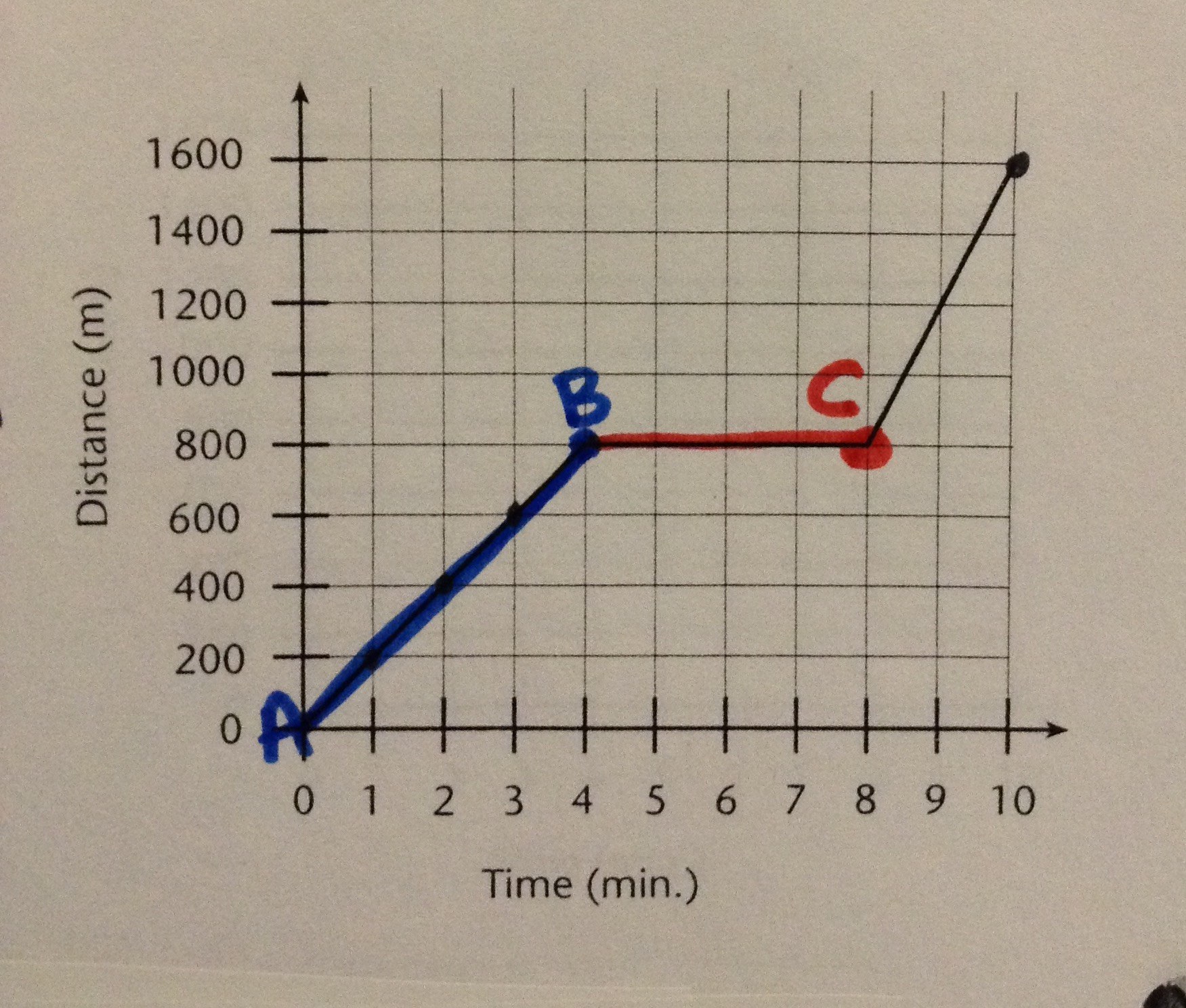
The graph shows Ashley riding her bike to Maria's house.
What is occurring from point A to point B?
What is occurring from point A to point B?
a)
they are traveling at a constant speed
b)
they are decreasing in speed
c)
they stopped to take a break
16.
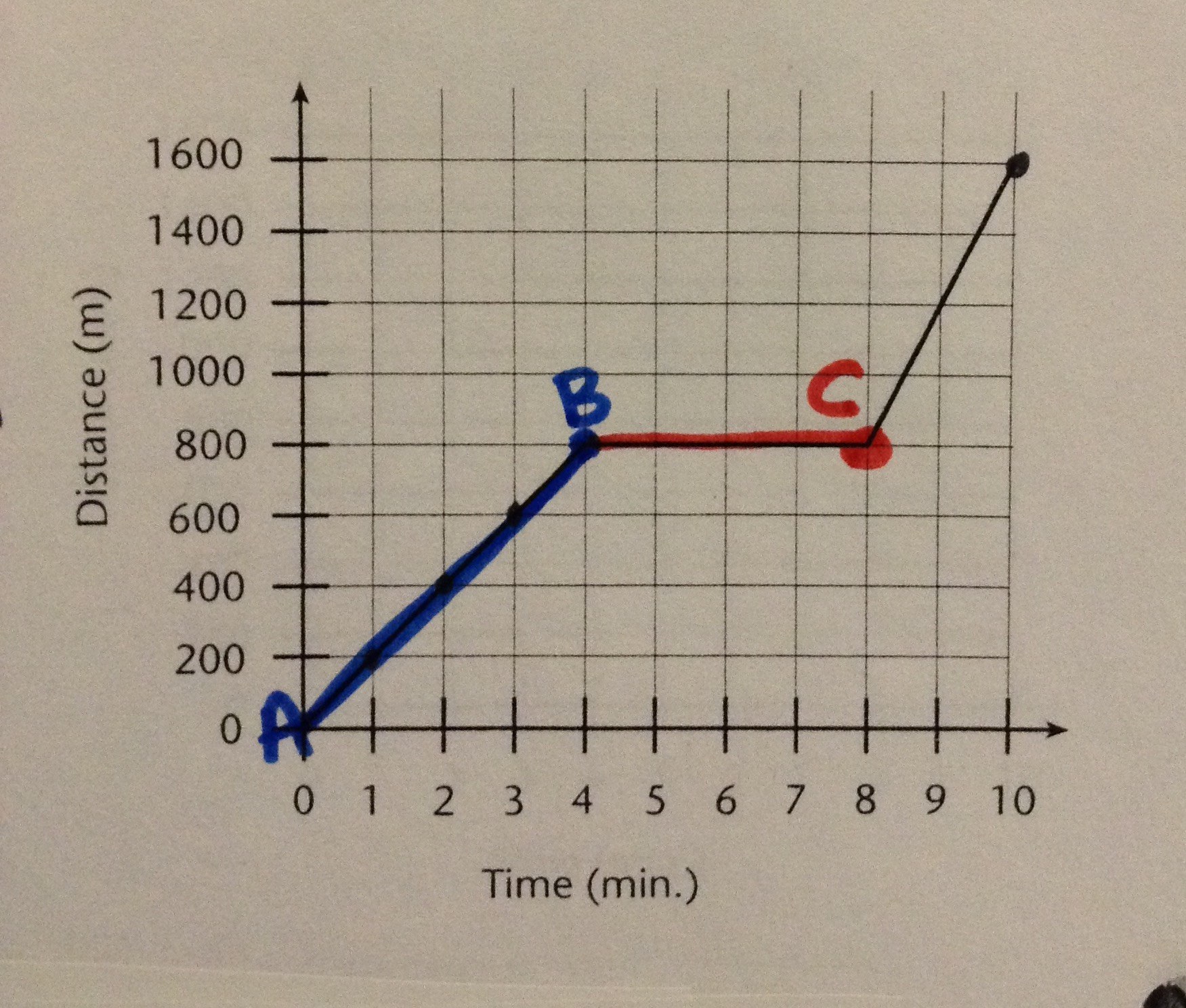
The graph shows Ashley riding her bike to Maria's house.
What was occurring from point B to point C?
What was occurring from point B to point C?
a)
She was increasing her speed.
b)
She stopped for 4 minutes
c)
She was decreasing in speed
17.
What is velocity?
a)
Time + Distance
b)
Speed in a given direction
c)
A fast dinosaur
d)
The direction a storm is moving
18.

The graph represents
a)
no motion
b)
Constant velocity
c)
Acceleration
d)
negative acceleration
19.

The graph represents
a)
no motion
b)
constant velocity
c)
acceleration
d)
negative acceleration
20.

The graph respresents
a)
No motion
b)
Constant Velocity
c)
Acceleration
d)
Deceleration
21.
An object is _____ if its position changes relative to another object.
a)
in motion
b)
at reset
c)
a frame of refence
d)
magical
22.
Speed =
a)
distance / time
b)
time / distance
c)
distance * time
23.
What is a PUSH or PULL of an object?
a)
Motion
b)
Force
c)
Friction
d)
Gravity
24.
What is MOVEMENT?
a)
Inertia
b)
Force
c)
Work
d)
Motion
25.
What happens when one force PULLS an object toward another?
a)
Friction
b)
Motion
c)
Gravity
d)
Magnetism
26.
What is a force that works AGAINST MOTION?
a)
Force
b)
Motion
c)
Gravity
d)
Friction
27.

In the image, which of the person and their bikes will get down a hill faster?
a)
The boy because he is younger
b)
The woman because she is stronger
c)
The boy because he has a greater mass which applies a greater force
d)
The woman because she has more mass and applies a greater force
28.
How is gravity affected by mass?
a)
the larger the mass of the object, the greater the gravity
b)
small objects have no gravity
c)
gravity is not affected by mass of objects, whether large or small
29.
Which force produces a change in motion?
a)
unbalanced force
b)
balanced force
c)
gravitational force
d)
frictional force
30.
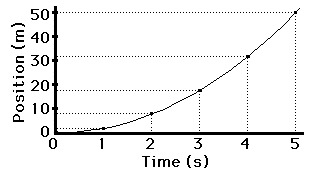
The picture of the position vs. time graph shows an object that is...
a)
accelerating/speeding up
b)
moving at a constant speed
c)
not moving
d)
accelerating/slowing down.
31.
What is the standard unit force is measured in?
a)
Newtons
b)
pounds
c)
grams
d)
meters
32.
Distance and direction of an object's change in position from a starting point
a)
displacement
b)
distance
c)
motion
d)
reference point
33.
What is magnitude?
a)
The direction that describes a quantity.
b)
A numerical value
c)
A unit of force
34.
A 150N weight hanging DOWN from a rope. Vector or scalar?
a)
Scalar
b)
Vector
35.
A quantity that has both magnitude and direction is called a scalar quantity.
a)
True
b)
False
36.
Velocity
a)
Vector
b)
Scalar
37.
Speed
a)
Vector
b)
Scalar
38.
Which symbol is used to show vector quantities?
a)
Circle
b)
Line
c)
Arrow
d)
Triangle
39.
Total distance divided by total time is
a)
average speed
b)
constant speed
c)
instantaneous speed
d)
acceleration
40.
You walk 10 meters to math class in 20 seconds. Your average speed is
a)
2 m/s
b)
0.5 m/s
c)
200 m/s
d)
5 m/s
41.
What is a Scalar Quantity?
a)
Quantities that are fully described by a magnitude (or numerical value) alone.
b)
Quantities that are fully described by both a magnitude and a direction.
c)
Quantities with an unknown direction
d)
Scalar refers to a quality, not a quantity
42.
A wave carries...?
a)
energy only
b)
matter only
c)
the matter carries the energy
d)
neither
43.
Why does sound travel faster through a solid object than in the air?
a)
The atoms in the solid object are farther apart than the atoms in the air
b)
The atoms in the solid object are closer together than the atoms in the air
c)
The atoms are smaller in the solid object than the atoms in the air.
d)
The atoms are larger in the solid object than the atoms in the air
44.
How are earthquakes, sound, and light waves alike?
a)
They transmit energy
b)
They carry matter
c)
They travel in space
d)
They can be seen
45.
What law is best described by inertia?
a)
1st
b)
2nd
c)
3rd
46.
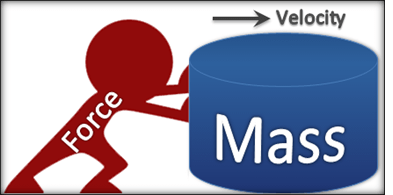
a)
1st
b)
2nd
c)
3rd
47.
Objects tendency to resist change
a)
Friction
b)
Inertia
c)
Force
d)
Gravity
48.

When you step on a Lego. You push on the Lego and the Lego pushes back on you.
a)
Newton's 1st Law
b)
Newton's 2nd Law
c)
Newton's 3rd Law
49.

A magician pulls a tablecloth out from under dishes and glasses on a table without disturbing them.
a)
Newton's 1st Law
b)
Newton's 2nd Law
c)
Newton's 3rd Law
50.

Rockets are launched into space using jet propulsion where exhaust accelerates out from the rocket and the rocket accelerates in an opposite direction.
a)
The Law of Inertia
b)
The Law of Acceleration
c)
The Law of Conservation of Momentum
51.

"For every action, there is an equal and opposite reaction."
a)
Newton's 1st Law
b)
Newton's 2nd Law
c)
Newton's 3rd Law
d)
Newton's 4th Law
52.

Force = Mass x Acceleration
a)
Newton's 1st Law
b)
Newton's 2nd Law
c)
Newton's 3rd Law
d)
Newton's 4th Law
53.

"An object in motion (or at rest) will to stay in motion (or at rest) until an outside force acts upon it."
a)
Newton's 1st Law
b)
Newton's 2nd Law
c)
Newton's 3rd Law
d)
Newton's 4th Law
54.
According to the Law of Conservation of Energy, energy can...
a)
Change from one form to another
b)
Be created
c)
Be destroyed
55.
A pendulum is an example of an...
a)
Isolated System
b)
Closed System
c)
Open System
56.
In a closed system..
a)
Energy can be exchanged with the surroundings but matter cannot
b)
Matter can be exchanged with the surroundings but energy cannot
c)
Both matter and energy can be exchanged with the surroundings
d)
Neither energy or matter can be exchanged with the surroundings
57.
As energy transformations occur within a system, the total energy of the system __________________.
a)
remains
constant
b)
increases
c)
is transferred out of the system
d)
decreases
58.
What energy transformation is completed during the process of cellular respiration?
a)
Light energy is transformed into chemical energy
b)
Mechanical energy is transformed into chemical energy
c)
Stored energy is transformed into usable chemical energy
d)
Stored energy is transformed into usable chemical energy
59.
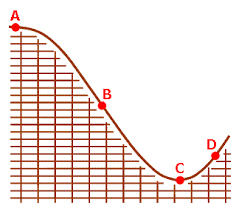
At which point(s) on the roller coaster is the kinetic energy at its maximum?
a)
A
b)
B
c)
C
d)
D
60.
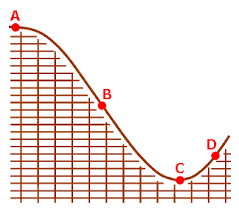
At which point(s) on the roller coaster is the gravitational potential energy at its maximum?
a)
A
b)
B
c)
C
d)
D
61.
What states that energy can never be created or destroyed?
a)
law of conservation of momentum
b)
law of conservation of energy
c)
law of conservation of matter
d)
law of conservation of water
62.
In a collision, momentum is
a)
created
b)
lost
c)
conserved
63.
The total momentum before a collision is _________ the total momentum after a collision.
a)
equal to
b)
less than
c)
more than
d)
It depends on the type of collision
64.
The momentum of an object depends upon the object's ___________&_____________.
a)
size and shape
b)
mass and speed
c)
mass and veloctiy
d)
mass and energy
65.
If two objects have the same mass, then the faster moving object has ____________ momentum.
a)
more
b)
less
c)
the same
66.
How can a tennis ball and a bowling ball have the same momentum?
a)
have the same speed
b)
have different speeds
c)
one is moving backwards
d)
they can't
67.
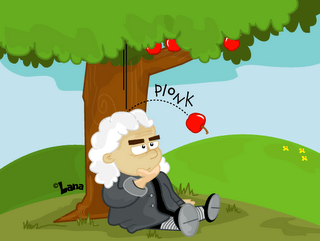
What is gravitational force?
a)
It makes objects at rest start moving.
b)
It makes objects that are moving stop.
c)
The force of attraction between two objects.
d)
It pulls you into space.
68.
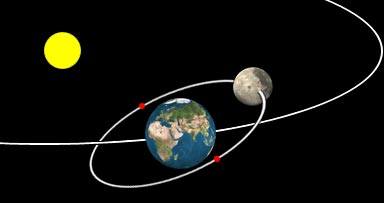
Why doesn't the moon crash into the Earth?
a)
The moon has more mass, so the Earth orbits around it.
b)
The moon's gravitational force is weak.
c)
Inertia keeps the moon stationary.
d)
The moon has a lot of mass and is farther away.
69.
Gravitational force between two massive spheres
a)
is always an attraction
b)
depends on how massive they are
c)
depends inversely on the square of the distances between them
d)
all of the above
70.
If I double the mass of one object, but don't change anything else... What happens to the gravitational force between two objects?
a)
Doubles
b)
Quadruples
c)
Cut in Half
d)
4x Smaller
71.

As a pendulum swings from its highest to lowest position, what happens to its kinetic and potential energy?
a)
Both the potential energy and kinetic energy decrease
b)
The potential energy decreases while the kinetic energy increases
c)
The kinetic energy decreases while the potential energy increases
d)
Bothe the potential energy and kinetic energy increase
72.

When a pendulum swings, at which point is kinetic energy highest?
a)
1
b)
2
c)
3
d)
4
73.

When a pendulum swings, at which point is potential energy at its greatest?
a)
1
b)
2
c)
3
d)
4
74.
Predict what would happen to the gravitational pull between the Sun and Earth if the Earth's distance from the Sun increased
a)
the gravitational pull would incre
b)
The gravitational pull would decrease
c)
The gravitational pull would stay the same
75.
The unit used to measure work is the
a)
Watt
b)
Newton
c)
Joule
d)
meter
76.
A force exerted over a distance to move an object is ______________________.
a)
power
b)
work
c)
momentum
d)
Watt
77.
Which of the following is the best example of work being done.
a)
doing homework
b)
lifting a box
c)
pushing a stationary box
d)
holding a box
78.
A 5000N block is lifted 10 m. How much work was done?
a)
50000 J
b)
5000 J
c)
500 J
d)
50 J
79.
How much power is the tractor that drags a plow with a force of 500 N a distance of 10 meters in 20 seconds?
a)
250 Watts
b)
250 Joules
c)
100,000 Watts
d)
100,000 Joules
80.
The more POWER you use to move an object, the more work you do.
a)
True
b)
False
81.
Work done = Force x _________
a)
a. distance
b)
b. acceleration
c)
c. velocity
d)
d. speed
82.
Copper is used to make electrical wires. Why is copper a good conductor?
a)
It contains free electrons that carry an electric current.
b)
It stops an electric current from flowing.
c)
It is an expensive metal.
d)
It is an abundant metal.
83.
Wires have a plastic coating on the outside of them.
What is the purpose of the plastic coating?
What is the purpose of the plastic coating?
a)
to carry electrical current from place to place
b)
to protect the wires from getting broken or bent
c)
to keep the two different types of metal wires from getting tangled
d)
to protect people from the electrical current flowing through the wires
84.
Gan is using a circuit to test materials to determine which ones are good insulators. What happens when he tests a good insulator?
a)
He gets an electrical shock.
b)
No current flows through the circuit.
c)
A strong current flows through the circuit.
d)
The current flowing through the circuit flows weakly and then strongly.
85.
What is another name for an open circuit?
a)
Complete Circuit
b)
Incomplete Circuit
86.
What is another name for a closed circuit?
a)
Complete Circuit
b)
Incomplete Circuit
c)
produces light energy
d)
has the right kind of insulators
87.

What type of circuit is shown below?
a)
Series Circuit
b)
Parallel Circuit
88.

What type of circuit is shown below?
a)
Series Circuit
b)
Parallel Circuit
89.
How many Volts would it take to push 1 Amp through a resistance of 1 Ohm
a)
10 volts
b)
1 volt
c)
48 volts
d)
5 volts
90.
What size resistor would produce a 3 Amp current flow with a 12 Volt battery
a)
1 Ohm
b)
3 Ohms
c)
4 Ohms
d)
12 Ohms
91.
If the battery produced 12.6 Volts and what would be the current flow be for a 6 Ohm resistor
a)
2.1 Amps
b)
2.4 Amps
c)
1.71 Amps
d)
15 Amps
92.

This is an example of a _______ circuit
a)
open
b)
series
c)
parallel
d)
square
93.

This is an example of a ______ circuit
a)
Series
b)
Parallel
c)
Open
d)
Dihexihedral
94.
Which way does heat flow?
a)
hot to cold
b)
cold to hot
c)
it doesn't
95.
What is the definition of CONDUCTION?
a)
When heat is transferred from objects like rays of light or electromagnetically.
b)
a hot liquid or air that expands, becomes less dense, and rises or becomes more dense, and sinks.
c)
When heat transfers from objects that are touching.
d)
When heat transfers through the heater or AC in your house.
96.
What is the definition of CONVECTION
a)
When heat transfers through waves.
b)
When heat transfers from objects that are touching.
c)
a hot liquid or air that expands, becomes less dense, and rises or becomes more dense, and sinks.
d)
Heat traveling from the sun
97.
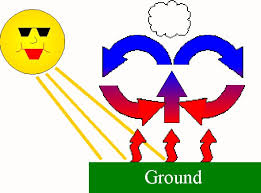
Warm air rises and the cool air sinks demonstrates this type of heat transfer.
a)
conduction
b)
convection
c)
radiation
d)
Insolation
98.
Transfer of thermal energy through "space"
a)
conduction
b)
convection
c)
radiation
99.
This is a measure of the average kinetic energy of the particles in an object.
a)
temperature
b)
thermal expansion
c)
electricity
d)
sound
100.

What is the temperature on the thermometer?
a)
28° Celsius
b)
20° Fahrenheit
c)
18° Celsius
d)
20° Celsius
100 %

