
 Worksheets
G.8 Science Final Exam I Review
Total questions: 100
Worksheet time: 1hrs 5mins

A wave is a disturbance that transfers ________ from one place to another.
Matter
Mass
Energy

What types of waves can travel through empty space AND mediums?
Longitudinal
Mechanical
Electromagnetic

Which of the following is a mechanical wave?
X-ray
Infrared
Radio waves
Sound

What medium do sound waves travel fastest through?
Solids
Liquids
Gases

The height of a wave from its resting point (B).
Frequency
Wave speed
Wavelength
Amplitude
The length of a wave, from crest to crest or trough to trough. (D)
Frequency
Wave speed
Wavelength
Amplitude

The number of waves passing a given point each second is:
Frequency
Wave speed
Wavelength
Amplitude
If a wave has a high frequency, it will have __________ energy.
High
Medium
Low
If a wave has a high amplitude, it will have __________ energy.
High
Medium
Low

Which letter represents wavelength?
A
B
C
D

Which letter represents the wave crest?
A
B
C
D

Which letter represents the wave trough?
A
B
C
D

What part of the wave is a compression?
A
B

What part of the wave is a rarefaction?
A
B

Transverse waves carry energy _______ to the direction the medium is moving.
perpendicular
opposite
parallel
at a 45 degree angle

A longitudinal wave carries energy __________ to the direction the medium is moving.
at a 90 degree angle
perpendicular
parallel
at a 45 degree angle

What is the Doppler Effect?
Where the wavelength of a wave is shifted due to the source moving
When a wave is shifted when a body pushes the wave
Where the apparent wavelength of a wave is shifted due to the source moving
What does the Auditory nerve do?
Carries the message to the brain
Carries the message to the Semi-Circular canal
Send the message to the Eustachian tube

Name the 3 bones in your ear
Hammer, Stirrup, Cochlea
Hammer, Anvil, Stirrup
Rods, Cones, Anvil
Where is the Eardrum located?
The Outer ear
The Inner Ear
The Middle Ear
Where is the Cochlea located
The Inner Ear
The Middle Ear
The Outer Ear
________ is a reflected sound.
Vibration
Echo
Pitch
Volume
Sound does not travel in space because
Distance is too far away.
There is no matter in space.
It is too dark.
Space has planets.
The volume of a sound is measured in units called ________
decibels
hertz
frequency
amplitude
What is Pitch?
How loud or soft a sound is.
Muscle that holds vocal cords.
Movement back and forth.
How high or low a sound is.
Which of the following sound wave produces the highest pitch of sound?


Diagram shows 3 types of sound waves generated from speaker. Which of the following statements is true?
P has a higher pitch than Q
Q has a higher pitch than R
R has the highest pitch
P, Q and R have the same pitch


What part is #2?
Pinna
Ear Canal
Ear Drum
Oval Window
What part is #3?
Pinna
Ear Canal
Ear Drum
Oval Window
What part is #7?
Semicircular Canals
Eustachian Tube
Cochlea
Oval Window
What part is #15?
Outer Ear
Middle Ear
Inner Ear
Sub Ear
What part is #17?
Outer Ear
Middle Ear
Inner Ear
Sub Ear
How can we protect our ears from hearing loss?
Wear ear plugs
Put our fingers in our ears
Try not to listen to loud things
All of the above
Echolocation is used in which of the following technologies?
Radar
Sonar
X ray imaging
Optic fibers
Sonar stands for
Sound narrowing and reflection
Sound navigation and ranging
Sound nearing and reabsorption
Sound navigation and reflection
Constructive interference causes a quieter sound
true
false
Destructive interference causes the amplitude of a wave to increase
true
false
Which of the following situations would cause light to refract?
traveling through a vacuum
moving from air to water
moving through the air
passing from one glass block to another


Which electromagnetic waves have the highest frequencies and the shortest wavelengths?
microwaves
visible light
gamma rays
x-rays

Which electromagnetic waves are used in ovens and cell phone communications?
microwaves
infrared rays
gamma rays
ultraviolet rays

A wave with a large wavelength will have a ______ frequency and _____ energy
high, low
low, high
high, high
low, low

Which type of waves are used in broadcasting?
infrared rays
X-rays
radio waves
gamma rays

Select the correct order of waves on the EMS from the longest wavelength to the shortest wavelength
Radio, Micro, Infra, Visible, Ultra, X-ray, Gamma
Gamma, X-ray, Ultra, Vis, Infra, Micro, Radio
Vis, Micro, Infra, Ultra, X-ray, Gamma, Radio
Micro, Radio, Vis, Infra, Ultra, X-ray, Gamma

Which section of the spectrum is the ONLY one we can see?
Ultraviolet Rays
Gamma Rays
X-Rays
Visible Light

Which electromagnetic waves are used in devices such as heat lamps & TV remote controls?
Ultraviolet Rays
Microwaves
Infrared Rays
Gamma Rays


Scientists observed a celestial object emitting a wavelength of 3 x 10⁻¹⁰m. What type of telescope did the scientists have to use to view this?
Radio wave
Infrared ray
X-ray
Gamma Ray
Heat seeking missiles use _____________ electromagnetic technology.
Gamma
X ray
Microwave
Infrared
The medical profession uses _______ to sterilize medical equipment
Infrared
x ray
Gamma
Ultraviolet
Which electromagnetic waves are useful for Television?
Gamma
x ray
radio
microwave
Which wavelengths of the EM spectrum are dangerous to life?
radio, micro and gamma
gamma, infrared, and UV
Infrared, UV and X Rays
UV, X rays and Gamma
Which of the following does not use microwaves?
A mobile phone
Wifi
A speed Camera
A TV remote control

Materials that do not let any light pass through them.
opaque
transparent
transluecent
reflective material
Matter that transmit light is _______________.
opaque
transparent
transluscent
reflective material
What is the difference the way light interacts with the shirt and the way light interacts with the mirror?
The shirt reflects light while mirror absorbs light.
The shirt absorbs the light while mirror reflects light
The shirt transmit light while mirror scatters light.
The shirt absorbs light while mirror transmit light.
All the colors that we observed in an object are _________________ colors.
absorbed
reflected
transmitted
scattered
Occurs when light is sent in many direction as it passes through a medium.
absorption
reflection
refraction
scattering
In the evening sunlight travels trough a lot of air. The blue light _________________, leaving only redder light.
absorbs
reflects
refracts
scatters
A white surface absorbs all the color of light.
TRUE
FALSE

A material that allows almost all of the light striking it to pass through
transparent
translucent
opaque
reflection
Materials that allow light to pass through but not all of it are ___________.
Translucent
Transparent
Opaque

An apple appears red, because the red light is ________ to our eyes.
Reflected
Absorbed
A ________ object absorbs all colors.
Black
White
A _______ object reflects all colors.
Black
White

What is true about this yellow banana?
The color yellow is reflected while the other colors are absorbed.
The color yellow is absorbed while the other colors are reflected.
The color yellow is refracted while the other colors are reflected.
The color yellow is refracted while the other colors are absorbed.

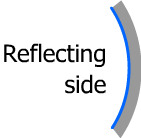
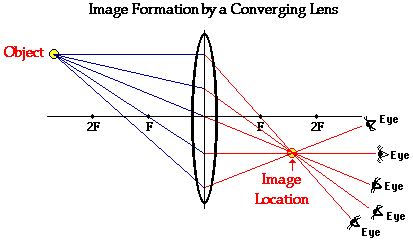
Which ray diagram shows a real image?


None of the above

The ray diagram when the object is placed on the focal point shows no image. Why is no image formed?
Because the principal rays intersect on the virtual side of the lens.
Because the principal rays are parallel to each other.
Because the principal rays are perpendicular to each other.
Because convex lenses cannot form images.
Four ray diagrams show the images formed in mirrors and lenses. Which shows a virtual image?


All of the above.


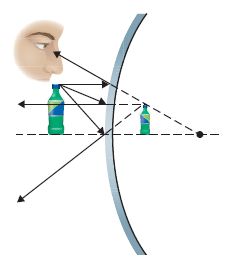
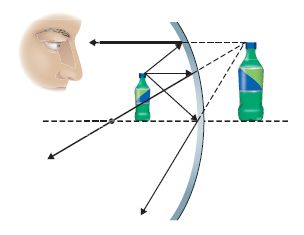
An image behind the mirror is...
virtual
real
inverted
upright
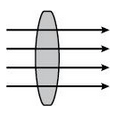
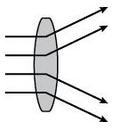
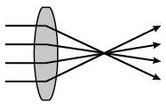
Which lens represents the path light takes through a diverging lens?


Which figure represents the path light takes through a converging lens?
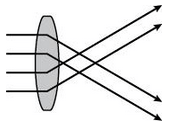
Which ray diagram is correct for convex lens?



