Worksheets
IIT-JEE & NEET LEVEL-3 (8-T)
Total questions: 100
Worksheet time: 2hrs 40mins
What is the sum of exterior angles of a quadrilateral?
180
90
360
540
The diagonals do not necessarily intersect at right angles in a ?
paralellogram
square
rhombus
kite
The measure of each interior angle of a rectangular polygon of 12 sides is ?
90
120
140
150
If a convex polygon has n sides, the no. of diagonals is given by ?
2n(n+3)
2n(n−3)
2n+(n−3)
2n+(n+3)
How many pairs of adjacent sides does a hexagon have ?
4
6
8
5
What is the formula for finding angle sum of a polygon if n is the number of sides ?
(n-1)x180
(n+1)x180
(n-2)x180
(n+2)x180
A circle is a ?
Simple closed curve
Simple curve
polygon
open curve
If a quadrilateral ABCD is such that AB=AD, BC=CD then it is called a ?
parallelogram
square
rectangle
kite
The angles of a quadrilateral are in the ratio 2:3:5:8, the angles are?
130,70,120,140
45,75,160.80
40,60,100,160
100,40,75,145
The measures of the angles of a quadrilateral ABCD are are in the ratio 1:2:3:4, which one of the statement is true?
AC=BC
AB II CD
AD II BC
None of the above
Which of the following statements is false for a square?
It is a rectangle
It has all sides of equal length
All squares are not parallelograms
Eid darkness bisect each other at right angles.
-3/4 ________ -4/5
-1.8_____ 0.8
-3.4 ________ -2.5
1/2 _______ -1/2
-3/4 ________ -4/5
Is the inequality statement true or false?
1.95 > 1.4 > 0.5 > -1.25 > -2.0
True
False

Which number has the least value?
0.4
1/3
5/6

Which statement about rational numbers is NOT correct?
All rational numbers are also integers.
Zero is a rational number.
All integers also rational numbers.
All rational numbers can be written in the form a/b .
Which statement is correct?
−1.5 < −2
−2.5 < −3
−3.5 < −2.5
Find -6.23 + 7.5
13.73
1.3
-1.27
1.27
-3/7 + 4/5
43/35
-13/35
13/35
4 3 +45 =
(a)
74+7−3=
(a)
−87+ 8−3 =
(a)
6−5+ 63 =
(a)
3−1 + 7−3=
(a)
−52 + 43 =
(a)
Solid particles are able to...
Move around
Move in random directions
Vibrate in a fixed position
Be compressed
Solid particles are able to...
Move around
Move in random directions
Vibrate in a fixed position
Be compressed
liquid particles are able to
move around
move in random directions
vibrate in a fixed position
be compressed
Gas particles move in random direction and at...
steady speeds
random speeds
faster speeds
slower speeds
Which state of matter is able to be compressed?
Liquids
Solids
Texas
Gases
Which state of matter is able to be compressed?
Liquids
Solids
Texas
Gases
Which state of matter is able change to the shape of the container but not be compressed?
Solids
Gases
Liquids
Sublimation
What is the name given to a substance changing state from a liquid to a gas?
Condensation
Freezing
Melting
Evapouration
What is the name given to a substance changing state from a solids to a gas?
Evaporation
Boiling
Sublimation
Condensation
What is the name given to a substance changing state from a liquid to a solid?
Boiling
Condensation
Melting
Freezing
What is the name given to a substance changing state from a gas to a liquid?
Freezing
Condensating
Evaporation
Boiling
What temperatures does water melt at and boil at? You need both (2) answers please
0 oC
1 oC
100 oC
60 oC
Which two statements correctly describe the properties of a solid?
The particles are close together
The particles have an irregular structure
The particles are held together with strong bonds
The particles have no bonds between them
Which two statements correctly describe the properties of a liquid?
The particles are held to together by strong bonds
The particles have a random structure
The particles can not flow and move
The particles are held to together by weaker bonds
Which two statements correctly describe the properties of a gas?
The particles have no bonds between them
The particles have weak bonds between them
The particles move in random directions at steady speeds
The particles move in random directions at random speeds
When we add ... to a substance new the bonds between particles are weakened and broken.
(a)
When we ... energy from a substance bonds are formed between the particles.
(a)
When we add more energy to a solid to particles will do what?
Vibrate more
Vibrate less
Move apart
Flow around each other
Why can gases be compressed?
The have lots of space between the particles so can be pushed closer together
The particles can flow and move
The particles have lots of energy
The particles have no bonds
The reason that liquids can take the shape of the container that they are in is because...
The particles have a random structure
The particles have space between them
The particles can move around each other
The particles are closer together so take up less space


A bobber floats on the water because it is....
more dense than the water
less dense than the water
the same density as the water
to show you when you have a bite

Why does the egg not sink or float?
it is more dense than the water
it is less dense than the water
it has the same density as the water
it is light


An object will float in a liquid if it is
cooled to the same temperature.
heated to the same temperature.
less dense than the liquid.
more dense than the liquid.

If the density and mass is known what is the correct formula to find volume?
v=m*d
v=m/d
v=d/m
v=d+m


#18 Show all your work on your answer document. D=m/v
0.5 g/cm3
6 g/cm3
2 g/cm3
4 g/cm3
What food substance is made by plants during photosynthesis?
Carbon dioxide
Glucose
Granulated sugar
Oxygen
Where is chlorophyll found in plants?
Leaves
Root
Flower
Stem
Humans cannot make their own food, what are they called?
Autotrophs
Producers
Heterotrophs
Herbivores
The factory or storehouse of the plant is the
flower
root
stem
leaves
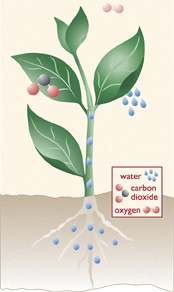
Which of the following is not transported in plants?
minerals
oxygen
water
carbon dioxide
Which is a major source of nutrients in plants?
soil
leaves
stem
roots
This part of the transport system in plants is made up of dead cells.
Xylem
Phloem
Shoot
Leaves
This part of the transport system in plants is made up of living cells.
Xylem
Shoots
Phloem
Leaves
Water and minerals move upward from the root to the rest of the plant in this vascular tissue.
Root
Xylem
Leaves
Phloem
This vascular tissue carries substances from the leaves to the other parts of the plant.
Phloem
Leaves
Roots
Xylem
This is the process in which plants sweat.
Transportation
Transpiration
Explanation
Exportation
The flow of water in the xylem travels in two directions up and down.
True
False
What is needed for photosynthesis to take place? Select all that apply.
sunlight
water
carbon dioxide
chlorophyll