
 Worksheets
Unit 2: Waves
Total questions: 104
Worksheet time: 2hrs 41mins
Name
Class
Date
1.

Wave A represents what type of wave?
a)
transverse
b)
mechanical
c)
longitudinal
d)
radio wave
2.

What type of wave does B represent?
a)
transverse
b)
mechanical
c)
longitudinal
d)
electromagnetic
3.
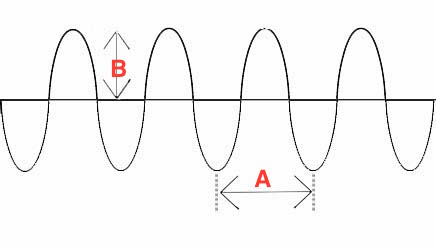
What property of the wave is represented by the letter "B"?
a)
amplitude
b)
crest
c)
trough
d)
wavelength
4.
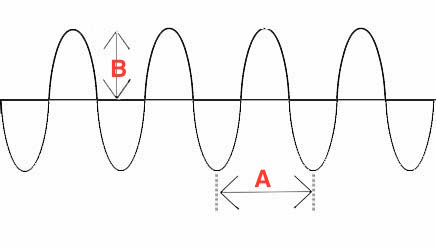
What property of this wave is represented by the letter "A"
a)
amplitude
b)
crest
c)
trough
d)
wavelength
5.
The highest point on a wave is:
a)
the crest
b)
the trough
c)
the top
d)
the coast
6.
The lowest point on a wave is the:
a)
Amplitude
b)
Crest
c)
Trough
d)
Wavelength
7.
The number of wavelengths that pass a point each per second is:
a)
frequency
b)
period
c)
longitudinal
d)
transverse wave
8.
The type of waves that require medium to pass:
a)
Mechanical Waves
b)
Electromagnetic Waves
9.

Which vocabulary term is used to identify the distance between points C & G?
a)
Amplitude
b)
Crest
c)
Frequency
d)
Wavelength
10.
When the frequency of a wave increases, what happens to the wavelength?
a)
The wavelength is not directly affected by the frequency of a wave.
b)
The wavelength increases.
c)
The wavelength decreases.
d)
More specific information is needed to form a conclusion about the wavelength.
11.
A mechanical wave cannot travel through...
a)
a vacuum(empty space).
b)
water.
c)
air.
d)
glass.
12.
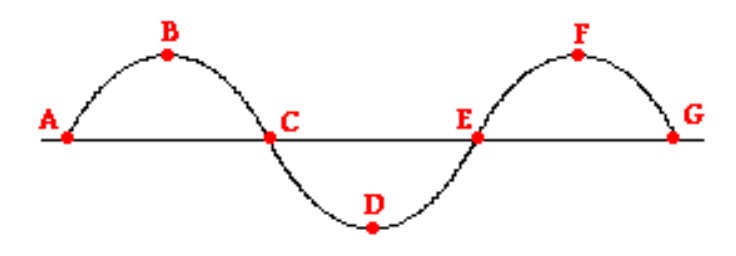
Which letter(s) represent the trough of the wave?
a)
A
b)
B & D
c)
D
d)
C & G
13.
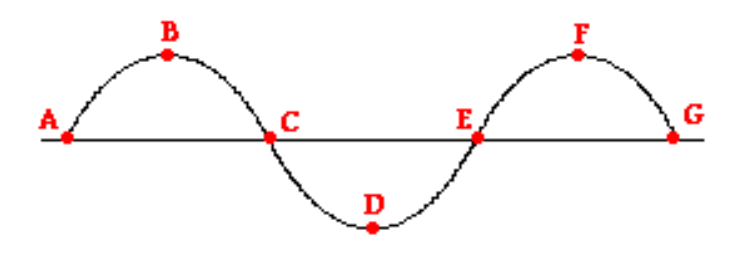
Which letter(s) represent the crest of the wave?
a)
A
b)
B & D
c)
B & F
d)
F
14.
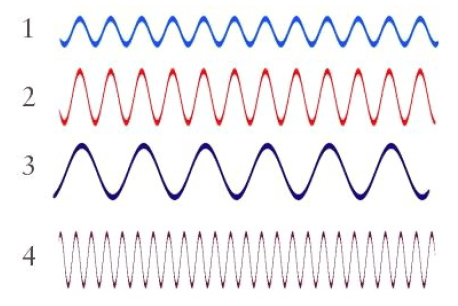
Which wave in the diagram has the greatest frequency?
a)
1
b)
2
c)
3
d)
4
15.
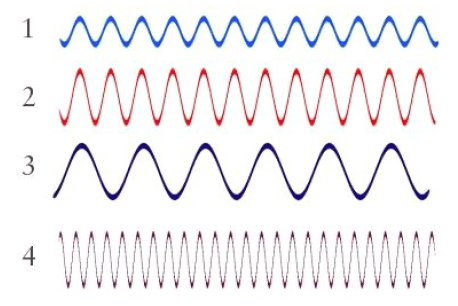
Which wave in the diagram has the greatest wavelength?
a)
1
b)
2
c)
3
d)
4
16.
Which of the following can sound travel through?
a)
solid
b)
liquid
c)
gas
d)
all of the above
17.
crest to crest or trough to trough
a)
crest
b)
trough
c)
amplitude
d)
wavelength
18.
Electromagnetic waves include the following except
a)
radio waves
b)
X-rays
c)
doing the wave at a football game
d)
microwaves
19.
regular disturbances that carry energy through matter or space
a)
crest
b)
energy
c)
wave
d)
trough
20.
which material does sound travel the fastest?
a)
solid
b)
liquid
c)
gases
21.
When a wave strikes and object and bounces off. (example echo)
a)
medium
b)
refraction
c)
reflection
d)
interference
22.
When a wave bends as it passes through at an angle from one medium to another.(example: pencil in a glass of water-)
a)
medium
b)
refraction
c)
reflection
d)
interference
23.
The units for frequency are measured in _____________.
a)
hertz
b)
seconds
c)
m/s
d)
m
24.
Why is sound able to travel faster through a solid than a gas?
a)
Gas molecules are packed tightly.
b)
Sound does not travel faster through a solid than a gas.
c)
Solid molecules are packed tightly.
d)
Gas molecules move slowly.
25.
How does a sound wave interact with a human ear?
a)
vibrates the ear drum
b)
bounces off the ear canal
c)
rotates the ear drum
d)
vibrates the ear canal
26.
Waves can travel through empty space or they can travel through a medium. Which statement best describes a medium?
a)
The solid matter that waves travel through
b)
The gas matter that waves travel through
c)
The liquid matter that waves travel through
d)
The solid, liquid, or gas matter that waves travel through
27.
Mechanical waves cannot be transmitted through a vacuum. Therefore, which of the following are NOT mechanical waves?
a)
Water waves
b)
Seismic waves
c)
Sound waves
d)
Light waves
28.

How would a person measure the wavelength on this sound wave?
a)
dense to less dense
b)
trough to crest
c)
compression to compression
d)
beginning of illustration to the end
29.
Which of the following is transmitted by waves?
a)
atoms
b)
matter
c)
energy
d)
resonance
30.
What is another name for wave height?
a)
Frequency
b)
Amplitude
c)
Wavelength
d)
Origin
31.

Which wave has a greater frequency?
a)
A
b)
B
32.
Which of these waves can travel in a vacuum (empty space)/
a)
sound wave
b)
radio wave
c)
compressional wave
d)
water wave
33.

This type of Electromagnetic wave shows a break in bones.
a)
gamma ray
b)
x-ray
c)
brokenometer
d)
radio wave
34.
Waves are a transfer of what?
a)
Heat
b)
Light
c)
Energy
d)
Food
35.

What kind of wave is pictured below?
a)
compressional wave
b)
transverse wave
c)
sound wave
d)
mechanical wave
36.

What kind of waves can travel through space?
a)
electromagnetic waves
b)
compressional waves
c)
longitudinal waves
d)
sound waves
37.
What is the measure of how many waves pass a point in a second?
a)
frequency
b)
wavelength
c)
midpoint
d)
crest and trough
38.
The longer the _____________ the ______________ the frequency.
a)
wavelength, lower
b)
wavelength, higher
c)
amplitude, lower
d)
amplitude, higher
39.
When a wave's amplitude increases it means
a)
it's carrying more energy
b)
its wavelength gets longer
c)
its frequency increases
d)
its wavelength decreases
40.

Which is an example of a longitudinal wave?
a)
light wave
b)
sound wave
c)
visible wave
d)
radio wave
41.
In a longitudinal wave, the particles move...?
a)
back and forth
b)
up and down
c)
not at all
d)
at a 90 degree angle
42.
A wave in which the particles of the medium vibrate parallel to the direction of the wave motion
a)
A. mechanical
wave
b)
B. surface
wave
c)
C. longitudinal
wave
d)
D. wave
43.
A wave in which the particles of the medium move perpendicularly to the direction the wave is traveling
a)
A. surface
wave
b)
B. transverse
wave
c)
C. electromagnetic wave
d)
D. longitudinal
wave
44.
When the crests of one wave overlap the crests of another wave or waves, this occurs.
a)
A. diffraction
b)
B. destructive
interference
c)
C. constructive
interference
d)
D. resonant
frequencies
45.
A section of a longitudinal wave where the particles are crowded together is called a
a)
A. rarefaction.
b)
B. vibration
c)
C.compression
d)
D. surface
wave.
46.
Which of the following items would work well in space?
a)
A. flashlight
b)
B. radio
c)
C. guitar
d)
D. drum
set
47.
A wave can make a leaf bob up and down on the water, but it cannot move the leaf toward the shore. This is because waves only transfer
a)
A. matter.
b)
B. energy.
c)
C. media.
d)
D. crests.
48.
If you want to change the pitch of a sound, you have to change the ___
a)
frequency
b)
amplitude
c)
speed
d)
volume
49.
Sound waves are what kind of wave?
a)
Longitudinal
b)
Transverse
c)
Surface
d)
Electromagnetic
50.
This is the unit used to measure the volume of a sound.
a)
Decibel
b)
Medium
c)
Vibration
d)
Oscilloscope
51.
This is what you get when sound waves are reflected, or bounce back, off of a hard surface.
a)
Amplitude
b)
Pitch
c)
Volume
d)
Echo
52.
What happens when you increase the amplitude of a sound?
a)
it makes the sound louder
b)
it makes the sound travel faster
c)
it increases the wavelength of the sound
d)
it increases the frequency of the sound
53.
The speed of a sound wave depends on
a)
the frequency
b)
the medium
c)
both air temperature and medium
d)
the air temperature
54.
The Doppler effect can cause an apparent change in...
a)
loudness
b)
intensity
c)
pitch
d)
reasonance
55.
As a sound source approaches and then moves past a stationary observer, the observer will hear
a)
a steady rise in pitch
b)
a sudden drop in pitch
c)
a drop in pitch, then a rise in pitch
d)
a rise in pitch, then a drop in pitch
56.
What is a pitch?
a)
highness or lowness of a sound
b)
the intensity of a vibration
c)
the amplitude of the sound wave
d)
volume of sound
57.

If the distance represented by the letter A were increased, how would it change the way the sound was heard?
a)
The sound would be higher.
b)
The sound would be lower.
c)
The sound would be softer.
d)
The sound would be louder.
58.
Sound waves are able to be heard around corners. This property of waves is known as_______.
a)
reflection
b)
refraction
c)
diffraction
d)
interference
59.

This image represents what type of wave interaction?
a)
interference
b)
reflection
c)
refraction
d)
diffraction
60.

Areas with high density of particles are know as what?
a)
trough
b)
compression
c)
crest
d)
rarefaction
61.
Areas with low density of particles are know as what?
a)
troughs
b)
compressions
c)
crests
d)
rarefactions
62.

Image B represents what type of wave interaction?
a)
refraction
b)
reflection
c)
interference
d)
diffraction
63.
Image C represents what type of wave interaction?
a)
refraction
b)
reflection
c)
interference
d)
diffraction
64.
The overlapping of two waves in either a constructive or destructive manner is know as what?
a)
interference
b)
reflection
c)
refraction
d)
diffraction
65.

The image above shows what type of wave interaction?
a)
reflection
b)
constructive interference
c)
destructive interference
d)
diffraction
66.

The image above shows what type of wave interaction?
a)
reflection
b)
constructive interference
c)
destructive interference
d)
diffraction
67.
A high pitch sound results from a wave with a ____________.
a)
low amplitude
b)
high frequency
c)
low frequency
d)
low amplitude
68.
A low pitch sound results from a wave with a ____________.
a)
low amplitude
b)
high frequency
c)
low frequency
d)
low amplitude
69.
What color on the visible light spectrum has the highest energy?
a)
red
b)
blue
c)
violet
d)
green
70.
What color on the visible light spectrum has the lowest energy?
a)
red
b)
blue
c)
violet
d)
green
71.
List the electromagnetic spectrum from lowest energy to highest energy.
a)
radio, microwaves, infrared, visible light, ultraviolet, x-rays, gamma rays
b)
gamma rays, x-rays, ultraviolet, visible light, infrared, microwaves, radio waves
c)
red, orange, yellow, green, blue, indigo, violet
d)
violet, indigo, blue, green, yellow, orange, red
72.
List the electromagnetic spectrum from highest energy to lowest energy.
a)
radio, microwaves, infrared, visible light, ultraviolet, x-rays, gamma rays
b)
gamma rays, x-rays, ultraviolet, visible light, infrared, microwaves, radio waves
c)
red, orange, yellow, green, blue, indigo, violet
d)
violet, indigo, blue, green, yellow, orange, red
73.
List the visible light spectrum in order from highest energy to lowest energy.
a)
radio, microwaves, infrared, visible light, ultraviolet, x-rays, gamma rays
b)
gamma rays, x-rays, ultraviolet, visible light, infrared, microwaves, radio waves
c)
red, orange, yellow, green, blue, indigo, violet
d)
violet, indigo, blue, green, yellow, orange, red
74.
List the visible light spectrum in order from lowest energy to highest energy.
a)
radio, microwaves, infrared, visible light, ultraviolet, x-rays, gamma rays
b)
gamma rays, x-rays, ultraviolet, visible light, infrared, microwaves, radio waves
c)
red, orange, yellow, green, blue, indigo, violet
d)
violet, indigo, blue, green, yellow, orange, red
75.
Which of the following has the highest frequency?
a)
violet
b)
radio wave
c)
red
d)
gamma ray
76.
Which of the following has the lowest frequency?
a)
violet
b)
radio wave
c)
red
d)
gamma ray
77.

This image represents what wave interaction?
a)
refraction
b)
interference
c)
reflection
d)
diffraction
78.

Which of the above waves would have the highest pitch?
a)
A
b)
B
c)
C
d)
D
79.
Which of the above waves would have the lowest pitch?
a)
A
b)
B
c)
C
d)
D
80.

What wave property allows you to see a rainbow?
a)
reflection
b)
diffraction
c)
refraction
d)
interference
81.

Which wave above represents a soft sound with a high pitch?
a)
A
b)
B
c)
C
d)
D
82.
Which wave above represents a loud sound with a high pitch?
a)
A
b)
B
c)
C
d)
D
83.
Which wave above represents a loud sound with a low pitch?
a)
A
b)
B
c)
C
d)
D
84.
Which wave above represents a soft sound with a low pitch?
a)
A
b)
B
c)
C
d)
D
85.
The higher the energy.....
a)
the shorter the wavelength & lower the frequency
b)
the shorter the wavelength & higher the frequency
c)
the longer the wavelength & lower the frequency
d)
the longer the wavelength & higher the frequency
86.
What is the "the apparent change in the frequency of sound caused by the motion of either the listener or the source of the sound"?
a)
conservation of sound
b)
Doppler effect
c)
law of reflection
d)
pitch perfect
87.

Measure of how high or low a sound is
a)
amplitude
b)
compression
c)
speed of sound
d)
pitch
88.

This image represents what type of wave interaction?
a)
interference
b)
diffraction
c)
reflection
d)
refraction
89.

The boy behind the car hears what pitch and frequency?
a)
lower pitch
higher frequency
higher frequency
b)
higher pitch
lower frequency
lower frequency
c)
higher pitch
higher frequency
higher frequency
d)
lower pitch
lower frequency
lower frequency
90.
The boy in front of the car hears what pitch and frequency?
a)
lower pitch
higher frequency
higher frequency
b)
higher pitch
lower frequency
lower frequency
c)
higher pitch
higher frequency
higher frequency
d)
lower pitch
lower frequency
lower frequency
91.

Which of these waves would be the wave for a tuba?
a)
A
b)
B
c)
C
92.
Which of these waves would be the wave for a flute?
a)
A
b)
B
c)
C
93.
Electromagnetic waves can only travel as a ___________ wave.
a)
transverse
b)
longitudinal
94.
Mechanical waves can only travel as a ___________ wave.
a)
transverse
b)
longitudinal
c)
both
95.
In destructive interference, what parts of the wave match up?
a)
crest to crest
b)
trough to trough
c)
crest to trough
96.
Which type of electromagnetic wave is formed because of heat?
a)
gamma ray
b)
microwave
c)
infrared
d)
ultaviolet
97.
Which electromagnetic wave can only penetrate through the surface of your skin and cause skin cancer?
a)
gamma ray
b)
microwave
c)
infrared
d)
ultaviolet
98.
Which visible light spectrum color enters your eye with the highest frequency?
a)
blue
b)
red
c)
green
d)
violet
99.

What is B?
a)
Angle of incidence
b)
Angle of reflection
c)
Incident ray
d)
Reflected ray
100.
What is C?
a)
Angle of incidence
b)
Angle of reflection
c)
Incident ray
d)
Reflected ray
101.
What is D?
a)
Angle of incidence
b)
Angle of reflection
c)
Incident ray
d)
Reflected ray
102.
What is E?
a)
Angle of incidence
b)
Angle of reflection
c)
Normal
d)
Reflect ray
103.
What is A?
a)
Angle of incidence
b)
Angle of reflection
c)
Incident ray
d)
Reflected ray
104.
Law of reflection state that - The angle of incidence is .................. to the angle of reflection.
a)
equal
b)
double
c)
half
100 %

