wayground logo

Free Printable Worksheets

Font size

S
M
L
XL
Worksheets

IIT-JEE, NEET LEVEL-1 (8-T)

Total questions: 100

Worksheet time: 2hrs 40mins
Name
Class
Date
1.

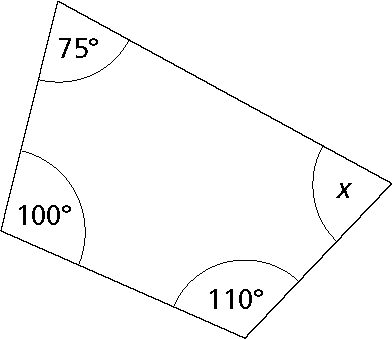
Find the missing angle.

a)

75o

b)

85o

c)

100o

d)

45o

2.

Angle 1 is 34o, angle 2 is 58o, angle 3 is 100o. If this shape is a quadrilateral, what is the measure of the 4th angle.

a)

186o

b)

121o

c)

168o

d)

90o

3.

Solve for x.

a)

5o

b)

12o

c)

-7o

d)

-6o

4.

What is the value of x?

a)

4o

b)

360o

c)

12o

d)

6o

5.
What is the measure of angle b?
a)
36o
b)
56o
c)
63o
d)
117o
6.
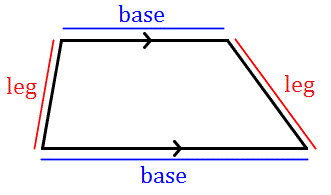
I am a quadrilateral with exactly one pair of parallel sides.
a)
trapezoid
b)
parallelogram
c)
rhombus
d)
kite
7.
I am a quadrilateral with 2 sets of parallel lines, my opposites sides are congruent, and I have four right angles.
a)
square
b)
kite
c)
rectangle
d)
rhombus
8.
I am a polygon with 4 sides.
a)
pentagon
b)
quadrilateral
c)
triangle
d)
octagon
9.
I am a quadrilateral with exactly one pair of parallel sides and 2 congruent sides.
a)
isosceles triangle
b)
trapezoid
c)
isosceles trapezoid
d)
kite
10.
Which One is not a property of a Parallelogram?  
a)
Opposite Sides Congruent 
b)
Opposite Angles Congruent 
c)
Diagonals Bisect Each other 
d)
Diagonals Congruent 
11.

What is true about ALL quadrilaterals?

a)

They have parallel sides

b)

All their sides are the same length

c)

They have four sides

d)

They have at least one right angle

12.

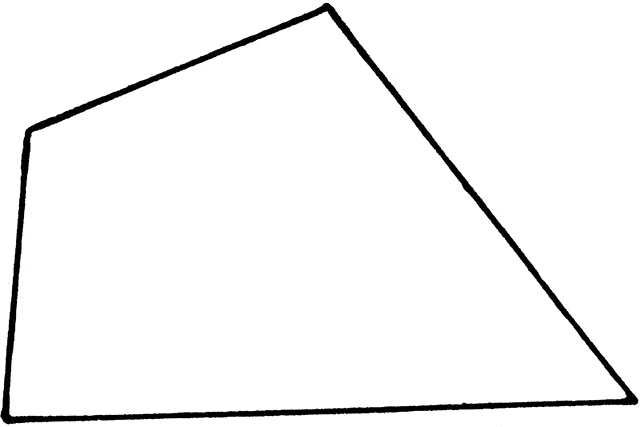
What is true about this quadrilateral?

a)

It has no sets of parallel sides

b)

It has one set of parallel sides

c)

It has two sets of parallel sides

d)

It has four sets of parallel sides

13.

A __________________ is always a rhombus, but a rhombus is not always a _______________.

a)

kite

b)

parallelogram

c)

square

d)

rectangle

14.

If a quadrilateral has 4 equal sides, then it is a square.

a)

TRUE

b)

FALSE

15.
All squares are rectangles.
a)
True
b)
False
16.
Which statement is true?
a)
All squares are rectangles.
b)
All rectangles are squares.
c)
All triangles are quadrilaterals.
d)
All quadrilaterals are rhombuses.
17.

How many pairs of parallel sides does a parallelogram have?

a)

0 pairs of parallel sides

b)

1 pair of parallel sides

c)

2 pairs of parallel sides

d)

More than 2 pairs of parallel sides

18.

A trapezium has....

a)

No parallel sides

b)

1 pair of parallel sides

c)

2 pairs of parallel sides

d)

more pairs of parallel sides

19.
a)
Trapezoid
b)
Square
c)
Rectangle
d)
Kite
20.
Find the missing angle.
a)
100o
b)
260o
c)
180o
d)
205o
21.
I am a quadrilateral with 2 pairs of adjacent sides that are congruent and my diagonals are perpendicular.
a)
rhombus
b)
trapezoid
c)
isosceles trapezoid
d)
kite
22.
Find the area
a)
11cm
b)
11cm2
c)
28cm
d)
28cm2
23.
I am a quadrilateral with 2 sets of parallel sides, four right angles, 4 congruent sides and perpendicular diagonals.
a)
kite
b)
trapezoid
c)
rhombus
d)
square
24.
Find the missing angle
a)
64o
b)
56o
c)
106o
d)
66o
25.
Name that shape.
a)
trapezoid
b)
quadrilateral
c)
parallelogram
d)
rhombus
26.

A quadrilateral with two sets of parallel sides, 4 right angles, and 4 congruent (equal) sides is a __________________.

a)

trapezoid

b)

parallelogram

c)

rectangle

d)

square

27.

Use your graph paper to plot the points (2,5), (3,3), (5, 3), and (6,5). Which quadrilateral is shown?

a)

Triangle

b)

Trapezoid

c)

Parallelogram

d)

Rhombus

28.
Which is a property of a rhombus? 
a)
Diagonals Congruent 
b)
Diagonals Perpendicular
c)
Four Right Angles 
29.
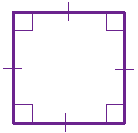
What shape is this? 
a)
Square 
b)
Rectangle 
c)
Rhombus 
d)
Parallelogram 
30.
What is true about a Rectangle? 
a)
Diagonals Congruent 
b)
Diagonals Perpendicular
c)
Four Congruent Sides 
d)
Diagonals Angle bisectors 
31.
How many unique properties does  a rhombus have? 
a)
1
b)
2
c)
3
d)
4
32.
How many quadrilateral families are there? 
a)
1
b)
3
c)
2
d)
4
33.
What shape is this? 
a)
Parallelogram 
b)
Rhombus 
c)
Rectangle 
d)
Trapezoid
34.
Name that shape. 
a)
square
b)
square
rhombus
c)
quadrilateral
parallelogram
rhombus
d)
quadrilateral
parallelogram
square
35.
A trapezoid is a parallelogram.
a)
True
b)
False
36.
A rectangle is a square.
a)
Never
b)
Sometimes
c)
Always
37.
Which quadrilaterals have 4 congruent sides?
a)
only the parallelogram
b)
parallelogram, rhombus, and square
c)
rhombus and trapezoid
d)
rhombus and square
38.
The diagonals of a rectangle are
a)
parallel
b)
congruent
c)
perpendicular
d)
not congruent
39.
A ________ is any polygon that has 4 sides.
a)
square
b)
parallelogram
c)
quadrilateral
d)
trapezoid
40.
A polygon with 4 sides and 4 angles is a quadrilateral.
a)
True
b)
False
41.
The plant tissue that carries food materials DOWNWARD from the leaves to the rest of the pant is the ______.
a)
Phloem
b)
Stomata
c)
Chlorophyll
d)
Xylem
42.
Vascular tissue that transports water and minerals UPWARDS from a plant's roots is know as ______.
a)
Chlorophyll
b)
Phloem
c)
Stomata
d)
Xylem
43.
Plant absorbs water through the _________. 
a)
stem
b)
roots 
c)
leaves 
d)
all of the above
44.
The plant transport system are made up of ____ types of tubes.
a)
1
b)
2
c)
3
d)
many
45.
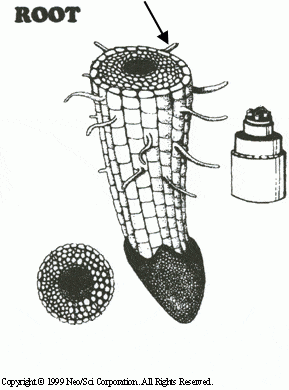
What is the name of the part of the root that allows water and minerals enter?
a)
root hairs
b)
epidermis
c)
phloem
d)
phyla
46.
what is the function of root hair?
a)
it is place to store the food
b)
it has large surface area to absorb more water
47.
How do water enter the roots from the soil?
a)
diffusion
b)
osmosis
c)
transpiration
d)
active transport
48.
Water vapour exits a plant leaf by
a)
the stomata
b)
the epidermis
c)
the palisade cells
d)
the spongy mesophyll
49.
Transpiration is
a)
the movement of water through a plant from the roots up the stem
b)
the loss of water from the leaves of a plant by the process of evaporation
c)
the flow of water into plant roots by osmosis from the soil
d)
the process of minerals and sugars moving through plant veins
50.
Transpiration is
a)
the movement of water through a plant from the roots up the stem
b)
the loss of water from the leaves of a plant by the process of evaporation
c)
the flow of water into plant roots by osmosis from the soil
d)
the process of minerals and sugars moving through plant veins
51.
Transpiration is
a)
the movement of water through a plant from the roots up the stem
b)
the loss of water from the leaves of a plant by the process of evaporation
c)
the flow of water into plant roots by osmosis from the soil
d)
the process of minerals and sugars moving through plant veins
52.
Transpiration is
a)
the movement of water through a plant from the roots up the stem
b)
the loss of water from the leaves of a plant by the process of evaporation
c)
the flow of water into plant roots by osmosis from the soil
d)
the process of minerals and sugars moving through plant veins
53.
This is the definition for which word:The movement of water molecules from a high concentration of water to a low concentration of water across a partially permeable membrane.
a)
Osmosis
b)
Diffusion
c)
Active transport
d)
Transpiration
54.
Why is the evaporation of water from leaves important?
a)
It cools leaves and helps move water up the plant.
b)
It makes the plant wilt
c)
It helps the plant to respire
55.
Which of these is true?
a)
Xylem vessels carry water and dissolved minerals up the plant
b)
Phloem tissue carry water and dissolved minerals up the plant
c)
Xylem vessels carry dissolved sucrose up and down the plant
56.
What happens to the transpiration rate as light intensity increases?
a)
It increases
b)
It stays the same
c)
It decreases
57.
What happens to the transpiration rate as light intensity increases?
a)
It increases
b)
It stays the same
c)
It decreases
58.

Where is xylem found in the plant?

a)

leave -> roots -> stem

b)

roots -> stem -> leaves

c)

root hairs -> leaves -> veins

d)

stem -> roots

59.

Water and minerals move in which direction within the plant

a)

Upward

b)

Down

60.

Where does sugar transport begin?

a)

Roots

b)

Leaves

c)

Root hairs

d)

Vascular bundles

61.

which of the following is a mixture?

a)

air

b)

ice

c)

hydrochloric acid

d)

mercury

62.

Tick the COMPOUNDS.

a)

SOAP

b)

METHANE

c)

CALCIUM CARBONATE

d)

SILICON

e)

TIN

63.

WHICH ONE IS A MIXTURE?

a)

BLOOD

b)

CARBON DIOXIDE

c)

SILICON

d)

SODIUM

e)

TIN

64.

Air is regarded as mixture because?

a)

It's pressure may vary.

b)

It's temperature may vary.

c)

Volume changes under different compositions.

d)

It's compositions may vary.

65.

In which of the following constituents are present in the ratio?

a)

Mixture.

b)

Compound.

c)

Solution.

d)

Colloid.

66.

Which of the following will result in the formation of a mixture?

a)

Crushing of marble tiles into smaller particles.

b)

Breaking ice cubes into smaller pieces.

c)

Adding sodium metal to water.

d)

Adding milk in water.

67.

A mixture will appear translucent in the case of?

a)

Copper sulphate + water.

b)

Alum + water.

c)

Sugar + water.

d)

Starch + water.

68.

Which of the following is not a mixture?

a)

Pure water.

b)

Sea water.

c)

Air.

d)

Brass.

69.

Which of the following is a heterogeneous mixture?

a)

Air.

b)

Brass.

c)

Iodised table salt.

d)

Steel.

70.

Which of the following is an example of heterogeneous substance?

a)

Bottled water.

b)

Table salt.

c)

Pieces of copper.

d)

Candle.

71.

Which of the following is an example of homogeneous substance?

a)

Granite.

b)

Copper sulphate.

c)

m&m candy.

d)

Muddy water.

72.

Brass is an example of?

a)

Homogeneous compound.

b)

Homogeneous mixture.

c)

Heterogeneous mixture.

d)

Heterogeneous compound.

73.

Name the flask

a)

round bottom flask

b)

flat bottom flask

c)

conical flask

74.

colloids can be seperated by

a)

filtration

b)

distillation

c)

sedimentation

d)

centrifugation

75.

how will you seperate sulphur and iron fillings

a)

handpicking

b)

sieving

c)

crystallization

d)

magnetic seperation

76.

how will you seperate oxygen from a mixture of liquid air?

a)

centrifugation

b)

seperating funnel

c)

fractional distillation

d)

distillation

77.

how will you seperate the components of sugar solution

a)

evaporation

b)

crystallization

c)

filtration

d)

chromatography

78.

burning of candle is a

a)

physical change

b)

chemical change

c)

both physical and chemical change

d)

none of the above

79.

a mixture of dye in a volatile liquid can be seperated by?

a)

evaporatoion

b)

sedimentation

c)

chromatography

d)

filtration

80.

Tyndall effect is observed in forests because of

a)

tress

b)

high oxygen level

c)

mist and dust particles in the air

d)

less sunlight

81.
What are the three states of matter?
a)
solid, volume, mass
b)
density, volume, mass
c)
solid, liquid, gas
d)
density, gas, volume
82.
Something that takes up space and has mass.
a)
volume
b)
matter
c)
mass
d)
density
83.
A state of matter that has a definite volume and shape.
a)
solid
b)
liquid
c)
gas
d)
matter
84.
The amount of space something takes up
a)
density
b)
volume
c)
mass
d)
matter
85.
A watermelon has more matter than a grape, so it has more
a)
mass
b)
eat
c)
solid
d)
greater
86.
You can measure ______ with grams.
a)
mass
b)
volume
c)
conductivity
d)
melting point
87.
Solids have a definite _______________.
a)
smell
b)
shape
c)
picture
d)
sound
88.
Liquid matter takes the shape of _______.
a)
a gas
b)
water
c)
a pet
d)
Its container
89.
Water in its solid form is _____________.
a)
a vapor
b)
ice
c)
a liquid
d)
boiling
90.
The amount of matter something contains is its ______________.
a)
gas
b)
solid
c)
weight
d)
mass
91.
The measurement system used by scientist around the world.
a)
metric system
b)
customary systerm
c)
calorie system
d)
science system
92.
What is the measure of gravity on an object?
a)
matter
b)
mass
c)
weight
d)
volume
93.
Volume is ______________.
a)
length X width
b)
height X length
c)
length X width X height
d)
width X height
94.

What is the study of matter and how matter changes?

a)

Physical Science

b)

Chemistry

c)

Biology

d)

Matterology

95.

What term means "take up space"

a)

Volume

b)

Matter

c)

Mass

d)

Substance

96.

What term refers to a single kind of matter that is pure?

a)

Solution

b)

Mixture

c)

Substance

d)

Matter

97.

It refers to the space that matter occupies.

a)

volume

b)

mass

c)

weight

d)

density

98.

What units do we use to measure mass?

a)

meter

b)

Celsius

c)

kilogram/gram

d)

Newton

99.

Which property of matter changes depending on the gravitational pull?

a)

volume

b)

mass

c)

weight

d)

density

100.

Which of the following determines an object’s ability to float in water?

a)

volume

b)

mass

c)

weight

d)

density