
 Worksheets
FINAL EXAM REVIEW
Total questions: 100
Worksheet time: 1hrs 17mins
What is Energy?
The ability to do anything
The ability to cause change/ do work
The investigation of nature
A fact of life
What is an example of kinetic energy?
A bird sitting in a tree
A bouncy ball on the table
A car driving on the highway
A book on shelf
What is an example of potential energy?
A bowling ball rolling down a lane
A car parked in a lot
An apple falling from a tree
Sunlight heating up the atmosphere
Energy cannot be created or destroyed.
True
False
What is nuclear energy?
Energy in the nucleus of an atom
Energy in the particles of an object
Energy that is carried by electromagnetic waves
Energy in a system of objects
What is the definition of friction?
A force that resists the sliding of two objects that are touching
A force that increases sliding between two objects
The change from potential to kinetic energy
A transformation from radiant to mechanical energy
What transformation occurs in a toaster?
Electrical to radiant
Electrical to thermal
Thermal to mechanical
Solar to electrical
What type of energy transformation occurs when a piece of wood burns?
Electrical energy is released as radiant energy
Stored chemical energy is released as thermal energy
Mechanical energy is stored as chemical energy
No transformation occurs
What is the equation for kinetic energy?
KE = 1/2 m x v2
KE = Speed (m/s) + height (m)
KE = Distance (m) / time (s)
KE = Mass (g) * gravity * height (m)
What is potential energy?
The energy an object has due to its atomic structure.
The energy an object has due to its chemical composition.
The energy an object has due to its motion.
The energy an object has due to its position or condition.
What is kinetic energy?
The energy an object has due to its position or condition
The energy an object has due to its motion
The energy an object has due to its chemical composition
The energy an object has due to its atomic structure
Which object has the most potential energy?
A ball resting on the ground.
A ball being thrown at 100 miles per hour.
A ball on top of a refrigerator.
A ball resting on the edge of a cliff.

Four cars are positioned at the top of a hill. Which car has the most potential energy?
A
B
C
D
Which of the following is the appropriate measurement for volume ?
56 mL
10 grams
47 centimeters
4 quarts
What is a unit used to measure the volume of a solid object?
milliters
pounds
cubic centimeters
grams
When reading the volume of water in a graduated cylinder, you should always ______________
look at the water level above the curve (meniscus)
hold the graduated cylinder in the air to read the meniscus (curve)
estimate the water level
look at the bottom of the meniscus (curve)

Calculate the volume of the rock
10.0 cm3
10.0 mL
30.0 cm3
40.0 cm3
We start with 50 mL in a graduated cylinder and drop in an object. The water rises to 64 mL. What is the volume of this object?
64 mL
64 cm3
14 mL
14 cm3
The definition of volume
The amount of matter an object has
The amount of matter within a certain amount of space
The amount of space inside something
The amount of space something takes up

What causes an object to sink in water?
if the object's density is less than the water's density.
if the object's density is the same as water's density.
if the object's density is greater than water's density.
if the object's density is zero
The attraction between particles gives solids a definite
shape and volume
shape and color
shape and position
flow and radius
The temperature at which a solid begins to liquefy is its ______ point.
freezing
boiling
melting
mass
The amount of energy required for a liquid at its boiling point to become a gas is _____________.
heat of fusion
heat of vaporization
transpiration
freezing point
Which of the following is a state of matter?
particle
thermal
plasma
diffuse
When the temperature of a substance is lowered, its particles
vibrate more quickly
stop vibrating completely
escape the attractive forces of the other particles
vibrate more slowly
An example of a substance that can undergo sublimation is
glass
liquid crystals
water
dry ice (frozen carbon dioxide)
When a gas becomes a liquid it is called
condensation
evaporation
sublimation
freezing


Identify the mode of heat transfer in the given picture.
Conduction
Convection
Radiation

Identify the mode of heat transfer in the given picture.
Conduction
Convection
Radiation
Heat flows from a warmer place to a cooler one.
True
False
Subatomic particles with a negative charge
Electrons
Neutrons
Protons
Quarks
He claimed that matter was made of small, hard particles that he called “atomos.”
Democritis
Dalton
Moseley
Einstein
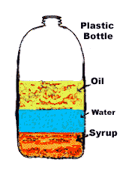
What is the density of water?
0 g/mL
1 g/mL
10 g/mL
100 g/mL
All matter consists of particles called
Units
Atoms
Cubes
Pints
The nucleus of an atom contains protons and_______________
Electrons
Haptons
Neutrons
Wontons
Electrons move around_________________the nucleus
Inside
Outside
On top of
Without
An element is determined by the number of ___________________ (also known as its atomic number).
Neutrons
Electrons
Protons
Wontons
A ___________________ is a combination of two or more atoms that are held together by covalent bonds.
Moles
Ions
Molecules
Megatrons
The number of _______ in one atom of an element determines the atom's identity.
Protons
Electrons
Neutrons
Isotope
The arrangement of electrons in energy levels around an atomic nucleus.
Electron shell
Electron affinity
Electron configuration
Electrical charge
A negatively charged particle, located in the outermost shell of an atom.
Valence electron
Muon
Neutrino
Lepton
How many neutrons are in an atom of carbon-14?
6
8
10
14
An atom with the same number of protons and electrons (no charge) and the expected atomic mass or number of neutrons from the periodic table.
Neutral/Normal Atom
Ion
Isotope
An atom that has gained or lost electrons in an attempt to become stable/bond with another atom.
Normal/Neutral Atom
Ion
Isotope
A negatively charged ion that has gained electrons to satisfy the octet rule (metals do this)
Anion
Cation
Neutral Atom
Isotope
A positively charged ion that has lost electrons to satisfy the octet rule (non-metals do this)
Anion
Cation
Neutral Atom
Isotope
Atoms of the same element that have different mass than expected because they have a different number of neutrons.
Neutral Atom
Ion
Isotope
Cation
A weak bond between two ions of opposite charge (a metal that loses electrons and a non-metal that gains electrons)
Ionic Bond
Covalent Bond
Alloy
Mixture
A strong bond between two non-metals that share electrons to satisfy the octet rule.
Ionic Bond
Covalent Bond
Alloy
Mixture
If an atom has 9 protons and 10 electrons it has a charge of ____.
0
-1
+1
-2
If an atom has 4 protons and 2 electrons it has a charge of ____.
0
-2
+2
+1
Who invented the Periodic Table?
Mendeleev
Bohr
Lewis
Democritus
The first energy shell can hold ______ electrons.
2
8
18

Elements in the same group or column have the same ...
# of valence electrons
# of shells
# of protons
Mass Number

Rows on the periodic table are called ___________.
Periods
Sentences
Fences

The columns in the periodic table are called ___________.
Towers
Herds
Groups
Elements in the same group have __________
Similar Properties
Same number of shells
Similar Mass

This could be the dot diagram of
Mg
Cl
C
O
What is the goal of the Lewis Dot Structure?
To determine the electron position.
To show the element's valence electrons & bonding capabilities.
To find the atomic mass of an element.
To search for the number of electrons in an individual atom.
How many valence electrons should Lithium have in its Lewis dot model?
1
2
3
4

This is a correct dot diagram for nitrogen (N)
true
false
Which of the following is an ionic compound?
HCl
H2O
MgO
CO2
When one atom transfers one or more valence electrons to another atom, a(n) __________ is formed.
covalent bond
ionic bond
metallic bond
hair bond
What is the ionic charge of a Calcium ion?
2+
2-
3+
3-
Which element will be paired to Sulfur for it to become a covalent compound?
Potassium
Magnesium
Aluminum
Carbon
What is the ionic charge of an Oxygen ion?
2+
2-
4+
4-
What type of bond is formed between Li and F?
Covalent
Ionic
Metallic
Carbon
Which of the following is an Covalent compound?
NaCl
CaCl2
KI
CO
2H2 + O2 --> 2H2O
2H2 + O2 --> 2H2O
_Mg + _Cl2 --> _MgCl2

