
 Worksheets
World History Semester 1 Final Exam
Total questions: 150
Worksheet time: 2hrs 38mins
Name
Class
Date
1.
The Renaissance began in
a)
England
b)
France
c)
Italy
d)
Constantinople
2.
What is Gutenberg known for?
a)
newspaper
b)
printing press
c)
writing "The Prince"
d)
painting the Mona Lisa
3.
Humanism refers to
a)
focusing on Christianity
b)
the time after the Renaissance
c)
the Crusades
d)
focusing on human potential
4.
frescos are
a)
paintings using calligraphy
b)
art pieces done with crayons
c)
paintings done on wet plaster
d)
cold drinks
5.
Secular means
a)
part of religion
b)
separate from religion
c)
similar
d)
part of religion
6.
The book called "The Prince" was about
a)
religion
b)
politics
c)
art
d)
science
7.

Who painted the Mona Lisa?
a)
Michelangelo
b)
Boticceli
c)
Leonardo da Vinci
d)
Donatello
8.

When was the Renaissance?
a)
12th until 15th century
b)
14th unti 17th century
c)
10th until 15th century
d)
15th until 16th century
9.
This may be the most important development in human history.
a)
cultural revolution
b)
language revolution
c)
agricultural revolution
d)
american revolution
10.
Who made the greatest contribution toward Christianity becoming a world religion?
a)
Peter
b)
Paul
11.

Julius Caesars enemies assassinated him because
a)
the feared he planned to make himself king
b)
they were opposed to his expansion ideas
12.
Large numbers of Germanic peoples crossed into the lands of the Roman empire in the late 300's to escape...
a)
religious persectution
b)
invading Huns
c)
black death
d)
mass starvation
13.
To try to restore order to the empire, Roman emperor Diocletian..
a)
divided the empire into two parts
b)
overhauled the legal system
14.
In the early Roman republic, members of the landholding upper class were called...
a)
tribunes
b)
patricians
15.

Alexander the Great extended his empire as far east as...
a)
China
b)
Southeast Asia
c)
Mongolia
d)
India
16.

Greek architecture reflects
a)
fearsome chaotic powers of god
b)
perfect balance and harmony
17.
According to the Mandate of Heaven
a)
a ruler was divine and should never be overthown
b)
society should not be divided into classes
18.
Migration of people in and out of China was hindered by
a)
Ural mountains
b)
Himalayas
19.
Hindus believed that the ultimate goal of existence is
a)
achieving moksha
b)
practicing ahimsa
c)
following dharma
20.
Why did Shi Huangdi order the construction of the Great Wall
a)
to discourage invasion from the north
b)
to protect his system of fuedalism
c)
to establish the borders of China
21.
Which of the following is one of Buddhisms; Four Noble Truths?
a)
all life is full of suffering, pain and sorrow
b)
before all, honor your father and mother
22.
Who made a covenant with God in which Canaan was promised to the Hebrew people
a)
Solomon
b)
Moses
c)
David
d)
Abraham
23.

What two rivers are these?
a)
Tigris and Euphrates
b)
Yangtze and Yellow
c)
Indus and Valley
d)
Rhine and Elba
24.
Which of the following was NOT a major agricultural advancement for early man?
a)
Slash-and-burn farming
b)
Domestication
c)
Metallurgy
d)
Irrigation
25.
One of the earliest written languages was _______, which used a wedge-shaped stylus to imprint signs into clay tablets.
a)
Cuneiform
b)
Animism
c)
Zoroastrianism
d)
Papyrus
26.
Which of the following was the most famous of the Sumerian city-states?
a)
Babylon
b)
Ninevah
c)
Jerusalem
d)
Ur
27.
What was the concept in Ancient China where a dynasty was overthrown by a new dynasty because they had become corrupt?
a)
Survival of the Fittest
b)
Confucianism
c)
Mandate of Heaven
d)
Religious Ritualism
28.
What were the major rivers of the Mesopotamian civilizations?
a)
Tigris
and Euphrates
b)
Indus
and Nile
c)
Tiber
and Rhine
d)
Yellow
and Yangtze
29.
Who was the first major Babylonian ruler famous for his law code?
a)
Hammurabi
b)
Nebuchadnezzar
c)
Darius
d)
Shalmanessar
30.
Athens was frequently ruled by what type of government?
a)
Monarchy
b)
Direct Democracy
c)
Republic
d)
Representative Democracy
31.
The famed philosopher who argued for self-reasoning and questioning in Athens, and was killed for in, was:
a)
Socrates
b)
Zeno
c)
Anaximander
d)
Confuscius
32.
The twin brothers who supposedly founded Rome in 752 B.C. were:
a)
Romulus and Remus
b)
Mr. and Gass
c)
Achilles and Aeneas
d)
Caesar and Augustus
33.
Why was the office of Tribune so important to Roman history?
a)
It gave plebeians the power to suggest legislature and veto the Senate
b)
It was the equivalent of a third consul
c)
It created an office that officially hunted witches
d)
It allowed for Patricians to tax plebeians directly
34.
The highest elected office in the Roman Republic was the two ____, executive officials who served for one-year terms and enacted the decrees and will of the Senate.
a)
Consuls
b)
Tribunes
c)
Senators
d)
Dictators
35.
Who was the Egyptian queen who seduced both Marc Antony and Julius Caesar?
a)
Cleopatra
b)
Ptolemy
c)
Julia
d)
Maria Theresa
36.

What city is highlighted here?
a)
London
b)
Athens
c)
Constantinople
d)
Baghdad
37.

What country is this?
a)
Italy
b)
Germany
c)
Greece
d)
Egypt
38.
Why did Sparta go to war with Athens in the Peloponnesian War?
a)
Athens had dominated the Delian League and enriched itself to the point of threatening Sparta
b)
Athens had allied with Persia
c)
Athens was smelly
d)
Pericles had murdered Spartan diplomats
39.
The blending of Greek, Persian, and Indian cultures introduced by Alexander was:
a)
Hellenism
b)
Democracy
c)
Socratism
d)
Anaximanderistismalism
40.
The Roman wars with Carthage were called the:
a)
Punic Wars
b)
Samnite Wars
c)
Pyrrhic Wars
d)
Macedonian Wars
41.
Which of the following was not one of the members of the first triumvirate?
a)
Pompey
b)
Crassus
c)
Julius Caesar
d)
Lepidus
42.
On what two rivers did Mesopotamia develop?
a)
Tigris and Nile
b)
Euprhates and Nile
c)
Tigris and Euphrates
d)
Nile and Amazon
43.

The land between two rivers
a)
Ancient Egypt
b)
Ancient Mesopotamia
c)
Ancient India
d)
Ancient China
44.
A scribe is a
a)
writer
b)
ruler
c)
worker
d)
farmer
45.
What is a large arc of rich soil used for farmland?
a)
Empire
b)
Monarch
c)
Fertile Crescent
d)
City-state
46.
Why was writing first invented?
a)
for texting
b)
to write stories
c)
for fun
d)
to keep records
47.
a pyramid-shaped structure with a temple at the tops, has many terraces
a)
pyramid
b)
ziggurat
c)
Ishtar
d)
battering ram
48.

Luther criticized the Roman Catholic Church for:
a)
Selling indulgences.
b)
Translating the bible into German.
c)
Believing in the Bible
d)
None of the above.
49.

Ruler who started the Church of England, known as the Anglican church
a)
Elizabeth I
b)
Philip II
c)
Henry VIII
d)
Louis XVI
50.

Catholic monk who wanted to reform the Roman Catholic Church and rid it of corruption.
a)
Martin Luther
b)
Theodore Roosevelt
c)
John Calvin
d)
Jamie Sieminski
51.

The child of Henry VIII who tried to bring back Catholicism, and sent hundreds of Protestants to burn at the stake.
a)
Bloody Mary Tudor
b)
Good Queen Bess Elizabeth
52.

A lessening or dissolution of punishment for sins?___________
a)
recant
b)
annual
c)
predestination
d)
indulgence
53.

The Divine Right of Kings was the belief:
a)
That the kings of Europe were divine.
b)
That the king's authority to rule came from God.
c)
That is was the right of Kings to behave like Gods.
d)
That the Kings of Europe were above the church.
54.

What did Luther post to the door of the Church at Wittenburg?
a)
His resume he was looking for a teaching job.
b)
The 95 Thesis, arguments against the church.
c)
Indulgences
d)
None of the above.
55.

Luther wanted the bible translated into which language?
a)
English
b)
German
c)
Turkish
d)
None of the above
56.

Religious Reformer who believed in pre-destination.
a)
Mary Tudor
b)
Martin Luther
c)
John Calvin
d)
Elizabeth I
57.
What does the word "Renaissance" mean?
a)
Rebirth
b)
Stagnation
c)
Traditional
d)
A Latin term for art
58.
Which of the following is associated with Humanism?
a)
the ideas of the middle ages
b)
the ideas of Greece & Rome
c)
the ideas of ancient China
d)
the ideas of ancient India
59.
What was the Protestant Reformation?
a)
an attempt to overthrow the Pope and replace him with a Frenchman.
b)
an attempt to reform the Catholic practices that were considered corrupt.
c)
a call for Christian Europe to reclaim the Holy Land from the Arabs.
d)
An attempt to strengthen the power of the Pope
60.
What invention helped to spread the information of the Reformation?
a)
The Globe
b)
The internet
c)
The Paint Brush
d)
The Printing Press
61.
Which of the following was an effect of the Black Death?
a)
people developed greater religious tolerance as they united in prayer
b)
doctors trying to stop the epidemic made rapid advances in medicine
c)
peasants migrated into large cities seeking medical care
d)
there were large increases in wages and prices throughout Europe
62.
During the First Crusade in 1099, Christian knights succeeded in capturing...
a)
Jerusalem
b)
Cordoba
c)
Constantinople
d)
Tangier
63.
Why did many rural peasants move to cities during the plague years of the late 1300s?
a)
due to high labor costs, landowners devoted less land to raising crops
b)
needing new members, guilds encouraged villagers to relocate
c)
villagers sought out new medical treatments available in the city
d)
villagers feared the plague came from witches in the countryside
64.
Which of the following is a key belief of Islam?
a)
a priest should mediate between the people and God
b)
sins should be washed away through baptism
c)
the Quran may be read by Muslims in any language
d)
each Muslim should make a pilgrimage to Mecca
65.
When Muslims conquered a new land, they often...
a)
forced the conquered people to convert to Islam
b)
adopted the beliefs of the conquered people
c)
looted and burned conquered cities
d)
imposed a special tax on non-Muslims
66.
According to Muslim belief, Muhammad became the prophet of Islam after he...
a)
saw a mysterious burning bush in the desert
b)
heard the voice of the angel Gabriel calling him
c)
had a vision about bringing peace to Arab clans
d)
was blinded by a heavenly light as he traveled to Mecca
67.
Muslims believe the sacred word of God as revealed to Muhammad is contained in the...
a)
Quran
b)
Qiyamah
c)
Dawah
d)
Jannaj
68.
Many lower-caste Hindus in India converted to Islam because...
a)
Islam taught that all believers were equal
b)
Muslim sultans killed those who refused to convert
c)
they wanted jobs in the Muslim government
d)
they wanted to escape the tax on Hindus
69.
During their rule of China in the 1200s and 1300s, the Mongols...
a)
ended the exchange of goods and ideas with Europe
b)
set up a government based on Islamic law and customs
c)
executed thousands of scholars, artists, and artisans
d)
stabilized China and increased trade
70.
The purpose of the Council of Trent was to...
a)
fight Protestantism by rooting out heresy
b)
spread the Catholic faith to distant lands
c)
translate the Bible into the vernacular
d)
direct the reform of the Catholic Church
71.
What changes did the Catholic Church make during the Catholic Reformation?
a)
it stopped using the Inquisition to fight Protestantism
b)
it revised and updated many traditional Catholic beliefs
c)
it restored a version of the Book of Common Prayer
d)
it provided penalties for corruption among the clergy
72.
The main goal of the Jesuits was to...
a)
end corruption within the Catholic Church
b)
end the growth of Calvinism in England
c)
defend, restore, and spread the Catholic faith
d)
reform Spanish convents and monasteries
73.
In 1598, the Edict of Nantes helped to ensure...
a)
that France and Spain would not unite
b)
that Germans could choose their own religion
c)
that French Catholics would not be persecuted
d)
that French Protestants would not be persecuted
74.
Luther believed that...
a)
good deeds were necessary for salvation
b)
the Pope was the sole religious authority
c)
the Bible was a hoax
d)
salvation could be achieved through faith alone
75.
Which of the following was a reason Ghana grew wealthy?
a)
Taxed salt and gold trade
b)
They produced fine porcelain objects
c)
They raided prosperous areas
d)
They controlled the spice routes from Asia
76.
Confucian beliefs center on the 5 ________.
a)
Pillars
b)
Relationships
c)
Gods
d)
Caliphs
77.
Which of the following was NOT a purpose of the Crusades?
a)
To help European knights and Christians achieve salvation
b)
To recapture Jerusalem from Muslim rulers
c)
To conquer Mecca and Medina
d)
To assist the Byzantines in their war with the Turks
78.
Who was married to the Empress Theodora?
a)
Charlemagne
b)
Raymond d'Aguiliers
c)
Justinian
d)
Leif Eriksson
79.
In which of the following social systems was it important to pass a written test to become a scholar-official?
a)
Indian Caste System
b)
Chinese Confucianism
c)
Mayan social system
d)
Medieval Western Europe
80.
How did Islam spread to Sub-Saharan Africa?
a)
Primarily by conquest
b)
After Arab countries colonized the region
c)
It did not - there are virtually no Muslims south of the Sahara
d)
It spread mainly through trade along the Indian ocean and trans-Saharan trade routes
81.
Where did the black death originate?
a)
Middle East
b)
England
c)
Central and East Asia
d)
Russia
82.
Which of the following were famous for engaging in biological warfare, helped spreading the Plague?
a)
Mali
b)
Ghana
c)
the Vikings
d)
the Mongols
83.
During which era did farming develop?
a)
Neolithic Age
b)
New Age
c)
Mesolithic Age
d)
Paleolithic Age
84.
Pottery-making is a type of
a)
domestication
b)
specialization
c)
surplus
d)
social class
85.

T 1.1 - Page 78
Leonardo da Vinci is often referred to as a true "Renaissance Man." Why has he come to symbolize the spirit of the era?
Leonardo da Vinci is often referred to as a true "Renaissance Man." Why has he come to symbolize the spirit of the era?
a)
He excelled at everything he did, bringing him in line with the heroic intellectual stature of the ancient Greek gods who helped inspire the Renaissance.
b)
His interests and body of work spanned many subjects, media, and disciplines, reflecting the quest for knowledge and the spirit of creative adventure that embodied the Renaissance era.
c)
His paintings, the Mona Lisa and The Last Supper are superlative examples of expressionism and perspective, and are the most famous of the era.
d)
His scientific works showed a level of genius that was confirmed by his prediction of technologies that would not exist for centuries.
86.
Who is the founder of Buddhism?
a)
Jesus Christ
b)
Siddhartha Gautama
c)
Muhammad
d)
Abraham
87.
This is the holy book of Judaism
a)
Koran
b)
Gospels
c)
Torah
88.
The everyday language of ordinary people
a)
Slang
b)
Vernacular
c)
Shakespearian
d)
Nick Names
89.
Michelangelo is famous for his work in what building?
a)
Westminster Abbey
b)
Tower of Pisa
c)
Notre Dame
d)
Sistine Chapel
90.
"The end justifies the means" was a key belief of this man, who wrote "The Prince"
a)
Machiavelli
b)
Castiglione
c)
Shakespeare
d)
Petrarch
91.
What helped propel West African kingdoms such as Ghana to power?
a)
trading gold for salt
b)
dominating the desert
c)
advancing irrigation techniques
d)
trading ivory across the Indian Ocean
92.
Why are the writings of Ibn Battuta significant
a)
They are a diary of his travels to China.
b)
It is Timbuktu's written plan for government.
c)
It describes his practices as a devout Christian.
d)
They show the diversity within the Islamic world
93.
Which controversy nearly destroyed the political and religious unity of the Byzantine Empire?
a)
icons should be part of Christian worship
b)
the emperor was truly a leader chosen by God
c)
Godthe Eastern Church should break from the Roman Church
d)
pagans and other nonbelievers should be part of the empire
94.
Which is an example of Byzantine architecture?
a)
Coliseum
b)
Pantheon
c)
Parthenon
d)
Hagia Sophia
95.
What was a result of Kublai Khan’s rule of China?
a)
dilution of culturedue to a policy of enforced intermarriage
b)
contact with other cultures through foreign observer
c)
instability due to alteration of political tradition
d)
disruption of trade with other civilizations
96.
Which of the following was spread as a result of the conquests of Alexander the Great?
a)
Greek language, culture, and ideas
b)
ship building, the alphabet, and the first books
c)
technology such as aqueducts, the arch, and weaponry
d)
inventions such as gunpowder, paper-making, and printing
97.
Ibn Sina was BEST known for what?
a)
for being a cruel and harsh king
b)
for his contributions in medicine
c)
for his writing for Muslim theology
d)
for being a successful Persian military leader
98.
What was one aspect of the relationship between religion and politics in Ancient Egypt?
a)
The people considered political leaders to be gods
b)
There was a strong separation between church and state.
c)
There were many religions that took part in the system.
d)
Institutions had more power than political institutions.
99.
When Rome split near the end of its existence, why did the West fall when the East survived a thousand years longer?
a)
The Eastern Empire had a
powerful army which the West
did not.
b)
The Western Empire had no
slaves to use for fighting the
barbarians.
c)
The Eastern Empire had a more
sustainable and advanced
economy.
d)
The Western Empire had the
political system that the East did
not.
100.
How did the emergence of medieval feudalism in Europe influence the Christian Church?
a)
The Church encouraged voyages
of exploration.
b)
The Church published the Bible in
the vernacular.
c)
The Church adopted Latin as the
official language.
d)
The Church served as the
unifying power in society.
101.
Which of the following changes occurred in western Europe during the Middle Ages?
a)
rise in rural population
b)
rise in urban population
c)
decrease in church power
d)
increase in international trade
102.
What title was given to Charlemagne by the Pope in 800 AD?
a)
King of England
b)
Holy Roman Emperor
c)
Head of the Eastern Orthodox Church
d)
None of the above
103.
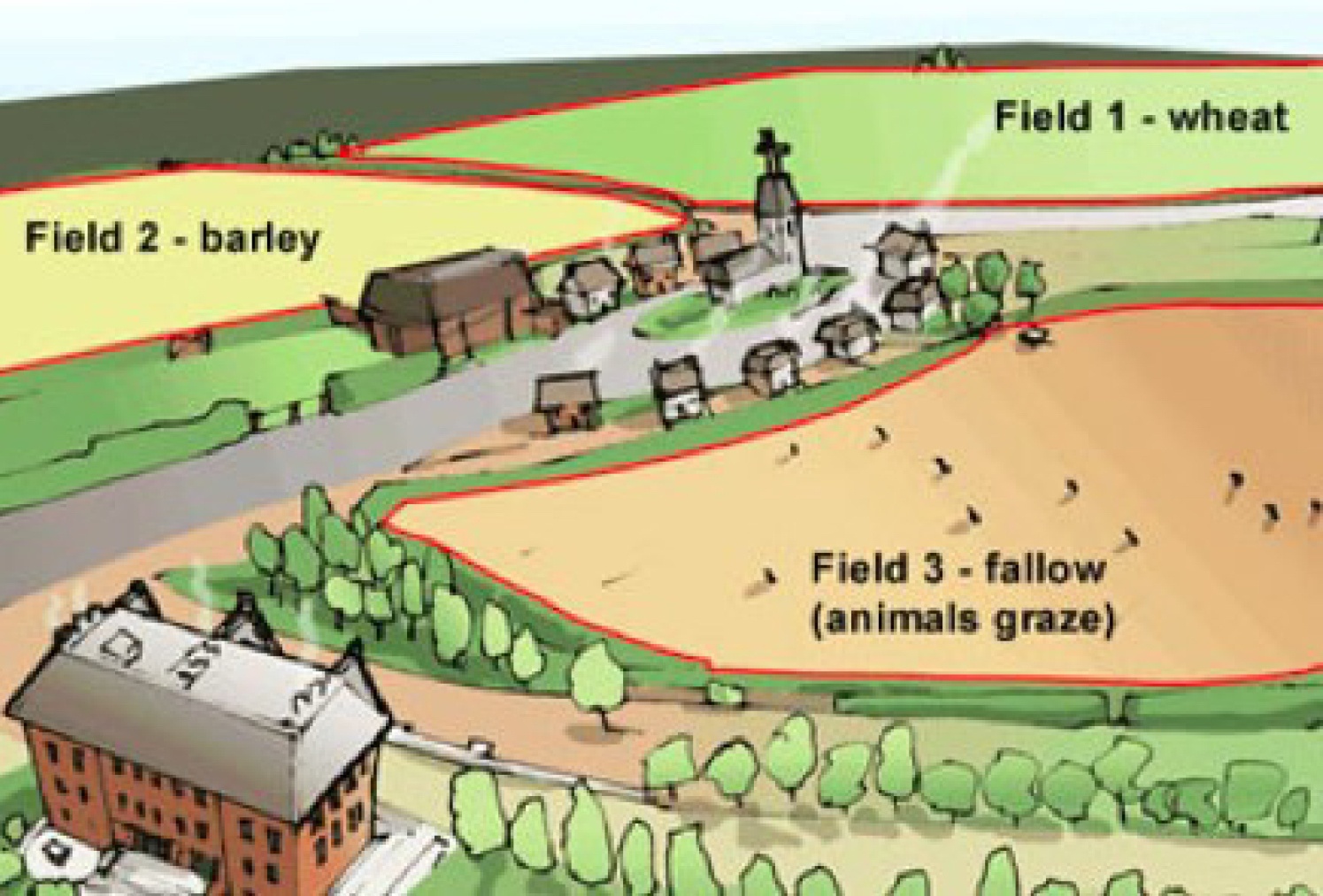
The picture above best describes which medieval farming technique?
a)
Three-field system
b)
Crop rotation
c)
Irrigation
d)
pig farming
104.
Catholics and the Eastern Orthodox were the two main factions of Christianity. How do the two differ?
a)
Orthodox is monotheistic while Catholic is polytheistic
b)
Catholic is headed by a Patriarch while Orthodox is controlled by the Pope
c)
Orthodox has priests while Catholic has shaman
d)
Orthodox is headed by a Patriarch while Catholic is controlled by the Pope
105.
Why was the time immediately following the fall of Rome called the Dark Ages?
a)
Emperors kept tight control of the people.
b)
There was little formal education for the masses.
c)
Artwork from Greece, not Rome, survived.
d)
There was no building being done.
106.
Which of Justinian’s actions reflects the close connection between church and state in the Byzantine Empire?
a)
He built large churches such as the Hagia Sophia.
b)
He developed and published Christian tenets.
c)
He relocated the capital from Rome to Byzantium.
d)
He was crowned head of the church by the Pope.
107.
Which of the following groups had the MOST political power?
a)
vassals
b)
serfs
c)
lords
d)
knights
108.
-Begun during the Roman Empire -Started as an offshoot of Judaism -Spread throughout the Roman Empire -Promoted the idea of salvation for all -Became the most powerful influence in medieval Europe Which of the following is the best title for the above list?
a)
Origins, Ideas, and Spread of Christianity
b)
Reasons for the Spread of Christianity
c)
History and Development of Feudalism
d)
Origins and Spread of Islam
109.
_____________ is a political/social system and _____________ is an economic system.
a)
Middle Ages…feudalism
b)
manorialism…feudalism
c)
feudalism…manorialism
d)
Roman Empire…feudalism
110.
Who was never a lord in a Feudal relationship?
a)
king
b)
noble
c)
knight
d)
peasant
111.
Which of the following is not a reason for the fall of the Roman Empire?
a)
the empire was too small
b)
barbarian invasions
c)
the empire was too big
d)
the population of Rome declined
112.
What is the name for the large estate of land a knight lived on?
a)
castle
b)
manor
c)
chivalry
d)
land
113.
Who was never a vassal in a Feudal relationship?
a)
king
b)
noble
c)
knight
d)
peasant
114.
Ghana, Mali, & Songhia were located in _________ Africa
a)
North
b)
East
c)
South
d)
West
115.

Mansa Musa was the leader of _______.
a)
Ghana
b)
Mali
c)
Songhai
d)
Egypt
116.
Ghana was rich in gold, but lacked what important resource?
a)
oil
b)
steel
c)
salt
d)
pepper
117.

Which number is Mali located at?
a)
1
b)
2
c)
3
d)
564,475,359,842,357.02
118.
Which number is Ghana located at?
a)
1
b)
2
c)
3
d)
564,475,359,842,357.02
119.
Which number is Songhai located at?
a)
1
b)
2
c)
3
d)
564,475,359,842,357.02
120.
What was the biggest reason why Christians were afraid of excommunication?
a)
They would not get into heaven.
b)
They would not receive communion.
c)
Everyone would ignore them.
d)
They weren't afraid.
121.
What types of economic power did the Church have during medieval times?
a)
it collected taxes, it collected fiefs in exchange for services, and it was the largest landowner
b)
it made people want to do good so they could get into heaven, it excommunicated people, it was involved in all aspects of life
c)
it had laws and courts, it excommunicated people, church officials advised kings and lords, it limited feudal warfare
d)
it spent a lot of money on everything
122.
What was the result of the Crusades?
a)
Christians were allowed in the Holy Land
b)
trade increased
c)
new ideas spread
d)
all of the answers
123.
Using reason to support Christian beliefs
a)
Problem Solving
b)
Scholasticism
c)
Scholarly
d)
Inquisition
124.
This term means the giving of gifts from non-clergy to the clergy
a)
Inquisition
b)
Lay Investiture
c)
Laissie Faire
d)
Inciting
125.
Holy Roman Emperor Henry IV argued with Pope Gregory VII concerning. . .
a)
the election of popes
b)
the election of kings
c)
Lay Investiture
d)
Excommunication laws
126.
As a result of the Great Schism of 1054, the Christian Church split into two parts. The part in Eastern Europe was:
a)
Catholic
b)
Orthodox
c)
Lutheran
d)
Calvinism
127.
The Crusades began in 1096 when:
a)
Muslim Turks threatened Constantinople
b)
The pope asked Christians from Europe to help protect Christians in the Ottoman Empire
c)
Knights from Western Europe went to the Holy Land for God, gold, and glory
d)
All of the above
128.
At the end of the Crusades, who had control of the Holy Land?
a)
Muslims
b)
Christians
c)
Ottomans
d)
Turks
129.
Who 1) ruled the Franks from
768 to 814 C.E.
2) united the Christian lands of Europe
3)was crowned Holy Roman emperor
in 800 C.E.
768 to 814 C.E.
2) united the Christian lands of Europe
3)was crowned Holy Roman emperor
in 800 C.E.
a)
Charlemange
b)
King Arthur
c)
Joan of Arc
130.
Which of these was a major effect of the Crusades on Europe?
a)
Reuniting the Roman Empire
b)
Everyone in the "East" became Christian
c)
Increased trade with non-European cultures
131.
Medieval business groups of craftsmen and merchants who set prices and quality are called
a)
guilds
b)
vassals
c)
nobles
d)
monarchs
132.
What is a fief?
a)
A lord of a manor
b)
A piece of land
c)
A poor person
d)
A knight in training
133.
Empire created by Otto called the Roman Empire of the German nation. It later became the
a)
Roman Empire
b)
Otto Empire
c)
Holy Roman Empire
d)
None of the above
134.
Many people lost faith in God after the Black Death. As a result, who lost power?
a)
Kings and Queens
b)
The Church
c)
Knights
d)
Serfs
135.
The head of the Roman Catholic Church
a)
Pope
b)
Priest
c)
Vassal
d)
Feif
136.
What conclusion about the effects of the plague can be drawn from the list below?
● Europe and China lost about one third of its population
● Labor shortages brought higher wages for many workers
● People blamed God for the plague
● The manor system collapsed as peasants left their manors to work for set wages in urban areas.
● Feudalism was weakened
● Europe and China lost about one third of its population
● Labor shortages brought higher wages for many workers
● People blamed God for the plague
● The manor system collapsed as peasants left their manors to work for set wages in urban areas.
● Feudalism was weakened
a)
Major, catastrophic events can trigger huge changes in society
b)
People seek comfort in traditions in the wake of tragic events
c)
Societies always grow/flourish during types of disasters and epidemics
d)
Tragic events always bring people closer to God
137.
In Europe during the Middle Ages, increases in trade and commerce resulted in...
a)
Lower living standards for industrial workers
b)
Decreased economic rivalry between kings
c)
Increased political power for the clergy
d)
Development of towns and cities
138.
Which term below refers to the ancient Greek religion which consisted of the worship of many gods and goddesses and explained how the world works?
a)
Monotheism
b)
Judaism
c)
Hellenism
d)
Mythology
139.
Which of the following is the most important political contribution of Athens to our world today?
a)
the concept of limited citizenship
b)
the importance of the marketplace
c)
the use of the column
d)
the idea of democracy
140.
What did Socrates, Plato, and Aristotle have in common?
a)
The were important Greek philosophers
b)
They were all Greek mathematicians
c)
They were important to the field of medicine
d)
They participated in the first Olympics
141.
Which area did Archimedes and Pythagoras excel?
a)
Literature
b)
Philosophy
c)
Mathematics
d)
Medicine
142.
A new style of teaching by using a questioning method was developed by which of the following philosophers?
a)
Plato
b)
Socrates
c)
Aristotle
d)
Alexander
143.
Which branch of the Roman Republic represented the common people?
a)
The Senate
b)
the magistrates
c)
the tribunes
d)
the consuls
144.
Octavian (Octavius) was given the title "Augustus Caesar." What change in the Roman government did this title represent?
a)
monarchy to republic
b)
republic to empire
c)
oligarchy to democracy
d)
empire to theocracy
145.
What is one similarity between Roman and Greek religion before the rise of Christianity?
a)
They were both monotheistic
b)
They both believed in reincarnation
c)
They both had their Sabbath day on Sunday
d)
They were both polytheistic
146.
Which religion provide the foundation for Christianity?
a)
Buddhism
b)
Islam
c)
Judaism
d)
Hinduism
147.
Which of the following groups of terms best summarizes the legacy of the Roman Empire?
a)
Architecture, engineering, government and language
b)
Mythology, drama, art, and religion
c)
Technology, government, philosophy and poetry
d)
Philosophy, drama, architecture, and are religion
148.
Why did Constantinople become the center of the Byzantine Empire?
a)
because it was a religious center for Muslims
b)
because its location made it the crossroads of Europe and Asia
c)
because the pope had made it the capital of the Christian world
d)
because it was economically isolated from surrounding empires
149.
"Western Europe owed a debt of gratitude to the Empire that for almost a thousand years ensured the survival of Christianity during a time when Europe was too weak to accomplish the task."
a)
Hellenistic
b)
Mongol
c)
Byzantine
d)
Ottoman
150.
What was a major accomplishment of the Justinian code?
a)
The rights of free speech was established
b)
Roman laws were organized and simplified
c)
Chinese and Japanese architecture was copied
d)
The right to practice any religion was allowed.
100 %

