
 Worksheets
Physical Science Fall Exam Review
Total questions: 96
Worksheet time: 2hrs 35mins
Name
Class
Date
1.

Information that you gather with your senses is called
a)
an opinion
b)
a question
c)
a belief
d)
an observation
2.
Which of these is a qualitative observation?
a)
The boy is 5 feet tall.
b)
There are six birds in the tree.
c)
The birds are tiny.
d)
There are more blue birds than black birds.
3.
Which of these is NOT a scientific observation?
a)
All birds have feathers.
b)
Some birds have colorful feathers.
c)
There are many different types of birds.
d)
Birds are a great pet.
4.
What statement is an inference?
a)
There are two fish in the bowl.
b)
They are eating their food.
c)
They like their food.
d)
Both fish are blue.
5.
Why do scientists conduct experiments?
a)
To make a lot of money.
b)
To ask a question.
c)
To make a hypothesis.
d)
To prove a prediction is correct.
6.
What are the steps in the Scientific Method?
a)
Ask a Question, Make a Hypothesis, Do Background research, Conduct an Experiment, Analyze your data, Report your results.
b)
Ask a Question, Make a Hypothesis, Analyze your data, Do Background research, Conduct an Experiment, Report your results.
c)
Ask a Question, Do Background research, Make a Hypothesis, Conduct an Experiment, Analyze your data, Report your results.
d)
Ask a Question, Do Background research, Conduct an Experiment, Make a Hypothesis, Analyze your data, Report your results.
7.
An experiment is a when scientists test their hypothesis, or prediction. They carefully plan their test, and decided what the variables will be. A controlled variable are the factors that
a)
will change in the experiment.
b)
will stay the same in the experiment.
8.
The formula for density is...
a)
volume/mass
b)
volume+mass
c)
mass x volume
d)
mass/volume
9.
The best tool to measure the mass of an object would be...
a)
hot plate
b)
hand lens
c)
grad. cylinder
d)
triple beam balance
10.
What is the base unit of mass in the metric system?
a)
oz
b)
gram
c)
lbs
d)
cm
11.
a force that opposes the motion of an object in contact with a surface
a)
motion
b)
force
c)
friction
12.
a change in the velocity of an object over time
a)
acceleration
b)
speed
c)
inertia
13.
a physical law stating that an object tends to stay at rest and an object moving in a straight line at a constant speed tends to continue moving that way
a)
Newton's 1st Law
b)
Newton's 2nd Law
c)
Newton's 3rd Law
14.
a physical law stating that an object's acceleration depends on the object's mass and the amount of the net force applied to it
a)
Newton's 1st Law
b)
Newton's 2nd Law
c)
Newton's 3rd Law
15.
a physical law stating that for every action there is an equal and opposite reaction
a)
Newton's 1st Law
b)
Newton's 2nd Law
c)
Newton's 3rd Law
16.
If runners are speeding up and changing direction during a race, they are changing their ___________________________________.
a)
acceleration
b)
speed
c)
velocity
17.
If you know the speed and direction of an object, then you also know the _______________________________ of the object.
a)
acceleration
b)
speed
c)
velocity
18.
A push or pull on an object is called _______________________________.
a)
force
b)
motion
c)
position
19.
A change in an objects position is called ____________________________.
a)
motion
b)
speed
c)
friction
20.
When net forces are equal in strength and opposite in direction, they are said to be _____________________________.
a)
balanced
b)
unbalanced
c)
equal
21.
the location of an object compared with things around it
a)
motion
b)
distance
c)
position
22.
the tendency of a moving object will continue to move in a straight line
a)
velocity
b)
position
c)
inertia
23.

When you step on a Lego. You push on the Lego and the Lego pushes back on you.
a)
Newton's 1st Law
b)
Newton's 2nd Law
c)
Newton's 3rd Law
24.

Force = Mass x Acceleration
a)
Newton's 1st Law
b)
Newton's 2nd Law
c)
Newton's 3rd Law
d)
Newton's 4th Law
25.

The combination of all the forces acting on an object is the...
a)
net force
b)
action force
c)
reaction force
d)
balance force
26.
You push on a tree with 20 N of force. If the tree doesn't move, the tree is pushing back on you with _____of force.
a)
20N
b)
40N
c)
10N
d)
70N
27.

A cannonball with a mass of 0.5 kg is flying at an acceleration of 10 m/sec/sec. What is it's force?
a)
50 Newtons
b)
5 Newtons
c)
20 Newtons
d)
9.5 Newtons
28.
If the mass of an object is 1000kg on Earth, what is it's mass on the moon?
a)
10kg
b)
100kg
c)
1000kg
d)
10,000kg
29.
If you exert a net force of 8 N on a 2-kg object, what will its acceleration be?
a)
2 m/s2
b)
4 m/s2
c)
16 m/s2
d)
10 m/s2
30.
Determine the accelerations that result when a 12-N net force is applied to a 3-kg object.
a)
3 m/s
b)
4 ft/s
c)
13 m/s
d)
4 m/s
31.
65 miles per hour North is an example of an objects what?
a)
Speed
b)
Velocity
c)
Average Speed
d)
Constant Speed
32.
Polar bears are extremely good swimmers. If a polar bear is swimming with an average of 2.6 m/s, how far will it have traveled after 120 seconds?
a)
46.2 m
b)
120 m
c)
312 m
d)
456.3 m
33.
Tree sloths are the slowest moving mammals. On average, their velocity is 0.743 m/s. How long does it take a tree sloth moving at this velocity to travel 22.3 m?
a)
16.6 s
b)
30.0 s
c)
0.03 s
d)
143.7 s
34.
What is the speed of a car that traveled 32 m in 2 seconds?
a)
64 m/s
b)
34 m/s
c)
16 m/s
d)
0.0625 m/s
35.

Joanna drives for 400km at an average speed of 80km/h. How long was her journey?
a)
Joanna's journey was 5hrs long
b)
Joanna's journey was 10hrs long
c)
Joanna's journey was 20hrs long
d)
Joanna's journey was 15hrs long
36.
If you travel 50 km/hr for 2 hours, how far will you get?
a)
25 km
b)
50 km
c)
100 km
d)
200 km
37.
If a runner has a distance of 786 meters and a time of 16 seconds. What is their speed?
a)
49.125 m/s
b)
0.02 m/s
c)
12576 m/s
38.
If an owl has a speed of 50 m/s, and has a time of 10 s. What is the distance that the owl traveled?
a)
500 m
b)
5 m
c)
10 m
39.
The unit used to measure work is the
a)
Watt
b)
Newton
c)
Joule
d)
meter
40.
A ______________ is a rope or chain wrapped around a wheel.
a)
wedge
b)
lever
c)
pulley
d)
screw
41.
Any device that makes work easier is called a ______________________.
a)
Joule
b)
prop
c)
lever
d)
machine
42.
A force exerted over a distance to move an object is ______________________.
a)
power
b)
work
c)
momentum
d)
Watt
43.
The efficiency of a machine can be increased by reducing __________________________.
a)
effort
b)
resistance friction
c)
fulcrum
d)
friction
44.
Which of the following is the best example of work being done.
a)
doing homework
b)
lifting a box
c)
pushing a stationary box
d)
holding a box
45.
No machine in existence has 100% efficiency due to ____________________.
a)
magic
b)
friction
c)
smoke
d)
input
46.
Work done = Force x _________
a)
a. distance
b)
b. acceleration
c)
c. velocity
d)
d. speed
47.
How much work is produced when 350 N is used to move a car 5 m?
a)
70 J
b)
1750 J
c)
355 J
d)
175 J
48.

Flagpole
a)
wedge
b)
pulley
c)
incline plane
d)
wheel and axle
49.

Stairs
a)
wedge
b)
pulley
c)
inclined plane
d)
wheel and axle
50.
A 5000N block is lifted 10 m. How much work was done?
a)
50,000 J
b)
5,000 J
c)
500 J
d)
50 J
51.
How much power is done? 30 Joules of work is done in 3 Seconds.
a)
90 Watts
b)
10 Watts
c)
87 Watts
d)
33 Watts
52.
(3.2) What is Mechanical Energy?
a)
Kinetic
b)
Potential
c)
Thermal Energy
d)
The sum of kinetic and potental energy that causes force to move an object any distance.
53.
Bernoulli's principle says that if a fluid's speed increases, its pressure will
a)
Decrease
b)
Increase
c)
Not be affected
54.
Pressure is measured in
a)
Pascals
b)
Newtons
c)
Meters squared
d)
Pounds per cubic meter
55.
If a boat displaces 1000 N of water, what is the buoyant force?
a)
1000 N
b)
9800 N
c)
1000 kg
d)
9800 kg
56.
Bernoulli's principle creates ___ in airplanes
a)
Drag
b)
Lift
c)
Weight
d)
Friction
57.
Fluids flow
a)
only when warmed up.
b)
from regions of low pressure to regions of high pressure.
c)
until evenly spread out.
d)
from high to low pressure.
58.
Weight is a
a)
measure of gravity on mass.
b)
characteristic property.
c)
property found everywhere.
d)
chemical property.
59.
If the mass of an unknown substance is 5.3 grams and the volume is 2 cm3. What would be its density? (round)
a)
2.7
b)
2.5
c)
2.4
d)
2.2
60.
Frank has a paper clip. It has a mass of 9g and a volume of 3cm3. What is its density?
a)
3 g/cm3
b)
1/3 g/cm3
c)
27 g/cm3
d)
39 g/cm3
61.
Herman's toy box is 4 feet long, 2 feet wide, and 2 feet high. What is the volume of his toy box?
a)
8 square feet
b)
8 cubic feet
c)
16 square feet
d)
16 cubic feet
62.

The density of four different substances is listed in the table. If water has a density of 1.0 g/cm3, which substance will float in water?
Substance Density g/cm3
wood 0.89
paper clip 1.5
golf ball 2.7
penny 8.9
Substance Density g/cm3
wood 0.89
paper clip 1.5
golf ball 2.7
penny 8.9
a)
The paper clip because it is more dense than water.
b)
The penny, because it has a round shape.
c)
The golf ball, because it is more dense than water.
d)
Wood, because it is less dense than water.
63.
An irregular object with a mass of 100 g displaces 25 mL of water. What is its density?
a)
0.25 g/mL
b)
4 g/mL
c)
2500 g/mL
d)
125 g/mL
64.
Energy can be classified into two main categories, kinetic energy and potential energy. Kinetic energy is when an object is:
a)
standing still
b)
actively doing something
c)
changing states of matter
d)
objects do not have kinetic energy
65.
What characteristic do all renewable resources share?
a)
Produced by waste products
b)
Form underground from dead organisms.
c)
Replaced in a short period of time
d)
Allow energy to pass through them easily
66.
The careful use of a resource is....
a)
recycling
b)
pollution
c)
depositing
d)
conservation
67.
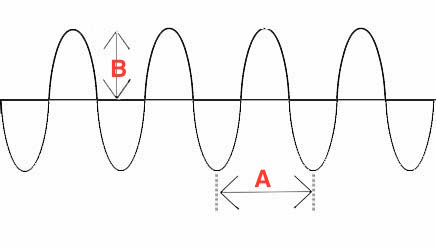
What property of this wave is represented by the letter "A"
a)
amplitude
b)
crest
c)
trough
d)
wavelength
68.
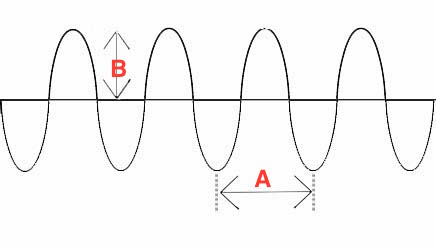
What property of the wave is represented by the letter "B"?
a)
amplitude
b)
crest
c)
trough
d)
wavelength
69.
The highest point on a wave is:
a)
the crest
b)
the trough
c)
the top
d)
the coast
70.
The lowest point on a wave is the:
a)
Amplitude
b)
Crest
c)
Trough
d)
Wavelength
71.
A mechanical wave cannot travel through...
a)
a vacuum(empty space).
b)
water.
c)
air.
d)
glass.
72.
Which of the following can sound travel through?
a)
solid
b)
liquid
c)
gas
d)
all of the above
73.
regular disturbances that carry energy through matter or space
a)
crest
b)
energy
c)
wave
d)
trough
74.
which material does sound travel the fastest?
a)
solid
b)
liquid
c)
gases
75.
The lower the frequency,
a)
the lower the pitch
b)
the higher the pitch
c)
the pitch stays the same
76.
Sound is produced by
a)
music
b)
vibrations of molecules
c)
Electromagnetic Waves
d)
Transverse Waves
77.
___________________ is known as when crests of one wave overlap with the troughs of another wave
a)
Refraction
b)
Reflection
c)
Constructive Interference
d)
Destructive Interference
78.
Which interaction of wave is known for when waves bend around a barrier?
a)
Refraction
b)
Reflection
c)
Diffraction
d)
Interference
79.
Which interaction of waves is known for waves bending between mediums?
a)
Reflection
b)
Refraction
c)
Diffraction
d)
Interference
80.
A wave carries...?
a)
energy only
b)
matter only
c)
the matter carries the energy
d)
neither
81.
The action of a wave bouncing off a surface is called __________________.
a)
rarefaction
b)
refraction
c)
reflection
d)
diffraction
82.

Sound is a form of?
a)
energy
b)
pitch
c)
volume
d)
matter
83.
How does a sound wave interact with a human ear?
a)
vibrates the ear drum
b)
bounces off the ear canal
c)
rotates the ear drum
d)
vibrates the ear canal
84.
What is the speed of a 20 Hz with a 4m wavelength?
a)
0.2 m/s
b)
5 m/s
c)
80 m/s
d)
320 m/s
85.
What is the frequency of a wave traveling at 300 m/s with a 4 m wavelength?
a)
0.013 Hz
b)
75 Hz
c)
300 Hz
d)
1200 Hz
86.
What is the wavelength of a wave traveling at 45 m/s with a frequency of 2000 Hz?
a)
0.0225 m
b)
44.4 m
c)
90,000 m
d)
90 m
87.
What is the frequency of a wave that has a period of 3.5 s?
a)
Not enough information
b)
0.286 Hz
c)
3.5 Hz
d)
12.25 Hz
88.
Why does sound travel faster through a solid object than in the air?
a)
The atoms in the solid object are farther apart than the atoms in the air.
b)
The atoms in the solid object are closer together than the atoms in the air.
c)
The atoms are smaller in the solid object than the atoms in the air.
d)
The atoms are larger in the solid object than the atoms in the air.
89.
Which of these factors affects how fast a sound wave moves?
a)
the kind of material it is moving through
b)
the amplitude of the sound wave’s vibrations
c)
the wavelength of the disturbance in the medium
d)
the type of motion that caused the sound wave to form
90.
Sound waves move as ________ waves.
a)
Longitudinal
b)
Electromagnetic
c)
Transverse
d)
Microwaves
91.
Which statement best explains the difference between longitudinal and transverse waves?
a)
Longitudinal waves have troughs, while transverse waves have crests.
b)
Longitudinal waves produce energy, while transverse waves consume energy.
c)
Particles in longitudinal waves travel towards a force, while particles in transverse wave travel away from a force.
d)
Particles in longitudinal waves travel in the direction of the wave, while particles in transverse waves travel perpendicular to the wave.
92.
What do we call the part of a compressional wave that is when the waves are squeezed together?
a)
compression
b)
rarefaction
c)
crest
d)
trough
93.
What is the name of a material in which waves, like sound waves, seismic waves, and waves in a slinky
a)
Vacuum
b)
Medium
c)
Mechanical
d)
Space
94.

What kind of wave is pictured below?
a)
compressional wave
b)
transverse wave
c)
sound wave
d)
mechanical wave
95.
Sound waves are...
a)
cool
b)
not cool
c)
transverse waves
d)
longitudinal waves
96.
The shorter the wavelength the
a)
shorter the frequency
b)
higher the freuqnecy
c)
frequency stays the same
d)
less energy
100 %

