
 Worksheets
Geo Sem 1 Final Review
Total questions: 145
Worksheet time: 4hrs 47mins
Name
Class
Date
1.
An exact location in space with no length or width.
a)
Ray
b)
Point
c)
Line
d)
Line segment
2.

Name the image
a)
Line
b)
Ray
c)
Line segment
d)
Angle
3.

Name the Image
a)
Angle
b)
Line
c)
Line Segment
d)
Ray
4.
A line is named by...
a)
Any 2 points on the line, or a lowercase script letter.
b)
Any 3 points on the line.
c)
Any 1 point on the line.
d)
Any 3 points on the line, or a uppercase script letter.
5.
A plane is named by...
a)
Any 1 point on the plane.
b)
Any 3 collinear points on the plane or a lowercase script letter.
c)
Any 3 non-collinear points on the plane or an uppercase script letter.
d)
All points on the plane that aren't part of a line.
6.

A line that contains point M.
a)
Line q
b)
Line p
c)
Line r
d)
Line NH
7.

An example of 2 non-collinear points.
a)
D, E
b)
C, B
c)
M, E
d)
F, B
8.

Are points D and E collinear or coplanar?
a)
Collinear
b)
Coplanar
9.

How many points do you need to make a plane?
a)
1
b)
2
c)
at least 3
d)
0
10.

Find the length of TU
a)
10
b)
52
c)
12
d)
22
11.
Part of a line. Has two endpoints and includes all of the points in between.
a)
Point
b)
Angle
c)
Line
d)
Line Segment
12.

How many degrees does the inside of a triangle have?
a)
240
b)
360
c)
180
d)
90
13.

Find the midpoint of these coordinates.
(2,3) and (-6, 8)
(2,3) and (-6, 8)
a)
(-2 , 5.5)
b)
(2.5 , 1)
c)
(2 , -1.5)
d)
(3 , -24)
14.

Find the complement of a 37° angle.
a)
37°
b)
53°
c)
90°
d)
143°
15.
Find the supplement of a 81° angle.
a)
9°
b)
99°
c)
101°
d)
180°
16.

What angle is this
a)
Intersectioning lines
b)
straight angle
c)
Parallel lines
d)
Reflexive Angle
17.

What is the Area of this shape?
a)
56
b)
50
c)
78
d)
I have no idea how to do this. I need to come to tutoring.
18.

True or False: Points B, C, and D are coplanar.
a)
True
b)
False
19.

True or False: Points A, B, and C are collinear.
a)
True
b)
False
20.

This is what kind of angle?
a)
right
b)
acute
c)
obtuse
d)
straight
21.

This is what kind of angle?
a)
obtuse
b)
right
c)
straight
d)
acute
22.

This is what kind of angle?
a)
acute
b)
obtuse
c)
right
d)
straight
23.
Where 2 lines meet and create an intersecting point is called what?
a)
vertex
b)
ray
c)
triangle
d)
line segment
24.

What is the measure of the following angle?
a)
21 degrees.
b)
34 degrees.
c)
70 degrees.
d)
172 degrees.
25.
Two lines going the exact same way and will never intersect
a)
Alternate exterior angles
b)
Parallel lines
c)
Alternate interior angles
d)
Vertical lines
26.

Baymax's eyes make a...
a)
Line
b)
Line segment
c)
Ray
d)
Angle
27.
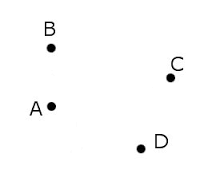
What is a point?
a)
a straight path
b)
an exact location
c)
endless flat surface
d)
lines that cross
28.

Name the angle with one arc
a)
< KLN
b)
< LNM
c)
<LMN
d)
< KNL
29.
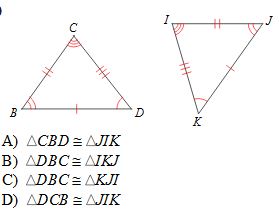
Which is a correct congruence statement.
a)
A
b)
B
c)
C
d)
D
30.

Name the blue angle
a)
∠GLK
b)
∠L
c)
∠HGL
d)
∠KLH
31.

These angles are...
a)
Complementary
b)
Supplementary
c)
Neither
32.

Find the missing angle.
a)
60
b)
70
c)
50
d)
140
33.
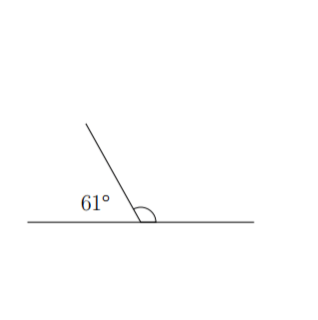
What is the measure of the missing angle?
a)
39
b)
129
c)
119
d)
129
34.

Find the value of x.
a)
16
b)
19
c)
20
d)
18
35.
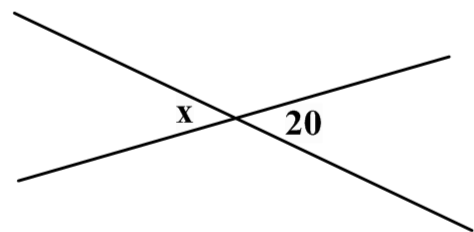
Find the missing angle. Find x.
a)
20o
b)
70o
c)
160o
d)
180o
36.
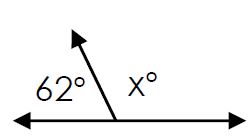
a)
x = 118
b)
x = 108
c)
x = 28
d)
x = 58
37.

Solve for x
a)
5
b)
90
c)
25
d)
10
38.

Solve for x
a)
6
b)
140
c)
20
d)
90
39.

Find the value of x.
a)
13
b)
8.6
c)
5
d)
130
40.
Given, "If I have a Siberian Husky, then I have a dog." Identify the contrapositive.
a)
If I do not have a Siberian Husky, then I do not have a dog.
b)
If I have a dog, then I have a Siberian Husky.
c)
If I do not have a dog, then I do not have a Siberian Husky.
d)
If I do not have a Siberian Husky, then I have a dog.
41.
Given, "If angles are congruent, then the measures of the angles are equal." Identify the converse.
a)
If the measures of the angles are equal, then the angles are congruent.
b)
"If angles are not congruent, then the measures of the angles are not equal."
c)
If the measures of the angles are not equal, then the angles are not congruent.
d)
If the angles are not congruent, then the measure of the angles are equal.
42.
Given, "If angles are congruent, then the measures of the angles are equal." Identify the inverse.
a)
If the measures of the angles are equal, then the angles are congruent.
b)
"If angles are not congruent, then the measures of the angles are not equal."
c)
If the measures of the angles are not equal, then the angles are not congruent.
d)
If the angles are not congruent, then the measure of the angles are equal.
43.
Given, "If angles are congruent, then the measures of the angles are equal." Identify the conclusion.
a)
If the angles are congruent.
b)
The angles are congruent.
c)
Then the measures of the angles are equal.
d)
The measures of the angles are equal.
44.
What is the hypothesis of the following statement: "If Johnny is late to school, then his mom will have to drive him."
a)
His mom will have to drive him
b)
If Johnny is late to school
c)
Johnny is late to school
d)
Then his mom will have to drive him
45.

To write the converse you negate both the hypothesis and the conclusion.
a)
False
b)
True
46.
Original: The sky is not blue.
What is this statement: The sky is blue.
What is this statement: The sky is blue.
a)
Converse
b)
Inverse
c)
Contrapositive
d)
Negation
47.
If it is a number, then it is either positive or negative. What is an appropriate counterexample?
a)
10
b)
-2
c)
0
d)
True. There is no counterexample.
48.
What does
~q -> ~p symbolize?
~q -> ~p symbolize?
a)
Conditional Statement
b)
Converse
c)
Inverse
d)
Contrapositive
49.
Is the given statement true:
If the chair is empty, then class is not in session.
If the chair is empty, then class is not in session.
a)
True. Class can't happen if a chair isn't occupied.
b)
False. Someone could be absent.
c)
True. Nobody sits down so we don't do work.
d)
True. There are no chairs here, so the hypothesis is true.
50.

What is this?
a)
Conditional Statement
b)
Inverse
c)
Converse
d)
THIS IS A GEOMETRY CLASS!!! GIVE ME NUMBERS!
51.

What is the justification?
a)
Reflexive Prop.
b)
Symmetric Prop.
c)
Transitive Prop.
d)
Substitution
52.

What is the measure of angle 2?
a)
50
b)
65
c)
115
53.

a)
A
b)
B
c)
C
d)
D
54.

Find x.
a)
x = 5
b)
x = 4
c)
x = -4
d)
x = 20
55.

Find the value of x .
a)
x = 4
b)
x = 5
c)
x = 6
d)
x = 20
56.

Find the value of x .
a)
x = 3
b)
x = 6
c)
x = 13
d)
x = 36
57.

∠1 and ∠3 can best be described as -
a)
complementary angles
b)
supplementary angles
c)
vertical angles
d)
adjacent angles
58.

∠AOB and ∠COB can best be described as -
a)
complementary angles
b)
supplementary angles
c)
vertical angles
d)
adjacent angles
59.

Name a segment that is parallel to NP.
a)
MR
b)
PR
c)
QP
d)
MN
60.

What is the measure of the following angle?
a)
120 degrees.
b)
171 degrees.
c)
60 degres.
d)
10 degrees.
61.
Translations, reflections and rotations are all known as ________________________.
a)
Geometry
b)
Transformations
c)
Congruent
62.

Name the transformation.
a)
Translation
b)
Reflection
c)
Rotation
63.
When you translate, you ______ a number to x and y.
a)
Add or subtract
b)
Multiply or divide
c)
Add or multiply
d)
Subtract or divide
64.
Translation are always _______
a)
Congruent
b)
Bigger
c)
Smaller
d)
Rotated
65.
When you translate, (x-4,y) will move _____.
a)
4 units right
b)
4 units left
c)
4 units up
d)
4 units down
66.
When you translate, (x,y+6) will move _____.
a)
6 units right
b)
6 units left
c)
6 units up
d)
6 units down
67.

Identify the transformation from ABC to A'B'C'.
a)
90o clockwise rotation
b)
90o counter clockwise rotation
c)
Reflection across the y-axis
d)
Reflection across the x-axis
68.

Identify the transformation from ABCD to A'B'C'D'.
a)
Translation
b)
Reflection across the y-axis
c)
Reflection across the x-axis
d)
90o counter clockwise Rotation
69.

Identify the transformation.
a)
Reflection across y-axis
b)
90 Rotation counter clockwise
c)
Translation 5 units left, 1 unit up.
d)
Translation 5 units right, 1 unit down
70.
Point (7,2) is translated vertically 2 units and horizontally -5 units. Where is the new point located?
a)
(9,-3)
b)
(2,4)
c)
(2,0)
d)
12,4)
71.
Point (-5,2) is reflected over the y axis. Where is the new point located?
a)
(5,2)
b)
(-5,-2)
c)
(-5,2)
d)
(5,-2)
72.

Identify the transformation from ABC to A'B'C'.
a)
(x+8, y+4)
b)
(x-8, y-4)
c)
(x+4, y+8)
d)
(x-4, y-8)
73.
The result of a transformation.
a)
Pre-image
b)
Image
74.

Reflections over the x-axis change the ____-__________.
a)
y-coordinate
b)
x-coordinate
75.

Which rule would result in a clockwise rotation of 90° about the origin?
a)
(x, y) → (y, x)
b)
(x, y) → (4x, 4y)
c)
(x, y) → (x, -y)
d)
(x, y) → (x + 4, y + 4)
76.

C(-6, 2) and B(-1, -1)
Translate (x, y) -> (x - 1, y - 3)
Translate (x, y) -> (x - 1, y - 3)
a)
C' (-6, 2), B' (-1, -1)
b)
C' (-7, -1), B' (-2, -4)
c)
C' (-5, 5), B' (0, 2)
d)
C' (-7, 1), B' (-2, -2)
77.

A(-2, 2) and B(3, 2)
Reflect over the x-axis
Reflect over the x-axis
a)
A' (-2, 2), B' (3, 2)
b)
A' (-2, -2), B' (3, -2)
c)
A' (2, -2), B' (-3, -2)
d)
A' (2, -2), B' (2, 3)
78.

How many degrees was the figure rotated?
a)
90 degrees counterclockwise
b)
180 degrees
c)
270 counterclockwise
79.

Name the parent function.
a)
constant
b)
square root
c)
linear
d)
absolute value
80.
What is Dilation?
a)
Dilation means to enlarge or reduce
b)
Dilation means to reflect on something
c)
Dilation means to like something
d)
Dilation means to make something different by making it smaller
81.
The __________ is the ratio of a length of the image to the corresponding length on the original figure.
a)
reduction
b)
enlargement
c)
scale factor
d)
center of dilation
82.
A dilation can produce a smaller figure or a(n)______
a)
reduction
b)
enlargement
c)
scale factor
d)
center of dilation
83.
Definition: The figure before a transformation has occurred.
a)
Pre-image
b)
Image
c)
Translation
d)
Reflection
84.
(x, y) -> (2x, 2y)
What is the coefficient 2 mean?
What is the coefficient 2 mean?
a)
plot 2 to the right and 2 up
b)
scale factor is 2 creating a new figure half the size
c)
scale factor is 2 making a figure twice the
original
original
d)
I don't understand this question : (
85.
A dilation can produce a larger figure or a(n)______
use a synonym for larger
use a synonym for larger
a)
reduction
b)
enlargement
c)
scale factor
d)
center of dilation
86.

Does the image show a dilation?
a)
Yes
b)
No
87.
A triangle has vertices with coordinates (2,0), (3, -1) and (-2,-5). If the triangle is dilated by a scale factor of 3 with the origin as the center of dilation, what are the coordinates of the vertices of the image?
a)
(5,3), (6,2), (1,-2)
b)
(6,0), (9,-3), (-6,-15)
c)
(2/3,0), (1,-1/3), (-2/3,-5/3)
d)
(-1,-3), (0,-4), (-5,-8)
88.

What is the area of this rectangle?
a)
40 square centimeters
b)
45 square centimeters
c)
28 centimeters
d)
50 square centimeters
89.
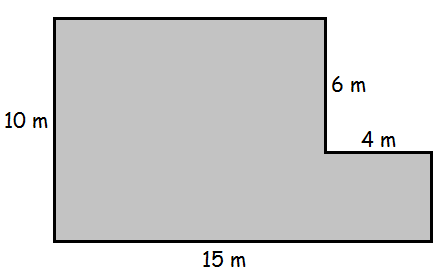
Find the perimeter
a)
25cm
b)
35cm
c)
50cm
d)
100cm
90.

Find the volume of the figure?
a)
460 cm 3
b)
660 cm 3
c)
60 cm 3
d)
360 cm 3
91.
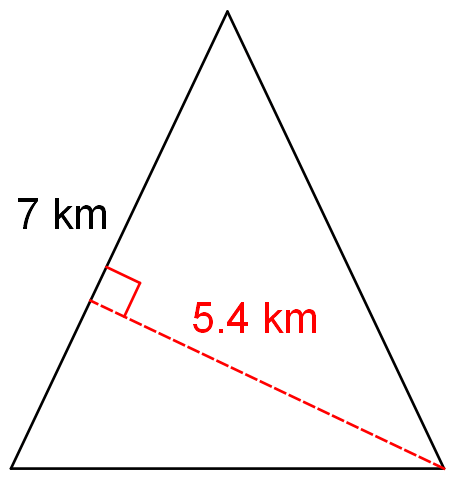
Find the Area of this triangle
a)
19.8 km2
b)
37.8 km2
c)
18.9 km2
d)
35 km2
92.
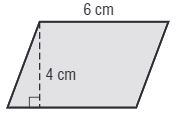
Find the area of the figure.
a)
10 cm2
b)
24 cm2
c)
12 cm2
d)
20 cm2
93.

Find the AREA of this figure.
a)
160 square feet
b)
160 feet
c)
abcdefghijklmnopqr
stuvwxyz
stuvwxyz
d)
1600 feet
94.
A polygon with eight sides.
a)
hexagon
b)
pentagon
c)
quadrilateral
d)
octagon
95.
A polygon with five sides.
a)
hexagon
b)
pentagon
c)
quadrilateral
d)
octagon
96.
A polygon with six sides.
a)
hexagon
b)
pentagon
c)
quadrilateral
d)
octagon
97.

Name this shape
a)
hexagon
b)
pentagon
c)
octagon
d)
parallelogram
98.

The folded line that shows a shape has symmetric is called what?
a)
Line of Symmetry
b)
Line of Special
c)
Line of Obtuse
d)
Line of Noral
99.

What is a polygon?
a)
A closed plane figure made up of line segments
b)
An open plane figure made up of line segments
c)
A closed plane figure made up of rays
d)
An open plane figure made up of rays
100.
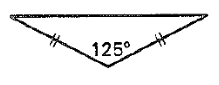
Classify the following triangle in as many ways as possible.
a)
Isosceles, Acute
b)
Isosceles, Obtuse
c)
Scalene, Obtuse
d)
Equilateral, Acute
101.
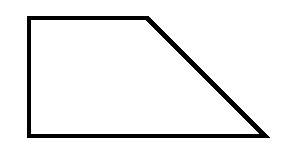
Name that shape.
a)
quadrilateral, parallelogram
b)
quadrilateral
c)
quadrilateral, kite.
d)
quadrilateral, trapezoid
102.
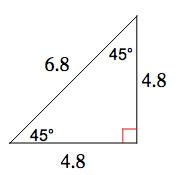
Which would be the best classification for the triangle shown?
a)
right isosceles
b)
obtuse scalene
c)
obtuse isosceles
d)
right scalene
103.

Name that shape.
a)
quadrilateral, parallelogram, rectangle, rhombus, square
b)
square
c)
quadrilateral, parallelogram, square
d)
quadrilateral, parallelogram, rhombus, square
104.

Why is a Triangle called Equilateral?
a)
It has two sides that congruent
b)
It has all 3 sides that are congruent
c)
It has no sides that match
d)
It has four sides that match
105.

Solve for C
a)
155
b)
90
c)
25
d)
65
106.

What is the value of the ANGLE A (not just x)?
a)
151
b)
68
c)
151
d)
70
107.

Find the value of r
a)
46
b)
44
c)
43
d)
47
108.

Solve for x.
a)
16
b)
11
c)
50
d)
6
109.

Find the measure of angle b.
a)
b=51
b)
b=129
110.

Find the missing angle
a)
30 degrees
b)
60 degrees
c)
80 degrees
d)
120 degrees
111.

Find the missing angle
a)
80 degrees
b)
60 degrees
c)
12 degrees
d)
70 degrees
112.

Which of the following is NOT one of the angle measures?
a)
95
b)
40
c)
85
d)
45
113.

What type of triangle is this?
a)
Acute Isoceles
b)
Right Scalene
c)
Acute Scalene
d)
Obtuse Isosceles
114.

How do you find the missing angle?
a)
124 + 77
b)
2(77)
c)
180 - 77
d)
124 - 77
115.

Find the value of x.
a)
A
b)
B
c)
C
d)
D
116.

Which of the following terms best describes Angle d?
a)
Remote interior angle
b)
Corresponding angle
c)
Exterior angle
d)
Interior angle
117.

a)
56˚
b)
72˚
c)
124˚
d)
304˚
118.

Find the measure of the indicated angle.
a)
26
b)
36
c)
85
d)
144
119.
The Triangle Sum Theorem states that the sum of the angles of a triangle equal how many degrees?
a)
90
b)
30
c)
150
d)
180
120.

Classifying the following the triangle as many ways as possible.
a)
Acute, Scalene
b)
Right, Scalene
c)
Obtuse, Scalene
d)
Acute, Isosceles
121.

a)
45°
b)
100°
c)
110°
d)
135°
122.

What is the Angle Relationship?
a)
Alternate Interior
b)
Alternate Exterior
c)
Corresponding
d)
Same Side Interior
123.

What is the relationship of the Angles
a)
Alternate Interior
b)
Alternate Exterior
c)
Corresponding
d)
Same Side Interior
124.

Which is a pair of corresponding angles?
a)
∠4 and ∠3
b)
∠4 and ∠1
c)
∠4 and ∠2
d)
∠4 and ∠8
125.

What is the angle relationship?
a)
Alternate Interior
b)
Alternate Exterior
c)
Corresponding
d)
Same-Side Interior
126.

What is the value of x?
a)
45
b)
54
c)
126
d)
135
127.

Angle 1 = 27o
Find the measure of angle 4
Find the measure of angle 4
a)
27o
b)
153o
c)
63o
d)
90o
128.

What is the measure of ∠8?
a)
55
b)
155
c)
135
d)
45
129.
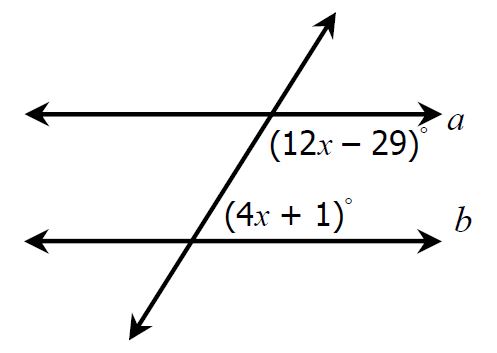
WHICH IS THE CORRECT EQUATION TO SOLVE FOR X?
a)
16X+180 = 90
b)
12X - 19 = 4X +1
c)
12X - 19 + 4X +1=90
d)
12X - 19 + 4X +1=180
130.

WHAT IS THE VALUE OF X?
a)
16
b)
11.4
c)
0
d)
-16
131.

What is the measure of ∠2?
a)
38
b)
58
c)
71
d)
142
132.

Angles 1 and 5 are
a)
Same Side interior
b)
Alternate Interior
c)
Alternate Exterior
d)
Vertical
133.
What is the inverse operation of addition?
a)
addition
b)
subtraction
c)
multiplication
d)
division
134.
What is the inverse operation of subtraction?
a)
addition
b)
subtraction
c)
multiplication
d)
division
135.
What is Addition property of equality
a)
a. If a=b, then a+c=b+c
b)
b. If a=b, then a-c=b-c
c)
c. If a=b, then ac=bc
d)
d. If a=b, then a/c=b/c
136.
What is Subtraction property of equality
a)
a. If a=b, then a+c=b+c
b)
b. If a=b, then a-c=b-c
c)
c. If a=b, then ac=bc
d)
d. If a=b, then a/c=b/c
137.

Step 1 is what
a)
addition property of equality
b)
given
c)
subtraction property of equality
d)
prove
138.

Step 2 is what
a)
Substitution property (simplify)
b)
Multiplication property of equality
c)
Division property of equality
d)
Distributive Property
139.
Which property states that 4 = 4?
a)
Substitution Property
b)
Reflexive Property
c)
Symmetric Property
d)
Transitive Property
140.

What is step 6
a)
Subtraction property of equality
b)
Addition property of equality
c)
Division property of equality
141.
How do you find the area of a triangle?
a)
bh
b)
bhl
c)
1/2bh
142.
How do you find the area of a parallelogram?
a)
bh
b)
bhl
c)
1/2bh
143.
If ∠1 = ∠2 and ∠2 = ∠3, then ∠1 = ∠3.
a)
Addition Property of Equality
b)
Symmetric Property of Equality
c)
Reflexive Property of Equality
d)
Transitive Property of Equality
144.
If k = 3, then 3 = k.
a)
Substitution Property of Equality
b)
Reflexive Property of Equality
c)
Symmetric Property of Equality
d)
Transitive Property of Equality
145.
If a=b, then 8a=8b.
a)
Multiplication Property of Equality
b)
Division Property of Equality
c)
Reflexive Property of Equality
d)
Addition Property of Equality
100 %

