wayground logo

Free Printable Worksheets

Font size

S
M
L
XL
Worksheets

Exponential and Log review

Total questions: 150

Worksheet time: 9hrs 29mins

Name
Class
Date
1.

Rewrite logx95 = 2.3

a)

x2.3 = 95

b)

952.3 = x

c)

2.395 = x

d)

x95 = 2.3

2.

Without a calculator, determine which of the following yields a negative answer.

a)

log9 (1/30)

b)

log9 3

c)

log9 -81

d)

log9 1

3.

Without a calculator, evaluate log41

a)

1/4

b)

0

c)

-1

d)

not possible

4.

Without a calculator, list the following in order, least to greatest:

A) log5 30

B) log0.25 32

C) log7 49

D) log8 40

a)

A,B,C,D

b)

A,B,D,C

c)

B,D,C,A

d)

B,D,A,C

5.

Without a calculator, determine which of the following ISN"T possible. Check all that apply.

a)

log2 (x - 4) when x = 4

b)

log3 (x+3) when x = 0

c)

-2log5 (x-1) when x = 0

d)

1/2 log (x+4) when x = -2

6.

Without technology, determine which of the following is an increasing function. Check all that apply.

a)

y = log2 (x - 4)

b)

y = log3 (x+3)

c)

y = -2log5 (x-1)

d)

y = 1/2 log x + 4

7.

Which of the following has a domain of all real numbers, x > 2 ?

a)

y = log2 x

b)

y = log3 (x+2)

c)

y = log4 (x - 2)

d)

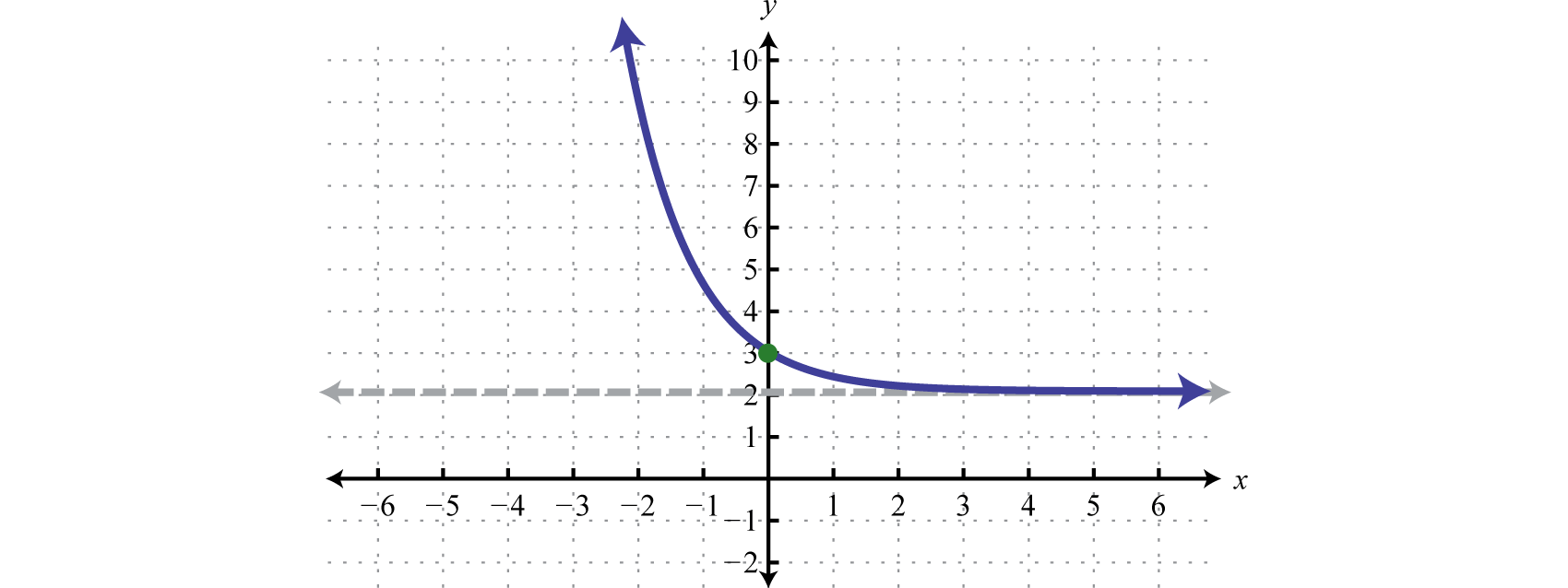
y = log7 x - 2

8.

Without a calculator, evaluate log125 25

a)

2/3

b)

3/2

c)

1/6

d)

1/5

9.

Which of the following is the sketch of the graph of y = -log3 (x+5) ?

a)
b)
c)
d)
10.

Without a calculator, evaluate log6 -36

a)

not possible

b)

-2

c)

2

d)

1/2

11.

log(4x)

a)

log4-logx

b)

log4+logx

c)

4logx

d)

xlog4

12.

log(xy2)

a)

logx+2logy

b)

logx+logy2

c)

logx-2logy

d)

logx+logy+log2

13.

 log(xy)\log\left(\frac{x}{y}\right)  

a)

logx+logy

b)

xlogy

c)

log(x-y)

d)

logx-logy

14.

 log(m3n)\log\left(\frac{m^3}{n}\right)  

a)

logm-log3-logn

b)

3logm+logn

c)

3logm-logn

d)

3log(m-n)

15.

log(3x)2

a)

2log(3+x)

b)

2log3+logx

c)

log3+2logx

d)

2(log3+logx)

16.

 ln(2x2yz4)\ln\left(\frac{2x^2y}{z^4}\right)  

a)

ln2+2lnx+lny+4lnz

b)

ln2+2lnx+lny-4lnz

c)

2ln(2xy)-4lnz

d)

2ln2x+lny-4lnz

17.
Write logb(x/y) as two logs
a)
logbx-logby
b)
logbx+logby
c)
logbx*logby
d)
logbx/logby
18.
Use multiple log properties to write as a single log:
log2x -  5log2y
a)
log2(x/y5)
b)
log2(xy5)
c)
log2(x/y)5
d)
log2(x/5y)
19.
a)
log (xy3)
b)
log (x− y3)
c)
log (x6/y3)
d)
log (x6 + y3)
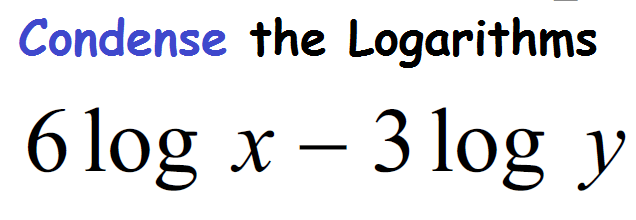
20.
Condense: log16 + log2 - log8
a)
log4
b)
log8
c)
log10
d)
log24
21.
Logarithmic functions are the inverse of...
a)
Linear Functions
b)
Exponential Functions 
c)
Quadratic Functions 
d)
Polynomial Functions 
22.

Which of the following does NOT describe the graph of the logarithmic parent function?

a)

The graph has a domain of all positive real numbers.

b)

The graph has a range of all real numbers.

c)

The x-intercept is 1.

d)

The x-axis is the horizontal asymptote.

23.

f(x)=log5(x+4) - 2

Describe the asymptote

a)

Horizontal Asymptote x = -4

b)

Vertical Asymptote x = -4

c)

Horizontal Asymptote x = 4

d)

Vertical Asymptote x = 4

24.

f(x)=log5(x+4) - 2

Find the Domain and Range

a)

Domain: x ≥ -4

Range: all real numbers

b)

Domain: all real numbers

Range: y ≥ -4

c)

Domain: all real numbers

Range: y > -4

d)

Domain: x > -4

Range: all real numbers

25.

f(x)=log5(x+4) - 2

Describe the transformation

a)

translation 4 units to the right, 2 units down

b)

translation 4 units to the left, 2 units down

c)

translation 4 units to the up, 2 units right

d)

translation 4 units to the up, 2 units left

26.

f(x)=2ln(x+2)

Describe the asymptote

a)

Horizontal asymptote x = -2

b)

Horizontal asymptote x = 2

c)

Vertical asymptote x = -2

d)

Vertical asymptote x = 2

27.

f(x)=2ln(x+2)

Find the Domain and Range

a)

Domain: (-∞, ∞)

Range: ( -2, ∞)

b)

Domain: (-∞, ∞)

Range: ( -∞, -2)

c)

Domain: ( -∞, -2)

Range: (-∞, ∞)

d)

Domain: ( -2, ∞)

Range: (-∞, ∞)

28.

f(x)=2ln(x+2)

Describe the transformation

a)

Vertical Stretch by 2, translation 2 units to the left

b)

Vertical Compression by 2, translation 2 units to the left

c)

Vertical Stretch by 2, translation 2 units to the right

d)

Vertical Compression by 2, translation 2 units to the right

29.

f(x)=¼ ln(x - 2) + 3

Describe the asymptote

a)

Horizontal asymptote x=2

b)

Horizontal asymptote x= -2

c)

Vertical asymptote x=2

d)

Vertical asymptote x= -2

30.

f(x)=¼ ln(x - 2) + 3

Find the Domain and Range

a)

Domain: all real numbers

Range: y > 2

b)

Domain: all real numbers

Range: y > -2

c)

Domain: x > -2

Range: all real numbers

d)

Domain: x > 2

Range: all real numbers

31.

f(x)=¼ ln(x - 2) + 3

Describe the transformation

a)

Vertical Stretch by 1/4, translation 2 units right, 3 units up

b)

Vertical Compression by 1/4, translation 2 units right, 3 units up

c)

Vertical Stretch by 1/4, translation 2 units left, 3 units up

d)

Vertical Compression by 1/4, translation 2 units left, 3 units up

32.
What is the domain of the graph?
a)
(-∞,∞)
b)
(-2, ∞)
c)
(0,∞)
d)
(-∞,2)
33.
What is the range of the graph?
a)
(-∞,∞)
b)
(-2, ∞)
c)
(0,∞)
d)
(-∞,2)
34.
What is the range of the graph?
a)
(-∞,∞)
b)
(-2, ∞)
c)
(0,∞)
d)
(-∞,-2)
35.
What is the domain of the graph?
a)
(-∞,∞)
b)
(-2, ∞)
c)
(0,∞)
d)
(-∞,-2)
36.
What is the domain of the graph?
a)
(-∞,∞)
b)
(2, ∞)
c)
(-3,∞)
d)
(0,-2)
37.
What is the range of the graph?
a)
(-∞,∞)
b)
(2, ∞)
c)
(-3,∞)
d)
(0,-2)
38.
What is the range of the graph?
a)
(-∞,∞)
b)
(2, ∞)
c)
(-5,∞)
d)
(-∞,6)
39.
What is the domain of the graph?
a)
(-∞,∞)
b)
(2, ∞)
c)
(-5,∞)
d)
(-∞,6)
40.
What is the domain of the graph?
a)
(-∞,∞)
b)
(-1, ∞)
c)
(-3.5,∞)
d)
(-∞,6)
41.
What is the range of the graph?
a)
(-∞,∞)
b)
(-1, ∞)
c)
(-3.5,∞)
d)
(-∞,6)
42.
Use the function, N = 14,000(.96)t. Where N is the number of employees and t is the number of years.
How many employees will there be after 3 years?
a)
14,000 employees
b)
12,386 employees
c)
40,360 employees
d)
15,748 employees
43.

Describe the tranformation

a)

translate 4 units up

b)

translate 4 units left

c)

translate 4 units right

d)

translate 4 units down

44.
What is the transformation?
a)
Left 5
b)
Right 5
c)
Up 5
d)
Down 5
45.
Classify the model as Exponential GROWTH or DECAY.
A=1200(.85)6
a)
Growth
b)
Decay
46.

What is the initial value of the situation represented by f(x)=0.05(2)x?

a)

0.05

b)

2

c)

0.1

d)

1

47.

Domain of y = log x ?

a)

All real numbers

b)

x>0

c)

x<0

d)

y>0

48.

Write the equation for the graph.

a)

f(x) = log2 (x-3)

b)

f(x)= 3 log2(x)

c)

f(x) = log2(x+3)

d)

f(x) = log2(x) + 3

49.
Logarithms and Exponentials are what?
a)
parallel
b)
perpendiular 
c)
inverses
d)
congurent
50.
Log with a base "e" (loge) is the same thing as...
a)
"e"
b)
Natural Logarithm (LN)
c)
Common Logarithm (Log)
d)
Natural Log, base "e"
LNe
51.
Describe the transformations of f(x)= -log2(x+1)
a)
left one & y-axis reflection
b)
right one & y-axis reflection
c)
left one & x-axis reflection
d)
right one & x-axis reflection
52.
Match the graph with its equation
a)
y = log6(-x) + 1
b)
y = log6(x − 2) + 1
c)
y = log6(x + 2) - 1
d)
y = log(x-8) + 1
53.
Match the graph with its equation
a)
y = log5 (x + 1) + 1 
b)
y = log5 (x - 1) + 1 
c)
y = log5 (x2) + 1 
d)
y = log5 (x)-1
54.
what transformation? y = log(x+3)
a)
left 3
b)
right 3
c)
up 3
d)
down 3
55.
Which has a horizontal asymptote?
a)
exponential
b)
logarithm
c)
both
56.
Which equation best describes the graph? 
a)
y = 2x + 4
b)
y = 2x - 3
c)
y = 2x - 4
d)
y = 2x + 3 
57.
Use the function, f(x) = (3/2)x.
What is the Domain?
a)
(3,2)
b)
(-∞,0)
c)
(-∞,∞)
d)
(0,∞)
58.
Use the function, f(x) = (3/2)x.
What is the Range?
a)
(3,2)
b)
(-∞,0)
c)
(-∞,∞)
d)
(0,∞)
59.
Use the function, f(x) = (3/2)x.
Is the function INCREASING or DECREASING?
a)
Increasing
b)
Decreasing
60.
Use the function, N = 14,000(.96)t.
Is the function INCREASING or DECREASING?
a)
Increasing
b)
Decreasing
61.
Use the function, N = 14,000(.96)t.
What is the Initial Amount?
a)
14,000
b)
4%
c)
.96
d)
t
62.
Use the function, N = 14,000(.96)t. Where N is the number of employees and t is the number of years.
How many employees will there be after 3 years?
a)
14,000 employees
b)
12,386 employees
c)
40,360 employees
d)
15,748 employees
63.

Determine the horizontal asymptote for the function

f(x) = 3(2)x-4 + 5

a)

x=4

b)

y=4

c)

x=5

d)

y=5

64.
Given y=3determine the y-intercept 
a)
(0,1)
b)
(0,3)
65.
Classify the model as Exponential GROWTH or DECAY.
A=1200(.85)6
a)
Growth
b)
Decay
66.
find the asymptotey = log10 (x+3)
a)
x=-3
b)
x=3
c)
y=-3
d)
y=3
67.
Find the asymptote of the following: y = log10 x - 6
a)
x=6
b)
x=-6
c)
x= 0
d)
y=0
68.

Domain of y = log x ?

a)

All real numbers

b)

x>0

c)

x<0

d)

y>0

69.

Florine-21 has a half-life of 4 seconds. You begin with a 50 mg sample of Florine-21.


Which exponential equation would represent the amount of Florine-21after t seconds.

a)

f(t)=50(12)t2f\left(t\right)=50\left(\frac{1}{2}\right)^{\frac{t}{2}}

b)

f(t)=50(12)2tf\left(t\right)=50\left(\frac{1}{2}\right)^{\frac{2}{t}}

c)

f(t)=50(12)4tf\left(t\right)=50\left(\frac{1}{2}\right)^{\frac{4}{t}}

d)

f(t)=50(12)t4f\left(t\right)=50\left(\frac{1}{2}\right)^{\frac{t}{4}}

70.

Prescription A has an initial value of 1200 mg/L and a half-life 6 hours.  Which equation will help us determine the remaining level after 1 day?

a)

 y=1200(12)16y=1200\left(\frac{1}{2}\right)^{\frac{1}{6}}  

b)

 y=1200(12)246y=1200\left(\frac{1}{2}\right)^{\frac{24}{6}}  

c)

 y=1200(12)61y=1200\left(\frac{1}{2}\right)^{\frac{6}{1}}  

d)

 y=1200(12)624y=1200\left(\frac{1}{2}\right)^{\frac{6}{24}}  

71.
What is the y-intercept of the function?
a)
2
b)
3
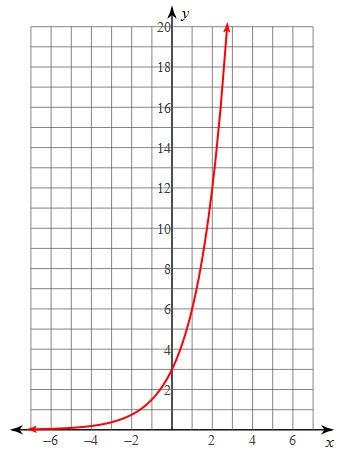
c)
1
d)
-2
72.
Is this exponential growth or decay?
a)
Growth
b)
Decay
73.
A new savings account is opened with $400 and gains 3% every year. What is the exponential function?
a)
f(x)=400(1+3)x
b)
f(x)=400(1-0.03)x
c)
f(x)=400(1+0.03)x
d)
f(x)=400(0.03)x
74.

Identify the common ratio (b value) of the function f(x)=2(4)x.

a)

2

b)

4

c)

(2)x

d)

8

75.

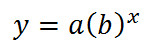
In an exponential function, what does the 'a' represent?

a)

Slope

b)

Rate of change

c)

Y-intercept

d)

Multiplier

76.
Which of the following is an increasing exponential function whose y-intercept is 50?
a)
y = 50(.05)x
b)
y = 50x - 4
c)
y = (2)x + 50
d)
y = 50(1.4)x
77.
A collectible car has been going up in price by 10% each year. If the car is already worth $29,000, how much will the car be worth in 5 years?
a)
$0.29
b)
$2,900,000,000
c)
$46,704.79
d)
$145,000
78.
The expression 12(1.015)t models the population of elephants in a wildlife refuge after t years since 1975.
Is the population of elephants increasing or decreasing?
a)
Increasing
b)
Decreasing
79.
Is y = 54(.20)x growth or decay?
a)
Growth
b)
Decay
80.
Is y = -5(4)x growth or decay?
a)
Growth
b)
Decay
81.
What values of b make an exponential decay function?
a)
b > 0
b)
b < 1
c)
b > 1
d)
0 < b < 1
82.

Identify the function y = 100(6x) as an example of exponential growth or decay. What is the y-intercept?

a)

exponential decay; y-intercept: 6

b)

exponential decay; y-intercept: 100

c)

exponential growth; y-intercept: 6

d)

exponential growth; y-intercept: 100

83.

The population of wolves in a certain place was 5,450 in 2013. Each year the population has decreased by 5%. What equation models the population of wolves since 2013?

a)

p(x) = 5450 - 95x

b)

p(x) = 5450(0.05)x

c)

p(x) = 5450(0.95)x

d)

p(x) = 5450 (1.05)x

84.

A savings account earns interest at an annual rate of 2.89%, compounded quarterly. If the account begins with a principal amount of $6000, what will be its total value after 5 years?

a)

$6,328.25

b)

$6,929.17

c)

$6,809.18

d)

$6,500.78

85.
Most automobiles depreciate as they get older. Suppose an automobile that originally costs $14,000 depreciates by 20% of its value every year. 
What exponential equation can we create to model this situation?
a)
y=14000(.20)x
b)
y=14000(.80)x
c)
y=14000(1+.20)x
d)
y=14000(1+.80)x
86.
A sculpture is increasing in value at a rate of 9% per year, and its value in 2000 was $1500. Write an exponential growth function to model this situation.
a)
f(t)=1500(1.09)t
b)
f(t)=1500(0.09)t
c)
f(t)=2000(0.09)t
d)
f(t)=1500(9)t
87.

I think this graph represents a growth. How accurate am I in my assertion?

a)

You are correct. b value is greater than 1

b)

You are incorrect. b value is less than 1

88.

Which does the graph represent?

a)

Growth

b)

Decay

89.
If $1,000 is invested at 16% interest, compounded continuously, for five years, what is the ending balance?
a)
$1,225,54
b)
$2,225.54
c)
$22,255.40
d)
$225.54
90.

What is the percent (%) of increase or decrease in the following function?


f(x) = 3000 (1 + 0.4)x

a)

Decrease by 4%

b)

Increase by 4%

c)

Increase by 40%

d)

Decrease by 40%

91.

What is the percent (%) of increaase or decrease in the following equation?


f(x) = 250 (0.95)x

a)

Decrease by 95%

b)

Increase by 5%

c)

Decrease by 5%

d)

Increase by 95%

92.
Kennedy won $3,000 from a radio contest. If she puts this money in a bank account that earns 2.9% interest compounded quarterly, how much total will she earn in 10 years?
a)
$4915.59
b)
$3933.28
c)
$2979.81
d)
$4005.09
93.
Caiden earned $475 from mowing lawns last summer. He deposited this money in an account that pays an interest rate of 3.8% compounded annually. What will be his balance after 15 year?
a)
$827.52
b)
$831.10
c)
$839.45
d)
$846.80
94.
You invest $1600 at an annual interest rate of 4.6% compounded continuously. How much will you have in the account after 4 years.
a)
$800.26
b)
$6,701.28
c)
$10,138.07
d)
$1,923.23
95.
Riley invested $1,000 in savings bonds. If the bonds earn 6.75% interest compounded semi-annually, how much total will Riley earn in 15 years?
a)
$1,584.62
b)
$2,651.39
c)
$2,706.86
d)
$1,825.10
96.
Caiden earned $475 from mowing lawns last summer. He deposited this money in an account that pays an interest rate of 3.8% compounded monthly. What will be his balance after 15 years?
a)
$827.52
b)
$839.17
c)
$839.45
d)
$846.80
97.
Determine the balance in the account if you deposited $4,000 at an interest rate of 3.4% compounded monthly for three years.
a)
$4422.03
b)
$4427.62
c)
$4428.90
d)
$4429.51
98.

The same amount of principal is invested in different accounts earning the same interest rate. Which of the following accounts would have the greatest accumulated value at the end of one year?

a)

An account earning no interest

b)

An account earning interest compounded monthly

c)

An account earning interest compounded annually

d)

An account earning interest compounded daily

99.
Change 6.75% to a decimal.
a)
67.5
b)
.675
c)
675
d)
.0675
100.

What does the n stand for in this formula?

a)

Initial amount

b)

Final amount

c)

Rate

d)

Time

e)

The number of times compounded per year

101.

What does the P stand for in this formula?

a)

Initial amount

b)

Final amount

c)

Rate

d)

Time

e)

The number of times compounded per year

102.

You deposit your life savings into Batrez Bank in the hopes it will double in 15 years. If Batrez Bank compounds quarterly, what interest rate are you hoping for?

a)

4.64%

b)

4.65%

c)

13.9%

d)

4.63%

103.

At 4% annual interest compounded quarterly, how long will it take to double your money?

a)

0.4 yrs

b)

16.4 yrs

c)

17.4 yrs

d)

18.4 yrs

104.

You invest $1600 at an annual interest rate of 4.6% compounded continuously. How much will you have in the account after 4 years.

a)

$1,923.23

b)

$10,138.07

c)

$6,701.28

d)

$800.26

105.

log4(3x-1)=log4(2x+3)

a)

4

b)

3

c)

1

d)

8

106.

logx1000=3

a)

1

b)

10

c)

30

d)

3

107.

log8(4x+4)=2

a)

15

b)

12

c)

10

d)

3

108.
log6(2x + 3) = 3
a)
x = 106.5
b)
x = 100
c)
x = 16
d)
x = 50
109.
Solve:
log x + log 8 = 2 
a)
10
b)
12.5
c)
15
d)
17.5
110.
log5(4x-7)=log5(x+5)
a)
3
b)
12
c)
4
d)
7
111.
log (x - 1)  - log (x - 2)  = log 5
a)
7
b)
4/9
c)
9/4
d)
1/7
112.
log2(2) + log2(8x) = 6
a)
x = 3
b)
x = 2
c)
x = 6
d)
x = 4
113.
This question is SLIGHTLY a challenge but you should all be able to do it!! 
log x - log 8 = 3
a)
x = 1000
b)
x = 800
c)
x = 8000
d)
x = 100
114.

Solve for x

 ex=6e^x=6  

a)

1.792

b)

403.4

c)

16.31

d)

-1.792

115.

Solve for x

 ex=10e^x=10  

a)

22026

b)

27.18

c)

4.605

d)

2.303

116.

Solve for x

 e2x=3e^{2x}=3  

a)

1.099

b)

0.549

c)

0.405

d)

2.197

117.

Solve for x

 e(x+1)=6e^{\left(x+1\right)}=6  

a)

1.609

b)

0.792

c)

1.792

d)

1096

118.

Solve for x

 e(3x1)=2e^{\left(3x-1\right)}=2  

a)

0.564

b)

0

c)

0.693

d)

1.079

119.

Solve for x

 2ex=152e^x=15  

a)

1.354

b)

1808

c)

4.029

d)

2.015

120.

Solve for x

 lnx=3\ln x=3  

a)

20.086

b)

1.099

c)

8.155

d)

-1.099

121.

Solve for x

 lnx=0.4\ln x=0.4  

a)

-0.916

b)

1.087

c)

1.492

d)

0.083

122.

Solve for x

 2lnx=0.42\ln x=0.4  

a)

1.221

b)

0.746

c)

1.492

d)

2.226

123.

Solve for x

 ln(x2)=0.5\ln\left(x-2\right)=0.5  

a)

12.182

b)

-0.351

c)

3.649

d)

1.307

124.

Solve for x

 ln3x2lnx=0.8\ln3x^2-\ln x=0.8  

a)

2.226

b)

6.677

c)

0.742

d)

1.075

125.

Rewrite ex = 9 using a logarithm

a)

ln x = 9

b)

ln 9 = x

c)

logx e = 9

d)

log9 x = e

126.

3e2x + 10 = 25

a)

{-3.940}

b)

{1.228}

c)

{0.451}

d)

{0.805}

127.
What is the value of ln(e7)
a)
2.718...
b)
1
c)
7
d)
Does not exist
128.
Rewrite in exponential form:
ln(2) = x
a)
2= 10
b)
102 = x
c)
e= 2
d)
e2 = x
129.
Which of the following is the value of x given;
7e(3x-5) = 49
a)
x = 2.315
b)
x = 0.681
c)
x = 2.964
d)
No Solution
130.
ln e5
a)
e5
b)
ln 5
c)
5
d)
5e
131.

A certain college has been raising tuition every year since the year it opened. The function T = 12,000 (1.03)x represents the tuition, T, after x years.


If the college opened in the year 1990, what would you predict the tuition will be in the year 2020?

a)

$29,127

b)

$2,020

c)

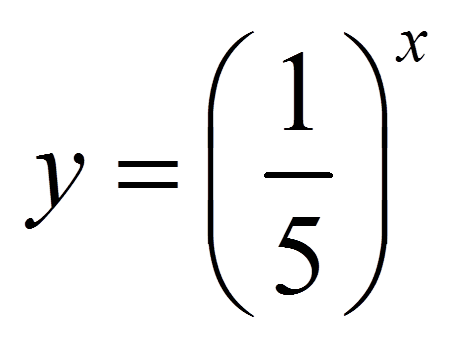
30 years

132.
Which equation matches the graph?
a)
y = 2x+3
b)
y = 2x + 3
c)
y = 2x
d)
y = 2-x
133.
Your shiny new boat cost $7650.  The depreciation for your boat is 14% per year. Estimate the value of your vehicle in 3 years. What is the equation that models this problem?
a)
y= 7650(.14)3
b)
y= 7650(.86)3
c)
y= 7650(1+.86/1)3*1
134.
Cade earned $475 from mowing lawns last summer. He deposited this money in an account that pays an interest rate of 3.8% compounded annually. What will be his balance after 15 year?
a)
$827.52
b)
$831.10
c)
$839.45
d)
$846.80
135.
Olivia would like to buy some new furniture for her home. She decides to buy the furniture on credit with 9.5% interest compounded quarterly. If she spent $7,400, how much total will she have paid after 8 years.
a)
$15,415.94
b)
$15,683.28
c)
$15,927.56
d)
$16,109.05
136.
A population of fish starts at 8,000 and decreases by 6% per year. What is the population of fish after 10 years?
a)
14327
b)
4309
c)
839
d)
7680
137.
Twenty years ago, Mr. Davis purchased his home for $160,000. Since then, the value of the home has increased about 5% per year. How much is the home worth today?
a)
$176,783.29
b)
$424,527.63
c)
$57,357.75
d)
$532,041,076.80
138.
Describe the end behavior of the graph.
a)
x →∞, y→∞ and x→∞, y→⁻∞
b)
x →∞, y→∞ and x→⁻∞, y→∞
c)
x →∞, y→∞ and x→⁻∞, y→0
d)
x →∞,y→0 and x→∞, y→⁻∞
139.
Describe the end behavior of the graph.
a)
x →∞, y→⁻∞ and x →⁻∞,y→⁻∞
b)
x →∞, y→∞ and x→⁻∞, y→∞
c)
x →∞, y→∞ and x→⁻∞, y→2
d)
x →∞,y→2 and x→⁻∞, y→∞
140.

Write an equation that models the following situation:

The current student count at John Jay is 6500, it is expected to grow at a rate of 14% next year.

a)

y= 6500(1+.14)x

b)

y= 6500(1-.14)x

c)

y= 6500(14)x

d)

y= 14(6500)x

141.

What is the Growth/Decay factor of the function f(x)= 2(4)x ?

a)

2

b)

8

c)

4

d)

x

142.
What does the y-intercept of the graph represent?
a)
The amount of grams the material is gaining.
b)
The amount of grams the material is losing.
c)
The amount of grams remaining after so many years.
d)
The initial amount of grams.
143.
Which one means the function goes up on the left
a)
x →-∞, y→∞
b)
x →-∞, y→-∞
144.
Which one means the function goes down on the left
a)
x →-∞, y→∞
b)
x →-∞, y→-∞
145.
Which one means up
a)
y →-∞
b)
y →∞
146.
Which one means left
a)
x →-∞
b)
x →∞
147.

What is the asymptote of y = 2x - 3

a)

y = 0

b)

y = -3

c)

x = 0

d)

x = -3

148.

What is the asymptote of y = log2x - 3

a)

y = 0

b)

y = -3

c)

x = 0

d)

x = -3

149.

What is the asymptote of y = log2(x - 3) ?

a)

y = 0

b)

y = 3

c)

x = 0

d)

x = 3

150.

What is the asymptote of y = log2(x - 3) ?

a)

y = 0

b)

y = 3

c)

x = 0

d)

x = 3