
 Worksheets
OCR AS Chemistry Part 1
Total questions: 78
Worksheet time: 1hrs 3mins
Name
Class
Date
1.
1) How many moles of CO2 are in 88.0 grams?
a)
a. 2.00 mol
b)
b. 3.14 mol
c)
c. 0.500 mol
d)
d. 7.63 mol
2.
1) How many grams of Cl2 are in 0.890 moles?
a)
a.63.2 g
b)
b. 31.6 g
c)
c. 1.48x10⁻²⁴ g
d)
d. 19.9 g
3.
1) What is the molar mass of K2Cr2O7?
a)
a. 3.4x10⁻³ g/mol
b)
b. 107.1 g/mol
c)
c. 294.2 g/mol
d)
d. 179.4 g/mol
4.
Lone pairs around the oxygen atom of a water molecule play no role in determining its molecular geometry which has what shape?
a)
True;
bent
bent
b)
False;
bent
bent
c)
True;
linear
linear
d)
False;
linear
linear
5.
What kind of chemical bond forms between a metal and a nonmetal?
a)
Covalent bond
b)
Ionic bond
c)
Can be either covalent or ionic
d)
Hydrogen bond
6.
What two types of atoms make a covalent bond?
a)
2 Nonmetals
b)
1 Nonmetal and 1 Metal
c)
2 Metals
d)
2 Noble Gases
7.

Choose the correct shape for this molecule:
a)
linear
b)
Trigonal pyramidal
c)
Bent
d)
Tetrahedral
8.

Choose the correct shape for this molecule:
a)
Bent
b)
Trigonal pyramidal
c)
Tetrahedral
d)
Trigonal planar
9.
A molecule consists of four bonds and no lone pairs. What is its structure?
a)
square planar
b)
tetrahedral
c)
linear
d)
square pyramidal
10.

Choose the correct shape for this molecule:
a)
Trigonal planar
b)
Trigonal pyramidal
c)
Bent
d)
Tetrahedral
11.

Choose the correct shape for this molecule:
a)
Bent
b)
Linear
c)
Tetrahedral
d)
Trigonal pyramidal
12.

molecules have two shared pairs have shape:
a)
trigonal pyramid
b)
linear
c)
bent
d)
angular
13.

Choose the correct shape for this molecule:
a)
Bent
b)
Linear
c)
Tetrahedral
d)
Trigonal pyramidal
14.

Choose the correct shape for this molecule:
a)
Bent
b)
Linear
c)
Tetrahedral
d)
Trigonal pyramidal
15.

Choose the correct shape for this molecule:
a)
Bent
b)
T-shape
c)
Tetrahedral
d)
Trigonal pyramidal
16.
An exothermic reaction:
a)
Produces heat when the reaction occurs
b)
Absorbs heat when a reaction occurs
17.
An endothermic reaction
a)
Produces heat when a reaction occurs
b)
Absorbs heat when a reaction occurs
18.

How many neutrons does this atom contain:
a)
17
b)
18
c)
35
d)
36
19.

How many electrons does the following element contain:
a)
19
b)
20
c)
39
d)
101
20.

How many protons does the following atom contain:
a)
11
b)
12
c)
22
d)
23
21.
In general, substances with stronger intermolecular forces have ___________ boiling points than those with weaker intermolecular forces
a)
higher
b)
lower
22.
A substance capable of hydrogen bonding has a ___________ boiling point than a similar substance that doesn't hydrogen bond.
a)
higher
b)
lower
23.
All molecules have London forces between them, but dipole-dipole and hydrogen bonding are so much stronger that when they are present we can ignore London forces. Which of these has ONLY London forces?
a)
I2
b)
NH3
c)
OCl2
d)
SH2
24.
Which is the second strongest intermolecular force, after hydrogen bonding?
a)
dipole-dipole attraction
b)
London forces
25.
Does HF have hydrogen bonding?
a)
yes
b)
no
26.
Does HCl have hydrogen bonding?
a)
yes
b)
no
27.
What explains the very high melting and boiling point of water
a)
Strong dipole-dipole bonds between water molecules
b)
Strong hydrogen bonds between water molecules
c)
Dispersion forces which are present in all molecules
d)
Asymmetrical shape of the polar bonds.
28.
Rank these in order of strength:
covalent bond
London forces
hydrogen bond
dipole-dipole attraction
covalent bond
London forces
hydrogen bond
dipole-dipole attraction
a)
dipole-dipole>covalent bond>hydrogen bond>London
b)
London>dipole-diple>hydrogen bond>covalent bond
c)
covalent bond>hydrogen bond>dipole-dipole>London
d)
hydrogen bond>dipole-dipole>London>covalent bond
29.
In order to convert to Kelvin, you add ______ to the Celsius measurement.
a)
372
b)
273
c)
237
d)
732
30.
100 degrees Celsius is equal to _______ Kelvin.
a)
0 K
b)
273 K
c)
173 K
d)
373 K
31.
The chemical equation below shows the complete combustion of propane, C3H8.
C3H8 + 5O2 −> 4H2O + 3CO2
What is the mass of oxygen required for the complete combustion of 200 cm3 of propane measured at r.t.p?
C3H8 + 5O2 −> 4H2O + 3CO2
What is the mass of oxygen required for the complete combustion of 200 cm3 of propane measured at r.t.p?
a)
0.650 g
b)
0.923 g
c)
1.14 g
d)
1.33 g
32.
What is the formula for potassium hydroxide?
a)
K(OH)2
b)
K(OH)
c)
K2(OH)
d)
K2(OH)2
33.
What is the formula for calcium hydroxide?
a)
Ca(OH)2
b)
Ca(OH)
c)
Ca2(OH)3
d)
Ca2(OH)2
34.
What is the formula for strontium nitride?
a)
Sr3N2
b)
SrN
c)
Sr2N3
d)
SrN3
35.
What is the formula for lithium phosphate?
a)
Li3(PO4)
b)
Li(PO4)3
c)
Li2(PO4)
d)
Li3(PO3)
36.
What is the formula for tin (I) phosphate?
a)
Sn(PO4)
b)
Sn3(PO4)2
c)
Sn2(PO4)
d)
Sn3(PO4)
37.
acid + base ₋>
a)
salt + hydrogen
b)
salt + water
c)
salt + carbon dioxide + water
d)
salt
38.
HCl + NaOH →
a)
NaH + ClOH
b)
NaCl + H2
c)
NaCl + H2O
d)
NaCl + Cl2
39.
What is the endpoint of a titration
a)
Where the amount of acid and base are balanced according to the equation
b)
Where there is no base
c)
At the end
40.

what is the reading on this burette?
a)
4.40mL
b)
3.50mL
c)
3.60mL
d)
4.50mL
41.
I am titrating 1M HCl with 1M NaOH. I have 25mL of HCl. How much NaOH will I need?
a)
2.5mL
b)
5mL
c)
25mL
d)
50mL
42.
How many moles of Ca(OH)2 are needed to neutralize three moles of HCl?
a)
8
b)
1.5
c)
6
d)
3
43.
Changes the color of indicators.
a)
Acids
b)
Bases
c)
All
44.
If phenolphthalein turns bright pink, it indicates
a)
an acid
b)
a base
c)
a neutral
45.

I have 25cm3 of 1M HCl which neutralises 20cm3 of NaOH. What is the concentration of the NaOH?
a)
0.8 M
b)
1 M
c)
1.25 M
46.
Why should you repeat your titration until you have results that are concordant (within 0.1cm3 of each other)
a)
To make sure your answer is accurate
b)
To make sure your answer is precise
47.
What is the limiting reactant if 10 moles of NH3 react with 30.0 moles of NO?
4NH3+6NO --> 5N2 + 6H2O
4NH3+6NO --> 5N2 + 6H2O
a)
NH3
b)
NO
c)
N2
d)
water
48.
What is the oxidation number of Fe in FeO?
a)
+1
b)
-1
c)
+2
d)
-2
49.
What is the oxidation number of O in CO2?
a)
+2
b)
-1
c)
+4
d)
-2
50.
What is the oxidation number of N in NO2-1?
a)
-3
b)
+4
c)
-2
d)
+3
51.
Identify the reaction type:
C2H5OH(l) + O2(g) --> CO2(g) + H2O(g)
C2H5OH(l) + O2(g) --> CO2(g) + H2O(g)
a)
Double displacement
b)
Synthesis
c)
Acid base
d)
Combustion
52.
What is the oxidation of C in CH4?
a)
-4
b)
-1
c)
+4
d)
+1
53.
What is the charge of the sulfate?
a)
-2
b)
+2
c)
+3
d)
-3
54.
What is the charge of the nitrate?
a)
-1
b)
-3
c)
+1
d)
+3
55.
Is calcium oxidized or reduced in the following reaction?
2CaO--> 2Ca + O2
2CaO--> 2Ca + O2
a)
Oxidized
b)
Reduced
56.
Which of the following half reactions correctly represents a reduction half reaction?
a)
Fe →Fe2+ + 2e-
b)
Pb4+ + 2e- →Pb2+
c)
2O-2 →O2 + 4e-
d)
Fe + 3e- →Fe3+
57.
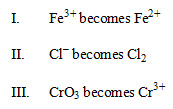
Which are examples of reduction?
a)
I and II
b)
I and III
c)
II and III
d)
I, II and III
58.
What is the electronic configuration of an arsenic atom?
a)
1s22s22p63s23p64s24p63d7
b)
1s22s22p63s23p63d104s24p3
c)
1s22s22p63s23p64s24p3
d)
1s22s22p63s23p63d104s24p6
59.
What is the maximum number of electrons in the third shell?
a)
8
b)
18
c)
32
d)
10
60.
What is the electronic configuration of the ions in potassium sulfide?
a)
1s22s22p63s23p6 1s22s22p63s23p6
b)
1s22s22p63s23p6 1s22s22p6
c)
1s22s22p6 1s22s22p63s23p6
d)
1s22s22p63s23p64s1 1s22s22p63s23p4
61.
How many non-bonded electrons in the outer shell of the central atom in a molecule of SCl2?
a)
0
b)
6
c)
4
d)
2
62.
Which of the following statements about dative covalent bonds is/are correct?
1 There is a strong electrostatic attraction between a shared pair of electrons and the nuclei of the bonded atoms.
2 The shared pair of electrons is supplied by one of the bonding atoms.
3 Dative bonds have lower average bond enthalpies than covalent bonds.
1 There is a strong electrostatic attraction between a shared pair of electrons and the nuclei of the bonded atoms.
2 The shared pair of electrons is supplied by one of the bonding atoms.
3 Dative bonds have lower average bond enthalpies than covalent bonds.
a)
only 2 and 3
b)
only 2
c)
only 2 and 1
d)
1,2,3
63.
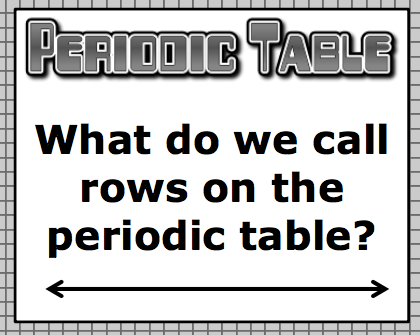
a)
Periods
b)
Groups
64.
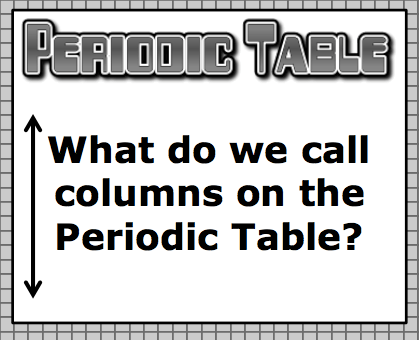
a)
Periods
b)
Groups
65.

a)
energy levels
b)
valence electrons
c)
protons
d)
neutrons
66.
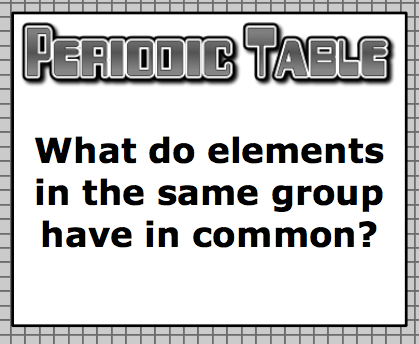
a)
energy levels
b)
valence electrons
c)
protons
d)
neutrons
67.
a)
Same group
b)
Same period
68.
a)
Group 1
b)
Group 17
c)
Group 18
d)
Group 2
69.
a)
Metals
b)
Nonmetals
c)
Metalloids
70.
a)
Metals
b)
Nonmetals
c)
Metalloids
71.
At room temperature, iodine is a....
a)
Gas
b)
Liquid
c)
Solid
72.
At room temperature, chlorine is...
a)
a yellow-green gas
b)
a brown gas
c)
a yellow-green liquid
73.
What colour is bromine?
a)
orange-brown
b)
orange-red
c)
yellow-green
d)
yellow
74.
What state is fluorine at room temperature?
a)
solid
b)
liquid
c)
gas
75.
As you go down the group of halogens, the melting points
a)
increase
b)
decrease
76.

Is this hydrocarbon saturated or unsaturated?
a)
saturated
b)
unsaturated
77.

what kind of molecule is this?
a)
alkane
b)
alkene
c)
alkyne
d)
cycloalkane
78.

Give the name of this compound...
C3H8
C3H8
a)
Propene
b)
Butyne
c)
Butene
d)
Propane
100 %

