
 Worksheets
Semester 1 Review
Total questions: 102
Worksheet time: 1hrs 22mins
Name
Class
Date
1.
What is a PUSH or PULL of an object?
a)
Motion
b)
Force
c)
Friction
d)
Gravity
2.
Which force produces a change in motion?
a)
unbalanced force
b)
balanced force
c)
gravitational force
d)
frictional force
3.
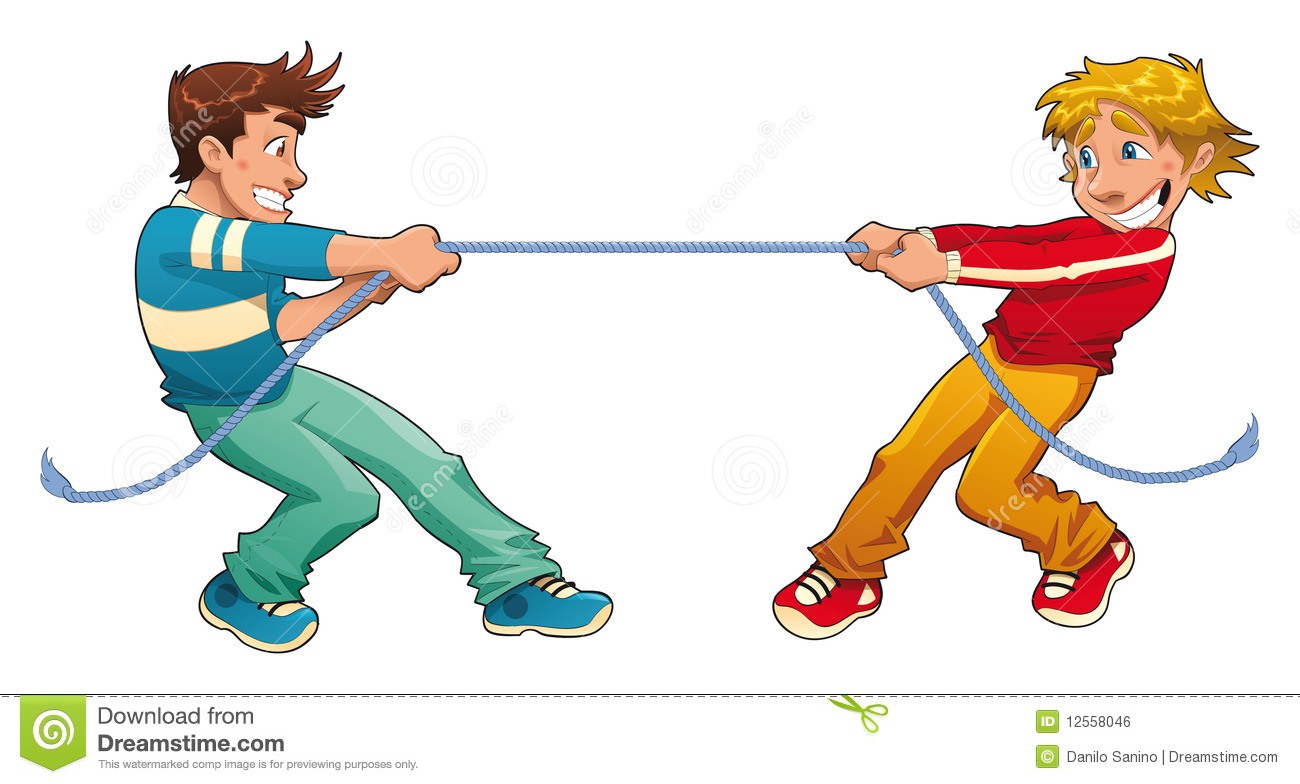
If these boys are pulling with the same amount of force. What will happen?
a)
The boy in blue will win.
b)
They will not move at all.
c)
The boy in red will win.
d)
Both will fall down.
4.
_______________ is how fast an object changes over time.
a)
speed
b)
velocity
c)
momentum
d)
acceleration
5.
What happens when two forces act in the same direction?
a)
They cancel each other out.
b)
The stronger one prevails.
c)
Their strengths are added.
d)
Their sum divided by the two is the total force.
6.
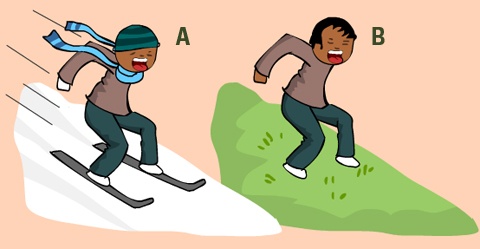
Why is it harder for the boy in Image B to get down the hill?
a)
Motion
b)
Friction
c)
Work
d)
Displacement
7.
Any time the forces are unbalanced, an object will remain at rest. True or false?
a)
true
b)
false
8.
When you tell the direction and speed of an object, you give its
a)
motion
b)
velocity
c)
acceleration
d)
mass
9.
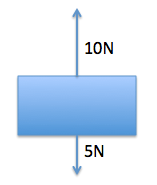
What is the net force on the block? (click on the words to view the picture)
a)
5 Newtons up
b)
5 Newtons down
c)
15 Newtons up
d)
15 Newtons down
10.
Which of the following statements is true?
a)
Balanced forces cause a change in motion.
b)
Unbalanced forces cause a change in motion.
c)
Forces do not effect the change in motion.
11.
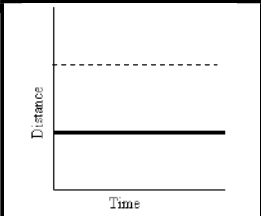
What does this graph represent?
a)
Constant speed
b)
Acceleration
c)
Not moving
12.
If a 10 kilogram object accelerates suddenly at 15 m/s2, how much force was applied to the object?
a)
150 Newtons
b)
15 Newtons
c)
150 kilograms
d)
100 kilograms
13.
Speed is equal to
a)
Distance/Time
b)
Time/Distance
c)
Time x Distance
d)
Acceleration
14.
Speed is different from velocity because
a)
Velocity has a direction
b)
Speed uses Distance /Time
c)
Velocity doesn't include time
d)
Velocity doesn't include distance
15.

During which interval is the object speeding up?
a)
A to B
b)
B to C
c)
D to E
d)
E to F
16.

What is this graph showing?
a)
Constant Speed
b)
Acceleration (speeding up)
c)
Deceleration (slowing down)
d)
No motion
17.
8 N to the left , and 4 N to the right. Find the net force. Is this balanced
a)
12 N Right No
b)
4 N Left No
c)
12 N Right Yes
d)
4 N Left Yes
18.
Objects that are changing their speed or their direction
a)
force
b)
energy
c)
acceleration
d)
friction
19.
a force that causes a change in motion of an object
a)
friction
b)
balanced force
c)
unbalanced force
d)
force
20.
two or more forces act upon an object in such a way as to exactly counteract each other
a)
friction
b)
balanced force
c)
unbalanced force
d)
force
21.
the ability to do work
a)
energy
b)
force
c)
friction
d)
inert
22.
the close interaction between two surfaces that are sliding across each other
a)
force
b)
friction
c)
centripetal force
d)
gravitational force
23.
Any two objects with mass attract each other with a type of force
a)
kinetic energy
b)
potential energy
c)
inertia
d)
gravitational force
24.
a tendency of an object to resist change in its state of motion
a)
inertia
b)
kinetic energy
c)
potential energy
d)
force
25.
the energy possessed by an object because of its motion
a)
force
b)
inertia
c)
kinetic energy
d)
potential energy
26.
the energy possessed by an object because of its height above the ground
a)
kinetic energy
b)
potential energy
c)
inertia
d)
speed
27.
the amount of material in a substance
a)
inertia
b)
force
c)
mass
d)
motion
28.
the quantity of motion that an object possesses
a)
momentum
b)
kinetic energy
c)
potential energy
d)
inertia
29.
An object at rest will remain at rest or in the same uniform motion unless acted upon by an unbalanced force: law of inertia.
a)
Newton's First Law of Motion
b)
Newton's Second Law of Motion
c)
Newton's Third Law of Motion
30.
as mass increases, the acceleration has to decrease: the law of acceleration
a)
Newton's First Law of Motion
b)
Newton's Second Law of Motion
c)
Newton's Third Law of Motion
31.
If one object exerts a force on a second object, the second object exerts a force equal in magnitude and opposite in direction on the object body; law of interaction
a)
Newton's First Law of Motion
b)
Newton's Second Law of Motion
c)
Newton's Third Law of Motion
32.

Pushing a child on a swing is easier than pushing an adult on the same swing, because the adult has more inertia.
a)
Newton's 1st Law
b)
Newton's 2nd Law
c)
Newton's 3rd Law
33.

This person bought coffee and put it on the seat next to them. If they stopped quickly and the coffee spilled which law would that represent?
a)
Newton's 1st Law
b)
Newton's 2nd Law
c)
Newton's 3rd Law
34.

When you step on a Lego. You push on the Lego and the Lego pushes back on you.
a)
Newton's 1st Law
b)
Newton's 2nd Law
c)
Newton's 3rd Law
35.

A force that opposes motion between a surface in contact with the atmosphere.
a)
air resistance
b)
gravity
c)
momentum
d)
terminal velocity
36.

The force of attraction between all matter.
a)
inertia
b)
friction
c)
net force
d)
gravity
37.

The force that opposes motion between two surfaces in contact with each other.
a)
inertia
b)
friction
c)
momentum
d)
gravity
38.

Any push or pull on an object.
a)
force
b)
velocity
c)
inertia
d)
momentum
39.

"For every action, there is an equal and opposite reaction."
a)
Newton's 1st Law
b)
Newton's 2nd Law
c)
Newton's 3rd Law
d)
Newton's 4th Law
40.

Force = Mass x Acceleration
a)
Newton's 1st Law
b)
Newton's 2nd Law
c)
Newton's 3rd Law
d)
Newton's 4th Law
41.

"An object in motion (or at rest) will to stay in motion (or at rest) until an outside force acts upon it."
a)
Newton's 1st Law
b)
Newton's 2nd Law
c)
Newton's 3rd Law
d)
Newton's 4th Law
42.

When all the forces on an object are equal and opposite, & the net force is zero, that's...
a)
balanced forces
b)
unbalanced forces
c)
terminal velocity
d)
reaction forces
43.

The combination of all the forces acting on an object is the...
a)
net force
b)
action force
c)
reaction force
d)
balance force
44.

Gravity is increased with...
a)
greater mass & shorter distance
b)
greater mass & farther distance
c)
lower mass & shorter distance
d)
lower mass & farther distance
45.

In the picture, the vehicle will move because of...
a)
Newton's 1st Law
b)
Newton's 2nd Law
c)
Newton's 3rd Law
d)
Newton's 9th Law
46.
Magnetism created by an electric current
a)
electricity
b)
electromagnetism
c)
wind energy
47.
____________ allows electricity to flow.
a)
A conductor
b)
An insulator
c)
A magnet
48.
____________ stops the flow of electricity.
a)
A conductor
b)
An insulator
c)
A magnet
49.
Electric charges that are different (positive and negative) _______ each other.
a)
Attract
b)
Repel
50.
What charge does a proton have?
a)
negative (-)
b)
positive (+)
c)
neutral or no charge (0)
51.
What charge does an electron have?
a)
negative (-)
b)
positive (+)
c)
neutral or no charge (0)
52.
What charge does an neutron have?
a)
negative (-)
b)
positive (+)
c)
neutral or no charge (0)
53.
Which of the following is caused by static electricity?
a)
a stove getting hot when it is turned on
b)
a magnet being attracted to a refrigerator
c)
a lightning strike during a storm
d)
a light bulb coming on when a switch is turned on
54.
Electrical charge built up on the surface of an object is called _________________.
a)
static electricity
b)
current electricity
c)
lightning
d)
electrons
55.
Electricity is the flow of ______.
a)
electrons
b)
protons
c)
neutrons
d)
atoms
56.
Electric charges that are alike (positive and positive) _______ each other.
a)
Attract
b)
Repel
57.
What types of charges attract?
a)
Positive and Positive
b)
Neutral and Negative
c)
Negative and Negative
d)
Positive and Negative
58.
The difference between attract and repel is that to attract is to pull something closer and repel is to push something away.
a)
True
b)
False
59.

) What would happen if an extra battery cell is added?
a)
A)The lights will glow dim
b)
The wire will glow
c)
The lights will glow brighter
d)
None of the above
60.
Magnetism is a type of ____________
a)
force
b)
book
c)
plant
d)
animal
61.
When two magnets attract, they ______________
a)
push apart
b)
change color
c)
get colder
d)
pull together
62.
When two magnets repel, they ________________
a)
change color
b)
pull together
c)
push apart
d)
get colder
63.
Magnets have a north and a south ___________
a)
shape
b)
color
c)
pole
d)
region
64.
Two north poles will attract.
a)
True
b)
False
65.
A north pole and a south pole will attract.
a)
True
b)
False
66.

What will happen when these magnets are brought close together?
a)
They will attract each other.
b)
They will repel each other.
c)
Both magnets will turn to the left
d)
Both magnets will turn to the right
67.
Where is the strongest attraction force of the magnet?
a)
at the poles
b)
in the middle
c)
above the magnet
d)
below the magnet
68.
A north pole and a south pole will attract.
a)
True
b)
False
69.
A tool that can be used to measure voltage, amperage and resistance is called a
a)
ammeter
b)
ohmmeter
c)
multimeter
d)
voltmeter
70.
magnetic field lines
a)
do nothing
b)
go from South to North
c)
go from North to South
71.
Electromagnets can be made from
a)
wire wrapped around plastic
b)
wire wrapped around iron
c)
wire wrapped around magnet
72.
what is the difference between motor and generator?
a)
motor generates electricity, motor does not
b)
generator generates electricy, motor does not
c)
neither generates electricity
73.
electromagnet can be made stronger by
a)
increasing # of turns
b)
Iincreasing current in coil
c)
both A and B
74.
Earths magnetic field does not
a)
trap solar wind particles
b)
create Northern Lights
c)
trap astronauts
75.
Earth's magnetic field created by
a)
moving iron
b)
moving molten iron
c)
the Moon
76.
what happens when a bar magnet is cut in half?
a)
magnet dies
b)
magnet is twice as strong
c)
2 new magnets are created
77.
Many animals use earths ______________ to help with navigation
a)
Magnetic Field
b)
Gravitational Field
c)
Stratosphere
d)
Liquid Core
78.
A glowing region in the atmosphere caused by charged particles from the sun
a)
Aurora
b)
Sun spots
c)
Magnetic Field
d)
Horizon
79.
The area around the earth where its magnetic field exists
a)
Magnetosphere
b)
Solar Wind
c)
Aurora
d)
Gravitational Field
80.
What is the correct order (starting from the surface) of Earth's layers?
a)
crust, outer core, inner core, mantle
b)
mantle, outer core, inner core, crust
c)
crust, mantle, outer core, inner core
d)
outer core, inner core, crust, mantle
81.
Earth's inner core is...
a)
a dense ball of solid iron and nickel.
b)
a layer of molten iron and nickel.
c)
a layer of hot rock.
d)
a layer of rock that forms Earth's outer skin.
82.
Which layer of Earth has the GREATEST density?
a)
crust
b)
mantle
c)
outer core
d)
inner core
83.
Heat transfer within a fluid takes place by...
a)
convection currents
b)
radiation
c)
conduction
d)
density
84.
Using data from seismic waves, geologists have learned that Earth's interior is made up of several
a)
continents
b)
layers
c)
ridges
d)
trenches
85.
Earth's mantle is
a)
a layer of molten metal.
b)
a layer of hot rock.
c)
a dense ball of solid metal.
d)
a layer of rock that forms Earth's outer skin.
86.
Earth's magnetic field results from movements in the
a)
mantle
b)
outer core
c)
inner core
d)
crust
87.
Which layer of Earth is the hottest?
a)
lithosphere
b)
asthenosphere
c)
outer core
d)
inner core
88.
Compared to rock in Earth's crust, rocks in the mantle are more
a)
dense
b)
mineral-rich
c)
granular
d)
porous
89.
A deep well or mine shaft goes through which layer or layers of Earth?
a)
crust only
b)
mantle only
c)
crust and mantle
d)
mantle and core
90.
If we compare the temperature and pressure of Earth's mantle to the core, what differences can we expect as we move downward into Earth?
a)
Both temperature and pressure increase.
b)
Both temperature and pressure decrease.
c)
Temperature decreases and pressure increases.
d)
Temperature increases and pressure decreases.
91.
Which layer of Earth is LIQUID?
a)
upper mantle
b)
lower mantle
c)
outer core
d)
inner core
92.
What are the two kinds of crust?
a)
lithospheric and asthenospheric
b)
silicon based and iron based
c)
continental and oceanic
d)
outer and inner
93.
Earth's oceanic crust is ______ than continental crust.
a)
thinner but denser
b)
thicker and denser
c)
thicker but less dense
d)
thinner and less dense
94.
Which layer of Earth is made up partly of crust and partly of mantle material?
a)
asthenosphere
b)
crust
c)
lithosphere
d)
mantle
95.
Geologists' main evidence about the structure of Earth's interior comes from
a)
temperature measurements in deep mines
b)
observations of other planets
c)
exploration of caves
d)
rock samples and seismic waves
96.
The soft layer of the mantle on which pieces of lithosphere move is called
a)
mesosphere
b)
lithosphere
c)
asthenosphere
d)
outer core
97.
Earth's solid inner core is surrounded by the hot, molten metal of which layer?
a)
lithosphere
b)
outer core
c)
crust
d)
mantle
98.
The asthenosphere is part of which layer of Earth?
a)
crust
b)
mantle
c)
outer core
d)
inner core
99.
Pressure increases with depth toward the center of Earth. In which layer would you expect pressure to be the greatest?
a)
crust
b)
mantle
c)
outer core
d)
inner core
100.
Which layer of Earth is made up of tectonic plates?
a)
outer core
b)
inner core
c)
asthenosphere
d)
lithosphere
101.
What is the difference between the inner and outer core?
a)
The outer core is liquid, the inner core is solid.
b)
The inner core is liquid and the outer core is solid.
c)
The outer core is made of nickel and the inner core is made of iron.
d)
The outer core is hotter than the inner core.
102.
Why have geologists not reached the mantle?
a)
It is too hot for humans to go there.
b)
It is too smelly for humans to go there.
c)
It doesn't have Wi-Fi so none of their instruments work.
d)
Scientists have not figured out how to time travel.
100 %

