
 Worksheets
Phy Sci Mid-term Exam Review
Total questions: 67
Worksheet time: 1hrs 11mins
Name
Class
Date
1.
There are two types of data. Which type of data involves numbers that are obtained by counting or measuring?
a)
quantitative
b)
qualitative
2.

Which statement is an inference about this picture?
a)
The van is tan.
b)
The van ran into KFC.
c)
The driver was hungry.
d)
Red and white are part of the KFC building.
3.
Mr. S. sets up an experiment to see how the mass of a ball affects the distance it rolls off a ramp. Identify the independent variable.
a)
distance traveled by the ball
b)
height of the ramp
c)
mass of the ball
d)
weight of the ball
4.
Mr. S. sets up an experiment to see how the mass of a ball affects the distance it rolls off a ramp. Identify the dependent variable.
a)
height of the ramp
b)
distance traveled by the ball
c)
mass of the ball
d)
weight of the ball
5.
A student is planning an experiment to find out how the height from which he drops a ball affects how high the ball bounces. The dependent variable is the _____.
a)
Diameter of the ball
b)
Force acting on the ball
c)
Height that the ball bounces
d)
Height from which the ball is dropped
6.
An experiment is performed on plants to see how different liquids affect plant growth. Each plant in the experiment is given a different liquid; water, apple juice, or milk. Each plant has the same amount of soil, sunlight, and listens to the same music. In this investigation, what is the dependent variable?
a)
Type of plant
b)
Water, apple juice, milk
c)
Plant growth
d)
Color of the plant's leaves
7.
If I study for my scientific method quiz, then I will have a better test score. What is the dependent variable?
a)
Scientific Method
b)
Studying
c)
Independent variable
d)
Test score
8.
This part of the experiment serves as a basis of comparison; the one variable being tested has been omitted.
a)
experimental group
b)
control group
c)
data
d)
variables
9.
Convert 17 m to cm:
a)
0.17 cm
b)
0.017 cm
c)
1,700 cm
d)
170 cm
10.
Convert 8 kilometers to meters
a)
800 m
b)
80,000 m
c)
8,000 m
d)
.008 m
11.
7,000 g = ____ kg
a)
70
b)
700
c)
7
d)
0.07
12.
5,000 mg = ____ g
a)
50
b)
5
c)
500
d)
5,000
13.
Jack has a rock. The rock has a mass of 14g and a volume of 2cm3. What is the density of the rock?
a)
7 mL
b)
7 g/cm3
c)
28 g/cm3
d)
1/7 g/cm3
14.
If an object has a density of 3.6 g/mL and you put it into water, will it sink or float?
a)
sink
b)
float
15.

Which liquid is the least dense?
a)
oil
b)
water
c)
syrup
d)
plastic bottle
16.
An empty beaker has a mass of 60 grams. When mercury is added to the graduated cylinder, it has a mass of 200 grams. What is the mass of the mercury?
a)
140 grams
b)
200 grams
c)
140 mL
d)
260 g
17.

What do we know about the density of lamp oil, rubbing alcohol, and vegetable oil?
a)
The density is greater than 1.0 g/mL
b)
The density is less than 1.0 g/mL
c)
The density is equal to 1.0 g/mL
d)
The density can not be determined
18.
Density is...
a)
the amount of mass in an object
b)
the amount of space an object takes up
c)
the amount of mass in a given space
d)
the weight of an object
19.
What units can be used to express density?
a)
g/mL
b)
grams
c)
millimeters
d)
milliliters
20.
What is the atomic number for an element with three protons?
a)
2
b)
1
c)
3
d)
6
21.
Which statement about the atomic nucleus is correct?
a)
The nucleus is made of protons and neutrons and has a negative charge
b)
The nucleus is made of protons and neutrons and has a positive charge
c)
The nucleus is made of electrons and has a positive charge
d)
The nucleus is made of electrons and has a negative charge
22.
Atoms have no electric charge because they...
a)
have an equal number of charged and non charged particles
b)
have neutrons in their nuclei
c)
have an equal number of electrons and protons
d)
have an equal number of neutrons and protons
23.
Most of the mass in an atom is concentrated in the...
a)
electrons
b)
nucleus
c)
protons
d)
empty space
24.
Matter always has mass.
a)
true
b)
false
25.
What is the smallest?
a)
worm
b)
molecule
c)
galaxy
d)
atom
26.
How many Hydrogen atoms are in Water (H2O)
a)
1
b)
2
c)
3
d)
4
27.
What is a pure substance?
a)
Protons Neutrons and Electrons.
b)
Particles that collide.
c)
Substance that can be separated by physical means.
d)
Substance that cannot be separated by physical means.
28.
What are compounds?
a)
Substances made of one or more types of elements.
b)
Substances made of one or more types of neutrons.
c)
Substances made of one or more types of nuclei.
d)
Substances made of one or more type of electron.
29.

What is the atomic number of Carbon?
a)
6
b)
12.0107
c)
C
d)
Carbon
30.
Solubility is
a)
an items ability to dissolve
b)
an items ability to melt
c)
an items ability to freeze
d)
an items ability to boil
31.
Which one is NOT a compound?
a)
H2O
b)
CO2
c)
NaCl
d)
Ne
32.
The slower the particles in a substance move,
a)
the colder it is.
b)
the warmer it is.
c)
the more energy it has.
d)
the less energy it has.
33.
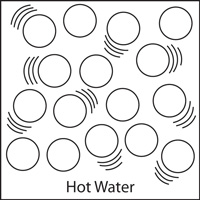
The speed of the molecules determines the _____.
a)
volume
b)
density
c)
pressure
d)
temperature
34.
What term describes a solid changing to a gas?
a)
Deposition
b)
Sublimation
c)
Evaporation
d)
Freezing
35.
A physical change is...
a)
a change that doesn't change the identity
b)
a change that makes something new.
c)
a chemical reaction
36.
Thermal energy is...
a)
heat energy.
b)
the energy of motion
c)
energy of nuclear processes.
d)
an indication of physical change.
37.

Which of the following statements is NOT true of all different types of matter?
a)
They are made of atoms and molecules
b)
The particles are always in motion
c)
The particles always move at the same speed
d)
They are made of particles that are too small to see
38.

What state of matter is segment 5?
a)
Solid
b)
Liquid
c)
Gas
d)
Plasma
39.
The resistance of a liquid to flow is called what?
a)
Viscosity
b)
Varsity
c)
Volume
d)
Variables
40.

From 30 degrees to 55 degrees, what state of matter is the substance?
a)
Solid
b)
Liquid
c)
Gas
d)
Plasma
41.
What happens to a substance when energy is released onto the environment?
a)
Endothermic
b)
Exothermic
c)
States of Matter
d)
Temperature increase
42.
What happens to a substance when energy is absorbed from the environment?
a)
Endothermic
b)
Exothermic
c)
States of Matter
d)
Temperature increase
43.
Ionic Bonding involves...
a)
The transfer of protons
b)
The transfer of nuetrons
c)
The transfer of electrons
d)
None Of the above
44.
What do atoms that form positive ions tend to do?
a)
Tend to lose electrons
b)
Tend to lose protons
c)
Tend to gain electrons
d)
Tend to gain protons
45.
What two types of atoms make a covalent bond?
a)
2 Nonmetals
b)
1 Nonmetal and 1 Metal
c)
2 Metals
d)
2 Noble Gases
46.

What elements generally make a covalent bond?
a)
metal and nonmetal
b)
2 or more nonmetals
c)
metal
d)
none of the above
47.
Predict the bond that will form between Se and Cl.
a)
Ionic
b)
Covalent
48.
Predict the bond that will form between Sr and S.
a)
Ionic
b)
Covalent
49.
What is a valence electron?
a)
an electron that is found in the outermost shell of an atom.
b)
an electron found in the innermost shell of an atom.
c)
an electron found in the middle shell.
50.

How many valence electrons in this structure?
a)
6
b)
5
c)
4
d)
7
51.
Is Hydrogen considered a metal or a non-metal?
a)
Metal
b)
Non-metal
52.
What is the number of valence electrons for Oxygen?
a)
8
b)
6
c)
2
d)
1
53.
Covalent compounds
a)
Share electrons
b)
transfer electrons
c)
contain a sea of electrons
d)
conduct electricity
54.
I can hit a metal with a hammer without the metal shattering because of its __________.
a)
Ductility
b)
Malleability
c)
Conductivity
d)
Lustrousness
55.
How many dots should be placed around silicone in a lewis dot structure?
a)
3
b)
4
c)
13
d)
14
56.
Identify this type of reaction,
Cl2 + 2KI --> I2 + 2KCl
Cl2 + 2KI --> I2 + 2KCl
a)
Synthesis
b)
Single displacement
c)
Double displacement
d)
Decomposition
57.
2 C5H5 + Fe --> Fe(C5H5)2
a)
single displacement
b)
double displacement
c)
decomposition
d)
synthesis
58.
Which chemical reaction breaks down into 2 substances?
a)
Double displacement
b)
Single displacement
c)
Synthesis
d)
Decomposition
59.
The following is what type of reaction:
NH3 + HCl → NH4Cl
NH3 + HCl → NH4Cl
a)
Synthesis
b)
Decomposition
c)
Single Replacement Replacement
d)
Double Replacement Replacement
60.
Balancing this reaction: ____ CH4 + ____ O2 ---> ____ CO2 + ____ H2O
a)
2,1,3,1
b)
1,2,1,2
c)
1,2,2,1
d)
2,1,1,2
61.
Balance this reaction: ____ NaF + ____ Br2 ---> ____ NaBr + ____ F2
a)
3,1,2,1
b)
1,2,3,4
c)
2,1,2,1
d)
1,2,1,2
62.
Balance this reaction: ____ BaS + ____ PtF2 ---> ____ BaF2 + ____ PtS
a)
1,1,1,1
b)
1,2,1,1
c)
1,1,1,2
d)
2,1,1,1
63.
What are the REACTANTS :
H2O + CO2 → HCO + HO
H2O + CO2 → HCO + HO
a)
H2O and CO2
b)
HCO and HO
c)
H2O ONLY
d)
HCO ONLY
64.
PRODUCTS are always on what side of the equation?
a)
right
b)
left
c)
top
d)
bottom
65.
What is a SUBSCRIPT?
a)
The large number next to a molecule
b)
The small number on the bottom right of an atom
c)
The small number on the top left of an atom
d)
The large number at the end of a molecule
66.
What is a COEFFICIENT?
a)
The large number next to a molecule
b)
The small number on the bottom right of an atom
c)
The small number on the top left of an atom
d)
The large number at the end of a molecule
67.
What happens to the atoms when baking soda combines with vinegar?
a)
New CO2 gas atoms are created when the chemicals mix
b)
The vinegar and baking soda atoms are destroyed, leaving only gas
c)
The atoms break apart and recombine to form new molecules
100 %

