wayground logo

Free Printable Worksheets

NEW

Font size

S
M
L
XL
Worksheets

Plate Tectonics Review

Total questions: 45

Worksheet time: 31mins

Name
Class
Date
1.
What layers of Earth make up the lithosphere?
a)
the crust and lower mantle
b)
the crust and upper mantle
c)
the continental crust and oceanic crust
d)
the upper and lower mantle
2.
The greatest concentration of metals occurs in Earth's _____.
a)
oceanic crust
b)
continental crust
c)
core
d)
mantle
3.
Wegener's continental drift hypothesis stated that all the continents once joined together to form __________.
a)
two major supercontinents
b)
two major supercontinents and three smaller continents
c)
one major supercontinent
d)
three major supercontinents
4.
The geographic distribution of the swimming reptile Mesosaurus provides evidence that _____.
a)
Europe was covered by a shallow sea when Mesasaurus lived
b)
a land bridge existed between Australia and India
c)
South America and Africa were once joined
d)
the Atlantic Ocean was wider when Mesosaurus lived than it is now
5.

Which of the following was NOT used in support of the continental drift hypothesis?

a)

fossil evidence

b)

paleomagnetisim

c)

ancient climate

d)

fit of South America and Africa

6.

What was the MAIN reason Wegener's continental drift hypothesis was rejected?

a)

he was not well liked by other scientists

b)

He could not provide a mechansm for the movement of the contients

c)

He could provide only illogical explanations for the movement of the continents

d)

His evidence was incorrect

7.

Which of the following statements correctly describes the asthenosphere?

a)

It is a thin, cold and rigid layer

b)

It is the source of Earth's heat

c)

It moves, which moves plates

d)

It occurs only near subduction zones

8.
Volcanic island arcs are associated with what type of plate boundary?
a)
Divergent boundary
b)
Convergent continental-continental boundary
c)
Convergent oceanic-continental boundary
d)
Convergent oceanic-oceanic boudary
9.

A divergent boundary at two oceanic plates can result in a _____________.

a)

mid ocean ridge

b)

volcanic island arc

c)

continental volcanic arc

d)

subduction zone

10.
Which of the following is a geographic example of a transform fault boundary?
a)
The East African Rift valley
b)
The San Andreas Fault
c)
the Mid-Atlantic Ridge
d)
The Andes Mountains
11.

Which of the following does NOT occur at a subduction zone?

a)

The leading edges of both plates are bent upwrd

b)

Oceanic crust is pushed down into the mantle

c)

A continental plate moves over an oceanic plate

d)

One oceanic plate moves beneath another oceanic plate

12.

If a subduction zone occurs near the coast, active volcanoes would likely be found ___________.

a)

On the oceanic side of the trench

b)

Along the trench

c)

At the ends of the trench

d)

On the continental side of the trench

13.
At a transform fault boundary
a)
New oceanic crust is formed
b)
oceanic lithosphere is destroyed
c)
lithosphere is neither destroyed nor produced
d)
new continetal crust is formed
14.
According to the property of paleomagnetism ___________.
a)
Iron rich rocks show the location of the magnetic poles at the time of their formation
b)
All rocks, regardless of when they are formed, have the same polarity
c)
All rocks have a reserved polarity
d)
Rocks do not possess magnetic properities
15.
Strips of alternating magnetic polarities found in rocks in the ocean basins_______.
a)
conflict with the theory of plate tectonics
b)
provide evidence that Earth's magnetic field has never reversed polarity
c)
indicate changes in Earth's gravitation field
d)
Provide evidence for seafloor spreading
16.
Which of the following causes Earth's tectonic plates to move?
a)
Energy from the Sun
b)
Magnetic Pole Reversal
c)
Convection currents in the mantle
d)
Faults in Mountain Ranges
17.
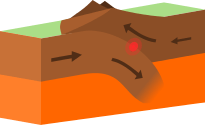
What type of plate boundary is this?
a)
Plate
b)
Divergent
c)
Convergent
d)
Transform
18.
What type of event will occur at this boundary?
a)
Earthquake
b)
Volcano Eruption
c)
Tornado
d)
Mountain Building
19.
A divergent boundary occurs when plates ....
a)
Pull apart
b)
Come together
c)
Slide past each other
d)
subduct
20.
Which of the following is the name of the ancient supercontinent formed 28 Million Years ago.
a)
Pangea
b)
Gondwanda
c)
Laurasia
d)
Neverland
21.
Which of the following is NOT evidence to support the theory of plate tectonics?
a)
Fossils
b)
Mountains
c)
Glaciers
d)
Sand Erosion
22.
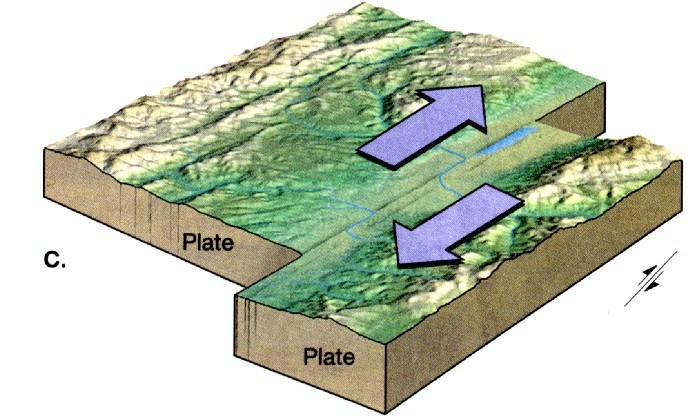
What type of plate boundary is this?
a)
Transform
b)
Convergent
c)
Divergent
d)
Plate
23.

The theory that says Earth's continents once made up an ancient supercontinent, and have been drifting apart ever since, is called the theory of...

a)

Pangea

b)

Continental Drift

c)

Natural Selection

d)

Gravity

24.

The Mid-Ocean Ridge was created by this boundary

a)

Divergent

b)

Convergent

c)

Reform

d)

Transform

25.
This layer of Earth is the thickest part
a)
crust
b)
outer core
c)
mantle
d)
inner core
26.
Which layer has convection currents?
a)
Inner Core
b)
Outer Core
c)
Mantle
d)
Crust
27.

Subduction zones in the ocean can create which features?

a)

islands

b)

volcanoes

c)

earthquakes

d)

all of the above

28.
The Himalayas in Asia are an example of what type of plate boundary?
a)
divergent
b)
continent-to-continent convergent
c)
ocean-to-continent convergent
d)
transform
29.
When an oceanic plate and a continental plate collide, which one will subduct?
a)
oceanic
b)
continental
c)
neither
30.
Most volcanoes and earthquakes occur...
a)
along the coast
b)
along tectonic plate boundaries
c)
in the Arctic
d)
in the ocean
31.
What type of boundary is the SAN ANDREAS FAULT on?
a)
Covergent
b)
Transformers
c)
Divergent
d)
Transform
32.
Which of these layers is ALL solid iron and nickle?
a)
inner core
b)
outer core
c)
lithosphere
d)
mesosphere
33.
Scientists think that convection currents that move the plates flow in Earth's
a)
Continental crust
b)
Oceanic crust
c)
Asthenosphere
d)
Lithosphere
34.
The mantle of Earth is made partly of magma. When magma rises and sinks, this is called ______________. 
a)
a conduction current
b)
a hot spot
c)
a volcanic eruption
d)
a convection current
35.

As you travel from the INNER CORE to the CRUST, how would temperature, pressure and density of the material change?

a)

They would all increase

b)

They would all decrease.

c)

They would stay the same.

d)

Temperature would decrease, but pressure and density would increase.

36.
What would happen to the convection currents if the heat from the inner core disappeared? 
a)
They would stop. 
b)
They would change directions. 
c)
It would not change. 
d)
They would speed up. 
37.
Where does the heat come from that drives this convection current in the mantle? 
a)
The sun
b)
The crust
c)
the mantle
d)
the core
38.
Which is true about hotter material in the mantle?
a)
more dense, sinks
b)
less dense, sinks
c)
less dense, rises
d)
more dense, rises
39.
During sea floor spreading, molten material rises up from the mantle...
a)
along the continents
b)
at the mid ocean ridges
c)
deep ocean trenches
d)
at north and south poles
40.
Which of the following is where one plate slides under another plate?
a)
submarine zone
b)
divergence zone
c)
subduction zone
d)
lower zone
41.
Which ocean is expanding due to a mid-ocean ridge (divergent boundary)?
a)
Indian
b)
Dead Sea
c)
Atlantic
d)
Artic
42.
Which layer of the Earth is liquid iron?
a)
Crust
b)
Mantle
c)
Outer Core
d)
Inner Core
43.
What is the correct order (starting from the surface) of Earth's layers?
a)
crust, outer core, inner core, mantle
b)
mantle, outer core, inner core, crust
c)
crust, mantle, outer core, inner core
d)
outer core, inner core, crust, mantle
44.
Which layer of Earth has the GREATEST density?
a)
crust
b)
mantle
c)
outer core
d)
inner core
45.
What observation can we make about Earth’s lithosphere AND asthenosphere?
a)
The asthenosphere floats on top of the lithosphere.
b)
The crust and the core make up the lithosphere.
c)
The crust and mantle make up the asthenosphere. 
d)
The lithosphere floats on top of the asthenosphere