
 Worksheets
All
Total questions: 87
Worksheet time: 1hrs 27mins
Name
Class
Date
1.
This organelle takes food and turns it into ENERGY for plant and animal cells.
a)
Chloroplast
b)
Mitochondria
c)
Lysosome
d)
Ribosome
2.
The site of photosynthesis
a)
ribosome
b)
mitochondria
c)
chloroplast
d)
nucleus
3.
The ___________ is the basic unit of life
a)
organ
b)
cell
c)
atom
d)
tissue
4.
What is the function of the mitochondria?
a)
Structure that manufactures ribosomes
b)
Structures that converts nutrients to energy
c)
Stack of membranes that packages chemicals
d)
Structure that contains DNA and directs the cell
5.
What is the function of the vacuole?
a)
Sac that stores water, nutrients, and waste products
b)
Sac filled with digestive chemicals
c)
Jelly-like substance within the plasma membrane
d)
stack of membranes that packages chemicals
6.
What is the function of nucleus?
a)
Structure that organizes motion of chromosomes.
b)
Structure that contains DNA and directs the cell
c)
Membrane that surrounds and protects the cell
d)
Stack of membranes that packages chemicals
7.
In what organelle is the genetic material found inside?
a)
Endoplasmic Reticulum
b)
Golgi Complex
c)
Nucleolus
d)
Nucleus
8.
What organelle is called the "powerhouse" of a cell?
a)
Endoplasmic Reticulum
b)
Nucleus
c)
Mitochondria
d)
Nucleolus
9.

Using this image, what organelle is C?
a)
Cell Wall
b)
Mitochondria
c)
Large Cell Vacuole
d)
Chloroplast
10.
Where does photosynthesis occur?
a)
mitochondria
b)
stomata
c)
xylem
d)
chloroplast
11.

I store water in both plant and animal cells. What am I?
a)
cytoplasm
b)
ribosomes
c)
vacuole
d)
lysosomes
12.

I make proteins for the cell. What am I?
a)
ribosome
b)
mitochondria
c)
chloroplast
d)
lysosome
13.
What can only be found in plant cells?
a)
Cell membrane
b)
Vacuole
c)
Chloroplast
d)
Mitochondrion
14.
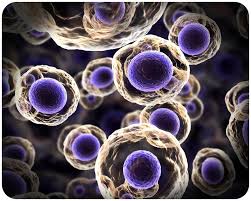
The two kinds of cells are Prokaryotes and Eukaryotes. How are they different?
a)
Prokaryotes have a nucleus.
b)
Eukaryotes have a nucleus.
c)
Prokaryotes are plant cells.
d)
There is no difference.
15.

What cell part is NOT found in all cells?
a)
Cell Wall
b)
Cell Membrane
c)
Cytoplasm
d)
Genetic Material
16.

Complex cell. Can be plant or animal. Contains membrane bound organelles.
a)
Eukaryotic Cell
b)
Prokaryotic Cell
c)
Bacteria
d)
Blood cell
17.
This organelle takes food and turns it into ENERGY for plant and animal cells.
a)
Chloroplast
b)
Mitochondria
c)
Lysosome
d)
Ribosome
18.
The site of photosynthesis
a)
ribosome
b)
mitochondria
c)
chloroplast
d)
nucleus
19.

Which part of the cell is often called "the brain of the cell"?
a)
nuclear membrane
b)
endoplasmic reticulum
c)
nucleus
d)
mitochondria
20.
Where are proteins made?
a)
Golgi body
b)
Mitoichondria
c)
Chromosomes
d)
Ribosomes
21.
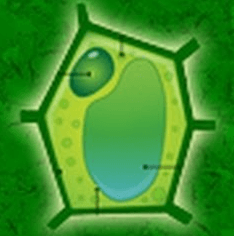
A rigid layer that lies outside the cell's membrane is...
a)
Cytoskeleton
b)
Cilia
c)
Cell Wall
d)
Flagella
22.
What organelle is called the "powerhouse" of a cell?
a)
Endoplasmic Reticulum
b)
Nucleus
c)
Mitochondria
d)
Nucleolus
23.
Main producer of ATP in all eukaryotes
a)
chloroplast
b)
mitochondria
c)
lysosome
d)
smooth er
24.
What is the function of the vacuole?
a)
Sac that stores water, nutrients, and waste products
b)
Sac filled with digestive chemicals
c)
Jelly-like substance within the plasma membrane
d)
stack of membranes that packages chemicals
25.

I store water in both plant and animal cells. What am I?
a)
cytoplasm
b)
ribosomes
c)
vacuole
d)
lysosomes
26.
What can only be found in plant cells?
a)
Cell membrane
b)
Vacuole
c)
Chloroplast
d)
Mitochondrion
27.
Only eukaryotic cells have....
a)
membrane-bound organelles
b)
DNA
c)
ribosomes
d)
cell membranes
28.

What does this organism use for movement?
a)
Pseudopod
b)
Cilia
c)
Flagella
d)
legs
29.

What does this organism use for movement?
a)
Pseudopod
b)
Cilia
c)
Flagella
d)
legs
30.
A nucleus is found in what type of cell?
a)
Prokaryotic
b)
Eukaryotic
c)
Both prokaryotic and eukaryotic
d)
Neither prokaryotic or eukaryotic
31.
Biotic factors of an ecosystem are:
a)
non-living
b)
plants
c)
living thing
d)
soil
32.
Identify an a example of an abiotic factor?
a)
Panda
b)
Turtle
c)
Butterfly
d)
sunlight
33.
Temperature, light, air, water, and soil are all _____ parts of the environment
a)
alive
b)
biotic
c)
abiotic
d)
living
34.
Which of the following choices only includes abiotic factors?
a)
Sunlight, algae, and temperature
b)
Fish, crabs, oxygen
c)
Sunlight, soil, and oxygen
d)
Algae, temperature, and dog
35.
Biomes with densely packed trees sometimes form a continuous green "roof" layer called a:
a)
canopy
b)
ceiling
c)
green layer
d)
forest top
36.
Which biome holds the greatest biodiversity?
a)
grassland
b)
tundra
c)
rainforest
d)
desert
37.
The trees in this biome shed their leaves and grow new ones each year:
a)
temperate deciduous forest
b)
grasslands
c)
deserts
d)
tundra
38.
The ability to conserve water is an important adaptation in which biome?
a)
Coniferous Forest
b)
Deciduous Forest
c)
Desert
d)
Tundra
39.
Which biome features permanently frozen soil called permafrost?
a)
Coniferous Forest
b)
Deciduous Forest
c)
Desert
d)
Tundra
40.
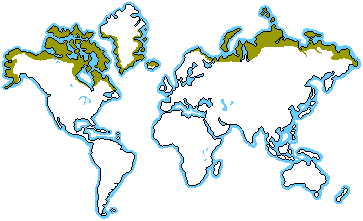
The area of the map shaded in green represents which of the following terrestrial biome
a)
Coniferous Forrest
b)
Deciduous Forrest
c)
Desert
d)
Tundra
41.
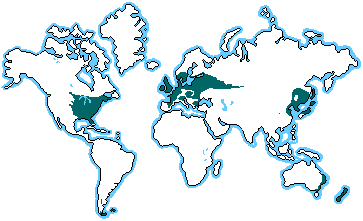
The area of the map shaded in dark blue represents which of the following terrestrial biome
a)
Coniferous Forest
b)
Deciduous Forest
c)
Desert
d)
Tundra
42.
Which of the following BEST MATCHES the meaning of the word TEMPERATE.
a)
temperatures within moderate limits
b)
an area with trees and bushes
c)
a forest with plants growing together
d)
an area with all the same temperature
43.
Coniferous (Boreal) forests are made up primarily of trees that _______________.
a)
change color in the fall
b)
bear cones
c)
shed their leaves
d)
have thin bark
44.
The term "terrestrial" means
a)
land.
b)
water.
45.
What are some problems associated with low tide?
a)
Waves crashing on shore may affect an organism's ability to hold on.
b)
Organisms may dry out due to lack of water.
c)
Organisms are exposed to direct sunlight.
d)
All of the above.
46.
Which two biomes have the least precipitation?
a)
tropical rain forest and temperate grasslan
b)
savanna and tropical dry forest
c)
tundra and desert
d)
boreal forest and temperate woodland
47.
In which biome is Georgia located?
a)
tropical rainforest
b)
temperate rainforest
c)
temperate deciduous forest
d)
alpine forest
48.
Which biome receives between 0 to 25 centimeters of rain per year, has a temperature range of 0 to 50 degrees Celsius, has poor soil, and is home to lizards, scorpions, and snakes?
a)
desert
b)
mountain
c)
taiga
d)
tundra
49.

Which biome is MOST LIKE the "desert" in terms of precipitation?
a)
tropical rainforest
b)
temperate deciduous forest
c)
tundra
d)
coniferous forest
50.
Why doesn’t photosynthesis occur in deep ocean water?
a)
There is no sunlight.
b)
There are not enough nutrients.
c)
The salinity level of the water is too high.
d)
The water temperature is too cold.
51.
This biome is found around the equator and is home to a large amount of biodiversity.
a)
Deserts
b)
Tropical Rain Forests
c)
Savannas
d)
Chaparral
52.
What might occur when a carnivore is removed from the food web?
a)
A) Nothing. Organisms cannot impact things below them on the energy pyramid.
b)
B) Primary consumers will overpopulate.
c)
C) Plants will be over browsed by herbivores.
d)
D) both B and C might occur.
53.

relationship in which two species live closely together
a)
resource
b)
mutualism
c)
succession
d)
symbiosis
54.

A living relationship between two species in which one organism is harmed is called...
a)
mutualism
b)
commensalism
c)
parasitism
d)
niche
55.
Which is NOT an abiotic factor:
a)
soil
b)
air
c)
bacteria;
d)
water
56.
What percentage of energy is passed on to each tropic level?
a)
10%
b)
50%
c)
90%
d)
100%
57.
What might happen if you remove a primary consumer from the ecosystem?
a)
There would be more food for secondary consumers.
b)
The number of primary consumers would increase.
c)
The number of plants would increase.
d)
The number of secondary consumers would increase.
58.
How do producers obtain energy?
a)
They conduct photosynthesis.
b)
They consume plants.
c)
They consume primary consumers.
d)
They consume secondary consumers.
59.
A consumer that hunts is called:
a)
a producer.
b)
an omnivore.
c)
a predator.
d)
a herbivore.
60.
Where do decomposers go in your food chain?
a)
at the beginning
b)
they don't belong in a food chain
c)
at the end
d)
at every level
61.
A food web can be broken down into several seperate
a)
food chains
b)
food pyramids
c)
producers
d)
consumers
62.
Which represents the largest group in a food web?
a)
carnivores
b)
omnivores
c)
herbivores
d)
producers
63.

diagram that shows the energy available to each trophic level in an ecosystem; 10% is passed on to upper levels, the rest is lost as heat
a)
succession
b)
cellular respiration
c)
energy pyramid
d)
biochemical cycle
64.

symbiotic relationship in which one organism benefits and the other organism is harmed
a)
secondary succession
b)
predation
c)
pioneer species
d)
parasitism
65.

anything that an organism needs to live, ex. food, water, space
a)
carrying capacity
b)
resource
c)
succession
d)
denitrification
66.

largest number of individuals of a population that the environment can support
a)
carrying capacity
b)
primary succession
c)
denitrification
d)
mutualism
67.

symbiotic relationship in which one organisms benefits and the other organism is not affected
a)
invasive (non-native) species
b)
mutualism
c)
nitrogen fixation
d)
commensalism
68.

symbiotic relationship in which both organisms benefit
a)
competition
b)
Mutualism
c)
nitrogen fixation
d)
energy pyramid
69.
Step in the food chain, food web, or ecological pyramid
a)
trophic Level
b)
abiotic factors
c)
community
d)
ecosystem
70.
Study of interactions between organisms and their environment
a)
niche
b)
community
c)
ecology
d)
ecosystem
71.
Where an organism lives
a)
habitat
b)
niche
c)
heterotrogh
d)
biosphere
72.
Non-living factor that affects an ecosystem
a)
biotic factor
b)
abiotic factor
c)
food chain
d)
biome
73.
Consumer that eats plants
a)
heterotroph
b)
herbivore
c)
producer
d)
community
74.
Living factors or organisms that affect an ecosystem
a)
abiotic factors
b)
species
c)
trophic level
d)
biotic factors
75.
Series of steps in which organisms transfer energy by eating and being eaten
a)
foodweb
b)
consumer
c)
food chain
d)
omnivore
76.
Consumer that eats animals or meat
a)
carnivore
b)
omnivore
c)
consumer
d)
producer
77.

This is an image of a _________.
a)
consumer
b)
scavenger
c)
decomposer
d)
producer
78.
Survival of the Fittest and Evolution were proposed by what scientist?
a)
Charles Darwin
b)
Albert Einstein
c)
Steven Hawking
d)
Isaac Newton
79.
Behavioral changes of individuals of a species that allow for better survival. (Acquired traits)
a)
Variation
b)
Adaptation
c)
Behavior
d)
Environment
80.
When every organism of a species has died.
a)
Evolution
b)
Natural Selection
c)
Extinction
d)
Artificial Selection
81.
Where the better adapted organisms survive to pass traits along to offspring.
a)
Evolution
b)
Natural Selection
c)
Extinction
d)
Artifical Selection
82.
What was the name of the ship Darwin traveled the world on?
a)
HMS Beagle
b)
SS Beagle
c)
HMS Bugle
d)
SS Bugle
83.
What are the most studied animals in the galapagos?
a)
Finches
b)
Tortoises
c)
Turtles
d)
Lizards
84.
What is the advantage of having different shaped beaks?
a)
To look different from other species.
b)
To be able to eat the food readily available in the environment.
c)
To protect itself against predators.
d)
To protect itself against prey.
85.
The theory of evolution by natural selection means that what is changing over time?
a)
The inherited traits of a population.
b)
The acquired traits of a population.
c)
Hair color and eye color
d)
Attractive features.
86.
Why are advantageous traits more likely to be passed onto offspring?
a)
Because they are more likely to survive and reproduce.
b)
Because they come from dominant alleles.
c)
Because they come from recessive alleles.
d)
Because the trait is an acquired phenotype.
87.
Mutations are a change in what?
a)
DNA
b)
tRNA
c)
genotype
d)
phenotype
100 %

