
 Worksheets
Science of Heredity
Total questions: 82
Worksheet time: 1hrs 23mins
A couple has two children both of whom are boys. What is the chance that the parents' next child will be a boy?
0%
50%
25%
75%
A dog's phenotype can be determined by _________.
Looking at the dog's parents
Examining the dog's chromosomes
Mating the dog and examining its offspring
Looking at the dog
What did Gregor Mendel do to study different characteristics in his genetics experiments?
He studied only asexual plants
He studied only tall and short pea plants
He cross-pollinated plants
He cross-pollinated both plants and animals
Factors that control traits are called______.
Genes
Purebreds
Recessives
Parents
Scientists call an organism that has two different alleles for a trait a __________.
Hybrid
Trait
Purebred
Factor
What does the notation TT mean to geneticists?
Two dominant alleles
Heterozygous alleles
At least one dominant allele
One dominant and one recessive allele
What does the notation Tt mean to geneticists?
Two dominant alleles
Two recessive alleles
Homozygous alleles
One dominant allele and one recessive allele
What is probability?
The actual results from a series of events
A number that describes how likely it is that an event will occur
The way the results of one event affect the next event
The number of times a coin lands heads up
What does a Punnett Square show?
All the possible outcomes of a genetic cross
Only the dominant alleles in a genetic cross
Only the recessive alleles in a genetic cross
All of Mendel's discoveries about genetic crosses
If a homozygous black guinea pig (BB) is cross with a homozygous white guinea pig (bb), what is the probability that an offspring will have black fur?
25%
50%
75%
100%
An organism's physical appearance is its ________.
Genotype
Phenotype
Codominance
Heterozygous
What happens during meiosis?
Two sex cells combine
Chromosome pairs separate and are distributed into new sex cells
Each sex cell copies itself to form four new chromosomes
Chromosome pairs remain together when new sex cells are formed
When sex cells combine to produce new offspring, each sex cell will contribute ______.
One fourth the number of chromosomes in body cells
Half the number of chromosomes in body cells
The normal number of chromosomes in body cells
Twice the number of chromosomes in body cells
Which term refers to physical characteristics that are studied in genetics?
Traits
Offsprings
Generations
Hybrids
The different forms of a gene are called _________.
Alleles
Factors
Masks
Traits
An organism's genotype is its _______.
Genetic makeup
Feather color
Physical appearance
Stem height
An organism that has two identical alleles for a trait is _______.
Codominant
Tall
Homozygous
Heterozygous
An organism that has two identical alleles for a trait is _______.
Codominant
Tall
Homozygous
Heterozygous
When will a recessive show its effect?
Even if no recessive genes for that trait are present
In the presence of one recessive gene
When two recessive genes for a trait are present
Only if the mother has the recessive
If a homozygous dominant (FF) is crossed with a heterozygous (Ff), what is the probability that the recessive trait will emerge?
100%
75%
25%
0%
When will a dominant trait show its effect?
Even if no dominant genes for that trait are present
In the presence of one dominant gene
When two recessive genes for a trait are present
Only if the mother has the trait
B-black fur
b-white fur
If two heterozygous cross, which of the following is the correct phenotype for the parents' fur?
Both parents have white fur
Both parents have black fur
The father has black and the mother has white
The mother has white and the father has black
What is the probability of two parents that are BB and Bb to have an offspring with a recessive trait?
0%
75%
25%
100%
What type of plants did Mendel use for his experiment?
Tomato
Pea
Flowering
None of the above
What type of allele represents a homozygous dominant gene?
TT
Tt
tt
tT
What type of cell contains only one of each kind of chromosome?
Diploid
Animal
Haploid
None of the above
When Mendel crossed purebred short plants with purebred tall plants, all of the offspring were _____________.
Tall
Short
A hybrid is the offspring of parents that have __________ alleles for a trait.
Different
Same
A pea plant that is _____________ for tall stems has the alleles Tt.
Heterozygous
Homozygous dominant
Homozygous recessive
A Punnett Square shows all the possible combinations of _______ resulting from a cross.
Alleles
Genes
Chromosomes carry _________ from parent to offspring.
Genes
Diploid Cell
Meiosis
If a _______________ allele is present, its trait will appear in the organism.
Dominant
Recessive
An organism that has two dominant or two recessive alleles is said to be _________ for that trait.
Homozygous
Heterozygous
The process in which a parent cell divides twice to produce sex cells is called ________.
Mitosis
Meiosis
Haploid Cell
Heterozygous
b = blue eyes
What is true about these two brothers that have brown eyes?
One has genotype BB the other Bb.
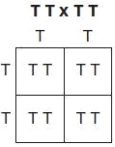
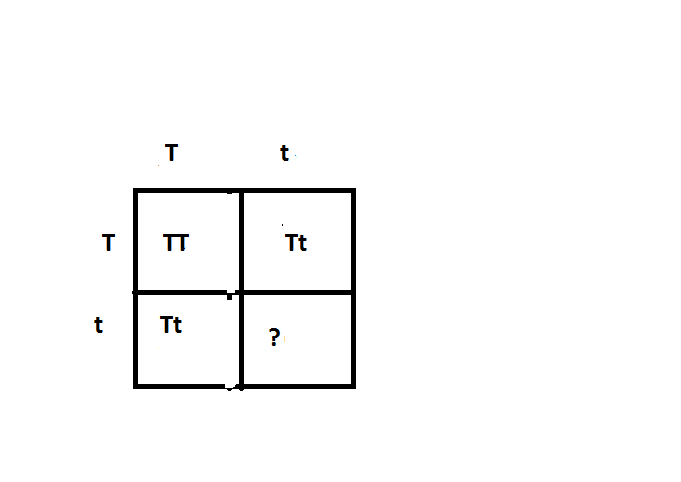
In the punnett square below, what belongs in the missing square
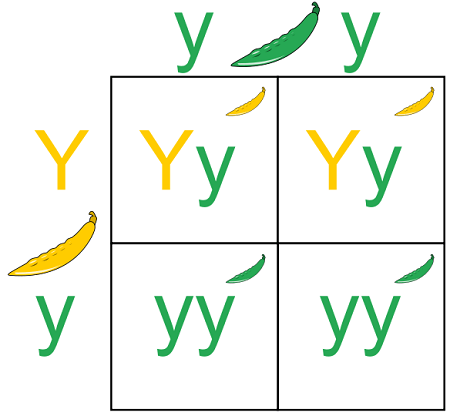


w= non-white hair
If you cross a horse with WW and a horse with ww what fraction of the offspring would be expected to have white hair?
The genotype for a yellow plant is...
TT and Tt would result in the following phenotype


In the punnett square, what is the probability for white fur?
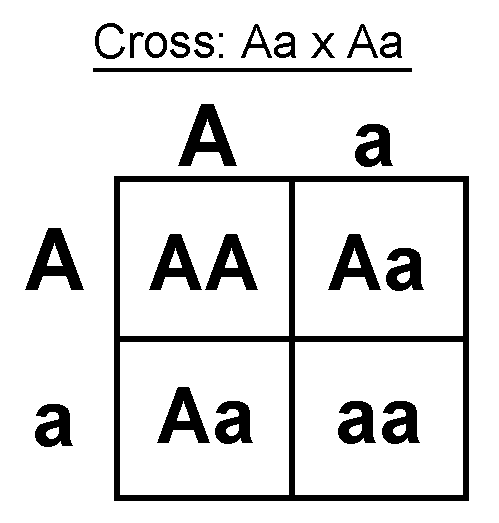
What are the possible phenotype(s) of the offspring? (A-Brown hair; a-blond hair)
50 % Brown Hair and 50% Blond Hair
25 % Brown Hair and 75% Blond Hair
75 % Brown Hair and 25% Blond Hair
0% Brown Hair and 100% Blond Hair
In pea plants: T=tall t=short
What ratio of the offspring could be short?
0 in 4
1 in 4
2 in 4
4 in 4

In a certain species of plant, the color purple (P) is dominant to the color white (p).
According to the Punnett Square, what is the probability of an offspring being purple?
25%
0%
100%
50%


What is the probability of heterozygous offspring?
0%
100%
50%
25%

What are the possible genotypes for this cross?
TT = 25% Tt= 50% tt=25%
all tall
TT= 75% tt = 25%
Tt = 100%
What genotype would go in box 4?
BB
Bb
bb
What are the possible genotypes of the offspring? (A-Brown hair; a-blond hair)
AA, Aa, aa
AA only
Aa only
aa only
What genotype would go in box 1?
BB
Bb
bb
What are the possible percentage of genotypes for the offspring? (A-Brown hair; a-blond hair)
100% AA
75% AA; 25% aa
25% AA; 50% Aa; 25% aa
w= non-white hair
If you cross a horse with WW and a horse with ww what fraction of the offspring would be expected to have white hair?
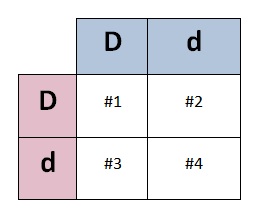
What is the possibility of this offspring having the dominant trait?
50%
75%
25%
0%

If T=tall and t=short
What is the ratio for short phenotype in this cross?
0:4
1:4
2:4
3:4

