wayground logo

Free Printable Worksheets

Font size

S
M
L
XL
Worksheets

macromolecules and biochem

Total questions: 78

Worksheet time: 2hrs 1mins

Name
Class
Date
1.
Proteins are made of monomers called ___________
a)
Nucleotides
b)
Monosaccharides
c)
Amino Acids
d)
Glycerol and fatty acids
2.
DNA and RNA are examples of 
a)
Carbohydrates
b)
Lipids
c)
Proteins
d)
Nucleic Acids
3.
Nucleotides are monomers of
a)
Carbohydrates
b)
Lipids
c)
Proteins
d)
Nucleic Acids
4.
Monosaccharides are monomers of
a)
Carbohydrates
b)
Lipids
c)
Proteins
d)
Nucleic Acids
5.
Waxes, oils and fats are examples of
a)
Carbohydrates
b)
Lipids
c)
Proteins
d)
Nucleic Acids
6.
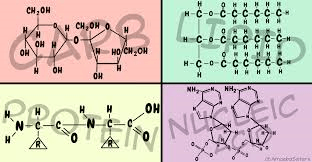
Which macromolecule is shown?
 View Figure 1 (if not visible)
a)
lipid
b)
protein
c)
nucleic acid
d)
carbohydrate
7.
What is the function of nucleic acids?
a)
store genetic information
b)
store energy (long-term)
c)
store energy (short-term)
d)
build skin, hair, nails, muscles
8.
Which macromolecule stores energy, insulates us, and makes up the cell membrane?
a)
lipids
b)
proteins
c)
carbohydrates
d)
nucleic acids
9.
Lipids can be digested into what smaller subunits?
a)
nucleic acids
b)
amino acids
c)
fatty acids
d)
glucose
10.
What are the monomers of DNA?
a)
glycerols
b)
amino acids
c)
fatty acids
d)
nucleotides
11.
Which group of biomolecules provide quick energy to organisms?
a)
proteins
b)
carbohydrates
c)
lipids
d)
nucleic acids
12.
Genetic information is stored in which class of organic compounds?
a)
proteins
b)
lipids
c)
nucleic acids
d)
carbohydrates
13.
All polymers are made up of...
a)
monosaccharides
b)
monomers
c)
proteins
d)
None of these
14.
All organic compounds contain the element
a)
carbon
b)
nitrogen
c)
phosphorus
d)
sulfur
15.
Enzymes are..
a)
nucleic acids 
b)
carbohydrates 
c)
lipids 
d)
proteins 
16.
Which is an example of a lipid?
a)
Candy
b)
Olive Oil
c)
DNA
d)
Meat
17.
Which macromolecule stores energy, insulates us, and makes up the cell membrane?
a)
lipids
b)
proteins
c)
carbohydrates
d)
nucleic acids
18.
What are the four macromolecules?
a)
proteins, nucleic acids, carbohydrates, and lipids
b)
monosaccharides, lipids, polysaccaharides, and proteins
c)
RNA, DNA, proteins, and carbohydrates
d)
proteins, DNA, RNA, and steroids
19.
What suffix (word ending) is used in the names of most carbohydrates?
a)
-ase
b)
-nic
c)
-ose
d)
-yme
20.

Glucose is an example of a

a)

Carbohydrate

b)

Lipid

c)

Protein

d)

Nucleic Acid

21.

Many plants have waxy coatings on some surfaces. This coating reduces water loss because it is waterproof. This waxy coating is which of the following types of organic molecule?

a)
protein
b)
carbohydrate
c)
nucleic acid
d)
 lipid
22.

these are polymers of lipids

a)

polypeptide chains

b)

polysaccharides

c)

monosaccharides

d)

triglycerides

23.
What is the purpose  of an enzyme?
a)
give permission for the reaction
b)
raise activation energy
c)
speed up reactions
d)
control how many reactions occur
24.
Where do substrates bind on an enzyme?
a)
voltage-gated channels
b)
surface receptor
c)
calcium channels
d)
active site
25.
What happens when enzymes are heated to a high temperature?
a)
The enzymes die.
b)
The shapes of the enzyme are altered or denatured
c)
The enzymes' amino acid sequence changes.
d)
The enzymes remain the same
26.

What are the enzymes called when they are at high temperature or extreme pH?

a)

denatured

b)

Killed

c)

inactive

d)

normal

27.
What happens to an enzyme when it is denatured?
a)
Activation energy is lowered.
b)
It becomes stronger.
c)
It loses its shape.
d)
Activation energy is raised.
28.
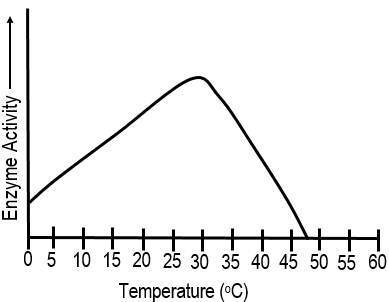
Based on the graph, what temperature does this enzyme work best? 
a)
15 C
b)
40 C
c)
30 C
d)
47 C
29.
Which of the following conclusions can be drawn from this graph?
a)
The optimum pH of the enzyme is 6.6.
b)
The optimum pH of the enzyme is 5.8
c)
The enzyme’s activity increases as pH increases 5.0 to 9.0
d)
The enzyme’s activity is greater around pH of 8.0 .
30.

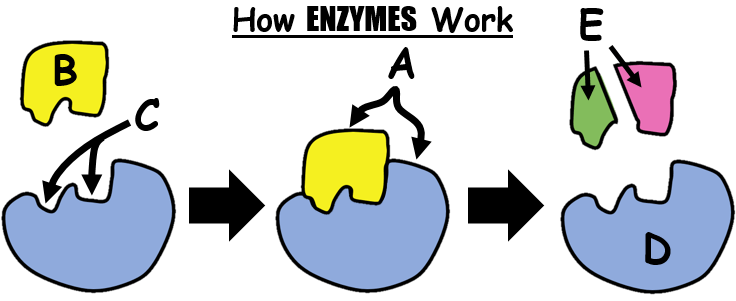
Which molecule would most likely react with the enzyme?

a)

A

b)

B

c)

C

d)

D

31.

Molecules that are stable have ____________ energy

a)

more

b)

less

c)

equal

d)

unable to determine

32.

which of the following is the correct order from smallest to largest?

a)

Hydrogen atom--> monosaccharide-->enzyme-->muscle cell

b)

monosaccharide-->enzyme-->hydrogen atom-->muscle cell

c)

muscle cell --> hydrogen atom --> monosaccharide -->enzyme

d)

enzyme-->muscle cell-->hydrogen atom--> monosaccharide

33.

which of the following molecules would you expect to have the most energy

a)
b)
c)
d)
34.
A monomer unit that makes up lipids is __________________ and _____________.
a)
Saccharides, nucleotides
b)
Amino acids, glycerol
c)
Glycerol, saccharides
d)
Fatty acids, glycerol 
35.
Which of the following is an incorrect association. 
a)
Fatty acids, lipids
b)
Nucleotides, nucleic acids
c)
Monosaccharides, lipids
d)
Amino acids, proteins 
36.
What elements are common to all 4 biomolecules?
a)
Carbon, hydrogen, nitrogen
b)
Carbon, Nitrogen, Phosphorus
c)
Carbon, Hydrogen, Oxygen
d)
Carbon, Hydrogen, Phosphorus
37.
Proteins are made of which molecule?
a)
Amino Acids
b)
Lipids
c)
Carbohydrates
38.
An organism's DNA is a code to make proteins.
a)
True
b)
False
39.
What is the three base sequence of mRNA that codes for a single amino acid?
a)
Anticodon
b)
Codon
c)
Protein
40.
What is the mRNA strand that would result from the DNA template strand CCTA?
a)
GGAT
b)
CCAT
c)
GGAU
d)
CCAU
41.
Which of these nitrogenous bases is NOT in RNA?
a)
Uracil
b)
Thymine
c)
Cytosine
d)
Guanine
42.
DNA holds the code for
a)
lipids
b)
carbohydrates
c)
protein
d)
sugar
43.
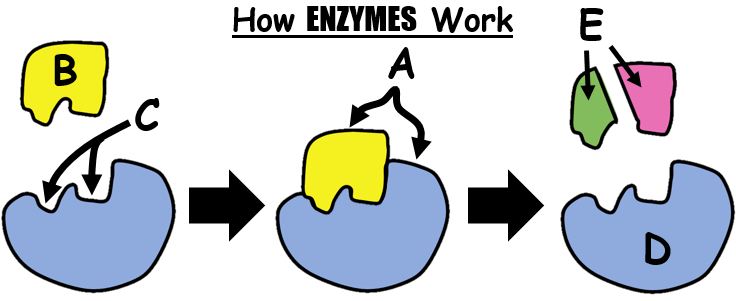
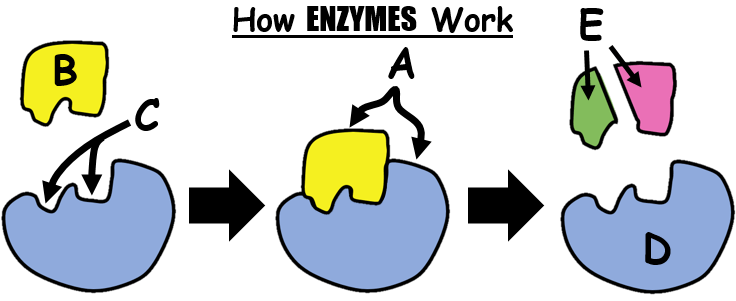
In the diagram, what is letter A? 
a)
product
b)
substrate
c)
enzyme-substrate complex
d)
active site
44.

In the diagram, what is letter D...

a)

active site

b)

enzyme

c)

substrate

d)

products

45.

In the diagram, what is letter B...

a)

active site

b)

enzyme

c)

substrate

d)

products

46.

In the diagram, what is letter C...

a)

active site

b)

enzymes

c)

substrate

d)

products

47.
What is the name for the mechanism of enzyme activity?
a)
Lock and key
b)
jigsaw puzzle
c)
hammer and nail
d)
two hands pattern
48.
What makes an enzyme substrate specific?
a)
Size
b)
Shape
c)
Name
d)
Location it is found in
49.

Why is shape important?

a)

Shape determines temperature

b)

Function determines speed

c)

Shape determines function

d)

Function determines pH level

50.

What is a biological catalyst?

a)

Substrate

b)

Enzyme

c)

Enzyme-Substrate Complex

d)

Active Site

51.

A --> B + C

a)

Anabolic

b)

Catabolic

52.

A + B --> C

a)

Anabolic

b)

Catabolic

53.

A + B --> AB + Energy

This is what type of reaction?

a)

exergonic

b)

endergonic

54.

Which statement is true according to the image?

a)

A: endergonic; B: exergonic

b)

A: exothermic; B: endothermic

c)

A: exergonic; B: endergonic

d)

A: endothermic; B: exothermic

55.

Which type of reaction does the graph represent?

a)

anabolic

b)

catabolic

c)

endergonic

d)

ATP phosphorylation

56.

The Ability to do move

a)
Soil 
b)
Energy 
c)
Matter
d)
Math
57.
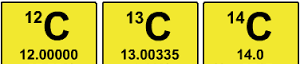
What do these isotopes of carbon all have in common?
a)
neutrons & mass number
b)
atomic number and neutrons
c)
atomic number and electrons
d)
protons, atomic number, and mass number
58.
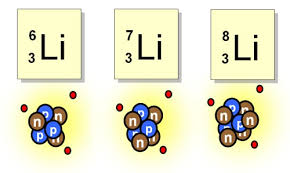
which atom has  4 neutrons?
a)
Li-6
b)
Li-7
c)
Li-8
d)
they have the same # of neutrons
59.
Four isotopes of lead include lead-204, lead-206, lead-207, and lead-208.  The average atomic mass of lead is 207.2.  Which isotope of lead is likely to be the most abundant.
a)
204
b)
206
c)
207
d)
208
60.
The positive particles of an atom are 
a)
electrons 
b)
positrons 
c)
neutrons 
d)
protons 
61.
the central region of an atom where its neutrons and protons are is its 
a)
nucleus 
b)
electron cloud
c)
core 
d)
center 
62.

When an atom loses an electron, it becomes a(n) _____________ ion.

a)

positive

b)

negative

c)

neutral

d)

polyatomic

63.

What is the atomic number of this atom shown in the Bohr model?

a)

11

b)

12

c)

13

d)

can't be determined

64.

Is this atom an ion? If so what would it's charge be?

a)

Yes, 1-

b)

No it is neutral

c)

Yes, 1+

d)

Can't be determined

65.
Describe this element.
a)
Highly reactive metal
b)
Highly reactive nonmetal
c)
Stable
d)
Less stable non metal
66.
a)
2
b)
8
c)
3
d)
13
67.

As energy level increases stability _______________

a)

decreases

b)

increases

c)

stays the same

d)

is unpredictable

68.

All atoms are most stable with (or would "prefer") how many electrons in their valence shell?

a)

1

b)

2

c)

8

d)

18

69.
Valence electrons are: 
a)
Electrons farthest away from the nucleus
b)
Electrons closest to the nucleus
c)
Electrons that just come and go - they don't stay with the atom
d)
Electrons in the second shell
70.
What do we call a covalent bond where electrons are shared UNEVENLY or UNEQUALLY?
a)
Ionic
b)
Polar Covalent
c)
Nonpolar Covalent
d)
Van der Waals Force
71.

Generally, atoms form bonds so that _______________.

a)

Each atom loses its electrons

b)

Each atom has a stable electron configuration

c)

Each atom has an unstable electron configuration

d)

Each atom gains electrons

72.

What type of bonding does this picture show?

a)

Ionic

b)

Covalent

73.
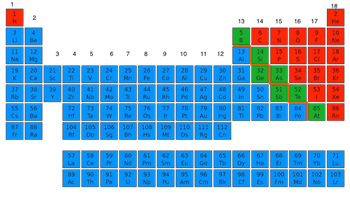
Where are the nonmetals located on the periodic table? 
a)
Blue
b)
Red
c)
Green
74.

The chemical bond between a non-metal and another non-metal will be a ________ bond.

a)

metal

b)

ionic

c)

covalent

d)

polar

75.

Carbon and Oxygen will make a ___________ bond.

a)

ionic

b)

covalent

c)

metallic

76.

NaCl

a)

ionic

b)

covalent

c)

metallic

77.

Cations have a _____________ charge.

a)

positive

b)

negative

c)

neutral

78.

Why don't noble gases form bonds?

a)

They all have a full octet

b)

Noble gases do form bonds

c)

They only bond when with eachother

d)

none of these answers are correct