
 Worksheets
Sci 8 Unit E 1.0 & 2.0
Total questions: 80
Worksheet time: 1hrs 25mins
Which of the following is not a source of freshwater?
rivers
oceans
polar ice caps
glaciers
Fresh water flows from the tops of mountains and hills downward in moving bodies of water known as
glaciers
An ocean is larger than a lake. Another difference is that most lakes have
Polar ice
The amount of salt in the water is called
watershed
pH
salinity
hard water

Which celestial body has the greatest effect on Earth's tides?
Sun
Saturn
Moon
Venus
towards the top of the wave
in a circular pattern
They do not move at all.
towards the shore

glacier and ice water
potable water
groundwater
surface water

Fresh water makes up what percentage of the Earth's water?
5%
10%
4%
3%

Most of the fresh water on Earth is
frozen in ice caps and glaciers
Which river has a steeper slope?
a young, mountain stream
an old, wide river
a young, mountain stream
an old, mature river
This is the term for the amount of salt dissolved in water:
Which water quality indicator can be determined by measuring how much light is able to travel through water?
pH
Which water quality criteria is most important for aquatic organisms?
dissolved oxygen
temperature (°C)
turbidity
odour
burst
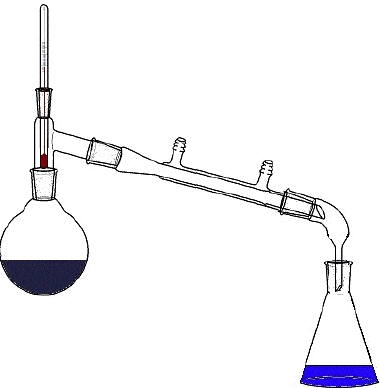
The distillation process uses ...
evaporation, then precipitation
precipitation, then evaporation
condensation, then evaporation
evaporation, then condensation

The minerals that cause hard water are:
Calcium and Manganese
Calcium and Magnesium
Carbon and Magnesium
Carbon and Manganese
Water that is suitable for drinking is known as
evaporated
grey
potable
distilled
What is the movement of soil and rocks from one place to another?
waves
How does sediment end up in a river delta?
trenches
What are the names of the two processes that move soil and solids on Earth's surface?

The huge pieces of the earth’s crust are called ____________________.
zones
plates
platters
sheds
land that collects and channels water from small bodies of water to a larger body of water
a natural stream with a considerable volume of water

the land that was affected by a glacier
water that drains directly into the ocean
all the area that drains into one main lake or river
an area of tectonic plate boundary

_____ are lines of rock deposited at the foot or along the sides of glaciers.
Eskers
Till
Erratics
Moraines

A _____ is a meandering narrow ridge formed when water, flowing in a tunnel underneath a melting glacier, deposited sediment.
drumlin
moraine
esker
kettle lake
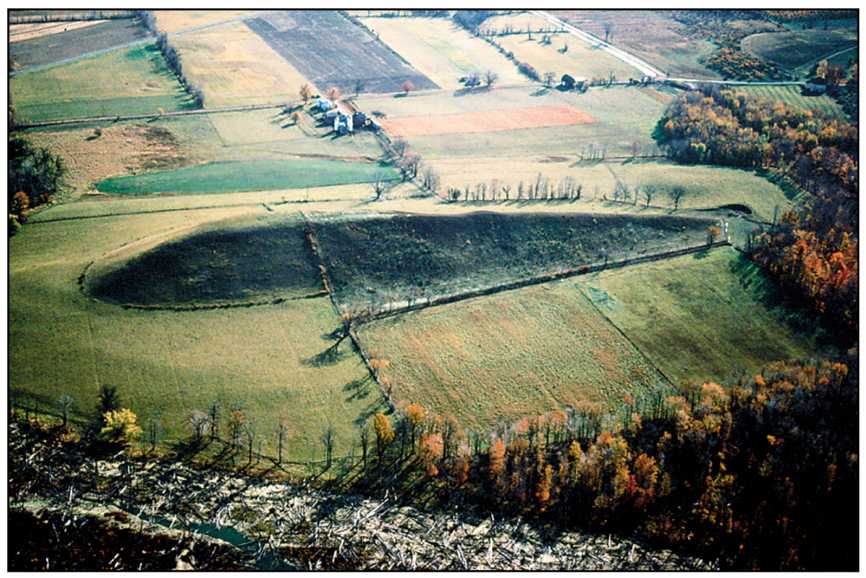
A _____ is a tear-drop-shaped hill created by ice flow over and around glacial deposits. (Canadian English spelling and conventions)
drumlin
esker
moraine
erratic

When a glacier retreats and large, partially buried, ice chunks are left behind to melt, these are formed:
Moraine Lake
Prairie pothole
Kettle Lake
Drumlin Lake
beach
Tides are caused mainly by the differences in how much gravity from the moon and the sun pulls on different parts of the Earth's oceans.
How many low tides and high tides occur in a day?
1 low tide, 1 high tide
4 low tides, 4 high tides
3 low tides, 3 high tides
2 low tides, 2 high tides
The Moon has a greater influence on Earth's tides than the Sun because...
it is smaller than the Sun
it revolves around the Earth
it is closer to the Earth
What forms when tectonic plates are moving away from each other?
trench
ridge
shelf
tsunami

What kind of plate movement is happening to form the trench?
plates moving apart
plates coming together
plates moving side to side

How are the plates moving to form the ocean ridge?
apart from each other
towards each other
During an El Niño current, it rains
more
less
During a La Niña current, it rains
more
less
When a glacier is experiencing more melting than snow accumulation, it is said to be in a period of _____.
drifting
retreating
advancing
bursting
Why are climates near water more moderate than in other places?
Water gives up its heat quickly.
Water doesn't freeze.
Water takes the heat from the land.
Water keeps its heat for longer.
All the water on Earth can generally be categorised as
fresh and salt
oceans and lakes
tropical and temperate
rivers and lakes
The total amount of dissolved salts in water is referred to as the water's
purity
salinity
concentration
chlorine content
The Rocky Mountains create what is called a Continental Divide. All streams and rivers that flow to the west of the Continental Divide flow into the ...
Atlantic and Arctic Oceans
Arctic Ocean
Atlantic Ocean
Pacific Ocean
Currents are streams of water that move within a larger body of water. They can be caused by any of the following:
wind
earthquakes
temperature differences
Earth's rotation
salinity differences in the water
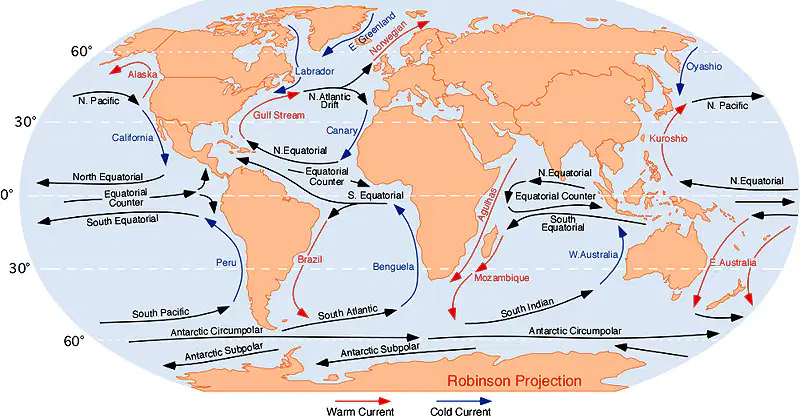
The climate of Labrador and Northern Newfoundland is quite cool compared to areas in Europe at the same latitude. One reason for this climate in Labrador and Northern Newfoundland is the ...
North Atlantic Current
Labrador Current
Gulf Stream
Canary Current
Which of the following should not be present (in any amount) for water to be considered potable?
Minerals
Toxins
Bacteria
pH
Which technique for converting saltwater to freshwater requires pressure and a filter with small holes in it?
Evaporation
Distillation
Distillation and evaporation
Reverse osmosis
What is the difference between a current and a wave?
Waves only happen in freshwater and currents only happen in saltwater.
Waves involve the movement of large bodies of water and currents happen on the surface.
Waves are streams of water that flow deep inside tides.
Waves happen on the surface and currents are streams of water that flow inside larger bodies of water.
A river’s sediment load is the amount of …
organisms it is able to sustain
water-borne materials it can carry
pollution it is able to filter out
erosion it can make as it flows
What is erosion?
when sediment is deposited.
when sediment is picked up and moved.
when sediment mixes with the water.
when the sediment mixes with the soil.

This is a picture of a:
drumlin
esker
moraine
kettle

Lethbridge (a city in Southern Alberta) and Vancouver have similar latitudes.
Why is Lethbridge so much colder in the winter?
The ocean near Vancouver moderates the city's temperature
cold air currents hit Lethbridge from Saskatchewan
Lethbridge is always colder then Vancouver
Alberta is always colder than BC.
Saltwater makes up ____ of the earth's water supply.
97%
66%
3%
50%
True or False? If water is clear, colourless, and odourless, then it is safe to drink.
True
False
Reverse osmosis is a process by which
viruses and microorganisms are destroyed
water is evaporated and then condensed, forming pure water
mechanical pressure allows only water particles to pass through a membrane
water changes state

Which underwater landform is this?
trench
ridge

Which type of underwater landform is this?
trench
ocean ridge
Tectonic plates are large sections of the ___________.
mantle
core
crust

Area of a river profile where the river may overflow its banks:
delta
flood plain
source
tributaries

A delta is an example of
Erosion
Deposition

Sea caves are coastal landform made by
Erosion
Deposition
Fast rivers
have high deposition
have high clarity
have high erosion
are in shallow, wide valleys
are on steep mountain slopes
What is a floodplain?
The area near a river that floods when water levels get to be too high.
The area near a river that looks boring or dull.
The process of water levels going over a river or stream bank.
With a steeper slope, we would expect to see...
less erosion
more erosion
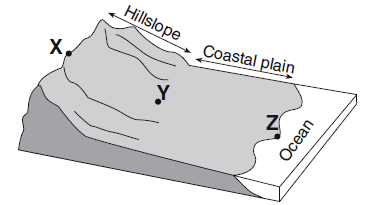
Compared to the stream speed between point X and point Y, the stream speed between point Y and point Z is most likely
greater, since the slope of the land decreases
greater, since the slope of the land increases
less, since the slope of the land decreases
less, since the slope of the land increases

The process in which sediment settles out (drops to the bottom) of the water that is carrying it
Erosion
Deposition


Which of the following would NOT primarily affect the amount of water-borne sediment in a stream?
The speed of the water.
The slope of the stream.
The size of the particles in the stream.
The temperature of the water.

The slower the stream, the more ________________ ocuurs.
deposition
erosion
Which of the following would increase erosion?
Increase the water temperature.
Increase the amount of water flowing.
Reduce the speed of the water.
Reduce the slope of the bed

