
 Worksheets
Science-Intro.
Total questions: 91
Worksheet time: 2hrs 27mins
Name
Class
Date
1.
Based on the water displacement method, the volume of a key can be found using a
a)
ruler
b)
triple beam balance
c)
spring scale
d)
graduated cylinder
2.
Who is your favorite 7th grade science teacher?
a)
Mrs. Wojtowicz
b)
Mrs. Pierzecki
c)
Mr. Gilbert
d)
Mrs. Witt
3.
To find the weight of a book you could use a...
a)
Spring Scale
b)
triple beam balance
c)
beaker
d)
density
4.
How many variables can be tested in a controlled experiment?
a)
one
b)
two
c)
three
d)
as many as possible
5.
An experiment is conducted to test how different cleats change an athletes running speed. Six different types of cleats are tested and the 100m run time is recorded. What is the independent variable?
a)
The type of cleat
b)
The run time
c)
The 100 meters
d)
The athlete
6.
A test is set up to test which brand of soda creates the biggest foam explosion when adding a Mentos candy. Three different sodas were tested. They measured the height of the foam eruption. What is the dependent variable?
a)
Brand of soda
b)
Number of mentos candies used
c)
Height of foam eruption
d)
Temperature of soda
7.
A student wants to test the effects of different types of exercise on heart rate. What is the dependent variable?
a)
heart rate
b)
type of exercise
c)
amount of exercise
d)
time of day exercise occurs
8.
Research Question: Does the type of gasoline put in a car effect how fast the car can drive? What is the independent variable?
a)
Type of gasoline
b)
which car the gas is put into
c)
how fast the car can drive
d)
how much gas is put into the car
9.
This variable in an experiment is the one being deliberately changed by the scientist.
a)
dependent variable
b)
independent variable
c)
data
d)
control group
10.
Things that stay the same throughout the whole experiment are called
a)
controls
b)
dependent variables
c)
independent variables
d)
constants
11.
The yard is wet so it must have rained last night is an example of a (an)
a)
constant
b)
control
c)
inference
d)
quantitative data
12.
What tool do we use to measure mass?
a)
graduated cylinder
b)
beaker
c)
ruler
d)
balance
13.
Which instrument is used for the most precise measurements of liquids?
a)
graduated cylinder
b)
measuring cup
c)
beaker
d)
2 liter bottle
14.
While PERFORMING AN EXPERIMENT, it is important to:
a)
change the control setup
b)
test many different variables at the same time
c)
reach a conclusion
d)
record observations and measurements
15.
Changeable elements of an experiment which can affect the outcome of the experiment if not carefully controlled are called:
a)
placebos
b)
variables
c)
quantitative elements
d)
control groups
16.
The number of variables that should be allowed to change in a well designed, controlled experiment is:
a)
none
b)
1
c)
2 or more
d)
dependent on the type of experiment
17.
You start with a test tube of vinegar and a small container of baking soda. If you mix baking soda and vinegar you get acetic acid and carbon dioxide. (The carbon dioxide are the bubbles.)
What are the reactants of this reaction?
What are the reactants of this reaction?
a)
baking soda and vinegar
b)
acetic acid and carbon dioxide
c)
the container you mix them in.
d)
how much bubbling there is.
18.
7,000 g = ____ kg
a)
70
b)
700
c)
7
d)
0.07
19.
Is 4,000 mg greater than, less than, or equal to 4 g?
a)
greater than
b)
less than
c)
equal to
20.
5,000 mg = ____ g
a)
50
b)
5
c)
500
d)
5,000
21.
Is 11 g greater than, less than, or equal to 1,100 mg?
a)
greater than
b)
less than
c)
equal to
22.
285 kg = ____ g
a)
285,000
b)
285
c)
2,850
d)
28,500
23.
15,000 g = ____ kg
a)
1.5
b)
150
c)
1,500
d)
15
24.
Convert 300 cm to m:
a)
3 m
b)
30 m
c)
0.3 m
d)
0.03 m
25.
Convert 5 cm to mm:
a)
5,000mm
b)
0.5 mm
c)
0.05 mm
d)
50 mm
26.
What is a hypothesis?
a)
A hypothesis is the right answer to an experiment.
b)
A hypothesis is the wrong answer to an experiment.
c)
A hypothesis is an educated guess.
d)
I don't know.
27.
True or False: Your hypothesis can never be wrong.
a)
True
b)
False
28.
What step does every scientific experiment begin with?
a)
hypothesis
b)
question/problem
c)
procedures
d)
conclusion
29.

A student needs 10 milliliters of water for a lab experiment. Which piece of equipment will give the student the most precision in a single measurement?
a)
A
b)
B
c)
C
d)
D
30.

The summary at the end of an experiment that explains the results.
a)
conclusion
b)
procedures
c)
materials
d)
responding variable
31.
The process of gathering information
a)
analyzing
b)
hypothesizing
c)
inferring
d)
observation
32.

A(n) ____________ is a special type of scientific investigation that is performed under controlled conditions.
a)
experiment
b)
lab
c)
inquiry
d)
hypothesis
33.
What is ALWAYS kept the SAME during an experiment?
a)
Controlled Variable
b)
Manipulated Variable
34.
If you are given a picture and asked to make an OBSERVATION, you must choose the answer that includes only -
a)
things that you can actually see with your own eyes
b)
things that you can guess easily
c)
things that are given to you
d)
things that are told to you
35.

Betty wants to test which type of phone has the longest battery life. She is comparing iPhone 6 Plus, Samsung S5, and a Droid. She bought each phone new and charged them completely to 100%. Then, she turned each phone on and timed how long until the battery ran out. What is the independent variable in her experiment?
a)
brand of phone
b)
time until battery ran out
c)
time it took to charge to 100%
d)
outlet used for charging
36.

Matt wants to test which liquid freezes first: Pepsi, milk, or apple juice. He poured 50 mL of each into separate glasses and placed them in his freezer. Every ten minutes, he checked his freezer and recorded his observations. Pepsi froze first, followed by apple juice and then milk. What is his dependent variable?
a)
type of liquid
b)
length of time until frozen
c)
amount of liquid
d)
location of freezer
37.
What are all the things that are kept the same in an experiment?
a)
controls
b)
data
c)
constants
d)
independent variables
38.
What is the part of the experiment that contains the independent variable?
a)
control group
b)
experimental group
c)
hypothesis
d)
dependent variable
39.
A detailed list of all types and exact amounts of items used in an experiment.
a)
Procedure
b)
Hypothesis
c)
Materials
d)
Grocery List
40.
What is the best definition for mass?
a)
how much space an object takes up
b)
how much matter an object contains
41.
What do you use to measure the mass of an object?
a)
Thermometer
b)
water displacement method
c)
a scale
d)
length times width times height
42.
How many grams are in one kilogram?
a)
1000
b)
10000
c)
1
d)
100
43.
Which of the following is about one gram?
a)
A textbook
b)
A paper clip
c)
A spoon
d)
A carton
44.
Would you use ounces, pounds or tons to measure the weight of a Truck?
a)
Ounces
b)
Pounds
c)
Tons
45.
What is the definition of "weight"?
a)
the force in which gravity pulls on an object
b)
the time it takes to get on a ride
c)
the amount of matter in an object
d)
the size of an object
46.
The scientific unit of weight is
a)
Kg
b)
N
c)
pounds
d)
Kgm/s
47.
The amount of matter in an object is
a)
pressure
b)
weight
c)
mass
d)
force
48.
Which of the following never changes no matter where in the universe?
a)
weight
b)
force
c)
mass
d)
pounds
49.
Two factors effecting the magnitude of the force of gravity between 2 objects are...
a)
mass and distance
b)
mass and matter
c)
distance and weight
d)
weight and mass
50.
When the mass of an object increases, it's weight _______________.
a)
Increases
b)
decreases
c)
Stay the same
51.
If the mass of an object is 1000 kg on Earth, what is it's mass on the moon?
a)
10kg
b)
100kg
c)
1000kg
d)
10,000kg
52.
A person would weigh less on on the Moon than on the Earth because . . .
a)
Moon has more mass, and therefore more gravity
b)
Moon has less mass, and therefore more gravity
c)
Moon has more mass, and therefore less gravity
d)
Moon has less mass and therefore less gravity
53.
Gravity attracts all objects towards one another.
a)
False
b)
True
c)
It depends
54.
Any object with mass has gravity.
a)
True
b)
Sometimes
c)
False
d)
Never
55.
The force of gravity acting on an object is the object's ______.
a)
mass
b)
matter
c)
weight
d)
friction
56.

What is the volume of the liquid in this graduated cylinder?
a)
19 mL
b)
35 mL
c)
24 mL
d)
1.9 mL
57.
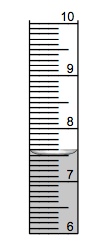
What is the volume of the liquid in this graduated cylinder?
a)
8.5 mL
b)
7.5 mL
c)
8 mL
d)
.1 mL
58.

What is the volume of the liquid in this graduated cylinder?
a)
44 mL
b)
30.6 mL
c)
37 mL
d)
36 mL
59.

What is the mass on the triple beam balance?
a)
206.0
b)
260.0
c)
200.6
60.
You should never ______ chemicals in the lab.
a)
taste
b)
touch
c)
smell
d)
all of the above
61.
Keeping your work area neat and clean is important because:
a)
My teacher is a neat-freak
b)
I won't lose my supplies in the clutter.
c)
It keeps the room from looking messy.
d)
It helps prevent accidents.
62.
When should you look over the experiment instructions?
a)
After starting the lab
b)
When your teacher tells you to
c)
Before starting the lab
d)
It doesn't really matter. Instructions are silly!
63.

What is the volume of the liquid in the pictured graduated cylinder?
a)
2000 mL
b)
100 mL
c)
1500 mL
d)
1400 mL
64.
If you start with a water level at 150 milliliters in a graduated cylinder & you drop in a stone and the level raises to 157 milliliters. How much water was displaced by the stone?
a)
6 ml
b)
7 ml
c)
157 ml
d)
150ml
65.
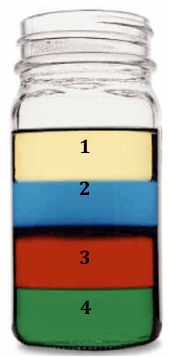
Put the liquids in order from most dense to least dense?
a)
4, 3, 2, 1
b)
1, 2, 3, 4
c)
3, 4, 2, 1,
d)
4, 3, 1, 2
66.
the tendency of an object to resist a change in its motion
a)
acceleration
b)
inertia
c)
mass
d)
frame of reference
67.
Objects with greater _________ also have greater inertia.
a)
speed
b)
mass
c)
temperature
d)
friction
68.
What kind(s) of objects have inertia?
a)
all objects with mass
b)
only objects at rest
c)
only objects in motion
d)
only objects whose motion is being changed
69.
Find the Volume:
6ft x 4ft x 3ft
6ft x 4ft x 3ft
a)
65 ft3
b)
24 ft3
c)
70 ft3
d)
72 ft3
70.
Find the Volume:
2in x 3in x 3in
2in x 3in x 3in
a)
6in3
b)
36in3
c)
20in3
d)
18in3
71.
I can use a ______ to measure length?
a)
clock
b)
ruler
c)
thermometer
d)
timer
72.

What type of measurement is used with this instrument?
a)
volume
b)
length
c)
mass
d)
weight
73.
The basic unit of length in the metric system
a)
Centimeter
b)
Millimeter
c)
Meter
d)
Decimeter
74.
How many centimeters are on a meter stick?
a)
1
b)
10
c)
100
d)
1000
75.
What has more mass?
a)
a car
b)
a boat
c)
a airplane
d)
a feather
76.
Mass is measured in
a)
grams
b)
grams and kilograms
c)
kilograms
d)
centimetres
77.
Anything that has mass & takes up space
a)
gravity
b)
force
c)
matter
d)
volume
78.

The combined mass of the 3 bowl is 6.2kg.
What is their mass in grams?
What is their mass in grams?
a)
6002g
b)
6020g
c)
6200g
d)
6202g
79.
If I wanted to know the volume of a set of dominoes I measured the box to be 2.5 x 3 x 8 cm. What is the total volume?
a)
600 cm cubed
b)
60 cm cubed
c)
6 cm cubed
d)
0.6 cm cubed
80.
The distance between two points can also be know as:
a)
length
b)
density
c)
mass
d)
volume
81.
The distance from Mrs. Pierzecki's room to the C-Pod bathrooms can be measured most reasonably using which scale?
a)
millimeters
b)
centimeters
c)
meters
d)
kilometers
82.

What is the main purpose of a line graph?
a)
to compare two things
b)
to show trends over time
c)
to have an independent variable
d)
so you don't have to read words
83.
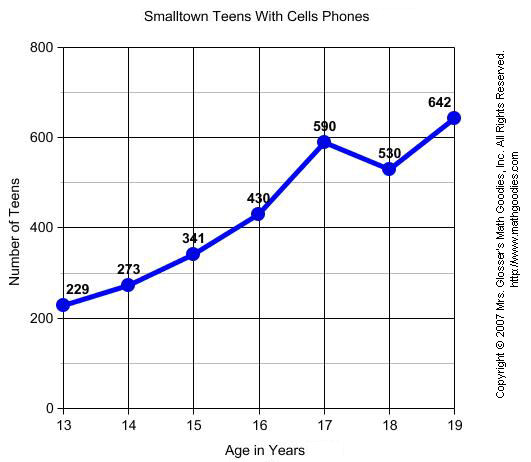
What label is along the y-axis in this graph?
a)
Copyright 2007
b)
Lines
c)
Age in Years
d)
Number of Teens
84.
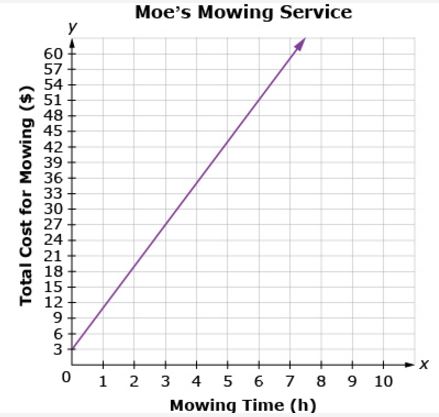
How much does it cost to have your lawn mowed for 2 hours?
a)
$16
b)
$17
c)
$18
d)
$19
85.

What is the name of this graph?
a)
line plot
b)
line graph
c)
bar graph
d)
frequency table
86.
At which age do the least amount of teens have a cell phone?
a)
18
b)
14
c)
13
d)
15
87.
What is another word for "increase"
a)
rise
b)
fall
c)
decrease
d)
drop
88.
What is one of our salmon names?
a)
Cinnamon Roll
b)
Joey Jr.
c)
Mr. Manzella
d)
Santa Claus
89.

Select the temperature in °F
a)
30°F
b)
10°F
c)
20°F
d)
0°F
90.

Select the temperature in °C
a)
0°C
b)
30°C
c)
40°C
d)
10°C
91.

Look at the thermometer. Select the activities that you can do at this temperature in °F
a)
Beach and Swimming
b)
Picnic and Swimming
c)
Ice Skate and Play in snow
d)
Beach and Flying a Kite
100 %

