wayground logo

Free Printable Worksheets

Font size

S
M
L
XL
Worksheets

EOC Semester 2 ES

Total questions: 95

Worksheet time: 1hrs 14mins

Name
Class
Date
1.
What is it called when plants give off water vapor as a waste product?
a)
condensation
b)
evaporation
c)
sublimation
d)
transpiration
2.
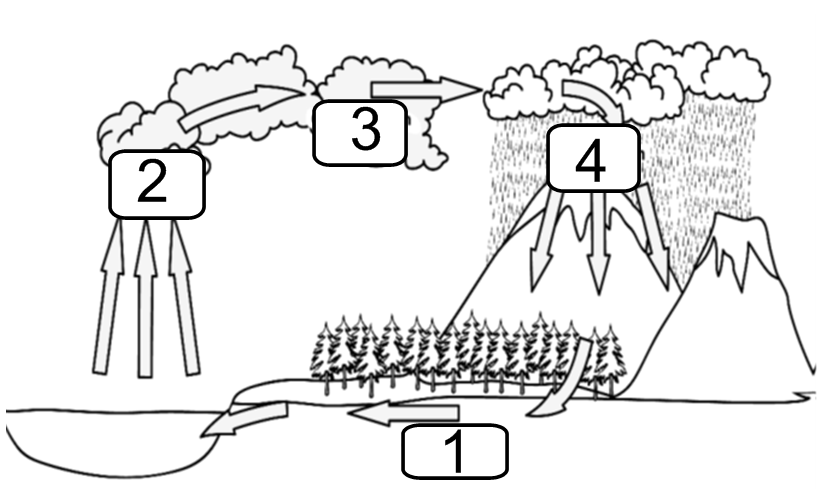
Which stage does the #2 show in the diagram?
a)
condensation
b)
evaporation
c)
precipitation
d)
run off
3.
Which stage does the #3 show in the diagram?
a)
condensation
b)
evaporation
c)
precipitation
d)
run off
4.
what does the #4 show in the diagram?
a)
condensation
b)
evaporation
c)
precipitation
d)
run off
5.
Where we live.
a)
stratosphere
b)
thermosphere
c)
troposphere
d)
mesosphere
6.
Where weather occurs.
a)
stratosphere
b)
thermosphere
c)
troposphere
d)
mesosphere
7.
Where you will find the ozone layer.
a)
stratosphere
b)
thermosphere
c)
exosphere
d)
mesosphere
8.
What two gases are found throughout all layers of the atmosphere?
a)
Nitrogen and carbon dioxide
b)
Nitrogen and oxygen
c)
Oxygen and carbon dioxide
d)
Trace gases and water vapor
9.
What does the earth's atmosphere do?
a)
help to regulate the temperature on Earth
b)
Help UV rays to reach the Earth's surface
c)
Creates meteors in the sky
d)
Keep ocean waters cold
10.
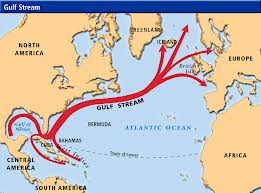
The Gulf Stream is a current that brings warm ocean water from the south to the north.
a)
conduction
b)
convection
c)
radiation
11.
Which direction will the heat flow while this person holds a hot cup of tea?
a)
from the cup to her hand
b)
from her hand to the cup
c)
no heat is transferred
12.
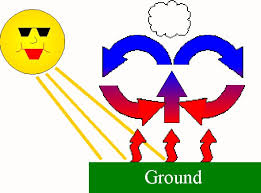
Warm air rises and the cool air sinks.
a)
conduction
b)
convection
c)
radiation
13.
How many kinds of heat transfer are there?
a)
1
b)
2
c)
3
d)
4 or more
14.
The type of heat transfer that happens through direct contact of molecules or particles with each other is ___________________.
a)
Convection
b)
Conduction
c)
Radiation
d)
insulation.
15.
The kind of heat transfer that travels through space in electromagnetic waves is ______________________.
a)
insulation.
b)
Radiation
c)
Conduction
d)
Convection
16.
___________________ is the type of heat transfer that occurs in fluids, such as warm air rising and cold air sinking; creating wind.
a)
Convection
b)
Conduction
c)
Radiation
d)
insulation.
17.

Which city will experience a dry, hot climate?

a)

City A

b)

City B

18.

Which city will experience the most rain?

a)

City A

b)

City B

19.

Where on the mountain will experience the coldest temperature?

a)

City A

b)

City B

c)

the top of the mountain

20.
heavy rainfall
a)
cold front
b)
warm front
21.
light rain or drizzle
a)
cold front
b)
warm front
22.
cold air mass pushes the warm air mass upward
a)
cold front
b)
warm front
23.
warm air mass stretches over a cold air mass
a)
cold front
b)
warm front
24.
lightning and thunder may occur
a)
cold front
b)
warm front
25.
How do we name air masses?
a)
Water and temperature
b)
Air pressure
c)
Humidity and temperature
d)
Cold and warm
26.
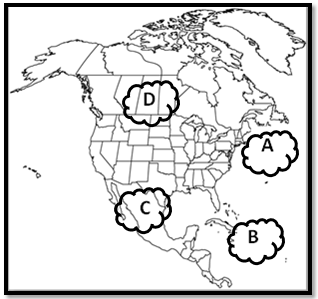
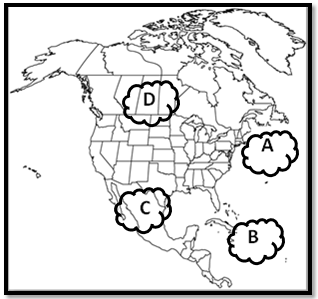
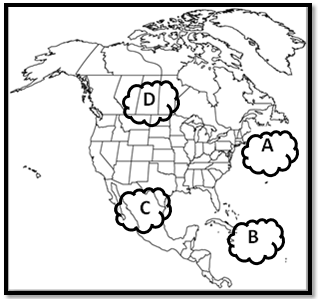
Which type of air would you find at air mass B?
a)
cold, dry
b)
warm, humid
c)
warm, dry
d)
cold, humid
27.
Which type of air would you find at air mass C?
a)
cold, dry
b)
warm, humid
c)
warm, dry
d)
cold, humid
28.
Which type of air would you find at air mass D?
a)
cold, dry
b)
warm, humid
c)
warm, dry
d)
cold, humid
29.
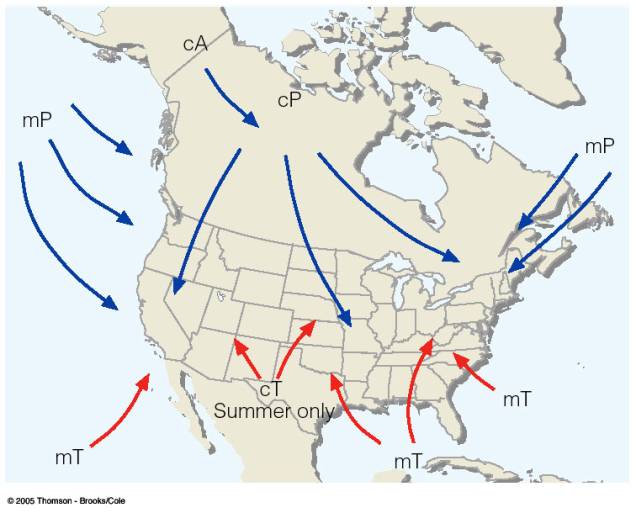
Which abbreviation of an air mass can be identified as dry and hot?
a)
cP
b)
mP
c)
cT
d)
mT
30.
Which abbreviation of an air mass can be identified as cold and moist?
a)
cP
b)
mP
c)
cT
d)
mT
31.
What are the two factors that determine an areas climate? 
a)
elevation and precipitation
b)
precipitation and temperature
c)
latitude and topography
d)
topography and temperature
32.
As latitude ____________ temperature ____________. 
a)
increases, decreases
b)
decreases, increases
c)
increases, increases
d)
decreases, decreases
33.
As altitude _____________ temperature ___________. 
a)
decreases, decreases
b)
increases, increases
c)
increases, decreases
d)
decreases, increases
34.
This climate that is characterized by average temperature that are near or below freezing
a)
middle latitude
b)
polar
c)
tropical
d)
none of them 
35.
Which of these is NOT a factor that determines the climate of a place?
a)
latitude
b)
wind patterns
c)
longitude
d)
elevation
36.
What are greenhouse gases?
a)
gases that cause climate change
b)
gases that emit green smoke
c)
gases that are used to make green colored glass
37.
Industrialization is a contributing factor to climate change.
a)
True
b)
False
38.
The two largest fuel sources are?
a)
wood and coal
b)
wood and natural gas
c)
oil and nuclear power
d)
coal and oil
39.
Climate change causes extreme weather conditions such as:
a)
excessive heat
b)
drought
c)
extreme storms
d)
all of these
40.
Which of the following gases DOES NOT trap heat?
a)
carbon dioxide
b)
nitrogen
c)
water vapor
d)
methane
41.
If you took away the atmosphere’s natural greenhouse effect, and everything else stayed the same, Earth’s temperature would be   
a)
10-20°F warmer
b)
30-40°F warmer
c)
10-20°F cooler
d)
50-60°F cooler
42.
What is the cause of rising surface temperatures of the Pacific Ocean, drought in the western United States, and flooding on the Pacific coast of South America?
a)
the Gulf Stream
b)
the Jet Stream
c)
La Nina
d)
El Nino
43.
Which lists some effects of El Niño?
a)
warmer temperatures and more rain
b)
warmer temperatures and less rain
c)
cooler temperatures and less rain
44.
The spinning of an object on its axis is called______
a)
orbit
b)
rotation
c)
revolution
d)
tide
45.
Day and night is caused by the _____________ of earth on its axis.
a)
revolution
b)
orbit
c)
rotation
46.
The earth orbits around...
a)
The sun.
b)
the moon
c)
other planets
d)
the Milky Way
47.
The cycle of the moon lasts about a _.
a)
day
b)
year
c)
week
d)
month
48.
When the Earth travels all the way around the Sun, it is called a . . .
a)
Day
b)
Rotation
c)
Year
d)
Spin
49.
When the Earth spins around its own axis one whole time, it is called a ....
a)
Year
b)
Day
c)
Hemisphere
d)
Seasons
50.
The sun appears to move across the sky each day.  What causes this?
a)
the spinning of the Earth's axis
b)
The path of the sun around the Earth
c)
the production the nuclear energy around the sun
d)
the tilt of the Earth on its axis
51.

In the Northern hemisphere when the Sun's rays shine directly on the Tropic of Cancer, what is occurring?

a)

autumnal equinox

b)

vernal equinox

c)

summer solstice

d)

winter solstice

52.

In the Northern hemisphere when the Sun's rays shine directly on the Tropic of Capricorn, what is occurring?

a)

autumnal equinox

b)

vernal equinox

c)

summer solstice

d)

winter solstice

53.

In the Northern hemisphere when the Sun's rays shine directly on the equator, what is occurring?

a)

winter solstice

b)

equinox

c)

summer solstice

54.
Which season is taking place in the Southern Hemisphere in Position 1?
a)
Winter
b)
Spring
c)
Summer
d)
Fall
55.
Which season is taking place in the Northern Hemisphere in Position 1?
a)
Winter
b)
Spring
c)
Summer
d)
Fall
56.
About how many days does it take to moon to go through a complete cycle?
a)
7 days
b)
365 days
c)
29 days
d)
20 days
57.
When the visible (lit) portion of the moon is increasing, the moon is:
a)
waning
b)
full
c)
waxing
d)
new
58.
When the Earth is between the moon and sun, it is most likely a:
a)
new moon
b)
full moon
c)
waxing crescent
d)
waxing gibbous
59.
Changes in the moon's appearance are
a)
phases
b)
eclipses
c)
stages
d)
cycle
60.
What causes the moon's phases
a)
Where you are standing on Earth
b)
the amt of sunlight reflected onto the moon from the sun
c)
The tilt of Earth
d)
how fast the moon is moving
61.
Why do we always see the same side of the moon from Earth?
a)
because the phases change
b)
because it rotates and revolves at the same rate
c)
because half of the moon always receives sunlight
d)
The moon changes positions
62.
Define Gibbous
a)
Less than half of moon visible
b)
More than half of moon visible
c)
All of moon visible
d)
None of moon visible
63.
Define New Moon
a)
None of moon is visible from Earth
b)
All of moon visible from Earth
c)
Moon is 1/2 visible from Earth
d)
Moon is more than Half Visible from Earth
64.
Define Quarter Moon
a)
None of moon visible
b)
Less than Half the moon is visible
c)
More than half of moon is visible
d)
Half of the moon is visible
65.
Name the moon phase
a)
Waxing Gibbous
b)
Waxing Crescent
c)
Waning Crescent
d)
Waning Gibbous
66.
Name the moon phase
a)
Waning Crescent
b)
Waxing Crescent
c)
Waning Gibbous
d)
Waxing Gibbous
67.
When only a small part of the moon is visible, it is probably in what phase?
a)
waxing or waning crescent
b)
first quarter
c)
new moon phase
d)
waxing or waning gibbous phase
68.
What is energy created by the sun called?
a)
sun energy
b)
hot energy
c)
solar energy
d)
solar heat
69.
Without _____ from the Sun we could not be able to see.
a)
Sun
b)
Star
c)
Temperature
d)
light
70.
Which is the largest object in our solar system?
a)
Sun
b)
Jupiter
c)
Earth
d)
Pluto
71.
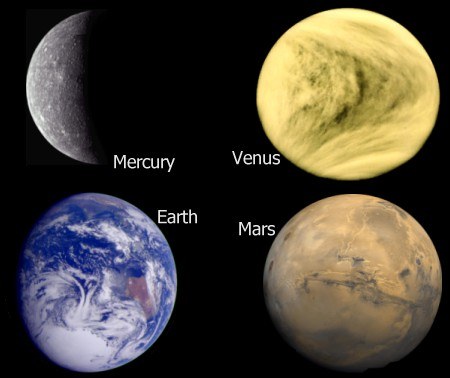
Which planet is closest to the sun?
a)
Uranus
b)
Mercury
c)
Neptune
d)
Earth
72.
A ball of ice and dust with a tail of gas and dust pointing away from the sun.
a)
Asteroid
b)
Comet
c)
Moon
d)
Meteor
73.
A small object that appears as a streak of light as it enters earth's atmosphere.
a)
Asteroid
b)
Comet
c)
Moon
d)
Meteor
74.
A small rocky object orbiting the sun.
a)
Asteroid
b)
Comet
c)
Moon
d)
Meteor
75.
A natural satellite of a planet.
a)
Asteroid
b)
Comet
c)
Moon
d)
Meteor
76.
Earth and the other planets closest to the Sun are made mostly of _______
a)
gas
b)
metal
c)
water
d)
rock
77.
One of the main differences between the outer and inner planets is __________.
a)
The inner planets all have water
b)
the inner planets are much bigger than the outer planets
c)
the outer planets are gas planets
d)
the outer planets have rings, and the inner planets don't
78.
Where is the asteroid belt found?
a)
between earth and mars
b)
Between Uranus and Neptune
c)
Between Mercury and Venus
d)
Between Mars and Jupiter
79.
Which outer planets have rings?
a)
Just Saturn
b)
Saturn and Jupiter
c)
Jupiter, Neptune, and Saturn
d)
all 4 of them
80.
About 90 percent of stars on the H-R diagram are ____ stars.
a)
red giant
b)
main sequence
c)
luminosity
d)
supergiants
81.
What is the name of our galaxy?
a)
The Milky Way
b)
The Snickers Bar
c)
The Local Group
82.
How do stars form?
a)
through the sun
b)
when nebula collapses and nuclear fusion occurs
c)
through supernova
d)
Magic
83.
What is the primary element that stars fuse early in their life cycle?
a)
Helium
b)
Dust
c)
Hydrogen
d)
Iron
84.
Which of the following would be classified as the beginning of star formation?
a)
red dwarf
b)
main sequence
c)
protostar
d)
white dwarf
85.
The life cycle of a star depends  on.
a)
mass
b)
luminosity
c)
radius
d)
temperature
86.
Stars are not forming in the Milky Way.
a)
True
b)
False
87.
All of the planets started and grew from
a)
magic
b)
gas and dust
c)
large planetesimals
d)
Small stars
88.

Most scientists believe the Big Bang Theory explains which of the following questions?

a)

How our planets and moons formed

b)

How our universe began

c)

How the sun turns hydrogen into helium

d)

How fast light travels through space

89.

Which statement is true?

a)

The galaxies are moving toward us.

b)

The galaxies are moving away from us.

c)

The universe remains static or unchanged in motion.

d)

None of the above

90.

Cosmic Microwave Background Radiation is a form of _________.

a)

Matter

b)

Energy

c)

Visible Light

d)

Water

91.

Which elements are most

abundant in the visible

universe?

a)

Hydrogen and Carbon

b)

Carbon and Helium

c)

Hydrogen and Oxygen

d)

Hydrogen and Helium

92.

As galaxies move away from our galaxy

a shift on the electromagnetic spectrum

(EMS) is noticed. This phenomena is

called _____________.

a)

redshift

b)

blueshift

c)

unshift

d)

blackshift

93.
How old do scientists think the Universe is?
a)
13.8 billion years old
b)
4.5 billion years old
c)
24,000 years old
d)
5 years old
94.
What is the best evidence for the Big Bang theory?
a)
How fast light can travel
b)
The expansion of the Universe
c)
Creation of new planets
95.
Red Shift means
a)
galaxies are moving towards each other
b)
galaxies are moving away from each other