
 Worksheets
Earth and Space Semester 1 Review
Total questions: 60
Worksheet time: 58mins
Name
Class
Date
1.
What is the hydrosphere?
a)
Water
b)
All water on Earth
c)
The Earth's surface
d)
All life on Earth
2.
What is Earth science?
a)
the scientific study of chemical mixtures
b)
the scientific study of Earth and the universe around it
c)
the scientific study of animal behavior
d)
the scientific study of life on Earth
3.

__________________ is the scientific study of the universe.
a)
Geology
b)
Meteorology
c)
Astrology
d)
Astronomy
4.
Which branch of science is most interested in the atmosphere and weather?
a)
Astronomy
b)
Ecology
c)
Biology
d)
Meteorology
5.
The color of a mineral in powder form is called the mineral's
a)
hardness
b)
specific gravity
c)
luster
d)
streak
6.
How light reflects off of a mineral is called the mineral's
a)
luster
b)
streak
c)
cleavage
d)
fracture
7.
Why is coal not a mineral?
a)
It's not a solid
b)
It is man-made
c)
It is not inorganic
d)
It is made of carbon
8.

By definition, a mineral has which of the following characteristic(s)?
a)
definite chemical composition
b)
crystal structure
c)
naturally occuring
d)
all of the above
9.
A mineral's resistance to being scratched is called?
a)
streak
b)
luster
c)
hardness
d)
heft
10.
Which of the following properties does the Mohs scale measure?
a)
Luster
b)
Hardness
c)
Density
d)
Streak
11.
Extreme Heat and Pressure creates a _________ rock.
a)
Igneous
b)
Metamorphic
c)
Sedimentary
d)
Mineral
12.
True or False: Once a rock is sedimentary, it cannot become an igneous rock.
a)
True
b)
False
13.

This rock was molten magma that slowly cooled under the ground. What type of rock is this?
a)
Sedimentary
b)
Igneous
c)
Metamorphic
14.
What two processes make sediment?
a)
Weathering
b)
Erosion
c)
Weathering & Erosion
15.
The three groups of rocks are classified by
a)
How they form
b)
Color
c)
Grain size
d)
Chemical Composition
16.

This rock formed when bits of other rocks became pressed into a solid. What type of rock is it?
a)
Sedimentary Rock
b)
Metamorphic Rock
c)
Igneous Rock
17.
When you watch a volcano erupt molten rock, you are seeing _____
a)
Lava
b)
Magma
c)
Mineral Crystals
d)
Igneous Rocks
18.
What are the 3 major types of rocks?
a)
Igneous, Metamorphic, Sedimentary
b)
Metamorphic, Igneous, Cementation
c)
Brown, Red, Gray
d)
Streak, Hardness, Breakage
19.
Two ways to describe types of igneous rocks are _____
a)
Extrusive and Intrusive
b)
Foliated and Non-Foliated
c)
Clastic and Biochemical
d)
Black and Gray
20.
What is deposition?
a)
Dropping off sediment
b)
Movement of sediment
c)
Breaking down of sediment
21.
The natural chemical or physical processes that breaks down rock on Earth's surface.
a)
weathering
b)
erosion
c)
deposition
d)
jackhammering
22.
The process by which water, ice, wind or gravity moves weathered rock and soil from one place to another.
a)
weathering
b)
erosion
c)
deposition
d)
dumptruck
23.
This type of weathering occurs when rock is physically broken down into smaller pieces of rock.
a)
mechanical weathering
b)
chemical weathering
c)
erosion weathering
d)
deposition
24.
This type of weathering occurs when rocks weaken then break down due to chemical changes in the composition of the rock.
a)
mechanical weathering
b)
chemical weathering
c)
erosion weathering
d)
deposition
25.
What is the force behind mass movements?
a)
the sun's energy
b)
flowing water
c)
gravity
d)
moving ice
26.
A mass movement that involves the sudden movement of a block of material along a flat, inclined surface is called a
a)
slide
b)
rockfall
c)
slump
d)
flow
27.
A wall along a river designed to stop flooding is called a
a)
lock
b)
dam
c)
levee
d)
barrier
28.
When water freezes and thaws causing rocks to weather it is called
a)
weathering
b)
ice wedging
c)
chemical weathering
d)
erosion
29.
Decayed organic material in soil is called______.
a)
Litter
b)
Silt
c)
Humus
d)
Clay
30.
Water hits the Earth's surface and then travels on the surface without going in the ground...
a)
Collection
b)
Transportation
c)
Infiltration
d)
Runoff
31.
This is the ratio of mass over volume.
a)
Density
b)
Specific Gravity
c)
Hardness
d)
Color
32.
Resources that can be made faster than they can be made.
a)
Fossil Fuels
b)
Renewable
c)
Nonrenewable
d)
Nuclear
33.
Whats the most unreliable way to identify a mineral
a)
Streak
b)
Taste
c)
Breakage
d)
Color
34.
What is an covalent bond?
a)
A chemical bond that involves sharing electrons
b)
A chemical bond that doesn't involves sharing electrons
c)
A chemical bond that requires the transfer of electrons
d)
A chemical bond that shares protons
35.
What is an ionic bond?
a)
two oppositely charged atoms chemically bonded.
b)
A chemical bond that requires the transfer of electrons
c)
A chemical bond that isn't important
d)
A chemical bond that involves sharing electrons
36.
Why do elements bond?
a)
To be friends
b)
To create a new element
c)
To become stable
37.
The Richter scale measures:
a)
the amount of radon gas released
b)
the movement of plates
c)
the strength of an earthquake
d)
the weight of tectonic plates
38.

The first wave of an earthquake is . . . .
a)
tsunami
b)
surface wave
c)
p wave
d)
s wave
39.

The epicenter of an earthquake shows up where?
a)
Below the surface of the earth.
b)
On the surface of the earth.
c)
Next to the P Wave.
d)
At the end of a Surface Wave
40.
Liquefaction is when...
a)
the soil behaves like liquid
b)
the ground becomes liquid
c)
magma rises to the surface
d)
buildings are damaged, crumbling like liquid
41.
What is the epicenter of an earthquake
a)
the location along a fault where the first motion of an earthquake occurs
b)
a seismic wave tht travels along the surface of Earth
c)
the point on Earth's surface directly above the earthquake's focus
d)
the last place that motion in an earthquake is detected
42.
How much bigger is a magnitude 8 earthquake compared to magnitude 7 one on the Richter Scale?
a)
1 time bigger
b)
10 times bigger
c)
100 times bigger
d)
1000 times bigger
43.
Earthquakes under the water can cause _________________________________.
a)
tornadoes
b)
tsunamis
c)
lightening
d)
hailstorms
44.

Earthquakes happen every day. Most are too small for humans to notice.
a)
True
b)
False
45.
At what location does the first motion of an earthquake occur
a)
the focus
b)
the seismic gap
c)
the mantle
d)
the epicenter
46.
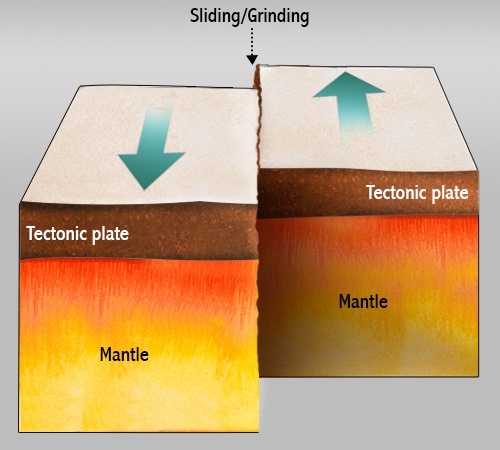
Which Plate Boundary does the picture illustrate?
a)
Spreading Boundary
b)
Fault Boundary
c)
Colliding Boundary
d)
Seismic Boundary
47.
Types of seismic waveS are
a)
P and S
b)
T and F
c)
O and P
48.
Most earthquakes happen along the _________________.
a)
coast
b)
faults
c)
desert
d)
directions
49.
The type of plate boundary where two plates come together is a .....
a)
Convergent Boundary
b)
Divergent Boundary
c)
Transform Boundary
d)
Plate Boundary
50.
Which of the following causes Earth's tectonic plates to move?
a)
Energy from the Sun
b)
Magnetic Pole Reversal
c)
Convection currents in the mantle
d)
Faults in Mountain Ranges
51.
Which of the following is the name of the ancient supercontinent formed 28 Million Years ago.
a)
Pangea
b)
Gondwanda
c)
Laurasia
d)
Neverland
52.
The theory that says Earth's continents once made up an ancient supercontinent, and have been drifting apart ever since, is called the theory of...
a)
Pangea
b)
Plate Tectonics
c)
Natural Selection
d)
Gravity
53.
Oceanic Trenches are formed by _______ plate boundaries
a)
Convergent
b)
Transform
c)
Plate
d)
Divergent
54.
Islands can from from magma which is pushed up at a __________ plate boundary
a)
Divergent
b)
Convergent
c)
Transform
55.
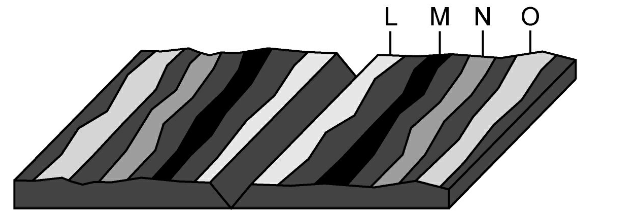
Where would the oldest rock be found?
a)
L
b)
M
c)
N
d)
O
56.
How is it possible for new crust to be formed without increasing the surface area of the Earth?
a)
Crust is destroyed at the same time it is created
b)
New crust is underwater where it sinks
c)
New crust breaks more easily than old crust
57.
Mountains are created when....
a)
Two continental plates collide
b)
Two oceanic plates pull apart
c)
An Oceanic plate subducts under a Continental Plate
d)
Two continental plates pull apart
58.
What was Wegener's hypothesis called?
a)
The Pangea
b)
Moving Continents
c)
The Continental Drift
d)
Techtonic Plates
59.
What evidence helped Wegener support his theory?
a)
Climate
b)
Fossils
c)
Land Features
d)
All of the Above
60.
What are the two types of crust
a)
continental and oceanic
b)
ocean and upper
c)
lower and upper
d)
pizza and subway
100 %

