
 Worksheets
PreAP/PreIB Objective Review Quiz
Total questions: 106
Worksheet time: 2hrs 27mins
Name
Class
Date
1.
Blue Color: Chemical or Physical Property
a)
Chemical Property
b)
Physical Property
2.
Density: Chemical or Physical Property
a)
Chemical Property
b)
Physical Property
3.
Flammability (burns): Chemical or Physical Property
a)
Chemical Property
b)
Physical Property
4.
Solubility (dissolves): Chemical or Physical Property
a)
Chemical Property
b)
Physical Property
5.
Reacts with Acid: Chemical or Physical Property
a)
Chemical Property
b)
Physical Property
6.
Which of the following is a sign that a chemical reaction has occurred?
a)
change in shape
b)
melting
c)
formation of a gas
d)
dissolving
7.
What kind of properties can only be observed when a substance changes into a different substance?
a)
physical properties
b)
chemical properties
c)
liquid properties
d)
real properties
8.
Is hammering wood together to build a house a chemical or physical change?
a)
chemical
b)
physical
9.
A change in the size, shape, or state of matter.
a)
chemical change
b)
physical change
c)
chemical reaction
d)
electron change
10.
Which of the following is NOT an example of a physical change?
a)
crumpled paper
b)
pencil sharpening
c)
shrunken clothing
d)
sour milk
11.
Intensive property is dependent on the amount of a substance.
a)
True
b)
False
12.
Freezing point is an example of extensive property.
a)
True
b)
False
13.
Density is an...
a)
Extensive Property
b)
Intensive Property
14.

Which state of matter has tightly packed molecules?
a)
solid
b)
liquid
c)
gas
15.

Which state of matter has molecules that move quickly and do not stay together? They do not form any pattern.
a)
solid
b)
liquid
c)
gas
16.

Which state of matter has molecules that slide past each other but stay close together? They do not form a regular pattern.
a)
solid
b)
liquid
c)
gas
17.
The measure of the amount of matter in an object
a)
mass
b)
area
c)
matter
18.
Has a definite shape and volume
a)
Solid
b)
Crystalline Solid
c)
Viscosity
d)
Surface Tension
19.
Has a definite volume but no shape.
a)
Liquid
b)
Solid
c)
Gas
d)
Fluid
20.
Is the change of a substance from a liquid to a gas.
a)
Melting
b)
Boiling
c)
Evaporation
d)
Condensation
21.
What is an example of a mixture?
a)
iron
b)
ice
c)
soil
d)
gold
22.
Addie's class is learning about mixtures and solutions. Her teacher writes statements on the board. Which statement BEST describes a mixture?
a)
Both substances mix evenly.
b)
Both substances can evaporate.
c)
One substance dissolves into another.
d)
One substance can be separated from the other.
23.
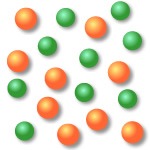
This picture represents which of the following?
a)
element
b)
compound
c)
mixture
24.
A mixture that appears to be evenly mixed throughout:
a)
an atom
b)
a compound
c)
a homogeneous mixture
d)
a heterogeneous mixture
25.
Alex goes into the garden and digs up a shovel full of dirt. This is a _____________ mixture.
a)
Homogeneous
b)
Heterogenous
26.
Copper is a mixture.
a)
True
b)
False
27.

Salt is a(n)
a)
element
b)
compound
c)
mixture
28.
Carbon dioxide
a)
Pure Substance & Element
b)
Pure Substance & Compound
c)
Mixture & Homogenous
d)
Mixture & Heterogenous
29.
Which of the following will have a higher electronegativity than arsenic (As)?
a)
Carbon (C)
b)
Neon (Ne)
c)
Antimony (Sb)
d)
Germanium (Ge)
30.
As atoms of elements in group 16 are considered in order from top to bottom, the electronegativity of each successive element....
a)
decreases
b)
increases
c)
remains the same
d)
none of the above
31.
Which atom has the largest atomic radius?
a)
potassium
b)
rubidium
c)
francium
d)
cesium
32.
As you move down the periodic table atoms get bigger. This is because ____________.
a)
The atoms have more mass.
b)
The atoms have more protons.
c)
The atoms have more energy levels
d)
The atoms have more nuetrons
33.
As you move across the periodic table atoms tend to get smaller because, ______________.
a)
the atoms have more mass.
b)
the atoms have less mass
c)
the atoms have more protons.
d)
the atoms have less electrons.
34.
Electronegativity is...
a)
how good an atom is at attracting electrons
b)
the ability of an atom to lose electrons
c)
the energy required to remove an electron from a specific atom
d)
how easy it is to make friends.
35.
Ionization energy is...
a)
the energy required to add an electron to a specific atom
b)
how much energy it takes to remove an electron from an atom
c)
the energy required to shield the outer electrons from the nucleus
d)
a measure of the ability of an atom to attract electrons
36.
Which statement correctly and completely identifies a trend?
a)
Atomic radius decreases across a period and increases down a group.
b)
Electronegativity decreases across a period and decreases down a group.
c)
Ionization energy increases across a period and increases down a group.
d)
Ionic radius increases across a period and increases down a group.
37.
What was Dmitri Mendeleev's greatest contribution to the history of the periodic table?
a)
He arranged all of the known elements by their atomic number
b)
He realised that there was a pattern of reactivity which repeated every 8 elements
c)
He predicted the existence (and properties) of new elements
d)
He identified the "law of triads" which became the groups
38.
Mendeleev classified elements based on not only atomic mass but what else?
a)
reactivity
b)
boiling points
c)
physical properties only
d)
chemical & physical properties
39.
Why were there blank spaces left in Mendeleev's periodic table?
a)
He didn't know what to put there.
b)
Undiscovered elements not yet known.
c)
Multiple elements could have fit
d)
He forgot to add the elements in.
40.
Each column in the periodic table is called a
a)
period
b)
group
c)
cluster
d)
unit
41.
If an element GAINS 2 electrons, what will its ion charge be?
a)
plus 1
b)
plus 2
c)
minus 1
d)
minus 2
42.
What is the most important thing about H Moseley's periodic table?
a)
it was arranged by atomic weight
b)
it was arranged by atomic number
c)
it was arranged by atomic mass
d)
it was arranged by color
43.
when we look at elements in the same GROUP, they are similar because they...
a)
have the same number of valence electrons
b)
have the same number of electrons
c)
have the same number of protons
d)
have similar energy levels
44.
The speed of a wave is its wavelength multiplied by its ___________
Or the formula
C = λ x ν
Or the formula
C = λ x ν
a)
amplitude
b)
vibration
c)
frequency
d)
reflection
45.
Put the visible light colors in order from longest wavelength to shortest wavelength
a)
Violet, Indigo, Blue, Green, Orange, Yellow, Red
b)
Red, Yellow, Green, Orange, Violet, Blue, Indigo
c)
Red, Orange, Yellow, Green, Blue, Indigo, Violet
46.
Which part of the electromagnetic spectrum has high enough energy to cause damage to eyes and skin, and sometimes even cancer?
a)
Infrared Rays
b)
Radio Waves
c)
Microwaves
d)
Ultraviolet Rays
47.
A wave with a large wavelength will have a ______ frequency and _____ energy
a)
high, low
b)
high, high
c)
low, high
d)
low, low
48.
A high-frequency wave has ___________ than a low-frequency wave
a)
a longer wavelength
b)
a shorter wavelength
c)
the same wavelength
d)
a stronger source
49.
Who first had the idea of the atom?
a)
Democritus
b)
Dalton
c)
Rutherford
d)
Thompson
50.
Who discovered the electron?
a)
Bohr
b)
Dalton
c)
Rutherford
d)
Thompson
51.
Who discovered the positive nucleus?
a)
Bohr
b)
Dalton
c)
Rutherford
d)
Thompson
52.
Schrödinger refined Bohr's model by saying electrons are...
a)
...dispersed in a positive soup
b)
...evenly spaced around the nucleus
c)
...found at different energy levels
d)
...found in clouds surrounding the nucleus
53.
Plum Pudding
a)
Dalton
b)
Rutherford
c)
Thompson
d)
Bohr
54.
Cathode Ray Tube
a)
Dalton
b)
Rutherford
c)
Thompson
d)
Bohr
55.
Gold Foil
a)
Dalton
b)
Rutherford
c)
Thompson
d)
Bohr
56.
Planetary Model
a)
Dalton
b)
Rutherford
c)
Thompson
d)
Bohr
57.
Which of the following is an Alkali Metal?
a)
Magnesium
b)
Chromium
c)
Sodium
d)
Fluorine
58.
Which of the following is a Halogen?
a)
Bromine
b)
Rubidium
c)
Argon
d)
Beryllium
59.
Which of the following is a Noble Gas?
a)
Krypton
b)
Chlorine
c)
Radium
d)
Gallium
60.
How many valence electrons does a halogen have?
a)
1
b)
2
c)
7
d)
8
61.
Horizontal rows on the periodic table are called?
a)
Columns
b)
Periods
c)
Families
62.
Which element is in group 4 period 6?
a)
Helium
b)
Chromium (Cr)
c)
Hafnium (Hf)
d)
Barium
63.

Where are the nonmetals located on the periodic table?
a)
top left corner
b)
bottom left corner
c)
top right corner
d)
bottom left corner
64.

Name group 1 on the periodic table.
a)
alkali metals
b)
alkaline earth metals
c)
noble gases
noble gases
noble gases
d)
halogens
65.
24.1% of all the isotopes of a an element have a mass of 75.23 amu, 48.7% have a mass of 74.61 amu, and 27.2% have a mass of 75.20 amu.
What is the average mass of this element?
What is the average mass of this element?
a)
74.92 amu
b)
24.97 amu
c)
75.01 amu
d)
74.51 amu
66.

What is the name of the atom pictured here?
a)
Nitrogen
b)
Nitrogen-15
c)
Nitrogen-7
d)
Nitrogen-8
67.
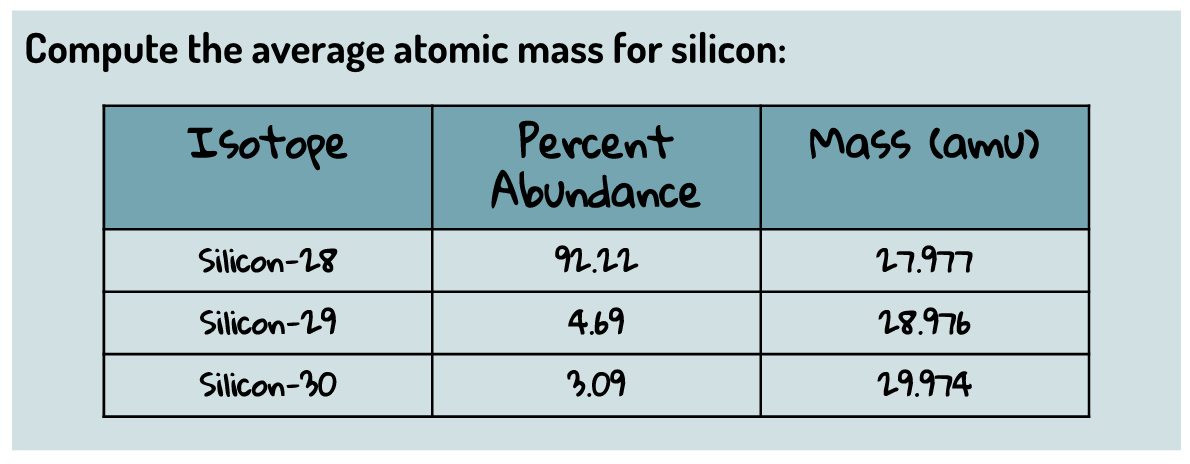
Compute the average atomic mass for silicon:
a)
27.977
b)
28.09
c)
28.976
d)
The average mass cannot be determined from provided information.
68.
How many neutrons would Fe-56 have?
a)
56
b)
26
c)
30
d)
33
69.
What element has 42 protons?
a)
Ca
b)
Mo
c)
Zr
d)
Po
70.
If an atom of oxygen has a charge of -2, how many electrons does the atom have?
a)
18
b)
6
c)
8
d)
10
71.

This is a correct dot diagram for oxygen (O)
a)
true
b)
false
72.

This is a correct dot diagram for fluorine (F)
a)
true
b)
false
73.
How many valence electrons does carbon (C) have?
a)
3
b)
4
c)
5
d)
6
74.

This could be the dot diagram of
a)
Ne
b)
H
c)
C
d)
F
75.

What is the shape of this molecule?
a)
Linear
b)
bent
c)
tetrahedral
d)
trigonal planar
76.

What is the shape of this molecule?
a)
bent
b)
linear
c)
trigonal pyramidal
d)
tetrahedral
77.

What is the shape of this molecule?
a)
Linear
b)
Bent
c)
Tetrahedral
d)
Trigonal Pyramidal
78.
Identify the Electron Configuration for Aluminum (Al)
a)
1s2 2s2 2p6 3s2 3p1
b)
1s2 2s2 2p6 3s2 3p3
c)
1s2 2s2 2p6 3s2 4p1
79.
What do you start electron configuration with?
a)
1s2
b)
1d10
c)
1f14
d)
1p6
80.

This orbital diagram represents:
a)
C
b)
B
c)
N
d)
O
81.
What is this element?
[Ne] 3s23p64s2
[Ne] 3s23p64s2
a)
Calcium
b)
Sodium
c)
Scandium
d)
Titanium
82.
Which of the following is an ionic compound:
a)
CH4
b)
I2
c)
LiBr2
d)
CO
83.
What would be the proper chemical formula for combining Al3+ and Cl- :
a)
AlCl3
b)
Al3Cl
c)
AlCl
d)
Al3Cl3
84.
Name the following ionic compound: BeCl2
a)
beryllium chlorine
b)
beryllium II chloride
c)
beryllium chloride
d)
beryllium dichloride
85.
Name the following compound: FeCl3
a)
iron chloride
b)
iron III chloride
c)
iron chlorate
d)
iron III chlorate
86.
Which of the following combinations would need roman numerals in the name?
a)
potassium + fluorine
b)
beryllium + oxygen
c)
boron + iodine
d)
silver + oxygen
87.
The name of the compound Ca3(PO4)2
a)
calcium phosphate
b)
tricalcium diphosphate
c)
calcium phosphorus oxide
d)
calcium phosphide
88.
N2O5
a)
nitrogen oxide
b)
dinitrogen pentoxide
c)
nitrogen pentoxide
89.
P4O10
a)
tetraphosphorus decoxide
b)
phosphorus decoxide
c)
phosphorus oxide
90.
CCl4
a)
carbon chloride
b)
carbon tetrachloride
c)
monocarbon tetrachloride
91.
SO2
a)
monosulfur dioxide
b)
sulfur oxide
c)
sulfur dioxide
92.

What is the formula for magnesium (Mg) chloride (Cl)?
a)
MgCl
b)
Mg2Cl
c)
MgCl2
d)
Mg(ClO3)2
93.
Write the correct formula for Calcium Sulfate
a)
CaSO4
b)
CaS
c)
CaSO3
d)
CaS2
94.
Write the correct formula for Iron (III) Oxide
a)
I3O
b)
I2O3
c)
Fe3O2
d)
Fe2O3
95.
How many molecules are there in 31.8 moles of water?
a)
5.28 x 10⁻²³ molecules
b)
1.91 x 1025 molecules
96.
How many grams is 1.2 moles of Neon?
a)
0.05 grams
b)
16.6 grams
c)
21.2 grams
d)
24 grams
97.
What is the molar mass of table salt (NaCl)?
a)
116.886 g/mol
b)
35.453 g/mol
c)
22.990 g/mol
d)
58.443 g/mol
98.
An empirical formula:
a)
is a formula that calculates the coefficients of a compound in a balanced equation.
b)
is the simplest whole-number ratio of moles of elements in the compound.
99.
You are given the following percentages: 40.05% S and 59.95% O. Find the empirical formula for these elements. (keep two decimal places throughout calculations)
a)
SO
b)
SO2
c)
SO3
d)
SO4
100.
What is the molecular formula if the empirical formula is C2H5 and the molecular molar mass is 58.14 g/mol?
a)
C2H5
b)
C4H10
c)
C1H2.5
d)
C4H8
101.
What is the percent by mass of magnesium in MgO?
a)
20%
b)
40%
c)
50%
d)
60%
102.

What charge do ELECTRONS have in an atom?
a)
Positive
b)
Neutral
c)
Negative
103.

What charge do NEUTRONS have in an atom?
a)
Positive
b)
Neutral
c)
Negative
104.

What charge does a PROTON have in an atom?
a)
Positive
b)
Neutral
c)
Negative
105.

Where in an atom is a neutron located?
a)
In energy levels around the nucleus
b)
In the nucleus
106.

Where in an atom are the protons located?
a)
In energy levels around the nucleus
b)
In the nucleus
100 %

