
 Worksheets
Science review
Total questions: 63
Worksheet time: 3600secs
Name
Class
Date
1.
If a lab fire erupts, immediately:
a)
A. Notify (or tell) your teacher
b)
B. Run and scream
c)
C. Throw water at the fire
d)
D. Open the windows
2.
Why are approved eye protection devices (such as goggles) are worn in the lab?
a)
A. To improve your vision
b)
B. To make you look like a bug
c)
C. To give you headaches
d)
D. To protect eyes around chemicals, heat, or glassware
3.
Why are approved eye protection devices (such as goggles) are worn in the lab?
a)
A. To improve your vision
b)
B. To make you look like a bug
c)
C. To give you headaches
d)
D. To protect eyes around chemicals, heat, or glassware
4.
Personal eyeglasses provide as much protection as:
a)
A. A shield
b)
B. Goggles
c)
C. A mask
d)
D. None of the above
5.
You are working in the lab using glassware. Your partner drops a glass beaker and it shatters. A piece of glass gets in his eyes. What should he have been wearing?
a)
A. Gloves
b)
B. Sun glasses
c)
C. Safety Goggles
d)
D. A lab aporn
6.
You are in lab and your partner accidentally gets their hair stuck in a triple beam balance. What should have your partner done?
a)
A. Worn a hat in class
b)
B. Skipped class
c)
C. Got a hair cut
d)
D. Tied/pulled their hair back
7.
If you have been injured in the lab, what should you do first?
a)
A. Apply the first aid yourself
b)
B. Go to doctor after school in a few hours
c)
C Tell your science teacher immediately
d)
D. Not tell anyone
8.
Flammable materials should never be dispensed (or used) near:
a)
A. An open door
b)
B. An open flame
c)
C.Another student
d)
D. A sink
9.
What should you do when gathering materials for an experiment?
a)
A. Read all directions carefully
b)
B. Check all materials for chips or cracks (or broken)
c)
Clean the materials if they seem dirty/used
d)
D. All of the above
10.

If you see a science experiment set up in the classroom...
a)
do not touch anything until instructed.
b)
immediately begin working on the lab.
c)
go and check all equipment.
d)
walk around and check each station.
11.

Horseplay or practical jokes in the laboratory are...
a)
always against the rules.
b)
okay.
c)
not dangerous.
d)
okay if you are working alone.
12.

You may eat or drink in the science laboratory...
a)
after you have washed your hands.
b)
on the days you are not doing a lab.
c)
only from the beakers.
d)
at no time unless given teacher approval.
13.

You have been injured in the laboratory (cut, burn, etc.) The FIRST thing you should do is...
a)
visit the school nurse after class.
b)
see a doctor after school.
c)
tell the science teacher straight away.
d)
apply first aid to yourself.
14.
After completing an experiment in the lab, all chemical wastes should be:
a)
poured down the sink.
b)
disposed of according to the teacher's directions.
c)
thrown at other students.
d)
taken home to play with.
15.

You are heating a piece of glass and now want to pick it up. You should...
a)
pour cold water on it.
b)
use tongs.
c)
pick up the end that looks cooler.
d)
use a rag or paper towels.
16.
Stores food and water for the cell.
a)
Cytoplasm
b)
Cell Wall
c)
Vacuole
d)
Nucleus
17.
Controls what enters and leaves the cell
a)
Mitochondria
b)
Cell Membrane
c)
Cell Wall
d)
Nucleus
18.

What would happen to the plant cell without the chloroplasts?
a)
There wouldn't be an organelle that performs photosynthesis
b)
There wouldn't be an organelle that serves as the resevoir for water and waste
c)
There wouldn't be an organelle that regulates what comes in and out of the cell
d)
They wouldn't be an organelle that makes necesary proteins
19.

What do all of these organisms have in common?
a)
They all have uniform offspring
b)
They are all made of cells
c)
They possess the same features
d)
They have the same internal and external structures
20.

According to cell theory, where did this cell come from?
a)
another living cell
b)
energy from sun
c)
a multicellular organism
d)
the nonliving environment
21.
What tool do you use to view the cells?
a)
metric ruler
b)
centrifuge
c)
microscope
d)
pipette
22.
Which of the following is NOT a cell theory.
a)
All non-living things are made of cells
b)
All cells come from pre-existing cells
c)
Cells are the basic unit of structure and function of all living things
23.
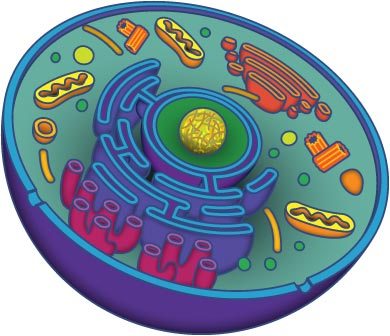
All living things are made up of...
a)
cells
b)
cell tissues
c)
organ
d)
organ systems
24.
All cells come from___________ cells.
a)
pregnant
b)
pre-existing
c)
paternal
d)
pin size
25.
The first part of the Cell Theory states: "What happens in Cell Theory, stay in Cell Theory."
a)
True
b)
False
c)
I don't know
d)
Ummmm
26.
Rocks are not living because
a)
they never move
b)
they aren't needed for humans
c)
they are not made of cells
d)
they don't break down
27.
What is the basic structural and functional unit of all living things?
a)
atom
b)
cell
c)
molecule
d)
human
28.
Heredity is the passing of traits from _____________________ to _____________________
a)
predators to prey
b)
water to rain
c)
parents to offspring
d)
fungi to protists
29.
___________________________ is the study of how traits are passed on, or inherited.
a)
dominant traits
b)
ratio
c)
phenotype
d)
genetics
30.
Why did Mendel choose to study pea plants in order to learn how traits are passed from parent to offspring?
a)
Pea plants grow quickly
b)
Pea plants are ultraviolet
c)
Pea plants are rare and expensive
d)
Pea plants are take years to grow
31.
If a child has red hair, they inherited a certain _______________ from their parents.
a)
ratio
b)
trait
c)
probability
d)
sex chromosome
32.
One trait that is ALWAYS present and causes the other traits to disappear is a ________________________
a)
recessive trait
b)
aggressive trait
c)
absent trait
d)
dominant trait
33.
True or False: Recessive traits are ALWAYS present
a)
True
b)
False
34.
A ___________________ is a relationship between two numbers
a)
genetic
b)
trait
c)
ratio
d)
cycle
35.
Offspring receives two sets of _____________ (one from each parent)
a)
blue jeans
b)
genes
c)
machines
d)
pedigree
36.
_____________________ is the appearance of an organism, or how it looks
a)
phenotype
b)
ratio
c)
recessive trait
d)
heredity
37.

The diagram shows the female reproductive system. The part labelled B is called
a)
sperm
b)
the egg
c)
the womb
d)
the ovary
38.
the sex cells of females that can be fertilized by sperm
a)
ovaries
b)
eggs or ovum
c)
uterus
39.
What are produced in the testicles?
a)
Egg Cells
b)
Ovum
c)
Sperm Cells
d)
Semen
40.
What are two parts of the central nervous system?
a)
brain/spinal cord
b)
spinal cord/motor neurons
c)
motor/sensory neurons
d)
brain/sensory neurons
41.
If I step on a nail...what type of neuron will take that signal TO the CENTRAL NERVOUS SYSTEM?
a)
interneurons
b)
motor
c)
sensory
d)
receptors
42.
Which part of a neuron receives or invites information?
a)
axon
b)
dendrite
c)
cell body
d)
axon terminal
43.
Division of the Autonomic Nervous System that is called FIGHT OR FLIGHT
a)
sympathetic
b)
parasympathetic
44.
Which of the following is NOT a function of the skeleton?
a)
Production of blood cells
b)
Gives the body form
c)
Protects internal organs
d)
Generates heat
45.
The soft inside part of the bone is
called__________________ .
called__________________ .
a)
periosteum
b)
spongy
c)
marrow
d)
cancellous
46.
The bone marrow makes
_______________________ cells.
_______________________ cells.
a)
blood
b)
cancer
c)
large
d)
normal
47.
What is the flexible rubbery tissue that helps cushion bones where they meet called?
a)
ligaments
b)
cartilage
c)
tendons
d)
knee pads
48.
The long straps that keep a joint in place are called?
a)
tendons
b)
cartilage
c)
ligaments
d)
muscle
49.
The bands of tissue that connect bones to muscle?
a)
tendons
b)
cartilage
c)
ligaments
d)
muscle
50.
Which of the following is a hinge joint?
a)
hip
b)
elbow
c)
shoulder
d)
neck
51.
A tough band of fibrous, slightly elastic connective tissue that attaches one bone to another.
a)
Ligaments
b)
Tendons
c)
Joints
52.
A very strong connective tissue that attaches skeletal muscle to bone.
a)
Ligaments
b)
Tendons
c)
Joints
53.
What ball and socket joint do you use when you throw a ball?
a)
shoulders
b)
hips
c)
elbow
d)
wrist
54.
Define Cartilage
a)
The organs that make up the skeleton
b)
A band of tissue that connects bone to muscle
c)
Durable, flexible material found throughout your body (ears and nose for example)
d)
Spongy material inside bones THAT PRODUCES RED BLOOD CELLS
55.
Which muscle type is found in your stomach, bladder, and intestines?
a)
Skeletal
b)
Smooth
c)
Cardiac
d)
Straight
56.
Which type of muscle is found in your heart?
a)
Skeletal
b)
Smooth
c)
Cardiac
d)
Straight
57.
What are the three main types of muscles?
a)
skeletal, cardiac, smooth
b)
biceps, triceps, quadriceps
c)
smooth, flexible, strength
d)
none of the above
58.
Which muscles are involuntary?
a)
skeletal
b)
cardiac
c)
smooth
d)
smooth and cardiac
59.
Which type of muscle is attached to bones?
a)
cardiac
b)
smooth
c)
skeletal
60.
Which muscle is found in your heart?
a)
smooth
b)
cardiac
c)
skeletal
61.
When a muscle contracts, it _______
a)
gets longer
b)
gets shorter
c)
gets thinner
d)
grows hair
62.
Muscles always work in _____
a)
pairs
b)
groups of 3
c)
bones
d)
joints
63.

what is a cardiac arrest
a)
the sudden loss of blood flow resulting from the failure of the heart to effectively pump
b)
the sudden loss of oxygen and carbon dioxide resulting from the faliure of the heart
c)
when the heart joins the crips/bloods (their choise) and gets arrested by the Police
d)
I don't know why. why don't you tell me
100 %

