
 Worksheets
Weather Unit Test
Total questions: 60
Worksheet time: 1hrs 15mins
Name
Class
Date
1.

What is happening to temperature from 0 to 10 km in height?
a)
temperature rises as height rises
b)
the higher you go, the colder it gets
c)
the higher you go the warmer it gets
d)
there is no correlation
2.
What is happening to temperature from 10 to 30 km in height?
a)
temperature rises as height rises
b)
temperature falls as height rises
c)
the higher you go the warmer it gets
d)
temperature remains about the same as height rises
3.
What is happening in segment C of the graph?
a)
overall as temperature rises as height rises
b)
overall as temperature falls as height rises
c)
the higher you go the colder it gets
d)
temperature remains about the same as height rises
4.

Which layer contains has the weather and water vapor?
a)
Troposphere
b)
Stratosphere
c)
Mesosphere
d)
Thermosphere
5.

The layers of the atmosphere are based on:
a)
Temperature
b)
Altutude
c)
Density
6.
What does the ozone layer protect us from?
a)
Ultra Violet (UV) Rays
b)
alien invasion
c)
global warming
d)
rising sea levels
7.
The ozone is located in this layer
a)
Troposphere
b)
Stratosphere
c)
Mesosphere
d)
Thermosphere
8.
What is the main source of energy that drives all weather patterns?
a)
Sun
b)
Moon
c)
Oceans
d)
Mountains
9.
Which receives more direct sunlight?
a)
north pole
b)
south pole
c)
North America
d)
equator
10.
What is it called when water changes from gas to liquid?
a)
evaporation
b)
freezing
c)
melting
d)
condensation
11.
What is wind that blows from the sea to the land due to local temperature and pressure differences called?
a)
global wind
b)
land breeze
c)
sea breeze
d)
jet stream
12.
What type of wind moves at very high speeds and high altitudes?
a)
prevailing winds
b)
jet stream
c)
land breezes
d)
sea breezes
13.
Which heat transfer process can be described as currents of warm air rising from Earth's surface as currents of cool air descend (go down)?
a)
conduction
b)
latent heat
c)
convection
d)
radiation
14.
Wind blows from regions of
a)
high temperature to regions of low air temperature
b)
high air pressure to regions of low air pressure
c)
high precipitation to regions of low precipitation
d)
convergence to regions of divergence
15.

Which statement best describes the difference between weather and climate?
a)
Weather is the conditions when you look outside while climate is the conditions you can expect for the next 6 months.
b)
Climate is the current condition outside while weather is what you can expect for the next 6 months.
16.
Climate change causes extreme weather conditions such as:
a)
Flooding
b)
Heat Waves
c)
Hurricanes
d)
All of the above
17.
Which human activity contributes the MOST carbon dioxide to the atmosphere?
a)
Fishing
b)
Breathing
c)
Burning Fossil Fuels
d)
Farming
18.
Clouds are made up of tiny drops of ______ or ice. The moisture in the cloud affects the weather.
a)
dust
b)
water
c)
cloud particles
d)
precipitation
19.
They are highest clouds in the sky. They look curly, white and feathery. Usually mean good weather.
a)
Cumulus
b)
Cumulonimbus
c)
Cirrus
d)
Stratus
20.
This is sometimes called a thunderhead cloud. It looks very tall like mountains and heavy rain comes from it.
a)
Cumulus
b)
Cirrus
c)
Stratus
d)
Cumulonimbus
21.
They are low in the sky and look soft and fluffy.
a)
Cirrus
b)
Cumulonimbus
c)
Cumulus
d)
Stratus
22.
These clouds are the closest to the ground. Their name means layer- or sheet like. They bring rain or snow and cover most of the sky.
a)
Cirrus
b)
Stratus
c)
Cumulonimbus
d)
Cumulus
23.
What is the “fuel” that “feeds” a hurricane
a)
cold air
b)
dry air
c)
warm and moist air
d)
warm and dry air
24.
What are conditions like in the eye of the hurricane?
a)
Very rainy
b)
Very windy
c)
Calm and possibly sunny
d)
Cloudy and humid
25.
This type of pressure system brings dry, clear skies.
a)
high pressure
b)
low pressure
c)
barometric pressure
d)
atmospheric pressure
26.
This type of air pressure is associated with warm air rising.
a)
high pressure
b)
low pressure
c)
barometric pressure
d)
atmospheric pressure
27.
This pressure system brings cloudy and stormy weather.
a)
high pressure
b)
low pressure
c)
barometric pressure
d)
atmospheric pressure
28.
This type of air mass is when cold air sinks.
a)
high pressure
b)
low pressure
c)
barometric pressure
d)
atmospheric pressure
29.

What does this symbol represent?
a)
high temperature
b)
low temperature
c)
high pressure
d)
low pressure
30.

What does this symbol represent?
a)
high temperature
b)
low temperature
c)
high pressure
d)
low pressure
31.

What is one city that is experiencing clear, dry conditions?
a)
Orlando
b)
Los Angeles
c)
Seattle
d)
Charleston
32.

What cities are probably experiencing stormy or rainy weather?
a)
Washington DC and New York City
b)
New York City and Los Angeles
c)
Charleston and New York City
d)
Charleston and Los Angeles
33.
A large body of air with similar characteristics throughout
a)
Air Mass
b)
Precipitation
c)
Cyclone
d)
Isotherm
34.
The weight of overlying air
a)
Air Pressure
b)
Air Mass
c)
Relative Humidity
d)
Dew Point
35.
Instrument used to measure wind speed
a)
Anemometer
b)
Barometer
c)
Psychrometer
d)
Thermometer
36.
Instrument used to measure air pressure
a)
Anemometer
b)
Barometer
c)
Psychrometer
d)
Thermometer
37.
An interface between two air masses
a)
Front
b)
Boundary
c)
Isobar
d)
Precipitation
38.
Lines connecting points of equal pressure
a)
Isobar
b)
Isotherm
c)
Front
d)
Relative Humidity
39.
Lines connecting points of equal temperature
a)
Isobar
b)
Isotherm
c)
Front
d)
Relative Humidity
40.
Instrument used to measure relative humidity and dewpoint
a)
Psychrometer
b)
Anemometer
c)
Barometer
d)
Thermometer
41.
The percentage of the air that is filled with water
a)
Relative Humidity
b)
Dew Point
c)
Saturation
d)
Air Pressure
42.
Release of water from plants
a)
Transpiration
b)
Condensation
c)
Precipitation
d)
Evaporation
43.

Weather conditions and patterns can be predicted based on weather data collected from various sources. I am the source used to see cloud patterns and movement. What am I?
a)
isobars
b)
radar
c)
satellite
d)
isotherms
44.

I am the source used to detect cloud cover, rainfall, or storm location, intensity, and movement, and the potential for severe weather. What am I?
a)
isotherm
b)
radar
c)
satellite
d)
isobars
45.
I am an expert that reads and reports weather data in the form of weather forecasts. Who am I?
a)
Archeologist
b)
Meteorologist
46.
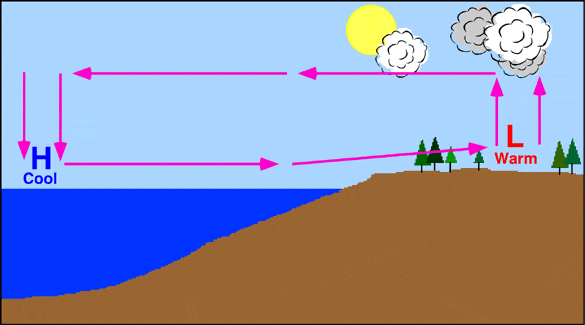
Is this a land or a sea breeze?
a)
land breeze
b)
sea breeze
47.
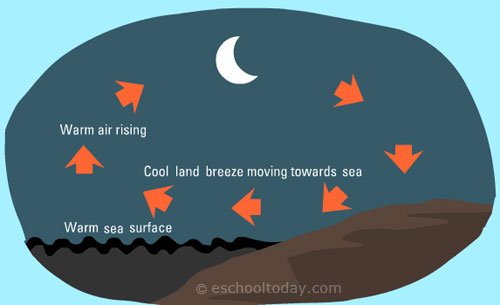
Is this a land or a sea breeze?
a)
land breeze
b)
sea breeze
48.
How does the air move in a sea breeze?
a)
wind moves from north to south
b)
wind moves from ocean to the land
c)
wind moves from the land to the ocean
d)
wind moves from south to north
49.
In a sea breeze, the air is warmer above the _____.
a)
land
b)
ocean
c)
sky
d)
beach
50.
What is the jet stream?
a)
Precipitation in North Carolina
b)
Weather over a long period of time
c)
Strong winds above the Earth's surface
d)
Football flying over the Earth
51.
How does the Gulf Stream affect weather conditions along the eastern coast of the United States?
a)
temperatures will decrease
b)
temperatures will increase
c)
more overcast skies
d)
it does not affect the east coast at all
52.

This Symbol is associated with a _____________________Front.
a)
Warm
b)
Occluded
c)
Cold
d)
Stationary
53.

This picture represents the symbol for a __________________________Front.
a)
Warm
b)
Occluded
c)
Cold
d)
Stationary
54.

an intense, warm ocean current in the western North Atlantic Ocean
a)
doldrum
b)
jet stream
c)
gulf stream
d)
Greenhouse effect
55.
What is the greenhouse effect?
a)
The warming of a planet due to trapped radiation.
b)
The cooling of Earth due to air pollution.
c)
The heating of a solid, such as a rock.
56.
What gas from the list below is a cause for global warming?
a)
Urethane
b)
Oxygen
c)
Carbon Dioxide
57.

This is an image demonstrating...
a)
Tornado Formation
b)
The Greenhouse Effect
c)
Hurricane Formation
58.

Identify the type of front that is shown in the image.
a)
Occluded Front
b)
Cold Front
c)
Stationary Front
d)
Warm Front
59.

Identify the type of front that is shown in the image.
a)
Occluded Front
b)
Cold Front
c)
Stationary Front
d)
Warm Front
60.

Identify the type of front that is shown in the image.
a)
Occluded Front
b)
Cold Front
c)
Stationary Front
d)
Warm Front
100 %

